
How should a plumbing company market to commercial customers?
- How does a plumbing company win restaurants, property managers and other commercial accounts?
- How is commercial plumbing marketing different from residential?
- Who actually hires a commercial plumbing company?
- Step 1: Which commercial niche should I start with?
- Step 2: What should the commercial side of my website show?
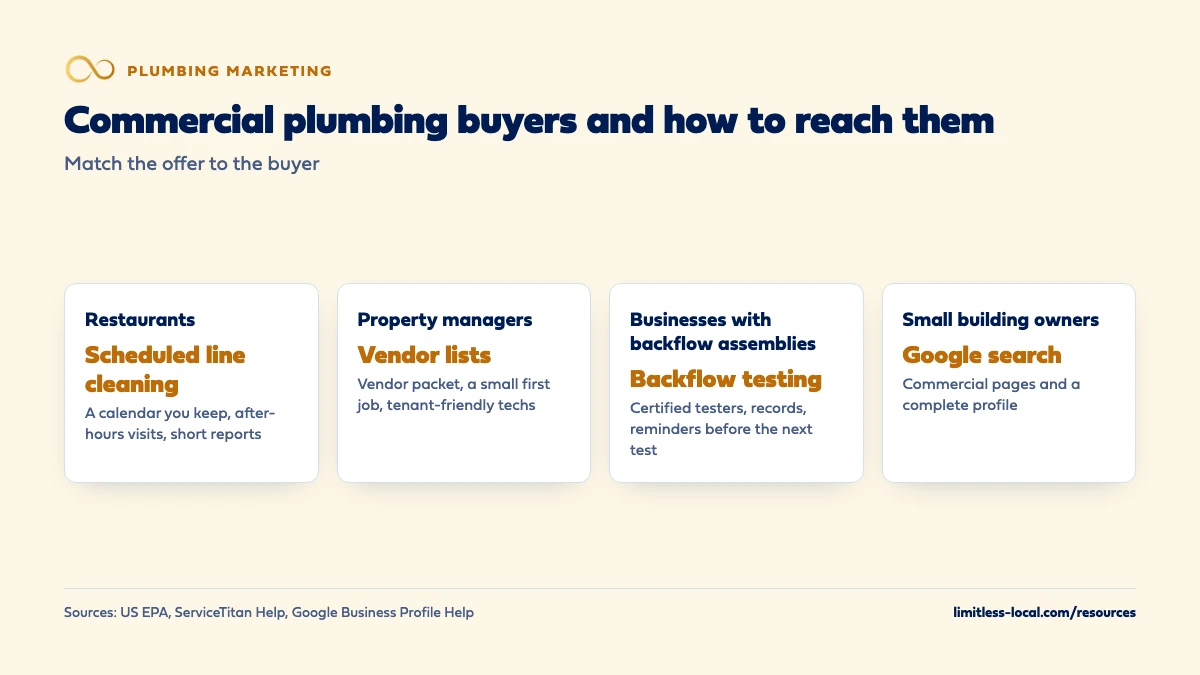
- Step 3: Can backflow testing open commercial doors?
- Step 4: How do I win restaurant accounts?
- Step 5: How do I sell commercial service agreements?
- Step 6: How do I get on a property manager's vendor list?
- Step 7: Does Google still matter for commercial plumbing?
- Step 8: Should I reach out to commercial buyers directly?
- Step 9: Are larger buildings and government work worth chasing?
- How do I measure commercial plumbing marketing?
- What's different about commercial work for plumbers
- A worked example: what one restaurant account is worth
- Frequently asked questions
- Key takeaways
- More in this section
- Sources
The short version
- Choose one or two niches, such as restaurants, property managers or backflow testing, instead of "commercial" in general.
- Lead with recurring work: scheduled line cleaning, required testing and written service agreements.
- Have a vendor packet ready, reach buyers directly, and follow the email rules when you do.
- Measure accounts won and agreement value, not cost per lead.
For plumbing owners who want commercial accounts alongside residential work: restaurants, property managers, facilities and the recurring work that comes with them.
Get a free visibility audit · Book a growth call
How does a plumbing company win restaurants, property managers and other commercial accounts?
Pick one or two commercial niches your crews and equipment fit, such as restaurants, multifamily property managers or businesses that need backflow testing, and build pages, a vendor packet and direct outreach around them. Lead with recurring work, like scheduled drain and grease line cleaning, backflow testing where your water system requires it, and written service agreements, because the prize is the account, not the single call. Keep your Google profile and website showing commercial work for the emergency calls, and judge results by accounts and agreement value, not cost per lead.
Commercial accounts mostly come from relationships, but buyers still check you out online before they call, and the emergency calls still come through Google. That getting-found side is what our packages cover: Essentials is $3,500 a month and includes Google Business Profile management, a content sprint of up to 10 pages, Google Ads management and call tracking, with ad spend paid to Google separately. See how we approach plumbing marketing, and the plumbing marketing questions library for the rest, one question at a time.
How is commercial plumbing marketing different from residential?
The phone still has to be answered, but most other things change. In our judgement the main differences are:
- The buyer isn’t the person with the problem. A line cook reports the backed-up floor drain; a restaurant owner or a property manager decides who fixes it.
- Downtime has a price tag. A restaurant that can’t run its dish machine, or an apartment stack that backs into three units, is losing money or tenants by the hour. Speed and reliability sell harder than price.
- Much of the work is recurring. Grease lines need cleaning on a schedule, many backflow assemblies need periodic testing, and buildings need ongoing service.
- The offer is an agreement, not a membership. ServiceTitan’s documentation separates residential memberships from commercial service agreements: memberships are simpler prebuilt plans more often sold in the field, while service agreements cover multiple equipment systems, are tailored to each customer, and are typically sold from the office after on-site inspections.
So the marketing has two jobs: reach the few people who control buildings, and be easy to approve when they look you up.
Who actually hires a commercial plumbing company?
Make the list for your own area before spending anything. The usual buyers:
- Restaurants and restaurant groups: grease lines, floor drains, water heaters, emergency backups.
- Property managers for apartments, offices and retail centers: tenant calls, unit turnovers, stacks and risers.
- Facility managers at schools, clinics, senior living, warehouses and plants.
- HOAs and condo boards, often through their management company.
- General contractors who need a plumbing sub for tenant build-outs and new construction.
- Public buyers: city, county, school district and federal facilities.
Each buys differently. A restaurant owner wants a plumber who answers on a Saturday night. A property manager wants clean paperwork and tenants who don’t complain. A general contractor wants accurate bids and a crew that keeps the schedule.
Step 1: Which commercial niche should I start with?
The one your crews, equipment and hours already fit. In our judgement:
- Restaurants fit a shop with jetting equipment and real after-hours coverage.
- Multifamily property managers fit a shop with service volume and techs who are good with tenants.
- Backflow testing fits a shop willing to get the testing certification your area requires and keep careful records.
- Construction work fits a shop with estimators and crews that can be tied up for weeks.
A new plumbing company living on home warranty dispatches is a common case. Commercial accounts can steady the calendar, but they are won one relationship at a time, so start with one niche and a short list of names. How a new plumbing company gets its first customers covers the residential side of the same start.
Step 2: What should the commercial side of my website show?
Enough that a manager can shortlist you without calling. In our judgement that means:
- Separate commercial pages, one per niche you chose: restaurant drain and grease line service, backflow testing, commercial water heaters, property management service, emergency commercial service.
- What you actually do, in the buyer’s terms: scheduled jetting, camera inspections, testing and repair records, after-hours response.
- Your service area and real response times, including how after-hours calls are handled.
- Proof: the kinds of buildings you serve, short job write-ups with the customer’s permission, and the license and insurance details a vendor packet will ask for.
- An easy first step: request a site walkthrough, a backflow test or a quote on scheduled maintenance, with a form that asks for the number of locations.
Drain and sewer work is often where commercial accounts start; getting more drain cleaning and sewer line jobs covers how to market it.
Step 3: Can backflow testing open commercial doors?
It can, because it’s recurring, required in many places and puts you on site at businesses that need plumbers. The EPA’s fact sheet on cross-connection control and backflow prevention explains that backflow, the unintended reversal of water flow through a cross-connection, can create a potentially serious public health hazard, and that programs to prevent it vary by state and municipality. The elements it lists for an effective program include the testing frequency for backflow prevention assemblies, records of testing and repair, staff who are trained and certified in testing, and the legal authority to require customers to act.
For marketing, that means:
- Learn how the water systems in your area run their programs, including how often testing is required and who may perform it.
- Get the certification your area requires before you advertise testing.
- Build a page for backflow testing and repair, and keep test dates on file so you can remind each customer before the next one is due.
Each test is a visit to a building whose owner may need other plumbing work. Do it well and on time, and you’re the obvious call when something else breaks.
Curious what your marketing is actually booking?
Get a free visibility audit — no obligation, no sales pitch.
Step 4: How do I win restaurant accounts?
Sell the schedule, not the emergency. A kitchen that backs up on a Friday night costs the owner a night’s sales; a drain and grease line cleaning schedule that prevents it is easy to explain. In our judgement the offer that works is:
- A first visit to camera and clean the main lines, with photos or video and a written note on condition.
- A recommended cleaning interval for that kitchen, and a calendar you keep, not the owner.
- After-hours visits so the kitchen isn’t shut during service.
- A short report after each visit.
Some sewer utilities run their own fats, oils and grease programs for restaurants. The EPA’s training on fats, oils and grease covers how utilities manage grease in the collection system, including fees and permitting options for food service establishments. Read your local program’s rules so your service fits what restaurants already have to do, and never imply your visit replaces a permit or an inspection.
Step 5: How do I sell commercial service agreements?
Start with a walkthrough. ServiceTitan describes service agreements as typically sold from the office, using equipment details technicians capture during site walkthroughs, with pricing based on the location’s needs, equipment types and quantities. It also notes an agreement can name an account manager, a not-to-exceed limit and service-level agreements, and pass them to the technician on every visit.
For a plumber, an agreement usually covers some mix of scheduled line cleaning, water heater service, fixture and valve checks, backflow testing where required, and response times for emergencies. The sales sequence is simple: walk the building, inventory what’s there, send a written proposal with the schedule and pricing, do the first visits well, and send a short report after each one. Those reports are what get you the next building in a manager’s portfolio.
Step 6: How do I get on a property manager's vendor list?
Make it easy to say yes. Property management companies usually have an approval process, and the paperwork is the first test. In our judgement, have a vendor packet ready before you reach out: your W-9, certificate of insurance, license numbers, service area, response times for emergency and routine calls, how tenant calls and unit access are handled, and two or three commercial references who’ve agreed to take a call.
Then ask for a small first job: a unit turnover, a water heater, a clogged stack. Done on time, with a tidy invoice and a tenant who didn’t complain, that’s how most vendor relationships start. Answering that first call fast counts as much as with homeowners; how fast a plumbing office should answer covers the phone side.

Step 7: Does Google still matter for commercial plumbing?
Yes, for the calls that don’t come through an agreement: a restaurant with no plumber on a Saturday, a new property manager without a vendor, a small building owner searching “commercial plumber” and a town. They use the same Google results homeowners do.
The same rules apply. Google says local results are mainly based on relevance, distance and popularity, that complete and detailed business info helps it match you to relevant searches, that more reviews and positive ratings can help, and that there’s no way to pay for a better local ranking. Make sure your profile’s services and photos show commercial work, and ask commercial customers for reviews just as you ask homeowners. Optimizing your plumbing Google profile covers the profile itself.
Step 8: Should I reach out to commercial buyers directly?
Yes, more than a residential shop would. In most markets the buyers are a short, knowable list, so direct contact makes sense: a short email or call to restaurant owners and property managers, a visit with your vendor packet, and time at local restaurant association or property management meetings.
If you use email, the rules apply to business buyers too. The FTC’s CAN-SPAM compliance guide says the law covers all commercial messages and makes no exception for business-to-business email. Among its requirements: no misleading header information or subject lines, identifying the message as an ad, including your valid physical postal address, and a clear way to opt out that you honor promptly. This is general guidance on a federal law, not legal advice; state rules and your own situation may add more.
Keep the message about their problem, not your history: fewer weekend backups, faster turnovers, paperwork they can hand to ownership.
Step 9: Are larger buildings and government work worth chasing?
They can be, once the basics work. Two openings worth knowing:
- Building water management. The CDC’s toolkit for developing a Legionella water management program says these programs can reduce the risk of Legionella growing and spreading in building water systems, that they are now an industry standard for many buildings in the United States, and that the toolkit is meant for building owners and managers. A plumbing company that understands what those programs ask of the plumbing can be a useful partner to the facility teams running them.
- Public work. The SBA’s guide on how to win contracts says government agencies use SAM.gov to list contracts over $25,000, and that the information you register in SAM also populates the database agencies search for small business contractors. City, county and school district work has its own bid rules; read them before you bid.
How do I measure commercial plumbing marketing?
Not by cost per lead. One commercial lead can be worth more than a month of residential calls, and the sale can take months. In our judgement the numbers worth tracking are new accounts and where each came from, agreements signed and renewed with their yearly value, backflow tests due and completed, pull-through repairs and replacements from agreement customers, and proposals out with their status, so a long sales cycle doesn’t hide a stalled pipeline.
Tag the source on every commercial job in your field software, the same as for residential. Tracking which plumbing marketing books jobs covers the setup.
Not sure which of these is costing you jobs?
A free visibility audit checks the Google profile, reviews, site and tracking, and shows what to fix first.
What's different about commercial work for plumbers
Some of the work is required. Few other trades have recurring work that local rules can call for, like backflow testing in many water systems or the grease programs some sewer utilities run. A plumber who knows those rules locally has a reason to be on a business’s calendar every year.
Emergencies hit the business, not just the building. A backed-up kitchen or a burst line in an occupied office stops revenue. Commercial buyers pay for a plumber who answers, shows up and leaves paperwork, and they remember the one who didn’t.
Tenants are part of the job. In multifamily and retail, your tech walks into someone else’s home or store on the manager’s behalf. Clean, polite and on time is marketing, because the tenant’s complaint goes straight to the person who hired you.
A worked example: what one restaurant account is worth
These numbers are made up to show the math, not a benchmark or pricing advice. Say a website request comes in from a restaurant group with 6 locations. After a walkthrough, you agree to clean each kitchen’s lines every quarter at $400 a visit, and to test each location’s backflow assembly once a year at $150.
- Line cleaning: 6 locations × 4 visits × $400 = $9,600 a year.
- Backflow testing: 6 × $150 = $900 a year.
- Together: $10,500 a year, and $31,500 if the account stays three years, before any emergency calls, water heaters or repairs.
On a lead report, that’s one lead. A month with one lead looks terrible next to a month with forty residential calls, and it may be worth more. That’s why commercial plumbing marketing should be judged by accounts and agreement value. Whether paid marketing is worth it for your commercial side is what a free visibility audit is for.
Frequently asked questions
Do I need different insurance for commercial plumbing work?
Commercial customers and property managers often ask for higher coverage limits and to be named on your certificate of insurance. Ask your insurance agent what your target buyers will require before you start pitching them.
Should commercial and residential work share one website?
One site is usually fine, as long as commercial work has its own pages and its own path from the menu. A restaurant owner shouldn’t have to read about faucet repairs to find out whether you clean grease lines.
Are home warranty companies a good source of commercial leads?
No; home warranty dispatches are residential work. They can keep a new shop busy, but commercial accounts come from your own outreach, pages and relationships, so start building those alongside the warranty work.
How do I price commercial plumbing agreements?
Base them on the walkthrough: locations, fixtures and equipment, visit frequency and response-time commitments. ServiceTitan’s documentation describes service agreement pricing the same way, by each location’s needs, equipment types and quantities.
Should I run Google Ads for commercial plumbing?
For emergency and specific service terms in your area, it can work. Keep the campaign narrow, such as commercial drain cleaning or backflow testing plus your towns, and send it to the matching commercial page.
Key takeaways
- Pick one or two commercial niches your crews and equipment already fit.
- Lead with recurring work: scheduled line cleaning, backflow testing where required and written service agreements.
- Build commercial pages and a vendor packet before reaching out.
- Contact buyers directly, and follow CAN-SPAM rules, which cover business email too.
- Keep your Google profile showing commercial work for the emergency calls.
- Judge commercial marketing by accounts and agreement value, not cost per lead.
Want a second set of eyes on your setup?
We'll look at how you show up locally and where calls are leaking, then send you a plain-English breakdown.
More in this section
- How should a new plumbing company get its first customers?
- Which plumbing services should I advertise first?
- How do I get more plumbing leads?
- How do I market water softeners and filtration as a plumber?
- How do I make my plumbing company look trustworthy online?
Sources
- Understand differences between memberships and service agreements — ServiceTitan Help
- Protecting Water Quality through Cross-Connection Control and Backflow Prevention — US Environmental Protection Agency
- Fats, Oils, and Grease: What We Know After 23 Years of FOG Work — US Environmental Protection Agency
- Tips to improve your local ranking on Google — Google Business Profile Help
- CAN-SPAM Act: A Compliance Guide for Business — Federal Trade Commission
- Toolkit: Developing a Legionella Water Management Program — Centers for Disease Control and Prevention
- How to win contracts — U.S. Small Business Administration