
How do I get my plumbing company recommended by ChatGPT?

- How can a plumbing business show up when people ask AI tools for a plumber?
- What happens when someone asks ChatGPT to find a plumber?
- Can I pay or sign up to get recommended by ChatGPT?
- Step 1: Can ChatGPT's search crawler read my website?
- Step 2: Do my name, phone number and hours match everywhere?
- Step 3: What should my plumbing service pages say?
- Step 4: Should my website show my license and insurance?
- Do Google reviews affect whether ChatGPT recommends me?
- What if ChatGPT gets my plumbing company wrong?
- How do I check whether ChatGPT mentions my plumbing company?
- What should a plumber avoid when chasing AI recommendations?
- What's different about AI recommendations for plumbing companies
- A worked example: a monthly AI spot check
- Frequently asked questions
- Key takeaways
- More in this section
- Sources
The short version
- No paid placement or published formula exists.
- Let OAI-SearchBot read your site.
- Keep name, number and hours identical everywhere, including Bing Places.
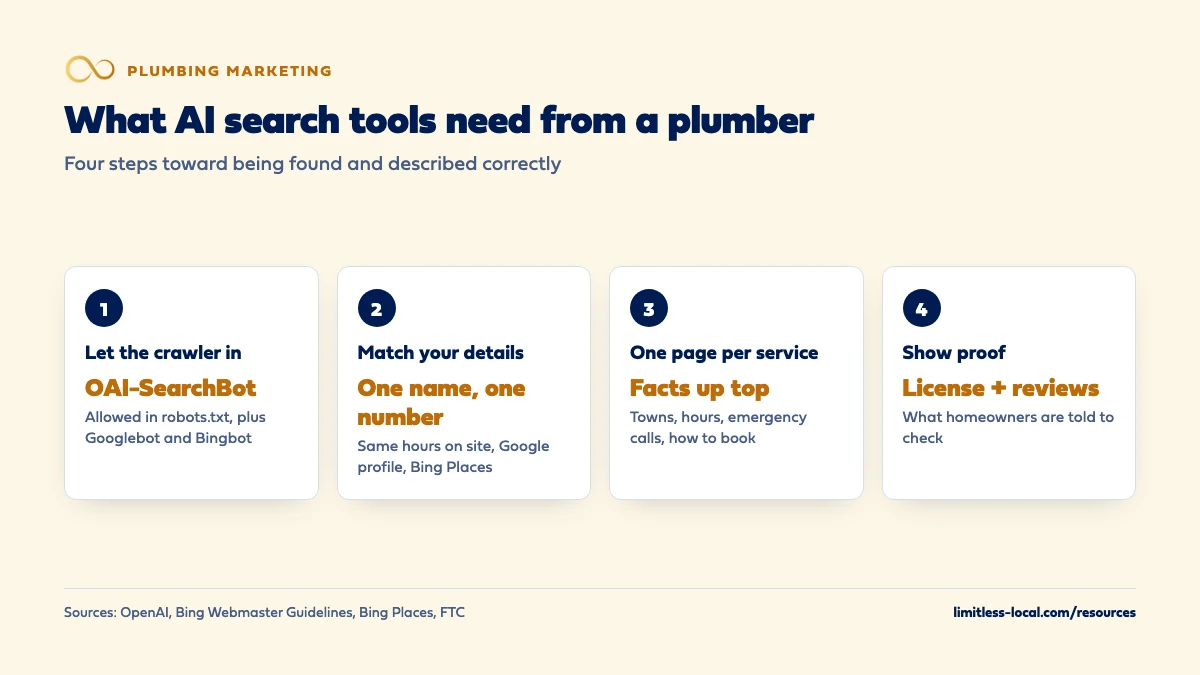
- One page per service with towns, hours and license near the top, then check monthly.
For plumbing owners who’ve heard customers say they found a plumber through ChatGPT and want to know what actually puts a company in those answers.
Get a free visibility audit · Book a growth call
How can a plumbing business show up when people ask AI tools for a plumber?
There’s no way to pay or sign up for a ChatGPT recommendation, and no published formula for how it picks a plumber. ChatGPT search builds answers from web pages its search crawler can read and can draw on business listings from outside providers, so a plumbing company improves its odds by allowing OpenAI’s search crawler on its website, keeping its name, phone number and hours identical on its site, Google Business Profile and Bing Places, and giving each service its own page that states the towns, hours, emergency availability and license outright. Nobody can promise placement, so check what ChatGPT says about you each month and fix any source it gets wrong.
Showing up in AI answers rests on the same foundation as showing up on Google and in Maps. Our local SEO work optimizes for all three places, the regular Google results, the Maps 3-pack and AI answers like ChatGPT, and syncs your name, address and phone across 50+ directories. We don’t promise placement, because nobody honestly can. See how we work with plumbing companies, or browse the rest of the plumbing marketing questions library.
What happens when someone asks ChatGPT to find a plumber?
OpenAI publishes part of the answer in its help article on ChatGPT search. ChatGPT can search the web for current information and show citations you can open. It may use an approximate location based on the person’s IP address for local results; sharing precise device location is optional and off by default. To give more local detail, it may share location with trusted third-party providers, such as for nearby business listings, and on phones a relevant answer may include a map.
In our judgement, plumbing questions reach ChatGPT in three kinds:
- Hiring questions: “Who can fix a burst pipe tonight in [town]?” or “Best water heater installer near me.” These lean on business listings and local service pages.
- Research questions: “Tank or tankless water heater?” or “Signs my sewer line is failing.” These lean on pages that explain things clearly.
- Do-it-yourself questions: “How do I unclog a shower drain?” These rarely name a plumber, unless the answer is that it’s time to call one.
The hiring questions are the ones that ring your phone, so most of this page is about them.
Can I pay or sign up to get recommended by ChatGPT?
No. There’s no listing to buy and no published ranking formula. Bing, whose search also powers Copilot answers, says it plainly in its webmaster guidelines: SEO doesn’t guarantee rankings or traffic, and generative engine optimization, the name for this kind of work, doesn’t guarantee being cited in AI answers either. OpenAI adds that ChatGPT’s search results and citations can be incomplete, outdated or incorrect.
So be wary of anyone who promises your plumbing company a spot in ChatGPT’s answers. What the platforms do document is what makes a business easy to find, read and describe correctly. That’s the work, and it overlaps almost entirely with good local SEO.
Step 1: Can ChatGPT's search crawler read my website?
Check this first, because it’s the one thing that can rule you out completely. OpenAI’s page on its web crawlers says OAI-SearchBot is what surfaces websites in ChatGPT’s search features, and that sites opted out of it won’t be shown in ChatGPT search answers, though they can still appear as navigational links. OpenAI recommends allowing OAI-SearchBot in your robots.txt file. Its training crawler, GPTBot, is a separate setting: you can block GPTBot and still allow OAI-SearchBot.
- Open
yoursite.com/robots.txtin a browser and look for lines that block OAI-SearchBot, Googlebot or Bingbot, or a rule that blocks every bot. - Ask whoever runs your website or hosting whether a firewall or bot-blocking setting is on. In our judgement it’s worth asking, because security plugins can block crawlers without the owner knowing.
Step 2: Do my name, phone number and hours match everywhere?
Every AI tool is trying to work out which business is which, and plumbing companies often make that hard. Google’s guidance on AI features in Search tells site owners to keep their Business Profile information up to date. Bing says it uses many data sources for local listings and that Bing Places is one of the primary sources, so claim that listing too. If you’ve moved, Bing recommends creating a new listing and marking the old one closed rather than editing the old one, to avoid data conflicts. Bing’s guidelines also ask for clear, consistent names for organizations and locations, and say that improves citation accuracy.
For a plumber, the details that drift are predictable, in our judgement: a separate after-hours number, tracking numbers from old campaigns left on directories, a DBA on the vans that doesn’t match the website, and round-the-clock service claimed in one place but office hours in another. Pick one name, one main number and one set of hours, and make every listing match. The Google Business Profile checklist covers the profile itself, and tracking numbers and rankings covers how to use tracking numbers without scattering your phone number.
Curious what your marketing is actually booking?
Get a free visibility audit — no obligation, no sales pitch.
Step 3: What should my plumbing service pages say?
Bing is the most specific of the platforms about content. Its guidelines say a page is more likely to be picked for AI answers and citations when it focuses on a single topic, puts essential information near the top instead of after a long introduction, makes facts and definitions explicit, and keeps important information visible on the page itself.
For a plumbing company, in our judgement, that means one page each for the work you want: drain cleaning, sewer line repair, water heaters, tankless installs, repipes, gas lines, leak detection. Near the top of each, in plain sentences, state the towns you cover, whether you take emergency calls and when, how fast you usually get out for an active leak if you can stand behind it, the equipment and brands you install, and how to book. “Same-day water heater replacement in Cedar Park and Leander, seven days a week” is something an AI tool can repeat. “Quality plumbing solutions for your home” isn’t. How many service pages a plumbing site needs covers the structure.
Step 4: Should my website show my license and insurance?
Yes, because it’s what homeowners are told to check. The FTC’s advice on avoiding home improvement scams tells people to consider only contractors who are licensed and insured, to confirm a license with their state or county, to ask for proof of insurance, and to get a written contract that includes the contractor’s name, address, phone number and license number.
In our judgement, an AI tool asked how to choose a plumber is likely to give similar advice, and the homeowner will then look for those facts on your site. Make them easy to find: your license number where your state issues one, how to request proof of insurance, your local address, how long you’ve served the area, and what your work warranty covers. Leave out anything you can’t back up.
Do Google reviews affect whether ChatGPT recommends me?
None of the AI documentation cited on this page says so directly, so be wary of confident claims either way. What Google does say is that reviews matter in regular local results: its page on improving your local ranking says local results are mainly based on relevance, distance and popularity, that how well-known a business is depends partly on how many reviews it has, and that more reviews and positive ratings can help your local ranking.
Our judgement is that reviews are worth the effort regardless of AI. Reviews that mention the job and the town, like a water heater swap in a named suburb or a midnight burst pipe, help Maps, help the homeowner deciding between you and the next plumber, and give any tool reading business listings something specific to work with. Getting more Google reviews covers how to ask.
What if ChatGPT gets my plumbing company wrong?
It happens. OpenAI’s own help article, Does ChatGPT tell the truth?, says ChatGPT can produce incorrect or misleading answers, sometimes with confidence, and that it may not be able to get information from a website because of technical issues or robots.txt settings. For a plumber, a wrong phone number or wrong hours in an emergency answer is a lost job.
You can’t edit ChatGPT’s answer, but you can fix what it reads. Open the sources it cites. If the wrong number comes from an old directory listing, fix or close that listing. If it’s from your own site, update the page, and if you use Bing Webmaster Tools, Bing recommends IndexNow to tell it about changed pages, which it says reduces outdated or incorrect references in Copilot answers. Then ask again in a few weeks.
How do I check whether ChatGPT mentions my plumbing company?
Ask the way a homeowner would, and keep notes:
- Ask ChatGPT, Google, Copilot and any other assistant a few real questions: “Emergency plumber open now in [town]”, “Who installs tankless water heaters near [town]?”, “Sewer line camera inspection [town]”.
- Put the town in the question. ChatGPT may otherwise use an approximate location from the IP address, so a search from your shop may not match what a homeowner across town sees.
- Open the sources each answer cites, and check your name, number and hours in each.
- Repeat with the same questions once a month, and again after a freeze or a big change like a move or a new phone number.
Treat it as a spot check, not a score; answers change with wording and location. Google’s AI answers are a separate question with their own effect on calls, covered in whether AI Overviews take plumbing calls.
What should a plumber avoid when chasing AI recommendations?
Bing’s guidelines list tactics that can cost visibility in Bing and Copilot, including:
- Prompt injection, meaning content designed to manipulate the AI models, which Bing says may lead to reduced visibility or removal.
- Misleading structured data: markup has to match what’s visible on the page, and markup that doesn’t may be ignored and can affect trust.
- Keyword stuffing and language engineered to trigger AI citations rather than help a reader.
One plumbing-specific trap, in our judgement: near-identical pages for every town in the county, including towns your trucks don’t really reach. If an AI tool repeats them, you get calls you can’t take. Building city pages without spam covers how to do town pages properly. If a tactic only makes sense because a machine is reading the page, it’s a risk to your whole site.
Not sure which of these is costing you jobs?
A free visibility audit checks the Google profile, reviews, site and tracking, and shows what to fix first.
What's different about AI recommendations for plumbing companies
Hours and phone numbers matter more. Someone asking an AI tool for a plumber at 11 p.m. will call whatever number it shows. If that’s an old tracking number or a daytime-only line, the recommendation does you no good. Accurate hours and one main number are the first job, not a detail.
Do-it-yourself questions are a different audience. Many plumbing questions people ask AI tools are about fixing it themselves. In our judgement, there’s little point writing pages to win those answers. A page that explains when a clog, a leak or a water heater problem is beyond a do-it-yourself fix can still earn a mention when the homeowner gets there.
Emergency and planned work need different pages. A burst pipe question and a tankless water heater question come from different moments. Separate pages, each with its own facts up top, give an AI tool a clean answer for each.
A worked example: a monthly AI spot check
The results here are made up to show how the check works, not what you’ll find. A plumbing owner picks four questions customers really ask and puts each to three AI tools, for 12 answers in all.
- Named in 3 of 12 answers, all for water heater questions, none for emergency questions.
- One answer showed an old phone number, traced through the cited sources to a directory listing from a past ad campaign.
- The emergency page turned out to bury the towns and hours below a long introduction.
The fixes follow the steps above: correct the directory listing, move towns and hours to the top of the emergency page, and ask the same four questions next month. The count of mentions is less important than the direction over a few months, and whether the details shown are right.
Frequently asked questions
Does ChatGPT use my Google Business Profile?
OpenAI doesn’t say which listing providers it uses. It does say ChatGPT may share location with third-party providers for things like nearby business listings, so keep every listing accurate, including Google and Bing Places.
Should I block GPTBot on my plumbing website?
That’s your call. OpenAI treats GPTBot, its training crawler, separately from OAI-SearchBot, its search crawler, so you can block training and still allow search.
How long does it take to start showing up in AI answers?
There’s no published timeline. The groundwork is the same as local SEO, which typically takes 3-6 months to show meaningful growth, and AI tools change often, so treat it as a ramp, not a date.
Do I need a separate page for every town I serve?
Only for towns you really serve and can say something specific about. Thin, copied town pages are the kind of content Bing’s guidelines warn against.
Should I add schema markup for AI tools?
It can help tools read your business details, but Bing says structured data doesn’t guarantee visibility and must match what’s visible on the page. Add your real name, address, phone and hours, and nothing the page doesn’t show.
Can I ask ChatGPT to remove wrong information about my business?
You can’t edit its answers directly. Fix the sources it cites, such as your website or an outdated directory listing, and check again later.
Key takeaways
- There’s no paid placement or published formula for ChatGPT recommendations.
- Allow OpenAI’s search crawler, OAI-SearchBot, in robots.txt; GPTBot is a separate choice.
- Use one name, one main number and one set of hours on your site, Google profile and Bing Places.
- Give each plumbing service its own page with towns, hours and emergency availability near the top.
- Show license and insurance details, and keep asking for reviews.
- Check monthly what AI tools say about you, and fix the sources they cite.
Want a second set of eyes on your setup?
We'll look at how you show up locally and where calls are leaking, then send you a plain-English breakdown.
More in this section
- How do I get more Google reviews for my plumbing company?
- How do I get my plumbing company into the Google map pack?
- How do I make my plumbing company look trustworthy online?
- How do I get more repeat customers and referrals for plumbing?
- How do I get more plumbing leads?
Sources
- Searching the web with ChatGPT — OpenAI Help Center
- Overview of OpenAI Crawlers — OpenAI
- Does ChatGPT tell the truth? — OpenAI Help Center
- Webmaster Guidelines — Bing Webmaster Tools
- Bing Places for Business — Bing Places for Business
- AI Features and Your Website — Google Search Central
- Tips to improve your local ranking on Google — Google Business Profile Help
- How To Avoid a Home Improvement Scam — Federal Trade Commission