
How many service pages should a plumbing website have?
- How many service pages does a plumbing company need to rank and get calls?
- Is there a right number of service pages for a plumber?
- Which service pages does almost every plumbing company need?
- When does a plumbing job deserve its own page?
- Do I need a separate page for every small plumbing task?
- Which plumbing service pages should I build first?
- What makes a plumbing service page worth having?
- Should residential and commercial plumbing have separate pages?
- How should plumbing service pages be organized on the site?
- Do city pages count toward my service pages?
- Do my plumbing Google Ads need their own service pages?
- How do I know if a plumbing service page is pulling its weight?
- What's different about service pages for plumbing companies
- A worked example: counting the pages for one plumbing company
- Frequently asked questions
- Key takeaways
- More in this section
- Sources
The short version
- One page per job you want more of and that people search for by name.
- Group small fixture jobs on one page instead of a page each.
- Build pages first for your highest-value and most-searched work.
- Skip pages for work you don't want; they bring calls you'll turn down.
For plumbing owners building or fixing a website and trying to decide how many service pages are enough, and which ones come first.
Get a free visibility audit · Book a growth call
How many service pages does a plumbing company need to rank and get calls?
There’s no number of pages Google rewards: a plumbing website needs one service page for each job you want more of and that homeowners search for by name. For most residential plumbers, that means separate pages for emergency service, drain cleaning, sewer lines, water heaters, leak detection and repiping, plus one for smaller fixture work and one for any specialty or commercial work you actually do. Small related tasks belong together on one page, and near-identical pages made only to rank can run into Google’s spam policies.
We plan plumbing sites the same way: start from the jobs the owner wants more of, then build only the pages that can win them. Service pages are part of our website work and the content in our plumbing marketing packages. The rest of the plumbing marketing questions library covers the other parts of getting found.
Is there a right number of service pages for a plumber?
No. Google doesn’t reward a page count, and it says the same about length: among its warning signs for content made for search engines rather than people is writing to a particular word count, because Google doesn’t have a preferred one (Creating helpful, reliable, people-first content). It also lists “producing lots of content on many different topics in hopes that some of it might perform well” as a warning sign.
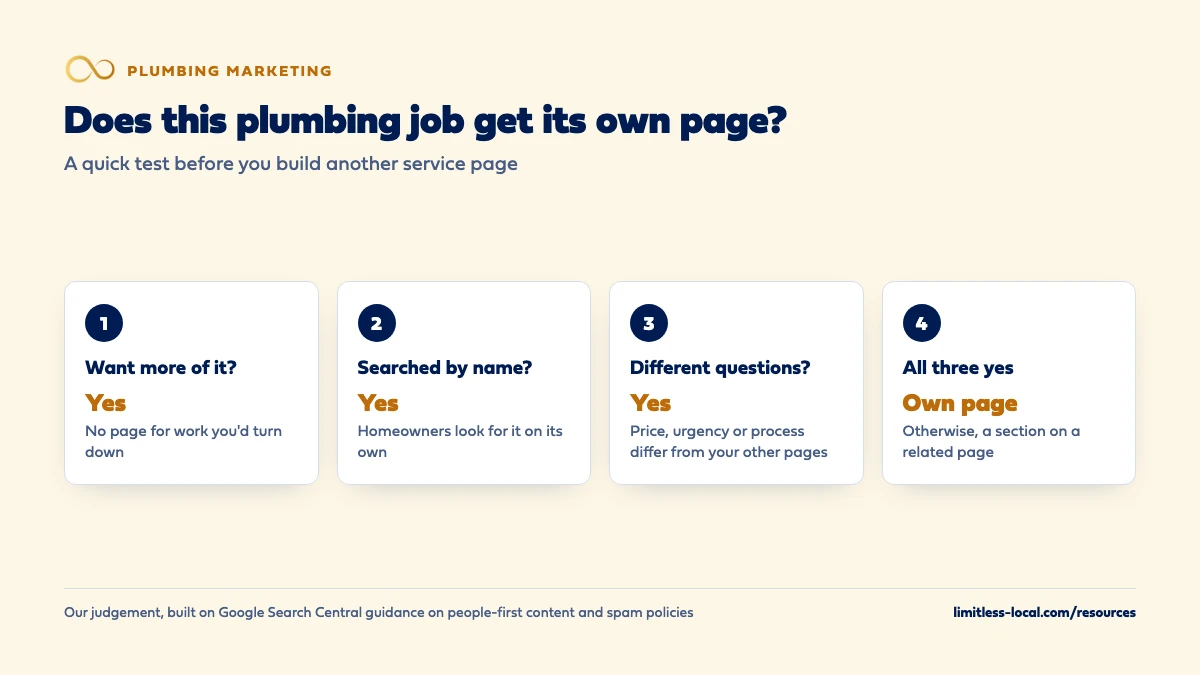
So the useful question isn’t “how many?” but “which ones?” In our judgement, a page earns its place when three things are true: you want more of that job, people search for it by name, and a homeowner would want different information from it than from your other pages. The count falls out of that list, and for most residential plumbing companies it lands somewhere in the single digits to low teens.
Which service pages does almost every plumbing company need?
In our judgement, these cover most residential plumbing work, each searched for differently and each with its own questions:
- Emergency plumbing: burst pipes, no water, active leaks, after-hours response.
- Drain cleaning: clogged sinks, tubs and main lines, and how you clear them.
- Sewer line repair and replacement: camera inspections, repair versus replacement, digging and trenchless options if you offer them.
- Water heaters: repair and replacement, tank and tankless.
- Leak detection: slab leaks, hidden leaks, high water bills.
- Repiping: whole-house and partial, the materials you use.
- Fixtures and general repairs: toilets, faucets, garbage disposals and the small jobs, together on one page.
Add pages for anything else you do enough of to want more: gas lines, water softeners and filtration, sump pumps, backflow testing, or commercial plumbing. Leave out work you don’t want. A page for it brings calls you’ll have to turn down.
When does a plumbing job deserve its own page?
In our judgement, give a job its own page when the customer’s questions, price range or urgency are different enough that one page can’t answer both well. Water heater replacement and drain cleaning are an easy split: one is a planned, high-ticket purchase where people compare options, the other is often a same-day problem. Sewer line replacement is different again, with inspections, digging and a bigger decision behind it.
Split further only when the search and the customer split. Tankless water heaters can deserve their own page if you install a lot of them, because the buyer is comparing tankless with tank and asking different questions. Faucet repair and faucet installation usually don’t need two pages. If you’d write the same paragraphs on both, they belong together. Getting more water heater and repipe jobs covers how those two high-ticket pages should sell.
Do I need a separate page for every small plumbing task?
Usually not. A page each for toilet repair, faucet repair, garbage disposal installation, shower valve replacement and hose bib repair tends to produce thin pages that say almost the same thing. Google’s spam policies describe scaled content abuse as generating many pages mainly to manipulate rankings rather than help users, typically unoriginal content with little value (Spam policies for Google web search). A handful of short fixture pages isn’t that on its own, but it points in that direction and rarely helps.
One solid fixtures and repairs page, with a short section for each task and real photos from those jobs, usually serves the homeowner better. Your Google Business Profile can carry the long list instead: its services editor suggests options such as “Install faucet” or “Repair toilet” for plumbing businesses, and lets you add descriptions and custom services (Manage your services on your Business Profile).
Which plumbing service pages should I build first?
In our judgement, start where the money and the searches meet:
- Emergency plumbing, because it’s the call you most need to answer and the page an ad or a Maps visitor often lands on.
- Water heaters, because it’s a high-ticket job homeowners search for by name.
- Drain cleaning and sewer lines, because drain calls are frequent and sewer jobs are large.
- The job you want to grow, whether that’s repiping, tankless or commercial work.
Then fill in the rest. If your budget only covers a few pages this quarter, a few strong pages beat a dozen thin ones. What an emergency plumbing page should include covers the first one in detail.
Curious what your marketing is actually booking?
Get a free visibility audit — no obligation, no sales pitch.
What makes a plumbing service page worth having?
In our judgement, a service page earns its keep when it answers what a homeowner needs before calling: what the job involves, signs they need it, how fast you can come out, whether you give estimates and how, what areas you cover, and proof that you’ve done this exact work, such as photos and reviews from those jobs. A clear phone number and a way to book belong near the top.
Google frames it as people-first content: made primarily for the person reading, not to manipulate rankings, and not leaving readers feeling they need to search again for better information (Creating helpful, reliable, people-first content). A page that lists “we do drain cleaning” and three keywords fails that test however many of them you have.
Should residential and commercial plumbing have separate pages?
In our judgement, yes, if commercial work is a real part of your business. A property manager or restaurant owner asks different questions from a homeowner: service agreements, after-hours response, grease traps, backflow testing, how you invoice. One commercial plumbing page, or a small set if you serve several kinds of commercial customer, keeps those buyers from reading a homeowner page and assuming you only do houses.
If you take commercial work only occasionally, one sentence on the relevant service pages is enough. Building a commercial section you don’t staff for brings calls you’ll struggle to serve.
How should plumbing service pages be organized on the site?
Simply. Put every service page under one services menu, link each one from a services overview page, and link related pages to each other, such as water heater repair to water heater replacement, or drain cleaning to sewer lines. Google’s starter guide says organizing a site logically can help search engines and people understand how pages relate, while also noting that Google will likely understand your pages as they are now, so there’s no need to tear up a working site to reorganize it (SEO Starter Guide).
Use plain, descriptive page addresses, like /water-heater-replacement/ rather than a string of numbers. Google says words in the URL can show as breadcrumbs in results and help people judge whether a page is useful.

Do city pages count toward my service pages?
No, they’re a separate question. Service pages are about what you do; city or town pages are about where. Google’s spam policies name “multiple domain names or pages targeted at specific regions or cities that funnel users to one page” as an example of doorway abuse (Spam policies for Google web search), which is why a service page for every town, with only the town name swapped, is the wrong way to multiply pages.
Get the service pages right first, and mention the towns you cover on each one. Town pages can come later, built only where you have something real to say about each place. Building city pages without spam covers how.
Do my plumbing Google Ads need their own service pages?
Usually yes. Sending a water heater ad to your home page makes the homeowner hunt for the answer. Google Ads rates landing page experience on how relevant and useful the page is to the person who clicked, and says well-rated pages are usually well organized with text that relates to the search (Landing page experience: Definition).
In our judgement, the service pages you build for SEO can usually double as ad landing pages if they lead with the phone number and the offer. If an ad is getting clicks but the phone isn’t ringing, the page is one of the first places to look; clicks but no calls walks through the checks.
How do I know if a plumbing service page is pulling its weight?
Check it on its own. In Search Console’s Performance report you can filter to a single page and see its impressions, clicks and average position, and which searches it appears for (Search Console Performance report). Pair that with call tracking or form tags so you know which calls started on that page, and with your job records so you know which ones booked.
In our judgement, a page that shows up for the right searches but never brings a call needs a better page, not a sibling. A page that never shows up after several months needs a look at whether it matches what people search, and whether anything links to it. Before adding pages, make the existing ones work, and give new pages time: how long plumbing SEO takes covers the ramp.
Not sure which of these is costing you jobs?
A free visibility audit checks the Google profile, reviews, site and tracking, and shows what to fix first.
What's different about service pages for plumbing companies
The emergency page does the heaviest lifting. Many plumbing calls are urgent, and the emergency page is often the one a stressed homeowner reads for ten seconds before calling. Response time, after-hours coverage and the phone number matter more on it than long copy.
Plumbing has more high-ticket jobs than most trades realize. Water heater replacement, repiping, sewer line replacement and slab leak repair are big decisions with more research behind them. In our judgement, those pages deserve the most detail: options, what affects the price, how long the work takes and what the homeowner should expect on the day.
Drain and sewer work is its own world. If you run jetting, camera inspections or trenchless sewer repair, those are worth explaining on the drain and sewer pages, because homeowners comparing quotes are often comparing methods.
Freeze-related work is seasonal in many markets. If frozen and burst pipes are a real part of your winters, in our judgement that’s a section of the emergency page rather than a page of its own, unless you get enough of that work to justify one.
A worked example: counting the pages for one plumbing company
This company is made up to show the counting, not a template to copy. Picture a residential plumber with three trucks who wants more water heater and repipe work, does a fair amount of drain and sewer work, and takes no commercial jobs. Their service pages: emergency plumbing, drain cleaning, sewer line repair and replacement, water heater repair and replacement, tankless water heaters, leak detection, repiping, and fixtures and repairs. That’s eight service pages, plus a services overview page linking to them.
Add the pages every business site needs (home, about, contact and reviews) and the site has 13 pages before any city pages or blog posts. They don’t build pages for gas lines or water softeners, because they don’t want that work, and toilets, faucets and disposals share the fixtures page.
For scale: our themed websites are $3,750 and include up to 25 pages, and our Essentials marketing package, $3,500 a month, includes a content sprint of up to 10 pages. Either is enough room for a plumber’s core service pages; the hard part is choosing the right ones.
Frequently asked questions
Is one services page listing everything enough?
It’s better than nothing, but in our judgement one page can’t answer an emergency caller and a water heater shopper well at the same time. Separate pages for your main jobs usually serve both better.
How long should a plumbing service page be?
As long as it takes to answer the homeowner’s questions. Google says it has no preferred word count.
Can I use AI to write my plumbing service pages?
Google’s spam policies name using generative AI tools to produce many pages without adding value as scaled content abuse. A draft is fine if you add the real details: your process, photos, prices you’re willing to share and the towns you cover.
Should I add prices to my service pages?
If you’re comfortable sharing ranges or a diagnostic fee, it can screen out bad-fit calls. Many plumbers explain what affects the price instead.
Do I need a page for every brand of water heater I install?
Rarely. Mention the brands on the water heater page. A page per brand mostly repeats itself.
Will more service pages get me into the map pack?
Not on their own. Google says local results are mainly based on relevance, distance and popularity; good service pages help relevance, but reviews and your Business Profile carry much of the rest.
Key takeaways
- Google doesn’t reward a page count; build one page per job you want more of and that people search for.
- Most residential plumbers need pages for emergency, drains, sewer, water heaters, leaks, repiping and fixtures.
- Group small fixture tasks on one page and list them in your Business Profile services.
- Build emergency and high-ticket pages first; skip pages for work you don’t want.
- City pages are a separate decision; swapping town names on copies is doorway abuse.
- Judge each page on the calls and booked jobs it brings, and fix weak pages before adding more.
Want a second set of eyes on your setup?
We'll look at how you show up locally and where calls are leaking, then send you a plain-English breakdown.
More in this section
- What should an emergency plumbing page on my website include?
- How do I build city pages for my plumbing company without spam?
- How many Google reviews does a plumbing company need?
- Which plumbing services should I advertise first?
- How long does plumbing SEO take to bring in calls?
Sources
- Creating Helpful, Reliable, People-First Content — Google Search Central
- Spam policies for Google web search — Google Search Central
- SEO Starter Guide: The Basics — Google Search Central
- Manage your services on your Business Profile — Google Business Profile Help
- Landing page experience: Definition — Google Ads Help
- Performance report (Search results): Overview and basic setup — Search Console Help
- Tips to improve your local ranking on Google — Google Business Profile Help