
How long does plumbing SEO take to bring in calls?
- How many months until SEO makes a plumbing company's phone ring?
- How long until plumbing SEO brings in calls?
- What happens in the first month of plumbing SEO?
- Do Maps calls and website calls ramp at the same speed?
- Which plumbing searches start bringing calls first?
- How can I tell plumbing SEO is working before the phone rings?
- Why aren't my SEO calls turning into booked jobs?
- What makes plumbing SEO take longer?
- Can I make plumbing SEO work faster?
- Does a cold snap or a slow season change the timeline?
- Should I run ads while plumbing SEO ramps up?
- How long should I give plumbing SEO before judging it?
- What's different about the SEO timeline for plumbing companies
- A worked example: what SEO has to cover while it ramps
- Frequently asked questions
- Key takeaways
- More in this section
- Sources
The short version
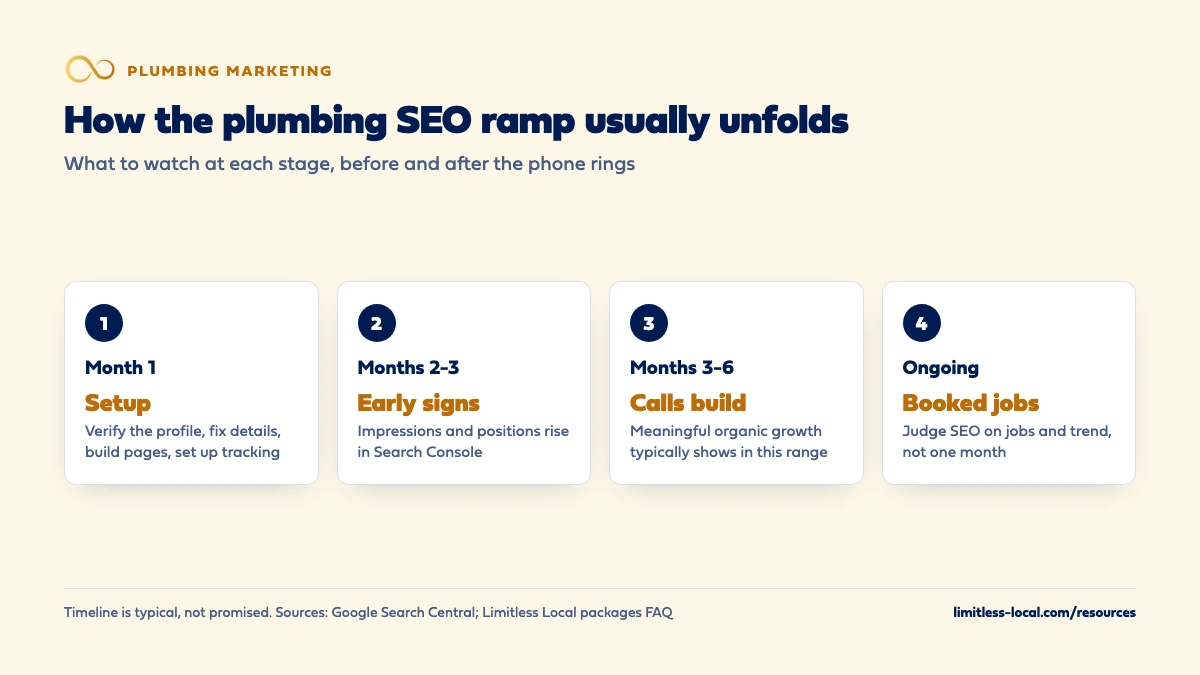
- Meaningful SEO growth typically takes 3 to 6 months; calls lag rankings.
- The first month is mostly setup: profile verification, fixes, pages and tracking.
- Specific job and town searches tend to move before "plumber near me".
- Run paid search for calls while SEO builds, and judge SEO on booked jobs.
For plumbing owners who’ve started SEO, or are about to, and want to know when it should start showing up as calls and booked jobs.
Get a free visibility audit · Book a growth call
How many months until SEO makes a plumbing company's phone ring?
Plumbing SEO typically takes 3 to 6 months to show meaningful organic growth, and the calls build gradually rather than arriving on a set date. Google says some changes can take effect in a few hours while others take several months. For a plumber, the ramp depends on how crowded your market is, how close searchers are to you, how many reviews you have, and whether your website has a page for each job you want, like water heaters, drains and sewer lines.
That ramp is why we pair SEO with ads instead of selling one as a replacement for the other, and judge both by what each booked job cost. Local SEO for plumbers is part of our local SEO work in every tier of our plumbing marketing packages. The rest of the plumbing marketing questions library goes channel by channel.
How long until plumbing SEO brings in calls?
The honest range is months, not weeks. SEO typically takes 3 to 6 months to show meaningful organic growth, while ads can bring leads within days of going live. Google’s own guidance points the same way: every change takes time to be reflected, some in a few hours and others in several months, and Google suggests waiting a few weeks before judging whether a change helped at all (SEO Starter Guide).
Calls come after rankings, not with them. A page first has to be found, then shown for a search, then shown high enough that a homeowner with a leaking water heater picks you over the next plumber. In our judgement, most plumbing companies see impressions and Maps views rise well before the phone rings more, and that gap is where owners give up too early.
What happens in the first month of plumbing SEO?
Mostly setup, which is why calls rarely move in month one. The usual groundwork for a plumber:
- Verify the Google Business Profile. Google says verification reviews take up to 5 business days and occasionally longer; postcard codes usually take about 2 weeks to arrive, and most codes arrive within 14 days (Verify your business on Google).
- Fix the profile. Categories, services, hours and service area, so the profile matches the work you do. Optimizing your plumbing Business Profile covers the details.
- Build the missing pages. A page for each main job, such as drain cleaning, water heaters, sewer lines and emergency service.
- Set up tracking. Call tracking and a way to tag which calls became jobs, so month four can be compared with month one.
None of that produces calls on its own in the first weeks. It’s the base everything after it builds on.
Do Maps calls and website calls ramp at the same speed?
Not usually, because they’re decided differently. Google says local results on Search and Maps are mainly based on relevance, distance and popularity, and that how well known a business is draws on things like how many websites link to your business and how many reviews you have (Tips to improve your local ranking on Google). Distance you can’t change, so a plumber tends to show in Maps near the shop long before showing across town.
The regular results depend more on your website: whether Google has found your pages and whether they match what people search. In our judgement, Maps calls often move first for a plumber with a well-reviewed profile, while website calls from job and town pages build more slowly behind them. Getting into the map pack covers the Maps side in depth.
Which plumbing searches start bringing calls first?
In our judgement, narrow searches move before broad ones. A search like “water heater replacement” plus the name of a nearby suburb has fewer plumbers competing for it than “plumber near me” in a big metro, so a good page for it can start showing sooner. The same goes for job types your competitors don’t bother writing about, such as tankless conversions, sump pumps or sewer camera inspections, if you do that work.
Emergency searches are different. Someone with water on the floor wants the nearest plumber who answers, which is a Maps and distance question more than a website question. That’s why the page count matters less than the page match: one clear page per job you want more of. How many service pages you need works through that.
How can I tell plumbing SEO is working before the phone rings?
Watch the numbers that move before calls do:
- Search Console impressions and average position. Impressions count how many times your site appeared in Google results, clicks count visits, and average position shows how high your topmost result sat. Filter by page to see your water heater or drain pages separately (Search Console Performance report).
- Business Profile performance. Google reports searches, interactions and calls, where calls means the number of times someone tapped the call button on your profile. The searches metric updates at the start of each month and can take up to 5 days to appear (Understand your Business Profile performance).
- Tracked calls and booked jobs. The end of the chain, and the one that pays the bills.
In our judgement, rising impressions and positions by month two or three are a fair sign the work is taking hold, even if calls haven’t caught up.
Curious what your marketing is actually booking?
Get a free visibility audit — no obligation, no sales pitch.
Why aren't my SEO calls turning into booked jobs?
Sometimes SEO is working and the calls are getting lost after they arrive. Plumbing searches don’t keep office hours: a burst pipe at night or a backed-up drain on a Sunday is exactly when someone searches and calls. If those calls ring out or reach a voicemail nobody checks until Monday, the ranking did its job and the booking didn’t happen. Stopping lost after-hours calls covers the fixes.
The other common gap is tracking. If calls from Google land on the same number as your truck wraps and your yard signs, nobody can tell an SEO call from a referral, and SEO gets judged on a feeling. Tracking which marketing books jobs shows how to tie calls to invoices in ServiceTitan, Housecall Pro or Jobber.
What makes plumbing SEO take longer?
In our judgement, these are the usual reasons a plumbing company sits at the slow end of the range, or past it:
- A crowded metro where established plumbers have years of reviews and links.
- Few reviews, or reviews that stopped coming in a while ago. Google says more reviews and positive ratings can help a business’s local ranking.
- A one-page website, or a site that lists services in a single paragraph instead of giving each job its own page.
- A Business Profile with the wrong categories, an unverified status, or details that don’t match the website.
- A service area drawn far wider than where your trucks can get to quickly, so you’re trying to rank in towns far from your base.
- A brand-new domain or a recent site rebuild that changed page addresses without redirects.
Can I make plumbing SEO work faster?
Not by paying Google: Google says there’s no way to request or pay for a better local ranking (Tips to improve your local ranking on Google). What you can do is remove the delays you control:
- Ask for a review after every finished job, so your review count keeps building.
- Keep the profile complete and accurate: hours, services, categories and service area.
- Give each main job its own page, and make sure each one says which towns you cover.
- Earn links from real local sources, such as suppliers, builders you work with, and local associations, because Google names links from other websites among the things that show how well known a business is.
- Fix the phones, so the calls you do earn become jobs.
None of these shortens Google’s own processing time, but in our judgement they keep a plumbing company near the faster end of the range instead of the slower one.
Does a cold snap or a slow season change the timeline?
It changes how the numbers look. In our judgement, plumbing is steadier through the year than heating and cooling, but a hard freeze can bring a wave of burst-pipe and no-water searches in a few days, and a mild winter can make the same months look flat. If SEO starts in a quiet month, calls may jump in a cold snap for reasons that have little to do with the SEO work.
So compare like with like. Look at average position and impressions for the pages you’ve worked on, or compare the same months year over year, before crediting or blaming SEO for a busy or slow stretch. Starting SEO well before the cold months gives the groundwork time to be in place when the freeze calls come.
Should I run ads while plumbing SEO ramps up?
For most plumbing companies, yes, if the phones are covered. Ads can bring calls within days of going live, which carries the months while SEO builds. Local Services Ads take longer to start: Google says screening and verification averages 3 to 4 weeks after you submit your documents, and because plumbing is an urgent category, plumbers also go through background checks (Business screening and verification requirements).
In our judgement, the useful pairing is paid search for emergency and high-ticket jobs now, and SEO for the same jobs over time, so the ad budget can come down where organic calls take over. Starting with LSAs, Google Ads or SEO covers which to turn on first.
How long should I give plumbing SEO before judging it?
In our judgement, give it at least six months before deciding it doesn’t work, and check the early signs along the way: impressions and positions rising by month two or three, profile calls and website calls starting to follow after that. If none of the early signs move by month four, ask why, rather than waiting it out.
Be wary of anyone who names a date. Google warns that no one can guarantee a #1 ranking on Google (Do you need an SEO?), and the same goes for a calendar date when the phone starts ringing. What’s reasonable to expect is a plan, monthly numbers you can read, and a straight answer when something isn’t moving.
Talk it through with someone who runs this every day
A 15-minute growth call: your market, your numbers, and what a realistic budget looks like. No pressure.
What's different about the SEO timeline for plumbing companies
Emergency calls lean on Maps. A homeowner with water coming through the ceiling calls whoever is close and answers. That makes your Business Profile, reviews and hours carry more of the early SEO calls than your blog does.
Each job type has its own ramp. Drain cleaning, water heater replacement, repipes and sewer line work are searched differently and compete differently. In our judgement, a plumber who wants more water heater jobs should judge SEO on the water heater page, not on the site as a whole.
Most plumbers work from a home base. If you run a service-area business with the address hidden, the distance factor still applies, so the towns nearest your base usually come first. Trying to rank in a city an hour away is a long road.
Calls happen after hours. SEO calls arrive at night and on weekends because pipes break then. If those calls go unanswered, SEO looks slower than it is.
A worked example: what SEO has to cover while it ramps
These numbers are made up to show the math, not a forecast for your company. Say each booked plumbing job leaves you $350 of gross profit. A $3,500-a-month marketing package then needs 10 booked jobs a month from it to cover its own cost, and six months of it comes to $21,000.
Now say SEO alone brings no extra booked jobs in months one to three while the groundwork goes in, then 4, 8 and 12 in months four, five and six. That’s 24 jobs, or $8,400 of gross profit, against $21,000 spent. On SEO alone, the first six months don’t pay for themselves, and that’s normal for a ramp. It’s why paid search carries the early months: Essentials, our $3,500-a-month package, includes Google Ads management alongside the SEO work, with ad spend paid to Google separately.
The point isn’t the exact numbers; it’s that you judge the ramp on trend and on booked jobs, not on month two. A free visibility audit can put your own job values and market into the same math.
Frequently asked questions
Is 30 days long enough to judge plumbing SEO?
No. Google suggests waiting a few weeks just to see whether a single change helped, and meaningful growth typically takes 3 to 6 months.
Does a new website reset my plumbing SEO?
It can slow it down if page addresses change without redirects or content is lost. Plan the move so old pages point to their new versions.
Will posting on my Business Profile speed things up?
Google lists complete, accurate info, reviews and replies among the things that help local ranking. In our judgement, posts help customers more than they move rankings on their own.
Why do I rank in my town but not the next one over?
Distance is one of the three main local ranking factors Google names, so being close to the searcher helps. Towns further from your base usually take longer.
Do I need to keep paying for SEO once calls come in?
Rankings can slip as competitors keep working, so most plumbers keep some ongoing work: reviews, page updates and profile upkeep. How much is a budget decision.
Can an agency promise when SEO calls start?
No. Google warns that no one can guarantee a #1 ranking, and a call date depends on the same things. We don’t promise one either.
Key takeaways
- Plumbing SEO typically takes 3 to 6 months to show meaningful growth, and calls lag rankings.
- The first month is setup: profile verification, fixes, job pages and call tracking.
- Maps calls near your base and narrow job-and-town searches usually move first.
- Watch impressions, positions and profile calls before judging on the phone alone.
- Run paid search for calls while SEO builds, and make sure after-hours calls get answered.
- Judge SEO on booked jobs and the trend, not on any one month.
Ready to compare options?
Book a short growth call and we'll walk through the math for your service area, including when we're not the right fit.
More in this section
- How do I get more plumbing leads?
- Why are my plumbing Google Ads getting clicks but no calls?
- How do I keep plumbing calls coming in during slow months?
- Should my plumbing company start with LSAs, Google Ads or SEO?
- How fast should my plumbing office answer a new call?
Sources
- SEO Starter Guide: The Basics — Google Search Central
- Do You Need an SEO? Tips for Hiring an SEO — Google Search Central
- Tips to improve your local ranking on Google — Google Business Profile Help
- Verify your business on Google — Google Business Profile Help
- Understand your Business Profile performance & insights — Google Business Profile Help
- Performance report (Search results): Overview and basic setup — Search Console Help
- Business screening and verification requirements (United States) — Google Local Services Help