
How should a new plumbing company get its first customers?
- What's the fastest way for a brand-new plumbing business to land its first jobs?
- Where do a new plumbing company's first customers usually come from?
- What should I set up in the first week?
- How long until a new plumbing company shows up on Google Maps?
- How do I get the first Google reviews?
- Do I need a website before I get customers?
- Should a new plumbing company run Google Ads?
- Can a brand-new plumbing company use Local Services Ads?
- Which local businesses should a new plumber go after?
- Is direct mail worth it for a new plumbing company?
- Should a new plumbing company buy leads from lead platforms?
- How do I turn the first customers into the next ones?
- What's different for a new plumbing company
- A worked example: is a first postcard mailing worth it?
- Frequently asked questions
- Key takeaways
- More in this section
- Sources
The short version
- This month's jobs come from people who already know you and businesses that need a reliable plumber.
- Week one: create and verify your Google Business Profile, get a simple website up, and set up call tracking.
- Ask every customer for a Google review from the first job; Maps visibility builds over months.
- Add Google Ads once every call gets answered, and start Local Services Ads screening early; it averages three to four weeks.
For plumbers who just went out on their own and need the phone to ring before the savings run out.
Get a free visibility audit · Book a growth call
What's the fastest way for a brand-new plumbing business to land its first jobs?
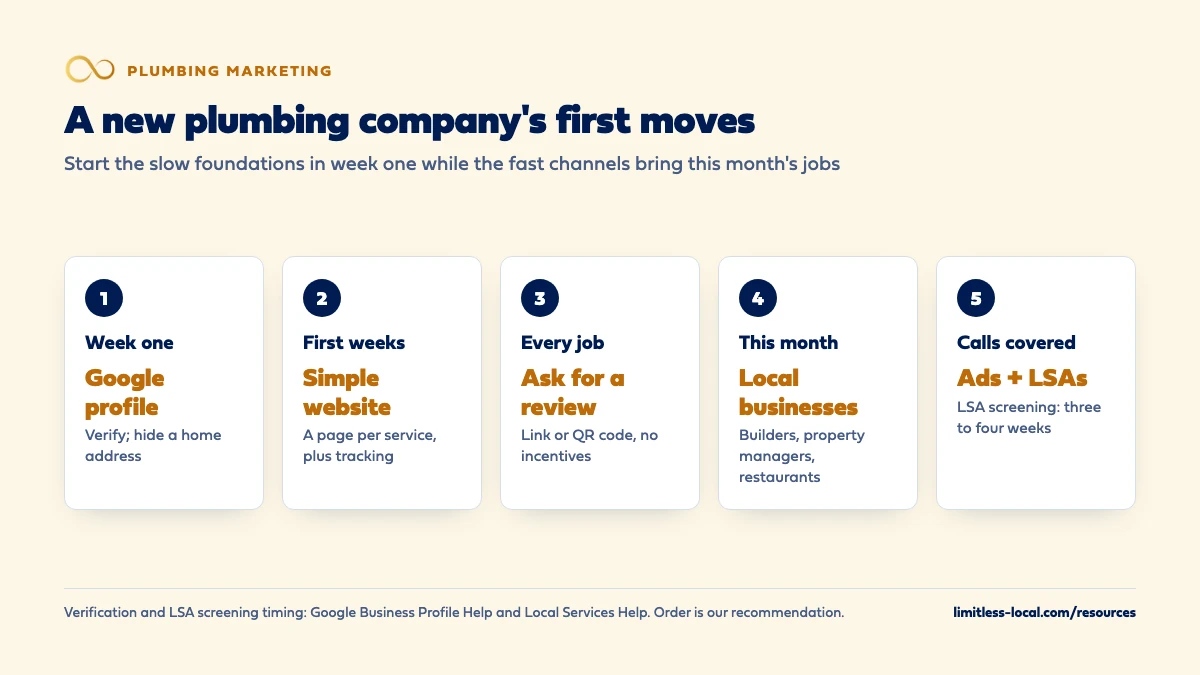
Start with the people who can send you work this month: customers and contacts who already know you, neighbors, and businesses that need a plumber they can count on, such as builders, remodelers, property managers and restaurants. At the same time, set up the free foundations that take weeks to come through: a verified Google Business Profile, a simple website with a page for each service, and a review request after every job. Add paid search once someone can answer every call, and start the Local Services Ads screening early, because Google screens plumbers more heavily as an urgent category and the process averages three to four weeks.
The first customers rarely come from a big marketing budget, and a lot of what’s on this page is free. Our plumbing marketing packages start at $3,500 a month plus ad spend, which is more than many brand-new shops should be spending, so start with the foundations here. When you’re ready to add ads and SEO with tracking from day one, the packages page lays out what each tier includes, and the rest of the plumbing marketing questions library goes question by question.
Where do a new plumbing company's first customers usually come from?
In our judgement, from three places, in roughly this order of speed:
- People who already know you. Friends, family, neighbors, your old contacts in the trade. Tell every one of them, directly, that you’re open and what you do. If you worked for another plumbing company, check any agreement you signed before contacting its customers.
- Businesses that need a plumber. Builders, remodelers, property managers and restaurants send repeat work to a plumber who shows up and answers the phone.
- Homeowners searching on Google. This is where the steady volume eventually comes from, but a new company has to build its way in, through a Google profile, reviews, a website and ads.
The first two can bring jobs this month. The third takes setup now and pays off over the following months, so do all three at once rather than waiting for one to work before starting the next.
What should I set up in the first week?
The things that cost little and take time to come through:
- A Google Business Profile, verified. Google says verification reviews take up to 5 business days, occasionally longer, and that most postcard codes arrive within 14 days when postcard is the method offered (Verify your business on Google).
- The right address setup. If you work out of a truck and your home, you’re a service-area business. Google’s guidelines say service-area businesses should hide their address, and they can’t list a virtual office unless it’s staffed during business hours (Guidelines for representing your business on Google).
- One phone number that always gets answered, with a voicemail greeting that names the company.
- A simple website with a page for each main service and your service area (more below).
- A place to record every customer and where they came from, even if it’s a spreadsheet at first.
How long until a new plumbing company shows up on Google Maps?
Being on Maps comes with verification. Showing up when a homeowner nearby searches “plumber” takes longer. Google says local results are mainly based on relevance, distance and popularity, and that prominence, meaning how well-known a business is, is also based on information like how many websites link to your business and how many reviews you have (Tips to improve your local ranking on Google).
A new company starts with no reviews and few links, so it has the least prominence on the block. That builds with every job, every review and every local mention. We tell owners that SEO typically takes three to six months to show meaningful growth, and Maps visibility for a brand-new profile is part of that ramp. Getting into the Google map pack covers it step by step.
How do I get the first Google reviews?
Ask every customer, from the very first job. Google’s tips are simple: remind customers to leave a review by sending a Google link or showing a QR code, and reply to the reviews you get (Tips to get more reviews).
Two rules matter more for a new company than anyone else, because a handful of reviews is all you’ll have:
- No incentives. Google says offering free or discounted goods or services in exchange for reviews is considered fake and misleading content.
- Real customers only. Reviews must reflect a genuine experience, so no reviews from friends who haven’t hired you.
In our judgement, the best moment to ask is at the end of the job, while the homeowner is standing next to the fix. Text the link before you leave the driveway. Getting more Google reviews covers building the habit.
Do I need a website before I get customers?
You can win your first jobs without one, but in our judgement you’ll want one within the first weeks, for three reasons: homeowners check you out before they call, a Google profile with a website looks more established, and you need somewhere to send Google Ads clicks.
It doesn’t need to be big. A homepage, a page for each main service (drain cleaning, water heaters, leak repair, repiping, whatever you actually do), a page about your service area, your license details where your state requires them on advertising, and your phone number at the top of every page. Photos of your own work and truck beat stock photos.
Curious what your marketing is actually booking?
Get a free visibility audit — no obligation, no sales pitch.
Should a new plumbing company run Google Ads?
Yes, once you can answer every call. Google’s list of what decides Ad Rank covers your bid, the quality of your ads and landing page, the minimum thresholds, the competitiveness of the auction, the context of the search and the expected impact of your ad assets (About Ad Rank). How long you’ve been in business isn’t on that list.
What a new company lacks is data: which towns, services and searches turn into paid jobs. In our judgement, the first months of ads are a paid test, so start narrow:
- Your core services and emergency searches, not everything a plumber can do.
- The towns closest to you, where you can get to a job fast.
- A budget you can afford to learn with, tracked by call.
Ads can bring calls within days of launch, unlike SEO. That’s why they’re usually the fastest paid way to fill a new schedule. Starting with LSAs, Google Ads or SEO compares the options in more detail.
Can a brand-new plumbing company use Local Services Ads?
Yes, but start the paperwork early. Google’s screening and verification requirements say plumbing is considered an urgent category, because people often call plumbers for time-sensitive needs like a hot water outage, so plumbing professionals go through an additional level of screening, including background checks. Depending on your situation, the list can include a business check, an owner check, general liability insurance and state business and owner licenses, and you need a public, verified Google Business Profile.
Google recommends starting as soon as possible after creating the account, and says the process takes three to four weeks on average after you submit documents. A new company that waits until it needs the calls loses most of a month. Whether LSAs are worth it for plumbers covers what happens once you’re live.
Which local businesses should a new plumber go after?
The ones that need plumbing regularly and hate unreliable plumbers. In our judgement, these are worth an in-person visit with a card and a straight offer to be their go-to plumber:
- Builders and remodelers who need rough-ins and fixture sets done on schedule.
- Property managers and landlords, who need someone to answer when a tenant’s water heater fails.
- Restaurants and other commercial spots, where a backed-up drain shuts the business down.
- Other trades, such as HVAC companies, electricians and handymen, who get asked for a plumber they trust.
What wins this work isn’t marketing. It’s answering, showing up when you said, and sending a clean invoice. If you take calls from a business at night, handling after-hours calls covers setting that up.

Is direct mail worth it for a new plumbing company?
It can be, in the neighborhoods closest to you. The USPS describes Every Door Direct Mail as a way to promote a small business in its local community, including when opening a new location, and its online tool lets you map ZIP codes and neighborhoods to mail (Every Door Direct Mail). When we checked in October 2026, USPS listed EDDM Retail flats at $0.26 a piece in postage.
In our judgement, a postcard for a new plumbing company should do one job: get your name and number onto the fridge for the day something breaks. Put a separate tracking number on it, so you know whether it worked, and mail the same streets more than once rather than a big area one time.
Should a new plumbing company buy leads from lead platforms?
Only with your eyes open. Buying leads can fill gaps in a new schedule, but before you sign up, ask two questions: does the platform send the same request to other plumbers, and do you pay for the lead when you don’t win the job? If the answer to either is yes, price those leads on what they turn into, not on what they cost; how much you can afford per lead walks through the math.
In our judgement, treat lead platforms as a bridge while your own Google profile, reviews and ads build, and track them as their own lead source so you can see when to stop.
How do I turn the first customers into the next ones?
Make it easy for them to send you work and call you again:
- Record every customer: name, address, what you did, what you noticed (an old water heater, galvanized pipe) and where they found you.
- Ask for referrals right after a job goes well. Field software can track them; Jobber’s referral tool, for example, lets clients earn credit for referring a friend and shows the jobs and revenue that came from referrals (Referrals). Keep referral rewards separate from review requests.
- Follow up on what you noticed. The old water heater you mentioned is next year’s replacement if you’re the plumber they remember.
Not sure which of these is costing you jobs?
A free visibility audit checks the Google profile, reviews, site and tracking, and shows what to fix first.
What's different for a new plumbing company
Emergencies don’t care that you’re new. A homeowner with water on the floor calls whoever answers and can come fast. That’s an opening for a new shop that picks up every call, and in our judgement it’s why answering matters more than polish in the first year.
Licensing and screening come up early. Plumbing is licensed in many places, and Google screens plumbers more heavily for Local Services Ads. Have your license and insurance paperwork ready to hand over before you start the ads that ask for it.
Small jobs lead to big ones. A first call for a leaking faucet puts you in a house with a water heater, a main line and pipes that will need work. Doing the small job well, and writing down what you saw, is how a new plumbing company builds its first big-ticket work.
A worked example: is a first postcard mailing worth it?
The postage figure is the USPS’s listed EDDM Retail price; everything else is made up to show the math, not a benchmark. Say you mail 2,000 homes in the neighborhoods closest to you. Postage at $0.26 a piece is $520. Add a made-up $280 for design and printing, and the mailing costs $800.
If an average first job from those homes leaves you a made-up $200 of gross profit, the mailing pays for itself on the first job once it brings in four paid jobs. Put a separate tracking number on the card, and count the calls and jobs it brings over the following weeks. If it doesn’t reach four, the first mailing still bought you a test, and you’ll know whether to mail again or spend the money on ads.
Frequently asked questions
Should I put my home address on my Google Business Profile?
If customers don’t come to you, no. Google’s guidelines say service-area businesses should hide their address and set a service area instead.
Can I ask friends and family to leave Google reviews?
Only if they’ve actually hired you. Google requires reviews to reflect a genuine experience, and offering anything in exchange for a review isn’t allowed.
How much should a new plumbing company spend on marketing?
Enough to test one paid channel properly once the free foundations are in place, and no more than you can afford to learn with. Track every call so you know what each dollar brought in.
Should I wrap my truck right away?
In our view, a wrap or a simple lettered truck is worth it once you can afford it, because it works in every driveway you park in. It’s hard to track, so don’t count on it for this month’s jobs.
Is it worth joining local business groups?
Often, if the members include builders, property managers, realtors and other trades. Go to meet the people who can send you repeat work, not to collect cards.
Key takeaways
- This month’s jobs come from people who know you and businesses that need a reliable plumber.
- Create and verify your Google Business Profile in week one; verification and postcards take days to weeks.
- Ask every customer for a Google review from the first job, with no incentives.
- Run Google Ads once every call gets answered, and start narrow on core services and nearby towns.
- Start Local Services Ads screening early; Google screens plumbers more heavily and it averages three to four weeks.
- Track every customer’s source from day one, and treat lead platforms as a bridge, not a plan.
Want a second set of eyes on your setup?
We'll look at how you show up locally and where calls are leaking, then send you a plain-English breakdown.
More in this section
- How do I get more plumbing leads?
- How do I work out my plumbing customer acquisition cost?
- How do I get more Google reviews for my plumbing company?
- Should I hire a plumbing marketing agency or do it myself?
- How much should a plumbing company spend on marketing each month?
Sources
- Verify your business on Google — Google Business Profile Help
- Guidelines for representing your business on Google — Google Business Profile Help
- Tips to improve your local ranking on Google — Google Business Profile Help
- Tips to get more reviews — Google Business Profile Help
- Business screening and verification requirements – United States — Google Local Services Help
- About Ad Rank — Google Ads Help
- Every Door Direct Mail — USPS
- Referrals | Marketing Tools — Jobber Help Center