
Are LSAs or Google Ads better for emergency plumbing calls?

- Is Local Services Ads or Google search ads the better buy for emergency plumbing calls?
- How do LSAs and Google search ads differ for emergency calls?
- Which one gets my number in front of someone with a burst pipe?
- What do I pay for an emergency call on each?
- What happens when I miss an emergency call?
- How do nights and weekends work on each?
- Which one lets me choose which emergencies I pay for?
- How fast can I start taking emergency calls from each?
- What happens to each budget when a freeze floods the phones?
- So which is better for emergency plumbing calls?
- How do I compare them fairly?
- What's different about emergency calls for plumbing companies
- A worked example: one month of emergency calls on each
- Frequently asked questions
- Key takeaways
- More in this section
- Sources
The short version
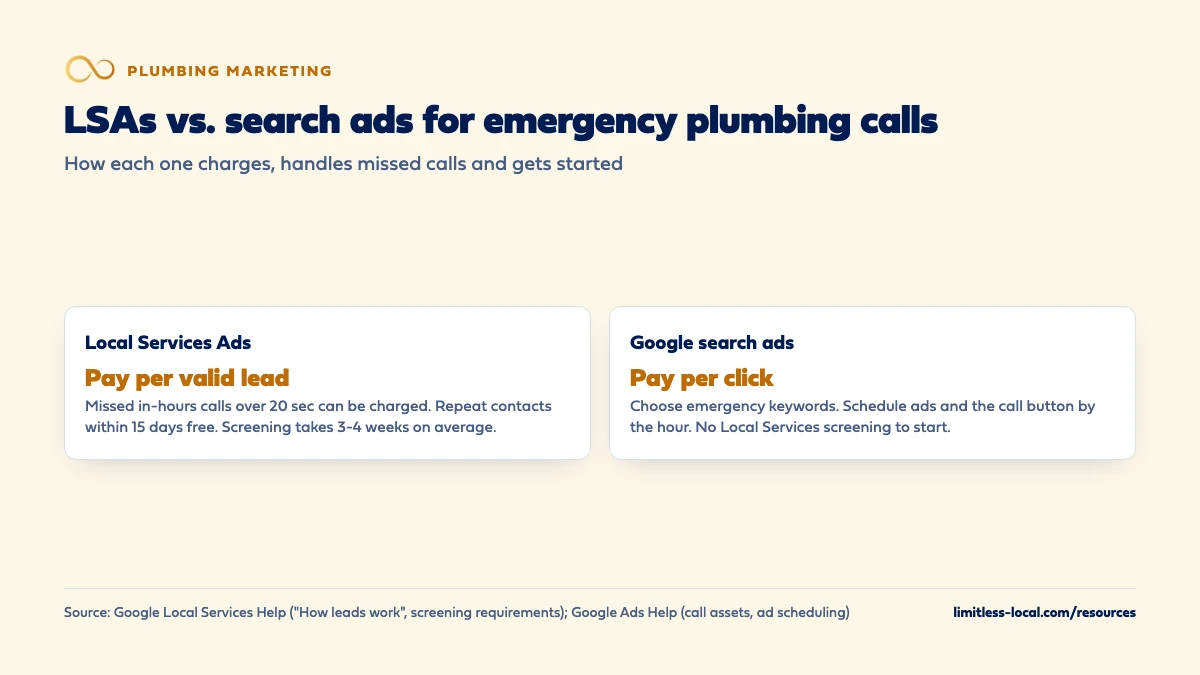
- LSAs: pay per valid lead, call straight from the ad, but missed calls in your listed hours can be charged.
- Search ads: pay per click, pick your emergency keywords, and schedule ads and the call button by the hour.
- LSAs reward answering the phone; search ads reward a tight keyword list and a page built for emergencies.
- If you answer around the clock, run both and compare cost per booked emergency job.
For plumbing owners deciding where to spend on burst-pipe, backed-up-drain and no-hot-water calls, and how each option handles nights, missed calls and sudden spikes.
Get a free visibility audit · Book a growth call
Is Local Services Ads or Google search ads the better buy for emergency plumbing calls?
For emergency plumbing calls, Local Services Ads usually have the edge when someone answers every call during the hours on your Google Business Profile: the customer calls straight from the ad, you pay per valid lead instead of per click, and follow-up calls from the same customer within 15 days aren’t charged again. Google search ads are the better fit when you need to choose exactly which emergency searches you pay for, control hour by hour when your number shows, or start advertising before Google’s Local Services screening, which takes 3 to 4 weeks on average, is finished. Plumbing companies that answer around the clock often run both and compare them on cost per booked emergency job.
Our local ads management covers both, with Local Services Ads in the Growth package, and judges each the same way: what every booked job cost. It’s part of our plumbing company marketing, and the rest of the plumbing marketing questions library goes question by question.
How do LSAs and Google search ads differ for emergency calls?
Both put you on Google when someone types “emergency plumber” with water on the floor, but they work differently:
- Local Services Ads charge for valid leads, such as calls, messages and booking requests. They show only on Google Search and Maps, and they’re keywordless: you pick service categories, job types and areas (Google Ads Help).
- Google search ads charge per click. You pick the keywords, write the ad, and add your number with a call asset so people on a phone can tap to call.
The short answer to this question is one section of whether to start with LSAs, Ads or SEO: LSAs have the edge when calls get answered, and missed calls cost you on LSAs. The full LSA billing rules are in whether LSAs are worth it for plumbers. This page goes further on what those leave out for the 9 p.m. call that wants someone tonight: how the call button behaves on search ads, what a redial costs, hour-by-hour control, a freeze week, and how to compare the two on booked emergency jobs.
Which one gets my number in front of someone with a burst pipe?
With Local Services Ads, the contact options are the ad: a customer can call, send a message or request a booking straight from it (How leads work). There’s no website in between, which in our judgement suits someone who wants a plumber now, not a page to read.
With search ads, the phone number comes from a call asset. On a phone, people can tap the call button or click through to your site. Two details from Google matter for emergencies. Call assets don’t appear with every impression; Google decides whether to show them based on past performance and other factors, so some of your ads will show without the call button. And a tap on the call button costs the same as a headline click (About call assets). The visitor who clicks through instead lands on your page, which needs to make calling easy; what an emergency plumbing page needs covers that.
What do I pay for an emergency call on each?
On Local Services Ads, Google charges for a valid lead: a call you answer or return and talk on, a missed call during your business hours where the caller stays on the line for more than 20 seconds, a text or email, a voicemail, or a booking request. Lead prices vary with your location, the job type, the type of lead and your bidding (How leads work).
One rule suits emergencies especially well. Once a lead is charged, follow-up calls or messages from the same phone number or email aren’t charged again, as long as there’s contact within 15 days. A panicked homeowner who calls three times in ten minutes is one lead, not three.
On search ads you pay for the click or the call-button tap, whether or not the person ends up booking. A homeowner who taps, hears the phone ring twice and hangs up has still cost you a click. That isn’t worse in itself, but it means cost per click tells you little; what matters is how many clicks became booked emergency jobs.
What happens when I miss an emergency call?
This is where the two differ most. On Local Services Ads, a missed call during your business hours becomes a charged lead once the caller stays on the line for more than 20 seconds, voicemail and automated greetings included (How leads work), and missed calls can lower your ranking because Google weighs responsiveness (About ad rankings). The LSA page walks through the phone-menu and voicemail details.
On search ads, you’ve paid for the click or the call-button tap whether or not anyone picks up, and there’s no separate charge for the missed call; it costs you the click and the customer. So a missed emergency call costs money on both, just at different moments: on search ads when the tap happens, on LSAs when the caller waits past 20 seconds. In our judgement, the real difference is the ranking penalty, which makes LSAs the stronger channel for a shop that answers reliably and the riskier one for a shop that doesn’t. If missed calls are the problem, how fast your office answers is worth fixing before either channel gets more money.
Curious what your marketing is actually booking?
Get a free visibility audit — no obligation, no sales pitch.
How do nights and weekends work on each?
On Local Services Ads, your control is mostly the hours on your Google Business Profile plus an ad schedule; missed calls are only charged inside both (How leads work). Google also lists the time of the search among the things it weighs when ranking LSAs, and says message and booking leads can raise your chance of a lead at night and on weekends, when you can’t answer the phone (About ad rankings).
Search ads give you finer control. An ad schedule lets you choose the days and hours your ads show and raise or lower bids for specific times (About Ad Scheduling), and the call asset has its own schedule, so it can show only when your business is answering (About call assets). In our judgement, that hour-by-hour control is the main advantage search ads have for emergencies: you can bid harder at 7 a.m. on a Saturday, keep the ad running overnight for form fills, and switch the call button off after midnight if nobody is on call. Stopping lost after-hours calls covers the answering side.
Which one lets me choose which emergencies I pay for?
Search ads, by a wide margin. You choose keywords such as emergency plumber, burst pipe repair or sewer backup, write ads for each, and exclude searches you don’t want. You decide whether a no-hot-water search goes to your emergency ad or your water heater ad.
Local Services Ads give you broader levers: job types, service areas, and whether you show for general searches like “plumber near me” (Edit your industries, service areas, and job types). In our reading of Google’s settings, there’s no way to say “only show me for burst pipes after 8 p.m.” In our judgement, that’s fine for a shop that wants all emergency work in its area, and limiting for one that only wants some of it.
How fast can I start taking emergency calls from each?
Google treats plumbing as an urgent category, using a hot water outage as its example, so plumbers go through an extra level of screening that includes background checks on service professionals. Google recommends starting as soon as you create the account and says the process takes 3 to 4 weeks on average after you submit your documents (Business screening and verification requirements). New pay-per-lead campaigns still can’t be created inside Google Ads, so new accounts start through Local Services (Google Ads Help).
Search campaigns don’t go through the Local Services screening and background checks, and ads can bring in calls within days of launch. In our judgement, if you need emergency calls this month and don’t have an LSA account yet, start search ads now and begin the LSA paperwork at the same time, so the slower channel is ready when it clears.

What happens to each budget when a freeze floods the phones?
Both now run on average daily budgets. Google says that after Local Services Ads move into Google Ads, weekly budgets become daily ones, daily spend may fluctuate on high-demand days, and the month is capped at your daily average budget times 30.4 (Google Ads Help). Plumbing is in the first phase of that move, which began in August 2026 for select advertisers. For search campaigns, Google can spend up to two times your average daily budget on a busy day, with the same 30.4 times monthly cap (About average daily budgets).
In our judgement, that flexibility helps on the first day of a freeze, but a budget set for a normal week runs out fast in a bad one. Raise budgets on both before the cold arrives, not after the phones are already ringing. Preparing plumbing marketing for a freeze goes through the timing.
So which is better for emergency plumbing calls?
In our judgement, it depends mostly on your phones:
- Lean on Local Services Ads if someone answers every call during your listed hours, you have a healthy rating and steady reviews, and you want all the emergency work in your service area.
- Lean on search ads if you can’t answer every call, need calls before LSA screening clears, want only certain emergencies, or want to control the hours your number shows down to the hour.
- Run both if you answer around the clock and have the budget. They charge differently, and in our view running both is the only honest way to see which one books your emergency jobs for less.
Whichever you choose, the answering is the channel. In our judgement, an emergency ad on either platform that rings out is money spent sending a customer to a competitor.
How do I compare them fairly?
On cost per booked emergency job, not cost per lead or per click. After the move into Google Ads, an LSA campaign’s Cost / conv. column shows your average cost per lead, because conversions there are the leads you were charged for (Google Ads Help). For search ads, you need call reporting or call tracking to count calls, and your job software to show which of them booked.
Tag every emergency call by channel, mark which ones booked, and compare a full month at a time, ideally the same month on both. Leave out repeat customers who would have called you anyway, so neither channel gets credit for them.
Not sure which of these is costing you jobs?
A free visibility audit checks the Google profile, reviews, site and tracking, and shows what to fix first.
What's different about emergency calls for plumbing companies
Google calls plumbing urgent. Google’s screening page uses a hot water outage as its example of why plumbing is an urgent category. That’s why plumbers face extra screening, and it’s a reminder that LSAs are built around the call that can’t wait.
Emergency callers redial. In our judgement, someone with a flooding basement often calls again and again until someone answers. On LSAs, repeat contacts within 15 days are one charge; on search ads, each new tap on an ad is a new click.
Not every urgent call is profitable. A midnight drain call and a midnight slab leak are worth very different amounts. Search ads let you separate them by keyword; LSAs mostly don’t, so watch which job types your LSA leads turn into.
A worked example: one month of emergency calls on each
These numbers are made up to show the math, not a benchmark for your market. Say a plumbing company spends about the same on each channel in one winter month.
Local Services Ads: 18 charged leads at an average of $60, or $1,080. Three of them were missed calls during business hours that rang out past 20 seconds. Of the rest, 9 booked. Cost per booked job: $1,080 divided by 9, or $120.
Search ads: 90 clicks at an average of $12, also $1,080. Those clicks produced 14 calls, and 7 booked. Cost per booked job: $1,080 divided by 7, or about $154.
LSAs win this month, but look at the three missed calls. If two of them had been answered and booked, LSA cost per booked job would have been $1,080 divided by 11, or about $98. The gap between the channels is partly a phone-answering gap.
For reference on management cost: Local Services Ads management is in our Growth package, at $4,500 a month, along with Google Ads up to $5,000 a month in spend; Essentials at $3,500 a month covers Google Ads but not LSAs. Ad spend is paid to Google separately. A free visibility audit runs this comparison on your own market.
Frequently asked questions
Will Local Services Ads charge me for a call I miss at 2 a.m.?
Only if it falls within both your Google Business Profile hours and any ad schedule you’ve set. If your listed hours end at 6 p.m., a missed 2 a.m. call isn’t charged under the missed-call rule.
Do I pay twice if an emergency customer calls back?
Not on Local Services Ads, as long as they call or message from the same number or email within 15 days of the last contact. On search ads, a new tap on your ad is a new click.
Can I bid more for emergency calls at certain hours?
On search ads, yes: ad scheduling lets you raise or lower bids for specific days and times. Local Services Ads let you set an ad schedule, but Google’s pages don’t describe bid changes by hour, and after the move into Google Ads, manual bidding is no longer supported.
Does a voicemail count as a lead on LSAs?
Yes. Google counts a voicemail as a valid lead, and a call that reaches voicemail during business hours is charged if the caller stays on the line for more than 20 seconds.
Do LSAs show on Google Maps for emergency searches?
Yes. Local Services Ads show on Google Search and Google Maps only, and Google says that stays the same after the move into Google Ads.
Key takeaways
- LSAs charge per valid lead and put the call straight in your hands, but missed calls during listed hours can be charged and can hurt ranking.
- Search ads charge per click and give you keyword and hour-by-hour control over emergency calls.
- Repeat calls from the same LSA customer within 15 days aren’t charged again, which suits emergency callers who redial.
- LSA screening for plumbers takes 3 to 4 weeks on average, so search ads are the faster start.
- Compare both on cost per booked emergency job, and fix answering before adding budget to either.
Want a second set of eyes on your setup?
We'll look at how you show up locally and where calls are leaking, then send you a plain-English breakdown.
More in this section
- Should my plumbing company start with LSAs, Google Ads or SEO?
- Are Google Local Services Ads worth it for plumbers?
- What keywords should my plumbing Google Ads target?
- Why are my plumbing Google Ads getting clicks but no calls?
- How much should a plumbing company spend on Google Ads?
Sources
- How leads work — Google Local Services Help
- About ad rankings — Google Local Services Help
- Business screening and verification requirements (United States) — Google Local Services Help
- Edit your industries, service areas, and job types — Google Local Services Help
- Local Services Ads transition to Performance Max campaigns with pay-per-lead goals — Google Ads Help
- About call assets — Google Ads Help
- About Ad Scheduling — Google Ads Help
- About average daily budgets — Google Ads Help