
How do I know if a marketing agency really knows plumbing?

- How can I tell a plumbing marketing specialist from a general agency?
- What does an agency that knows plumbing understand that others miss?
- What questions should I ask to test a plumbing marketing agency?
- What should a good answer about after-hours calls sound like?
- How should they talk about Local Services Ads in 2026?
- What should they ask me before pitching anything?
- What proof should a plumbing marketing agency show me?
- What are the signs an agency is running a generic playbook?
- How do I check their plumbing knowledge against my own numbers?
- Is a plumbing-only agency always better than one that serves several trades?
- What should I do after the first meeting?
- What's different about vetting an agency for plumbing
- A worked example: scoring two agency interviews
- Frequently asked questions
- Key takeaways
- More in this section
- Sources
The short version
- Ask how they'd handle emergency calls versus water heater and sewer jobs.
- Ask what happens to a call at 11 p.m. on a Saturday.
- Ask how they'd know which calls became paid jobs in your field software.
- Walk away from ranking promises and word-swapped town pages.
For plumbing owners sitting through agency pitches and trying to tell real trade knowledge from a generic plan with the word “plumbing” dropped in.
Get a free visibility audit · Book a growth call
How can I tell a plumbing marketing specialist from a general agency?
Ask the agency to explain your business back to you in plumbing terms, then check its answers against your own numbers and Google’s own help pages. An agency that knows plumbing talks about emergency versus planned jobs, who answers after hours, which Local Services Ads job types and towns to switch on, and cost per booked job, and it can show past work, explain every change it would make and give honest timelines. One that doesn’t tends to lead with traffic and rankings, quote national lead prices, and pitch the same plan it would sell any local business.
That’s the standard we’d want to be held to as well. Our marketing packages are built for local service businesses, plumbers included, and every one includes call tracking with recording and a monthly report with a cost-per-lead breakdown, so you can check the work against your own job records. How it fits a plumbing shop is on our plumbing marketing page, and the rest of the plumbing marketing questions library goes question by question.
What does an agency that knows plumbing understand that others miss?
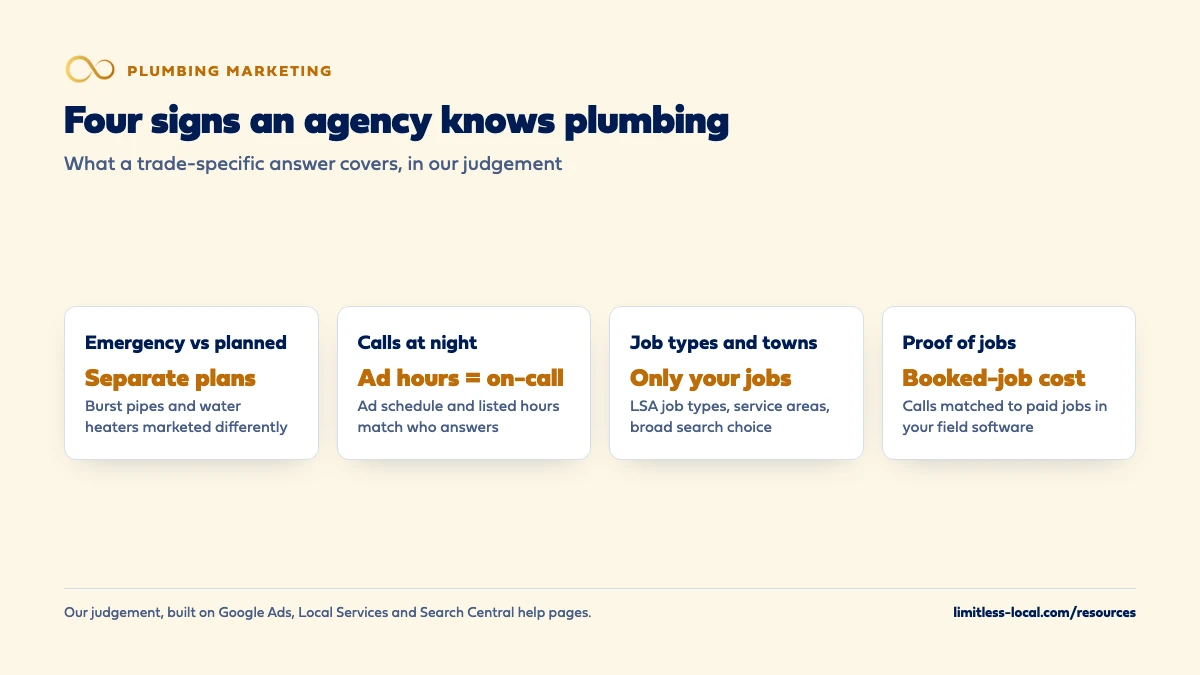
In our judgement, trade knowledge shows up as a handful of things a generic agency tends to skip:
- Emergency and planned work are different businesses. A burst pipe, a backed-up drain and no hot water are calls you win by answering. A repipe or a sewer line replacement is a quote you win over days. They need different ads, different pages and often different budgets.
- The phone is part of the marketing. Who answers, when, and what happens to the call at night decides whether paid clicks turn into jobs.
- Ticket sizes swing widely. A clogged sink and a water heater replacement can cost a similar amount to win, but they aren’t worth the same.
- A lot of plumbing searches are do-it-yourself. Someone searching how to fix a running toilet usually isn’t hiring.
- Plumbers serve an area, not a storefront. Google’s Business Profile help names plumbers as an example of a service-area business.
- The truth lives in your field software. ServiceTitan, Housecall Pro or Jobber shows which calls became paid jobs; an ad account doesn’t.
An agency doesn’t need to have run a plumbing company to know these. It does need to raise them without being prompted.
What questions should I ask to test a plumbing marketing agency?
The general checklist for any agency is in what makes a good plumbing marketing company; this page goes deeper on the plumbing part. Start with Google’s own list. Its guide to hiring an SEO suggests asking for examples of previous work and success stories, what results to expect and in what timeframe, how they measure success, their experience in your industry and in your city, and whether they’ll share all the changes they make with the reasoning behind them. Then add plumbing questions:
- How would you market emergency calls differently from water heater replacements and repipes?
- What happens to a call that comes in at 11 p.m. on a Saturday?
- Which Local Services Ads job types would you turn off for us, and why?
- Which searches would you block from our ads on day one?
- How would you know which calls became paid jobs?
- What would you change first in our current setup, and what would you leave alone?
- What does a realistic first three months look like for ads, and for SEO?
You’re not looking for one right answer. You’re listening for whether they ask about your business before answering, and whether their answers would change if you were a roofer.
What should a good answer about after-hours calls sound like?
It should start with a question back to you: who takes calls at night, and which jobs do you want at that hour? The settings follow from that. In Google Ads, campaigns show ads “All day” by default, and an ad schedule lets you choose the hours and days ads run and raise or lower bids for specific times. On Local Services Ads, a missed call during your business hours is charged as a lead if the caller stays on the line for more than 20 seconds, and Google uses the hours in your Google Business Profile as those business hours. Once your account moves into Google Ads, Google says ad schedules and service areas there are set separately from your Business Profile, so check both.
An agency that knows plumbing ties those settings to your on-call rotation: ads on when someone can answer, message leads or an answering service when nobody can, and listed hours that match reality. One that doesn’t will leave everything running all day and wonder why the leads look bad. Stopping lost after-hours plumbing calls covers the options in detail.
How should they talk about Local Services Ads in 2026?
With current facts. Google is moving Local Services Ads into Google Ads as Performance Max campaigns with pay-per-lead goals, and plumbing is named in the first phase, which began in August 2026 for select advertisers. Google says manual bidding, such as setting a maximum cost per lead, is no longer supported after the move, budgets become daily, and your old Local Services Ads performance reports don’t carry over, so it recommends saving them before your account migrates. An agency that’s on top of plumbing ads should raise those points without being asked.
It should also have a view on your settings. Google lets you choose job types and service areas, and it opts advertisers into a broad search setting that shows ads on category searches like “plumber near me.” Google says turning that off may reduce leads and may suit businesses that only want customers searching for specific services. A good agency explains that trade-off for your shop instead of leaving the defaults alone.
Curious what your marketing is actually booking?
Get a free visibility audit — no obligation, no sales pitch.
What should they ask me before pitching anything?
Google’s hiring guide says a good SEO should ask about what makes your business unique, who your competitors are, how search results can help, and how your customers find you. For a plumbing company, in our judgement, add:
- What’s your average ticket on service calls, and on water heaters, repipes or sewer work?
- Which jobs do you want more of, and which would you rather not chase?
- Which towns do your trucks actually go to, and which are too far?
- Who answers the phone, during which hours, and how fast?
- What field software do you use, and does every job get a lead source?
- How many more jobs a week can your crews take on?
If the first meeting is mostly them talking about their process and their results, they haven’t learned enough about your business to know whether their plan fits it.
What proof should a plumbing marketing agency show me?
Ask to see work, not just hear about it: pages they’ve built for trade businesses, a sample monthly report, and the kind of call recordings and lead lists you’d get. Google’s guide suggests checking references by asking past clients whether the work was useful, the agency was easy to work with and the results were positive. Treat any case result as one past client’s outcome, not a forecast for your shop.
If they offer to audit your current setup, Google advises giving an SEO only read access to Search Console at that stage, not write access. The same idea works for ads: Google Ads has a Read-only access level that lets someone view campaigns without editing them. Keep ownership of every account in your company’s name; who should own your plumbing website and ad accounts covers how.
What are the signs an agency is running a generic playbook?
- Town pages with only the name swapped. Ask to see pages they’ve written for other trade businesses. If two cities read the same, yours will too.
- A service area drawn too wide. Google’s Business Profile help says the boundaries of a service area shouldn’t be more than about 2 hours of driving time from where the business is based. A plan built around towns your trucks don’t reach is built for volume, not jobs.
- No plan for do-it-yourself searches. Google’s help on negative keywords describes them as a way to exclude search terms from your campaigns. A plumbing plan that never mentions blocking how-to searches is likely to pay for them.
- National lead prices quoted as your price. Lead costs vary by market and job type.
- Reports built on impressions and clicks instead of calls, booked jobs and cost per booked job.
- Promises nobody can keep. Google says no one can guarantee the top ranking on Google, and to be wary of anyone who claims a special relationship with Google or advertises a “priority submit.”
The broader checklist linked above also covers reporting, accounts and red flags in a pitch.

How do I check their plumbing knowledge against my own numbers?
Give them one real month: what you spent, how many calls came in, and how many became paid jobs, split by emergency service and planned work if you can. Ask them to tell you what they see. An agency that knows the trade will work out cost per booked job, ask which job types those were, and point to the leaks between a ringing phone and a paid invoice before it talks about more traffic.
Then ask how they’d report the same month back to you. Good answers mention call recordings, lead source on every job in your field software, and cost per booked job by channel. If the answer is a dashboard of rankings and impressions, the reports will be too.
Is a plumbing-only agency always better than one that serves several trades?
Not necessarily. In our judgement, what matters is whether the people doing the work understand home-service businesses and plumbing’s particular demands, and whether they’re honest about results. Plumbing, HVAC, electrical and roofing share a lot: service areas, emergency calls, Local Services Ads, call handling and field software. What differs is the job mix, the seasons and which searches are worth paying for, and a good agency adjusts for those instead of copying a plan between trades.
The test is the same either way: do their answers to the questions above sound like they were written for your shop?
What should I do after the first meeting?
- Score the answers while they’re fresh, question by question.
- Ask for the plan in writing: what they’d do in the first three months, what it costs, what ad spend sits on top, and how results will be reported.
- Check the timelines. Ads can generate leads within days of launch, while SEO typically takes three to six months to show meaningful organic growth. A plan that promises SEO results in weeks is a warning.
- Read the contract before signing. What to look for in a plumbing marketing agency contract goes clause by clause.
- Decide what stays with you. Even a strong agency shouldn’t take over your phones or your review requests. What plumbing marketing to keep in-house and what to outsource splits it task by task.
Not sure which of these is costing you jobs?
A free visibility audit checks the Google profile, reviews, site and tracking, and shows what to fix first.
What's different about vetting an agency for plumbing
Your busiest hours are often off-hours. Freezes, holidays and weekends bring emergency calls when offices are closed. An agency’s plan for nights and weekends tells you more about its plumbing knowledge than its case studies do.
Big-ticket work hides inside small calls. A service call can turn into a water heater replacement or a sewer line. An agency that understands plumbing will want to track what each call became, not just whether it booked.
Seasons hit differently. Plumbing demand doesn’t follow summer and winter the way heating and cooling does, but cold snaps can spike it overnight. Ask how they’d prepare budgets and ads before a freeze rather than after the phones start ringing.
A worked example: scoring two agency interviews
This scorecard is made up to show the method, not a standard. An owner asks two agencies the same 6 plumbing questions and scores each answer 0 (generic), 1 (partly specific) or 2 (specific to this shop), for a possible 12.
- Agency A asks about ticket sizes and who answers at night, suggests separate emergency and water heater campaigns, names searches to block, and explains how calls get matched to jobs in Housecall Pro. It’s vague on Local Services Ads settings. Score: 10.
- Agency B presents a ready-made plan, talks mostly about rankings and traffic, and quotes a national cost per lead. Asked about nights, it says ads run all day by default. Score: 4.
The scores don’t decide on their own. Agency A still has to show references and a fair contract. But a gap that wide usually says which one has thought about plumbing. Hold us to the same scorecard: a free visibility audit or a growth call is a fair place to ask us these questions.
Frequently asked questions
Should a marketing agency have worked with other plumbers?
It helps, but ask to see the work and talk to references rather than taking a client list on trust. Google’s hiring guide suggests asking about experience in your industry and your city, and checking references with past clients.
Is it a red flag if an agency promises first-page rankings?
Yes. Google says no one can guarantee the top ranking on Google, and that if an SEO promises its changes will give you first place in search results, you should find someone else.
Can I give an agency access to my accounts before I hire them?
Limited access only. Google advises giving an SEO read access to Search Console, not write access, at the audit stage, and Google Ads has a Read-only access level for viewing campaigns without editing them.
Does an agency need to know ServiceTitan or Housecall Pro?
It needs a plan for getting booked-job numbers out of whatever field software you use, because that’s where you see which calls became paid jobs. Ask exactly how it would match calls to jobs in your system.
How long should I give a new plumbing marketing agency?
Long enough for each channel’s ramp. Ads can generate leads within days of launch; SEO typically takes three to six months to show meaningful organic growth. Agree up front on what you’ll judge at each point.
What if the agency asks for a long contract?
Read what it says about leaving and what gets handed back, and make sure every account stays in your company’s name either way.
Key takeaways
- Test plumbing knowledge with plumbing questions: emergency vs planned work, after-hours calls, job types and towns.
- Start with Google’s own hiring questions: past work, expected results and timing, industry and local experience, shared changes.
- Good agencies ask about your tickets, phones, crews and field software before pitching.
- Generic signs: name-swapped town pages, oversized service areas, no plan for DIY searches, national lead prices.
- Give audit access read-only, keep accounts in your name, and judge results by cost per booked job.
Want a second set of eyes on your setup?
We'll look at how you show up locally and where calls are leaking, then send you a plain-English breakdown.
More in this section
- What makes a good plumbing marketing company?
- How can I tell if my plumbing marketing agency is making progress?
- What should I look for in a plumbing marketing agency contract?
- Should I hire a plumbing marketing agency or do it myself?
- How much does a plumbing marketing agency cost per month?
Sources
- Do You Need an SEO? Tips for Hiring an SEO — Google Search Central
- Edit your industries, service areas, and job types — Google Local Services Help
- How leads work — Google Local Services Help
- Local Services Ads transition to Performance Max campaigns with pay-per-lead goals — Google Ads Help
- About Ad Scheduling — Google Ads Help
- About negative keywords — Google Ads Help
- About access levels in your Google Ads account — Google Ads Help
- Manage your service areas for service-area & hybrid businesses — Google Business Profile Help