
Should an electrician optimize for calls or form fills?

- Should my electrical ads and website push phone calls or form fills?
- What does "optimize for calls or form fills" actually mean?
- When should an electrician push phone calls?
- When do form fills make more sense for electrical work?
- Why does it depend on who answers the phone?
- What does click-to-call mean for my electrical marketing?
- How do I count calls properly?
- How do I count form fills properly?
- Should calls and forms be worth the same to Google?
- Should I use Google's lead form ads?
- What about message leads from Local Services Ads?
- How do I know which one books more jobs?
- What's different about calls and forms for electricians
- A worked example: a call and a form worth the same
- Frequently asked questions
- Key takeaways
- More in this section
- Sources
The short version
- Count both calls and forms as leads; don't make it either-or.
- Push calls for emergency and service work; offer a form too for planned jobs.
- Choose by who answers: a fast form reply beats an unanswered call.
- Tell Google which actions count, and judge both by booked jobs.
For electrical contractors setting up Google Ads conversions or a new website, and deciding whether to chase phone calls, form fills or both.
Get a free visibility audit · Book a growth call
Should my electrical ads and website push phone calls or form fills?
Most electricians should count both calls and form fills as leads, but lean each campaign toward the one that fits the job: calls for emergency and service work, where the customer wants someone now, and a good form as well as a call button for planned jobs like panel upgrades, EV chargers and generators, where customers often want to send details and compare. The bigger deciding factor is who answers, because a form you reply to within minutes can book more work than a call that rings out. Whichever you choose, tell Google Ads which counts by setting your primary conversion actions, and judge both by how many booked jobs they produce.
Counting calls and forms side by side, then tying both to booked jobs, is part of how we run Google Ads and Local Services Ads; every package includes call tracking with recording and transcription, form and chat lead tracking, and source tagging. Our electrical contractor marketing page shows how ads, tracking and follow-up fit together, and the rest of the electrical marketing questions library goes question by question.
What does "optimize for calls or form fills" actually mean?
In Google Ads, it means choosing which actions count as conversions and are used for bidding. Google’s page on primary and secondary conversion actions explains that primary actions are reported in the Conversions column and used for bidding, while secondary actions are for observation only: reported in All conversions but not used for bidding. Google says misconfiguring these settings can prevent Smart Bidding from optimizing effectively.
So if only calls are primary, automated bidding chases searches likely to produce calls. If only forms are primary, it chases forms. If both are primary, it chases either, and treats them as equal unless you give them different values.
On your website, optimizing means deciding what the page puts first: a big tap-to-call button, a short request form, or both. In our judgement, the website and the ad account should agree. An ad optimized for calls that lands on a page built around a long form sends mixed signals to the customer.
When should an electrician push phone calls?
When the customer has a problem now. In our judgement, these jobs lean heavily toward calls:
- No power to part of the house, a breaker that won’t reset, or a burning smell.
- Storm or outage damage, and anything after hours.
- Small service calls where the customer wants to know when you can come, not a written quote.
For these, Google’s call assets add your phone number to the ad, and on a device that can make calls, a call button shows under the ad. Google also lets you schedule call assets so the number appears only when your business can accept calls, which matters for an electrician who can’t answer from a crawlspace. Our page on marketing emergency calls versus planned projects covers which channels suit each kind of work.
When do form fills make more sense for electrical work?
When the customer is planning, not panicking. In our judgement, forms suit:
- Panel upgrades, EV chargers and generators, where the customer may want to send a photo of the panel, the car model or where the charger should go.
- Customers at work, who can fill in a form on a lunch break but can’t take a call about scheduling.
- After-hours planning, such as a homeowner researching a remodel at night who doesn’t want to call at 10 p.m.
- Commercial requests, where a property manager needs to send scope and site details anyway.
A form also lets you screen before anyone gets in the truck. Our page on what an electrician’s website needs to get more calls covers what the request form should ask.
Why does it depend on who answers the phone?
Because a call only counts if someone picks up. If you’re the one answering, on a ladder or with your hands in a panel, many calls will ring out during the day. In that case, in our judgement, a well-handled form can book more work than a call button, because a form waits for you and a missed caller usually tries the next company.
The reverse holds too. A shop with someone answering live all day should push calls on urgent work, because a call books faster than a form that waits in an inbox. Our page on how fast the office should answer electrical calls covers what to do when nobody can pick up.
Whatever you choose, be honest about your answering before deciding. Optimizing ads for calls you can’t answer is paying Google to send customers to your voicemail.
What does click-to-call mean for my electrical marketing?
Click-to-call is a button that dials your number when it’s tapped, rather than opening your website. In Google Ads, that’s what call assets do on phones. Google’s call assets page explains:
- On devices that can make calls, a clickable call button shows under your ad. On desktops, a “Call us” button shows your number, along with a QR code that opens a phone’s dialer with the number filled in.
- A tap on the call button costs the same as a click on the ad’s headline.
- With call reporting turned on, Google shows a Google forwarding number so the call can be measured.
On your website, click-to-call is simply your phone number set up as a tappable link, ideally near the top of every page on mobile. In our judgement, every electrician’s site needs it regardless of whether you also push forms.
Curious what your marketing is actually booking?
Get a free visibility audit — no obligation, no sales pitch.
How do I count calls properly?
Google’s page on measuring calls from ads describes two ways to count a call as a conversion: by analyzing call recordings with Google’s AI to identify high-quality leads, or by counting calls that last longer than a minimum duration you set. It says the recording feature is currently limited to calls where both parties are in the U.S. or Canada, and that if a call can’t be recorded, the system falls back to the call duration you set.
A few practical points:
- Set the minimum call length so hang-ups and wrong numbers don’t count.
- Calls to the number on your website, after an ad click, can be tracked as a separate conversion.
- If your Google Ads account is linked to your Business Profile with call history on, Google says calls from the profile that can be attributed to an ad interaction are reported in Calls from ads.
For calls from every other source, a call tracking service fills the gap. Our page on whether you need call tracking numbers covers when they’re worth it.
How do I count form fills properly?
Count a form only when it’s actually submitted, not when someone opens the page, and check the submissions. In our judgement, forms attract more spam and wrong-fit requests than calls do, so a form count that looks high may be padded with sales pitches and bots. A quick weekly look at what came in keeps the number honest.
Two more things matter. First, route every form somewhere that someone checks during the day: a text alert or an email that reaches a phone, not an inbox that’s opened on Fridays. Second, reply fast. A form answered the next morning is often a lost lead on urgent work, and in our judgement it’s what makes forms look worse than calls in many shops, when the problem was the reply time.
Should calls and forms be worth the same to Google?
Only if they’re worth the same to you. Google’s page on conversion values says that if you offer different services at different price points, you should use different values for each conversion, and that values let you identify and focus on high-value conversions rather than just the number that happened.
For an electrician, in our judgement the useful value isn’t the ticket on a single lead but what a lead of that type is worth on average: the share that books times what a booked job of that kind earns you. The worked example below shows how a call and a form can end up worth the same even when calls book far more often.
The strongest signal of all is feeding booked or sold jobs back to Google. Google’s page on offline conversion imports explains that when an ad starts a customer down a path that ends in a sale at your office or over the phone, importing those conversions lets you measure what happens after the click or call. For accounts not already using it, Google recommends starting with enhanced conversions for leads, its upgraded version of offline conversion import.
Should I use Google's lead form ads?
Google’s lead form assets let people submit their contact details in a form directly in your ad, and can be added to Search and Performance Max campaigns. Google lists a privacy policy for your business as a requirement, and notes that it stores leads for 60 days and lets you download only the last 30 days by CSV, so leads need to be downloaded often or exported automatically to your CRM.
In our judgement, they’re worth testing for planned work like EV chargers or generators, where a customer is happy to leave details. They’re a poor fit for emergency work, where a call is what the customer wants. Judge them like any other lead source: by how many of those form leads book, not by how many come in.
What about message leads from Local Services Ads?
Local Services Ads have their own version of the same choice. Google’s page on how leads work says message leads let customers reach you by text or email directly from the ad, and that they’re typically priced lower than phone leads, although that isn’t always the case.
In our judgement, message leads are the LSA equivalent of a form: they suit customers planning a job or contacting you after hours, and they’re only worth paying for if someone replies quickly. Track whether message leads book at the same rate as calls before deciding how much weight to give them.
How do I know which one books more jobs?
Tag every lead with two things: where it came from and whether it was a call or a form. Then, at the end of each month, count how many of each type booked a visit and how many became sold work. Our page on whether a 30% close rate is good covers how to split those stages so the comparison is fair.
In our judgement, compare within a job type, not across the whole business. Calls may book more often overall simply because they’re mostly urgent service work, while forms are mostly planned jobs that take longer to decide. The fair question is whether panel upgrade calls book better than panel upgrade forms, not whether calls beat forms in general.
Not sure which of these is costing you jobs?
A free visibility audit checks the Google profile, reviews, site and tracking, and shows what to fix first.
What's different about calls and forms for electricians
Safety calls can’t wait for a form. A homeowner smelling something burning at the panel wants a person on the phone. Emergency pages and ads should lead with a call button, and in our judgement shouldn’t push a form at all for that kind of search.
Planned jobs often come with photos. A picture of the panel, the meter base or the garage wall where an EV charger will go can tell you whether the job needs a service upgrade before you quote. A form that accepts photos does work a phone call can’t.
You’re often unreachable during the day. An owner-operator in an attic or on a commercial site can’t answer every call. That’s the strongest case for giving planned-work customers a form and replying from the truck between jobs.
Commercial work runs on email. Property managers and general contractors usually want to send scope in writing. For commercial campaigns, a form or a clear email route often matters more than a call button.
A worked example: a call and a form worth the same
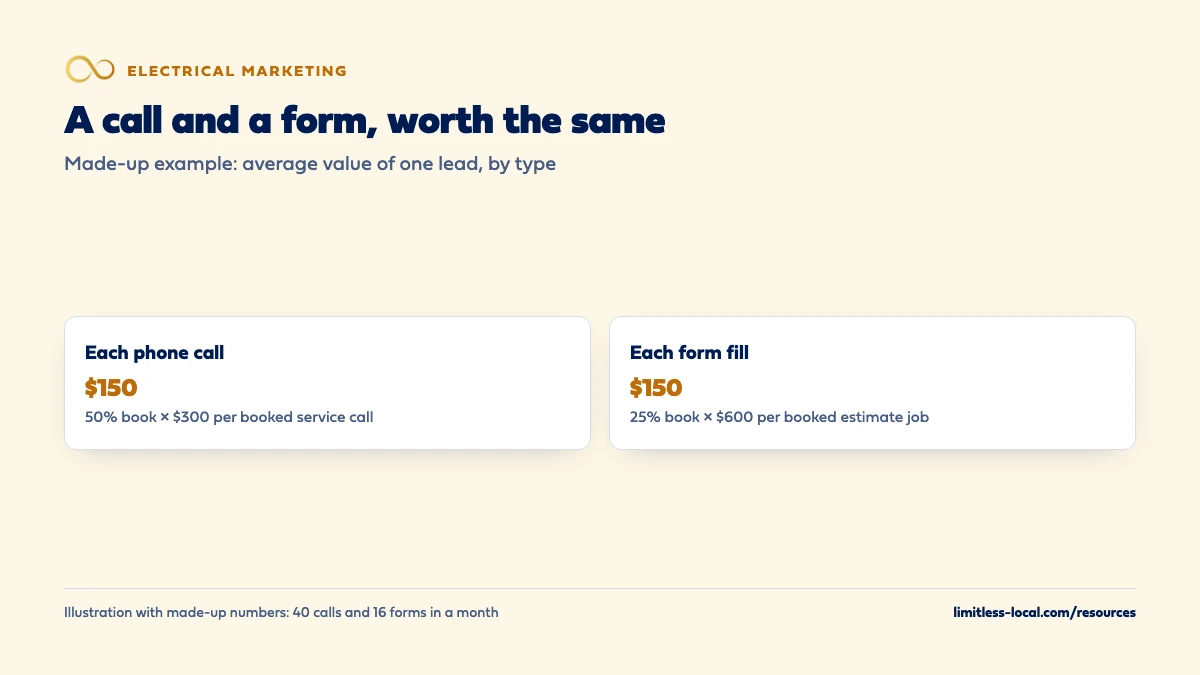
These numbers are made up to show the math, not a benchmark for your market. Say your ads bring in 40 calls and 16 form fills in a month.
- Calls: 50% book, so 20 booked jobs, mostly service calls. A booked service call earns you about $300 in gross profit on average. Each call is worth 50% of $300, or $150.
- Forms: 25% book, so 4 booked jobs, mostly panel upgrades and EV chargers. A booked estimate job from a form earns about $600. Each form is worth 25% of $600, or $150.
Calls book twice as often, so an owner looking at booking rates alone would push calls and drop the form. But each lead type is worth the same $150 on average, because the forms bring bigger jobs. Telling Google they’re equal happens to be right here; in a month where forms bring mostly small jobs, it wouldn’t be.
If you’d rather have this tracked for you, our Essentials package is $3,500 a month and includes call, web and form tracking with basic attribution and Google Ads management for up to $2,500 a month in spend; Growth, at $4,500 a month, adds advanced attribution and Local Services Ads management. Ad spend is paid to Google directly and isn’t part of any package.
Frequently asked questions
Should I remove the form from my website to get more calls?
In our judgement, no. Customers who can’t or won’t call will usually leave rather than call, so removing the form tends to lose those leads rather than turn them into calls.
Are form leads lower quality than calls?
Not necessarily. Forms often attract more spam, but real form leads for planned work can be worth as much as calls. Check booked jobs by type before deciding.
Can I hide my number in ads when I can't answer?
Yes. Google lets you schedule call assets to show only on certain days and hours, for example only when your business is answering phone calls.
Do I need a privacy policy for a form?
Google requires a privacy policy link for its lead form assets. For your own website form, in our judgement it’s good practice to have one, and your web provider can add it.
Should after-hours ads push forms instead of calls?
If nobody answers after hours, in our judgement yes for planned work, as long as someone replies first thing in the morning. For true emergencies, only advertise calls if you can answer them.
Does a text message count as a call or a form?
Treat it like a form: it waits for a reply. Track texts as their own lead type so you can see whether they book.
Key takeaways
- Count both calls and form fills as leads and tell Google which are primary conversion actions.
- Lean emergency and service campaigns toward calls; give planned jobs a good form as well.
- Who answers decides it: a form replied to in minutes beats a call that rings out.
- Set a minimum call length and check form submissions so neither count is padded.
- Value leads by what they book, and feed booked jobs back to Google where you can.
- Compare calls and forms within one job type, not across the whole business.
Want a second set of eyes on your setup?
We'll look at how you show up locally and where calls are leaking, then send you a plain-English breakdown.
More in this section
- Should an electrician use an AI receptionist for after-hours calls?
- What should an electrician's website have to get more calls?
- Should an electrician use a website chatbot to book estimates?
- How fast should my office answer electrical calls before I lose them?
- Should an electrician hire a full-service agency or one specialist?
Sources
- About primary and secondary conversion actions — Google Ads Help
- About call assets — Google Ads Help
- Measure calls from ads — Google Ads Help
- About conversion values — Google Ads Help
- About offline conversion imports — Google Ads Help
- About lead form assets — Google Ads Help
- How leads work — Google Local Services Help