
Which marketing wins emergency electrical calls vs planned projects?
- Should an electrician market emergency calls and planned jobs like panel upgrades differently?
- Why do emergency calls and planned projects need different marketing?
- Which channels work best for emergency electrical calls?
- Which channels work best for planned electrical projects?
- Where do Local Services Ads fit, emergency or planned work?
- Does SEO help emergency calls or only planned work?
- How should my phones work for emergency calls?
- Should I advertise emergency service after hours?
- How do I follow up on planned-project quotes?
- How should I split my budget between emergency and planned work?
- How do I measure emergency versus planned marketing?
- What's different about this split for electricians
- A worked example: two campaigns, two scorecards
- Frequently asked questions
- Key takeaways
- More in this section
- Sources
The short version
- Emergency work: Local Services Ads, call-focused search ads and the map pack, with a live person answering.
- Planned work: job-specific search ads and pages, reviews that name the work, and steady quote follow-up.
- Keep them separate in your ads, pages and tracking so one doesn't hide the other.
- Judge emergencies by calls answered and booked; judge planned jobs by estimates turned into signed work.
For electrical contractors who take both no-power calls and planned work like panel upgrades and EV chargers, and want each kind of job to get the marketing it needs.
Get a free visibility audit · Book a growth call
Should an electrician market emergency calls and planned jobs like panel upgrades differently?
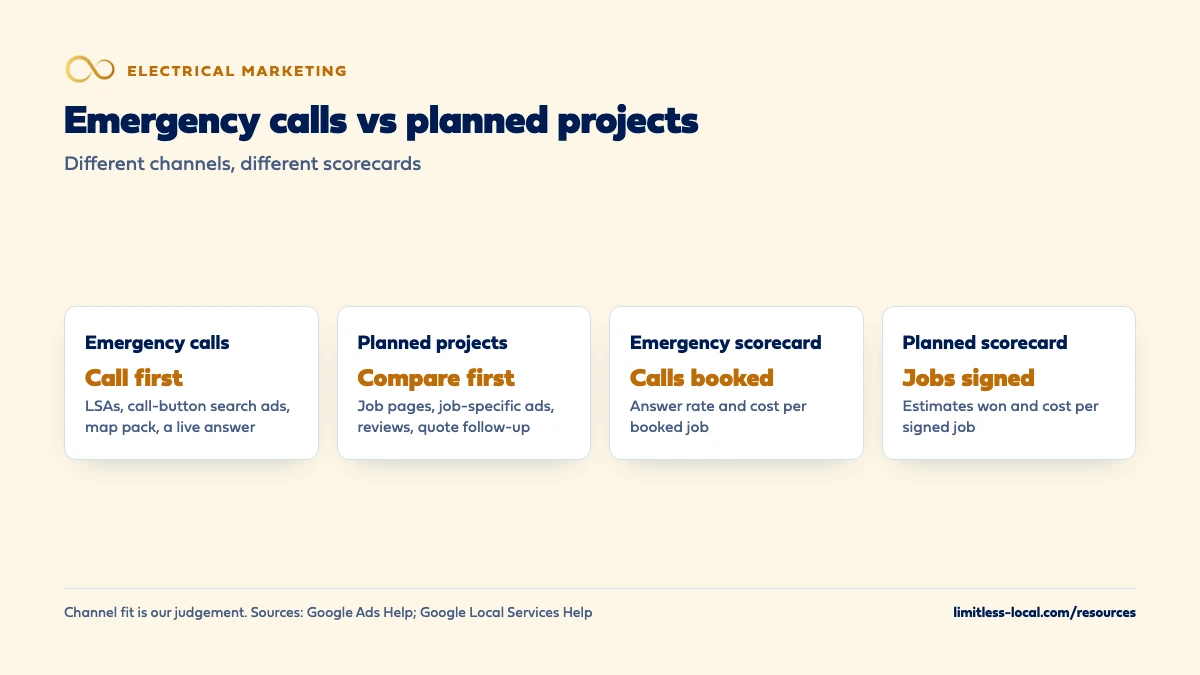
Emergency electrical calls are won by the channels that put a phone number in front of someone who needs help right now: Local Services Ads, Google search ads with a call button, and a strong spot in the map pack, backed by someone who answers live. Planned projects like panel upgrades, EV chargers and generators are won by channels that hold attention while the customer compares: search ads and service pages for each job, reviews that name the work, and quote follow-up. Run them as two separate efforts, and judge emergency work by how many calls you answer and book, and planned work by how many estimates turn into signed jobs.
We run Google Ads, Local Services Ads and local SEO for home-service businesses, with call and form tracking built in, so each kind of job can be measured on its own. Our local ads page covers how we set up paid search and LSAs, and our electrical contractor marketing page shows how we think about service calls versus bigger projects. The full electrical marketing questions library goes question by question.
Why do emergency calls and planned projects need different marketing?
Because the customer is in a different state of mind. Someone with no power in half the house, a breaker that won’t reset or a burning smell from an outlet wants a licensed electrician on the phone now. They search, they call the first credible number, and if nobody answers they call the next one. Someone planning a panel upgrade before a remodel, or an EV charger before the car arrives, has days or weeks. They read reviews, look at your website, ask for two or three quotes and think it over.
In our judgement, most electrical shops that are unhappy with their marketing have mixed the two together: one ad campaign, one homepage, one lead count. The emergency calls make the numbers look busy, and the planned work, which often carries the bigger tickets, never gets the pages, follow-up or tracking it needs. Splitting by urgency is a different cut from splitting by customer type; residential versus commercial channels covers that one.
Which channels work best for emergency electrical calls?
The ones that sit closest to the moment of need and make calling easy:
- Local Services Ads. Google’s page on how leads work says you’re charged for each valid lead you receive. For a customer who just wants a call answered, that format fits.
- Google search ads with a call button. Google’s page on call assets says they add your phone number to your ads so people can tap to call your business directly, and it advises against putting a number in the ad text itself.
- The map pack. Google says local results are mainly based on relevance, distance, and popularity. A searcher with an urgent problem near your shop is exactly who that system is built to match with a nearby business.
What these have in common is a phone call as the first step. A web form that waits for a reply is weak for emergencies, in our judgement, because the customer will have called someone else by the time you read it.
Which channels work best for planned electrical projects?
The ones that give a comparing customer reasons to pick you:
- Search ads by job type. Separate ad groups for panel upgrades, EV charger installation, generator installation and rewiring, each sending clicks to a page about that job, not your homepage.
- Service pages that answer the planning questions. What the job involves, whether a permit and inspection are part of it, how the quote works and what to expect on the day.
- Reviews that name the work. A homeowner researching an EV charger reads reviews from other EV charger customers.
- Follow-up on open quotes. Planned work is often decided days after the estimate, so the shop that follows up stays in the running.
- Past customers. Google’s page on Customer Match says you can use the customer information you’ve collected to reach and re-engage your customers across Google’s services, which can suit planned upgrades for people who already know you.
For the job-by-job side, see more panel upgrade and EV charger jobs.
Where do Local Services Ads fit, emergency or planned work?
In our judgement, they lean toward urgent work, because the format is built around a quick call or message. They can still bring planned jobs if you select those job types, and Google’s page on improving Local Services Ads performance advises selecting all the job types you perform.
The thing to know for emergency work is how missed calls are charged. Google’s how-leads-work page lists a missed call during your business hours, where the customer stays on the line for more than 20 seconds, as a chargeable lead. So an LSA campaign aimed at emergencies only pays off if someone picks up. LSAs are also changing in 2026: Google is moving them into Google Ads as Performance Max campaigns with pay-per-lead goals, starting in August 2026 with select home-service advertisers, electrical among them. Starting with LSAs, Google Ads or SEO covers the screening and setup side.
Curious what your marketing is actually booking?
Get a free visibility audit — no obligation, no sales pitch.
Does SEO help emergency calls or only planned work?
Both, in different ways. The map pack is the part of local SEO that matters most for urgent searches, because someone with a problem tends to call from the map rather than read a long page. Your Business Profile categories, hours, phone number and reviews carry that work.
Your website pages matter more for planned projects. A homeowner comparing three electricians for a panel upgrade often reads each one’s page about that job before choosing whom to call back. In our judgement, an electrician who wants more planned work should build a solid page for each of those jobs before spending more on ads for them. Keep the timeline honest: ads can bring calls within days of launch, while SEO typically takes 3 to 6 months to show meaningful growth, so SEO is the slower half of either plan.
How should my phones work for emergency calls?
Emergency marketing is only as good as the answer rate. A customer with no power doesn’t leave a voicemail and wait. In our judgement, a shop that can’t answer emergency calls live during its advertised hours should cut back on emergency advertising until it can, because it’s paying for calls that go to someone else.
Calls that describe warning signs, such as burning smells, warm outlets or sparking, should reach a person right away. Decide in advance who answers during the day, who covers evenings, and what the caller hears if the line is busy. How fast your office should answer sets out answer-time targets and what to do about after-hours calls.
Should I advertise emergency service after hours?
Only if you’ll actually answer. If you advertise after-hours or same-day service, the phone has to be picked up by a person, an answering service or a well-set-up AI receptionist who can book or route the call. If nobody will be there, set your ad schedule and business hours to match, so you’re not paying for calls you can’t take.
Google’s LSA performance page says message and booking leads give customers more ways to reach you, especially during nights and weekends. In our judgement, that helps only if someone reads those messages first thing. Using an AI receptionist after hours covers what that can and can’t handle for an electrical shop.

How do I follow up on planned-project quotes?
Planned work is often lost after the estimate, not before it. The customer had two or three quotes, got busy, and went with whoever called back. A short, consistent sequence fixes most of that: a thank-you with the quote the same day, a check-in a few days later, and a final note before the quote expires.
Field software such as Jobber, Housecall Pro or ServiceTitan can send most of this automatically. Following up on electrical quotes automatically covers the steps and the wording. In our judgement, this is the cheapest planned-work marketing an electrician can add, because it works on leads you have already paid for.
How should I split my budget between emergency and planned work?
There’s no fixed split, and anyone who gives you one without seeing your numbers is guessing. Start from your capacity and your margins. If your crews are already full of service calls and the bigger jobs carry better margins, tilt toward planned work. If you have open hours most days and can answer the phone, emergency calls can fill them quickly.
In our judgement, the cleanest approach is two campaigns with two budgets, so you can move money between them. Adjust monthly, not daily, and base each move on booked jobs, not clicks or lead counts.
How do I measure emergency versus planned marketing?
With different scorecards, because the jobs move differently:
- Emergency: calls received, the share answered live, calls booked, and cost per booked job. Results show within days.
- Planned: leads, estimates given, estimates won, average job value and cost per signed job. Results can take weeks, because the customer decides after the quote.
Use separate tracking numbers or campaign tags for each side so the calls don’t blend together. If you judge planned-project ads by the same week-one numbers as emergency ads, they’ll look worse than they are, and you may cut the campaign that brings your best jobs.
Not sure which of these is costing you jobs?
A free visibility audit checks the Google profile, reviews, site and tracking, and shows what to fix first.
What's different about this split for electricians
Safety-driven urgency. Many electrical emergencies involve a real hazard, not just an inconvenience. Callers want a licensed electrician fast, which makes an answered phone and visible credentials matter more than a low price.
Handyman competition on small jobs. Homeowners don’t always know the difference between a licensed electrician and a handyman. In our judgement, planned-work pages should explain where permits and inspections come in, which a homeowner comparing quotes may not know to ask about.
New-technology work is planned work. EV chargers, generators, solar tie-ins and smart home installs are researched purchases. They respond to job-specific pages, reviews and follow-up much more than to emergency-style call ads.
Service calls feed projects. An emergency visit can reveal an old panel or a home that needs rewiring. In our judgement, the tech’s notes from emergency calls are one of the best sources of planned-project leads, so log them and follow up.
A worked example: two campaigns, two scorecards
These numbers are made up to show the math, not a benchmark for your market. Say an electrician spends $2,300 a month on Google Ads, split into two campaigns.
Emergency campaign: $1,000 a month brings 40 calls, the office answers and books twenty of them. Cost per booked job: $50.
Planned-project campaign: $1,300 a month brings 18 leads for panel upgrades and EV chargers. The shop gives estimates on most of them and signs 6 jobs over the following weeks. Cost per signed job: about $217.
Looked at together, the planned campaign seems expensive. Looked at on its own scorecard, with a much larger average job, it may be the better spend. That’s why the two need separate tracking. On our Essentials package ($3,500 a month), Google Ads management covers up to $2,500 a month in ad spend; Local Services Ads management starts with Growth ($4,500 a month). Ad spend is paid directly to Google.
Frequently asked questions
Should I use the same phone number for emergency and planned-work ads?
In our judgement, separate tracking numbers or campaign tags are worth it, so you can see which side the calls came from. Your main business number stays the same on your profile.
Do emergency calls pay more than planned work?
It depends on your pricing, your margins and how much each kind of job ties up a crew. Compare cost per booked job and profit per job for each side from your own records rather than assuming.
Can a one-truck electrician do both?
Yes, but in our judgement a one-truck shop should be careful advertising emergencies it can’t answer while on a job. Planned work is easier to schedule around a small crew.
Are Facebook ads good for emergency electrical calls?
In our judgement, rarely, because people with an urgent problem search rather than scroll. Social ads fit planned work and past-customer reminders better.
What about storm season and outages?
Demand for urgent work and generators can jump at the same time. Plan ahead for both; generator leads before storm season covers the planned side.
Key takeaways
- Emergency calls go to whoever answers first: LSAs, call-button search ads and the map pack, backed by a live answer.
- Planned projects go to whoever earns trust while the customer compares: job pages, job-specific ads, reviews and follow-up.
- Keep the two separate in campaigns, pages and tracking.
- Score emergencies by calls answered and booked; score planned work by estimates turned into signed jobs.
- Don’t advertise emergency or after-hours service you can’t answer.
Want a second set of eyes on your setup?
We'll look at how you show up locally and where calls are leaking, then send you a plain-English breakdown.
More in this section
- What marketing should I pause while I'm hiring electricians?
- How should an electrical contractor market to commercial customers?
- What is a good cost per booked job for electrical marketing?
- Should I hire an agency or DIY my electrical marketing?
- What marketing mistakes do independent electricians make?
Sources
- How leads work — Google Local Services Help
- Improve your Local Services Ads performance — Google Local Services Help
- Local Services Ads transition to Performance Max campaigns with pay-per-lead goals — Google Ads Help
- About call assets — Google Ads Help
- About Customer Match — Google Ads Help
- Tips to improve your local ranking on Google — Google Business Profile Help