
What marketing mistakes do independent electricians make?

- What are the most common marketing mistakes independent electrical contractors make?
- Mistake 1: Not knowing which marketing brings booked jobs
- Mistake 2: Letting someone else own your Google profile or ad account
- Mistake 3: Leaving your Business Profile half finished
- Mistake 4: Running Google Ads without excluding junk searches
- Mistake 5: Sending every ad click to the homepage
- Mistake 6: Paying for calls nobody answers
- Mistake 7: Giving a quote and never following up
- Mistake 8: Asking for reviews only when someone remembers
- Mistake 9: Expecting SEO to bring calls in a few weeks
- Mistake 10: Turning marketing on and off with the workload
- Mistake 11: Competing on price with handymen
- Mistakes that are specific to electricians
- A worked example: fixing junk leads on a tight budget
- Frequently asked questions
- Key takeaways
- More in this section
- Sources
The short version
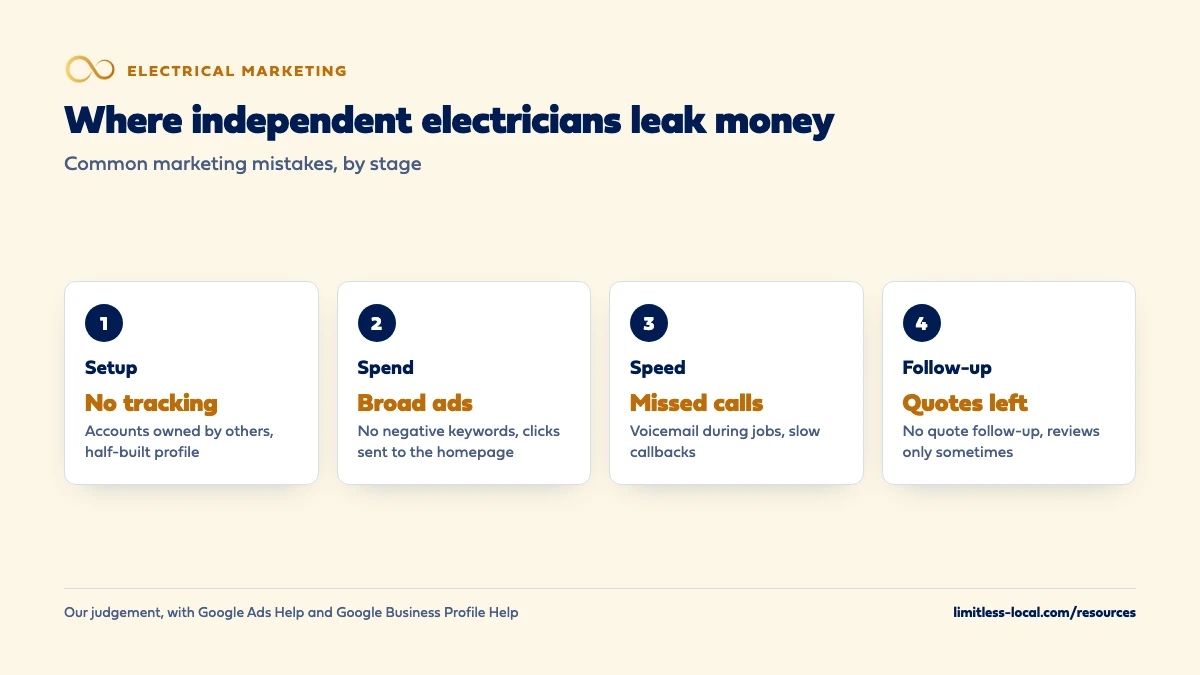
- Setup: no call tracking, and accounts owned by someone other than you.
- Spend: broad ads with no excluded searches, every click sent to the homepage.
- Speed and follow-up: missed calls, slow callbacks and quotes nobody chases.
- Patience: on-and-off marketing and expecting SEO to work in weeks.
For independent electrical contractors running their own marketing who want to know where the money and the calls usually leak out.
Get a free visibility audit · Book a growth call
What are the most common marketing mistakes independent electrical contractors make?
The most common marketing mistakes independent electricians make are not tracking which marketing produces booked jobs, letting someone else own their Google profile or ad account, and running Google Ads on broad searches without excluding the junk. After that come missed calls and slow callbacks, no follow-up on quotes, asking for reviews only when someone remembers, and expecting SEO to bring calls in weeks rather than months. Most of these cost little to fix, and fixing them usually does more than adding a new channel.
Our packages are built around fixing these in order: tracking and a clean online presence first, then local SEO and ads aimed at the jobs and towns you want, then monthly improvements based on calls, leads and revenue. Our packages page lays out what each tier includes, and our electrical contractor marketing page covers how we think about electricians. The full electrical marketing questions library goes question by question.
Mistake 1: Not knowing which marketing brings booked jobs
This is the most expensive one, in our judgement, because it hides every other mistake. If you can’t say which calls came from Google Ads, which from your Business Profile and which from referrals, you can’t tell what to cut and what to grow. Most owners end up judging by feel, or by the number of leads, which counts junk calls the same as booked panel upgrades.
Google’s page on phone call conversion tracking says conversion tracking helps you find how ad clicks lead to different kinds of phone calls. Pair that with call tracking on your other channels and a field in your job software for where each customer came from. Tracking which marketing brings real jobs covers the setup.
Mistake 2: Letting someone else own your Google profile or ad account
A nephew, a past web designer or an agency sets up your Google Business Profile or Google Ads account under their own login, and years later you can’t get in. Google’s page on managing Business Profile owners and managers says the owner has full control over the profile, including adding or removing users, and that a profile can have only one primary owner.
Make sure you, the business, are the primary owner, and give others manager access. Do the same with your ad account, website domain and tracking numbers. Agency red flags covers what to check if a vendor is involved.
Mistake 3: Leaving your Business Profile half finished
Many independent electricians verify their profile once and never come back. The categories don’t match the work they want, the services list is empty, the hours are out of date and the photos are a logo and a truck from years ago. Google says local results are mainly based on relevance, distance, and popularity, according to its guide to improving your local ranking, and it says businesses with complete and accurate info are more likely to show up in local search results.
An hour spent on categories, services, service area, hours and real job photos is, in our judgement, the cheapest marketing an electrician can do. Optimizing your Google Business Profile walks through each setting.
Mistake 4: Running Google Ads without excluding junk searches
This is where tight budgets usually leak. An ad for “electrician” can show for people searching electrician jobs, electrician school, DIY wiring questions or appliance repair. Every one of those clicks costs money.
Google’s page on negative keywords says they let you exclude search terms from your campaigns and help you focus on only the keywords that matter to your customers. Add the obvious ones before launch and check the search terms report every week for the first month. Negative keywords to add first has a starting list for electricians.
Mistake 5: Sending every ad click to the homepage
Someone searching “EV charger installation” who lands on a homepage about everything you do has to hunt for the answer, and many won’t. In our judgement, each main job you advertise should send clicks to a page about that job: what it involves, whether a permit and inspection are part of it, your service area, reviews from similar jobs and a tap-to-call button near the top.
You don’t need dozens of pages to start. A page each for your three or four most profitable jobs usually beats a bigger ad budget sent to the homepage. If cash is the main constraint, marketing on a tight budget puts the low-cost fixes in order.
Curious what your marketing is actually booking?
Get a free visibility audit — no obligation, no sales pitch.
Mistake 6: Paying for calls nobody answers
An independent electrician is often on a ladder or in a crawlspace when the phone rings. If the call goes to voicemail, many homeowners simply call the next name on the list, and you’ve paid for that click or lead anyway. In our judgement, this is the mistake that makes owners decide “Google Ads doesn’t work” when the ads were doing their job.
Know how many calls you miss during business hours, and have a plan for them: someone in the office, a call-forwarding setup, an answering service or an after-hours option. Stopping missed calls covers the options for a small shop.
Mistake 7: Giving a quote and never following up
Planned work like panel upgrades, generators and EV chargers is usually decided after the estimate. The homeowner has two or three quotes, gets busy, and goes with whoever stayed in touch. Many independent electricians send the quote and wait.
In our judgement, a short follow-up sequence is one of the highest-return fixes an electrician can make, because it works on leads you’ve already paid to get: a same-day thank-you with the quote, a check-in a few days later and a last note before the quote expires. Field software such as Jobber, Housecall Pro or ServiceTitan can send most of it automatically.
Mistake 8: Asking for reviews only when someone remembers
Reviews come in bursts when the owner remembers to ask, then stop for months. Meanwhile, the competitor with a steady flow looks busier and more trusted. Ask every customer, every time, ideally through an automatic text or email from your field software.
Don’t fix it the wrong way. Google’s policy on prohibited and restricted content doesn’t allow incentives for reviews, asking only happy customers or reviews from people with a conflict of interest, such as employees and family. The FTC’s rule on consumer reviews and testimonials also covers fake reviews. This isn’t legal advice; if you’re unsure whether something you’re doing is allowed, check with a lawyer.

Mistake 9: Expecting SEO to bring calls in a few weeks
Owners start SEO, see little after a month or two, and stop. Ads can bring calls within days of launch, while SEO typically takes 3 to 6 months to show meaningful growth. Stopping at month two throws away the part that was still building.
Common reasons it takes longer than expected, in our judgement: a thin or slow website, inconsistent business name, address and phone details across directories, few reviews, a profile that doesn’t list the services you want to rank for, and service areas much bigger than the shop can realistically cover. If calls are needed now, run ads alongside SEO instead of expecting SEO to do both jobs.
Mistake 10: Turning marketing on and off with the workload
When the schedule is full, the owner pauses everything. When it empties, they turn it all back on and wait for the phone. Ads come back quickly, but reviews, profile activity and SEO lose ground while they’re off, and the slow weeks arrive before the marketing catches up.
In our judgement, it’s better to turn the dial down than off: keep the profile active, keep review requests running and keep SEO going, and adjust ad budgets up or down with the workload.
Mistake 11: Competing on price with handymen
Homeowners don’t always know the difference between a licensed electrician and a handyman, and some will shop on price. Cutting your rates to match teaches customers to choose on the lowest number and leaves no margin for marketing at all.
In our judgement, the better answer is to make the difference visible: your license and insurance on your site and profile, reviews that mention permits and inspections, and project pages that explain what a proper job includes.
Not sure which of these is costing you jobs?
A free visibility audit checks the Google profile, reviews, site and tracking, and shows what to fix first.
Mistakes that are specific to electricians
Marketing every job the same way. Emergency calls and planned projects need different channels and different follow-up. An electrician who runs one campaign for both usually under-invests in the bigger planned jobs.
Hiding the license. Licensed work is the main thing that separates you from a handyman, yet many electricians leave the license number off their site and profile. Licensing rules vary by state, so check what your state requires you to show.
Ignoring new-technology work. EV chargers, generators, solar tie-ins and smart home installs are researched purchases. A shop that does them but doesn’t list them on its profile and site misses customers who search for those jobs by name.
Forgetting the contractors who refer work. Independent electricians often get steady work from general contractors and remodelers, then stop keeping in touch once the schedule fills. In our judgement, those relationships deserve the same attention as any paid channel.
A worked example: fixing junk leads on a tight budget
These numbers are made up to show the math, not a benchmark. Say an independent electrician spends $1,200 a month on Google Ads and gets 30 leads. Looking at the calls, 12 were junk: job seekers, DIY questions, appliance repair and towns outside the service area. That leaves 18 real leads, and the shop books 6 of them. Cost per booked job: $200.
Now the owner adds negative keywords, narrows the ad targeting to the towns the shop serves and sends ads for panel upgrades and EV chargers to their own pages. The same $1,200 brings 22 leads, with only 4 junk. With the same 18 real leads and better pages, the shop books 8 jobs. Cost per booked job: $150. Nothing new was bought; the leaks were closed.
That order, foundation first, then lead flow, then monthly improvement, is how our packages are set up. Essentials is $3,500 a month and includes call, web and form tracking and Google Ads management for up to $2,500 a month in ad spend, which is paid directly to Google.
Frequently asked questions
What should I fix first if I can only fix one thing?
In our judgement, tracking, because it tells you which of the other mistakes is costing you the most. Without it, every other fix is a guess.
Is it a mistake to do my own marketing?
Not by itself. Plenty of independent electricians run their own profile and reviews well. The risk is time: Google Ads in particular can waste money quickly if nobody checks the search terms.
Is buying leads from lead-sharing sites a mistake?
It depends on how many are shared with other electricians and what you pay per booked job. Track them like any other channel and compare cost per booked job.
Should I have a Facebook page if I'm an electrician?
It doesn’t hurt, but in our judgement it rarely comes before a complete Google Business Profile, reviews and a call-ready website.
How often should I check my marketing?
Ads: weekly at first, then at least monthly. SEO and Business Profile: monthly, judged on calls and booked jobs over several months.
Key takeaways
- Track which marketing produces booked jobs before adding anything new.
- Own your Google Business Profile, ad account, domain and tracking numbers.
- Exclude junk searches and send ad clicks to a page about the job.
- Answer calls, follow up on quotes and ask every customer for a review.
- Give SEO months, not weeks, and turn marketing down rather than off when you’re busy.
Want a second set of eyes on your setup?
We'll look at how you show up locally and where calls are leaking, then send you a plain-English breakdown.
More in this section
- How should I market a small electrical business on a tight budget?
- Should I hire an agency or DIY my electrical marketing?
- How should an electrician market lighting upgrades and LED retrofits?
- How do I grow a small electrical business with marketing?
- How should an electrical contractor market to commercial customers?
Sources
- About phone call conversion tracking — Google Ads Help
- Manage your Business Profile owners & managers — Google Business Profile Help
- Tips to improve your local ranking on Google — Google Business Profile Help
- About negative keywords — Google Ads Help
- Prohibited & restricted content — Google Maps User Contributed Content Policy Help
- The Consumer Reviews and Testimonials Rule: Questions and Answers — Federal Trade Commission