
How long until plumbing marketing hits a profitable cost per job?

- How long will a plumbing campaign take to reach a profitable cost per booked job?
- What counts as a profitable cost per job for a plumber?
- Why is cost per booked job so high in the first month?
- What brings cost per job down in the months after launch?
- How long does each plumbing channel usually take to get there?
- How do I track the trend instead of one month's number?
- Why does SEO get cheaper per job over time?
- Should I keep funding a campaign that isn't profitable yet?
- What can make cost per job get worse over time?
- Should repeat work and memberships count toward profitability?
- How long should I fund SEO before expecting it to pay?
- What's different about plumbing cost per job
- A worked example: ads versus SEO over six months
- Frequently asked questions
- Key takeaways
- More in this section
- Sources
The short version
- Set your ceiling first: the most you can spend in marketing to win one job.
- Paid search: judge cost per booked job over two to three months, not the first weeks.
- SEO and your Google profile: typically 3 to 6 months, then cheaper per job over time.
- Keep funding a channel while its trend heads under your ceiling; narrow or cut it when it doesn't.
For plumbing owners whose new campaign costs more per job than they’d like, and who need to know whether to keep funding it or pull the plug.
Get a free visibility audit · Book a growth call
How long will a plumbing campaign take to reach a profitable cost per booked job?
It depends on the channel. Paid search can bring plumbing leads within days, but the first month carries setup, learning and junk searches, so judge its cost per booked job over two to three months, not week one. SEO and your Google profile typically take 3 to 6 months to show meaningful organic growth, and their cost per job keeps falling after that because you aren’t paying per click. Either way, set your ceiling first, the most you can spend to win one job, and keep funding a channel while its trend is heading under that line.
Every package we sell includes monthly reports with a cost-per-lead breakdown, call tracking with recording, source tagging and a real-time dashboard, so the trend in this article is something you can see month by month. Our local ads management covers Google Ads on every tier and Local Services Ads on Growth; ad spend is paid directly to Google, never through us. See how it fits a plumbing shop on our plumbing marketing page, or browse the rest of the plumbing marketing questions library.
What counts as a profitable cost per job for a plumber?
Profitable means the cost to win a job is below what the job leaves you after parts, labor and overhead. That limit is your ceiling: the most you’re willing to spend in marketing to win one booked job.
Work it out from your own numbers. Take the average ticket for the kind of job the channel brings, take off the job costs, and decide how much of what’s left you’ll spend to win it. A drain-clearing call and a water heater replacement have very different ceilings, so set one for each kind of work if your channels bring different jobs.
How much you can afford to pay for a plumbing lead walks through setting the ceiling step by step. Once you have it, “profitable” stops being a feeling and becomes a line on a chart.
Why is cost per booked job so high in the first month?
Because month one pays for things that don’t repeat:
- Setup days. Campaigns usually go live partway through the month, so part of the spend runs with little data.
- Learning. Google’s Smart Bidding guide says new campaigns or bid strategies without history may see temporary swings as bidding ramps up, and that performance typically settles over one to two conversion cycles.
- Junk searches. Until you’ve seen which searches triggered your ads, some spend goes on do-it-yourself and job-hunting searches.
- New calls, old habits. The office may not be ready for more calls, so some real leads ring out.
- Reporting lag. Google Ads reports conversions by the date of the original search, so recent days can look worse than they’ll end up. Google’s page on conversion lag says this can make cost per acquisition look inflated.
None of that means the channel is bad. It means month one’s number is the worst one you should judge it by.
What brings cost per job down in the months after launch?
Mostly fixes, not time on its own. A campaign that’s left alone rarely gets cheaper. The changes that usually move cost per booked job in plumbing:
- Blocking wasted searches with negative keywords, once a month of real searches shows where money leaked.
- Running ads when emergency calls happen and someone can answer, and trimming hours when no one can.
- Trimming towns that sent calls you couldn’t take or jobs that didn’t pay.
- Moving budget to the services that booked, like water heaters or sewer lines if those turned into jobs.
- Booking more of the leads you get. Cost per booked job is cost per lead divided by booking rate, so a better office lowers it without touching the ads. Whether you have a lead volume, quality or closing problem helps you find which one it is.
- Better reviews and profile. For Local Services Ads, Google says ad ranking takes into account your rating, number of reviews, responsiveness and photos, and that higher quality profiles may rank higher and pay lower costs per lead.
How long does each plumbing channel usually take to get there?
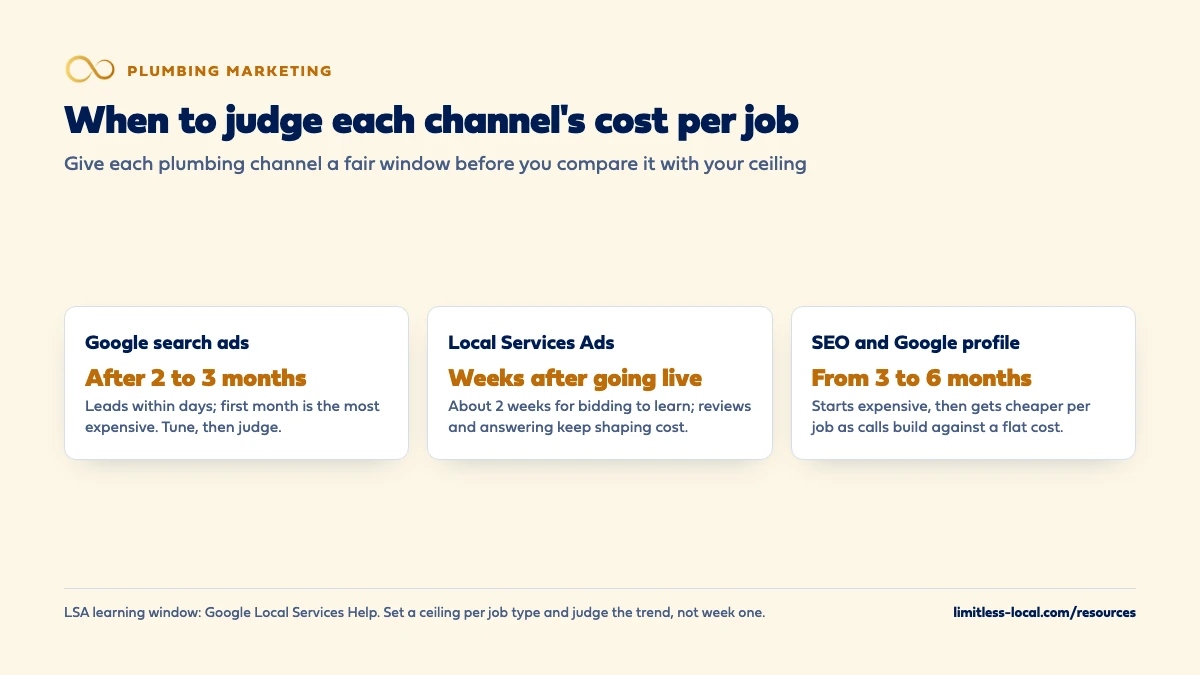
- Google search ads: leads can start within days of launch. Once Smart Bidding has settled, judge performance over 2 conversion cycles or a 2 week window, whichever is longer. In practice, give a new plumbing campaign two to three months of tuning before you call its cost per job.
- Local Services Ads: Google screens the business first. Once live, it takes about 2 weeks to see accurate results as the bidding model learns about your business, according to Google’s page on how bidding works. Then reviews and responsiveness keep shaping what you pay.
- SEO and your Google profile: SEO typically takes 3 to 6 months to show meaningful organic growth. The cost per job starts very high, because you pay for months of work before the calls build, and then falls as calls grow against a steady monthly cost.
- Bought leads: you pay per lead from day one, so cost per job mostly depends on how many you book. It rarely gets much cheaper with time.
Curious what your marketing is actually booking?
Get a free visibility audit — no obligation, no sales pitch.
How do I track the trend instead of one month's number?
Keep one small table, by channel, by month: spend, real leads, booked jobs, cost per booked job. Then add a rolling three-month average, so one freeze or one slow week doesn’t swing the decision.
A few rules keep the numbers straight:
- Count jobs by the month the lead came in, not the month the work was done, so a water heater quoted in March and installed in April still credits March.
- Count only new customers, not repeat ones who’d have called anyway.
- Use spend after credits for Local Services Ads. Google may credit charged leads it later finds were low quality, in most cases within 30 days, and the original charge still shows on your invoice.
- Include the management fee when you look at the full cost, not just ad spend.
Tracking which plumbing marketing books jobs covers how to tie each call to a booked job.
Why does SEO get cheaper per job over time?
Because the monthly cost stays roughly flat while the calls build. With ads, every extra call costs another click. With SEO and your Google profile, the work you paid for in months one to four keeps bringing calls in months five, six and beyond.
That’s also why SEO looks terrible early. In month two you might have paid for two months of work and booked a couple of jobs from it. That’s an expensive cost per job, but it’s the wrong moment to judge it.
The catch is cash. You have to fund SEO for months before it pays its way. That’s why most plumbers run ads alongside it: ads bring calls now while SEO builds. How long plumbing SEO takes to bring calls covers the ramp in detail.
Should I keep funding a campaign that isn't profitable yet?
Ask three questions:
- Is the trend falling? Month three cheaper than month one is a good sign, even if it’s still above your ceiling.
- Are the leaks fixed? If calls are still ringing out or tracking is broken, the number isn’t the channel’s fault yet. Fix those first.
- Is there a clear reason it’ll improve? More reviews coming, pages just going live, junk searches just blocked. “Give it more time” with no reason isn’t a plan.
Three yeses: keep funding it. A flat trend after a fair window and fixed leaks: narrow it to the jobs and towns that booked, and retest. Still over the ceiling after that: cut it and move the money. When to stop spending on a lead source covers the cut decision.

What can make cost per job get worse over time?
- Tinkering too often. Making several target changes within a single conversion cycle, without a clear business need, keeps bidding from settling.
- New competitors. When another plumber starts bidding on the same searches, clicks can cost more.
- Booking rate slipping. A new hire on the phones or a busy season can quietly push cost per booked job up with no change in the ads.
- Platform changes. Local Services Ads are moving into Google Ads as Performance Max campaigns with pay-per-lead goals, starting with plumbing and other home services in August 2026. Google’s transition page says to allow up to two weeks after migration for performance to ramp back to stable levels.
- Season. Mild weather means fewer emergencies, so the same spend can book fewer jobs.
Should repeat work and memberships count toward profitability?
Judge the channel on first jobs, then use repeat work as a tie-breaker. First-job cost per booked job is clean and easy to compare. But a channel that brings homeowners who later replace a water heater or sign up for a maintenance plan is worth more than its first ticket shows.
If a channel sits just above your ceiling on first jobs, check what its customers spent over the following year. If the follow-on work is real and in your records, it can justify keeping the channel. If it’s only a hope, it can’t.
How long should I fund SEO before expecting it to pay?
Plan for at least six months, and only start with money you won’t need back in month two. SEO typically takes 3 to 6 months to show meaningful organic growth, so a plan that expects SEO to pay for itself in month three is set up to disappoint.
Set checkpoints so it isn’t blind faith: by month three, the work should be visible and impressions growing; by month six, calls from the profile and website should be climbing and booking. If neither is happening, ask why before you fund another quarter.
Nobody can honestly guarantee rankings, lead counts or revenue, so treat any promised payback date as a sales line, not a plan.
Talk it through with someone who runs this every day
A 15-minute growth call: your market, your numbers, and what a realistic budget looks like. No pressure.
What's different about plumbing cost per job
Weather moves the number more than anything you do. A hard freeze can halve your cost per job for a week, and a dry spell can double it. Use rolling averages and compare with the same months last year when you can.
Ticket mix changes what profitable means. A channel that brings sewer replacements can afford a far higher cost per job than one that brings clogged sinks. Set ceilings by job type, not one number for everything.
After-hours calls are often the most profitable. Emergency calls book fast and pay well, but only if someone answers. Covering nights and weekends can lower cost per job more than any ad change.
A worked example: ads versus SEO over six months
These numbers are made up to show the shape of the curves, not a forecast for your market. Say your ceiling is $275 per booked job.
Search ads at $2,500 a month:
- Month one: 8 booked jobs, about $313 each. Over the ceiling.
- Month two: 12 booked jobs, about $208 each, after blocking junk searches and fixing lunchtime calls.
- Month three: 14 booked jobs, about $179 each.
SEO and profile work at $1,500 a month:
- Month two: 2 booked jobs, $750 each.
- Month four: 7 booked jobs, about $214 each.
- Month six: 10 booked jobs, $150 each.
The ads crossed under the ceiling in month two. The SEO took until month four, and by month six it was the cheaper channel per job. Judging either one in its first month would have cut the wrong thing.
Frequently asked questions
Is it normal for my first month of plumbing ads to lose money?
It’s common. Month one carries setup, learning and searches you haven’t blocked yet. What matters is whether months two and three come down.
What if my cost per lead is fine but cost per job isn't?
Then the problem is booking, not the ads. Listen to unbooked calls and check whether leads are being answered quickly, especially after hours.
Should I raise my budget to get to a profitable cost per job faster?
Only once the leaks are fixed. A bigger budget speeds up learning, but it also speeds up waste if junk searches and missed calls are still there.
Does cost per job keep falling forever?
No. It levels off once the obvious waste is gone. After that, gains come from booking rate, reviews, better pages and the job mix.
How do Local Services Ads credits affect cost per job?
Credited leads lower what you actually paid, so work out cost per job from spend after credits, not the charges before them.
Can an agency promise a profitable cost per job by a set month?
Nobody can honestly guarantee it. A good agency can show you the trend each month and what it’s doing to move it.
Key takeaways
- Set a ceiling first: the most you’ll spend in marketing to win one job, by job type.
- Month one is usually the most expensive month; judge paid search over two to three months.
- SEO typically takes 3 to 6 months, then gets cheaper per job as calls build against a flat cost.
- Fixes bring cost per job down: blocked searches, better hours and towns, a better booking rate, more reviews.
- Keep funding a channel while the trend falls and the reasons are clear; narrow, then cut, when it stalls.
Ready to compare options?
Book a short growth call and we'll walk through the math for your service area, including when we're not the right fit.
More in this section
- How much should a plumbing company spend on marketing each month?
- How much does a plumbing marketing agency cost per month?
- When should a plumbing company raise or cut its marketing budget?
- What will I still pay for if I do plumbing marketing myself?
- How long does plumbing SEO take to bring in calls?
Sources
- About Smart Bidding learning — Google Ads Help
- About conversion lag reporting — Google Ads Help
- About ad rankings — Google Local Services Help
- How bidding works for Local Services Ads — Google Local Services Help
- Local Services Ads transition to Performance Max campaigns with pay-per-lead goals — Google Ads Help
- About Automated Local Services Ads lead credits — Google Local Services Help