
Do homeowners click paid ads or organic results for roofers?
- When a homeowner searches for a roofer, do they tap the ads, the map pack or the regular results?
- What does a homeowner see when they search for a roofer?
- Which homeowners tend to click the ads?
- Which homeowners tend to skip the ads?
- Is the map pack paid or organic?
- If I already rank at the top, do my ads still bring extra clicks?
- Do AI Overviews change what homeowners click?
- Does running ads help or hurt my organic rankings?
- How do I see what homeowners click for my roofing company?
- Should I put my money into ads or SEO based on what homeowners click?
- How do I find out what happens if I turn my ads down?
- What's different for roofers
- A worked example: clicks versus signed roofs
- Frequently asked questions
- Key takeaways
- More in this section
- Sources
The short version
- Homeowners click ads, the map pack and regular results; which one depends on the homeowner and the search.
- Most ad clicks don't come back as organic clicks when ads are switched off.
- Ranking first organically still leaves room for ads to bring extra visits.
- Clicks aren't jobs: compare sources by signed roofs.
For roofing company owners deciding how much to put into ads versus SEO and Maps, based on how homeowners actually use a roofing search page.
Get a free visibility audit · Book a growth call
When a homeowner searches for a roofer, do they tap the ads, the map pack or the regular results?
Homeowners click both, and the ones in a hurry and the ones doing research tend to click different things. Google’s own ad-pause studies found most ad clicks weren’t replaced by organic clicks when ads stopped, and even advertisers ranked first organically got about half their ad clicks as extra visits. For a roofer, the map pack, the ads and the regular results each catch different homeowners, so it pays to show up in more than one and judge each by signed jobs, not clicks.
That’s why we build roofing marketing around being found in all three places, ads, Maps and the regular results, and tracking each one to signed roofs instead of clicks. Google Ads and Local Services Ads management is one part of our roofing marketing packages. For the cost side, whether Google Ads is worth it for a roofing company works through the break-even math, and the roofing marketing questions library covers the rest one question at a time.
What does a homeowner see when they search for a roofer?
Picture a homeowner typing roofer near me on their phone. Depending on the town and the day, they might see:
- Local Services Ads at the top, with business names, ratings and a Google Verified badge. These are paid, and you’re charged per lead.
- Search ads, the text ads with a headline and a call button. Paid per click.
- The map pack: a small map and a short list of roofing companies with their stars and reviews. These spots are free.
- The regular results: links to roofing company websites, directories and lead sites. Also free.
- Sometimes an AI Overview, a written summary at the top, especially for question-style searches.
Google says ads are clearly labeled so people can tell them apart from the rest of the page, that for most searches it shows no ads at all, and that no one can buy better placement in the organic results. For roofing searches, though, ads are common, so the homeowner is choosing between paid and free listings almost every time.
Which homeowners tend to click the ads?
Ads sit at the top, carry a call button and answer the search in one line. That suits homeowners who want someone now:
- The one with water coming through the ceiling during a storm.
- The one who just got off the phone with their insurance company and was told to get an inspection.
- The one searching on a phone, standing in the yard looking at missing shingles.
These homeowners are less likely to read five websites. They want a company that looks legitimate, serves their town and answers the phone. If your ad says the job and the town in the headline, and someone picks up, you’re in a good spot for these calls.
Ads also catch searches you’d struggle to rank for organically: towns farther from your shop, or jobs your website doesn’t have a page for yet.
Which homeowners tend to skip the ads?
A full roof replacement is a big decision, and plenty of homeowners treat it that way. They scroll past the ads to the map pack to compare stars and read reviews, then open a few websites to look at photos, warranties and how long each company has been around.
Some homeowners skip ads out of habit. Others have heard about storm chasers and trust the free listings more. Either way, these are the people your Google Business Profile, your reviews and your website are working on. They’re often slower to call, but when they do, they’ve already done their homework on you.
Most roofing companies get both kinds of homeowners. The mix shifts with the season: right after a hailstorm, urgent searches flood in; in a quiet stretch, more of the searches are people planning a replacement.
Is the map pack paid or organic?
The regular map pack is free. You can’t pay to rank higher in it: Google says local results are based mainly on relevance, distance and popularity, and that there’s no way to pay for a better local ranking. What gets you in is a complete, verified Google Business Profile, a real presence near the homeowner, and a steady flow of reviews.
The confusion comes from Local Services Ads, which show above or near the map and look a lot like it. Those are paid. And running them doesn’t move you up the free list. Whether Local Services Ads help a roofer rank on Google Maps explains where one stops and the other starts.
For many roofers, the map pack is where a lot of the phone calls come from, because it puts your stars, your reviews and a call button in front of the homeowner at once.
Curious what your marketing is actually booking?
Get a free visibility audit — no obligation, no sales pitch.
If I already rank at the top, do my ads still bring extra clicks?
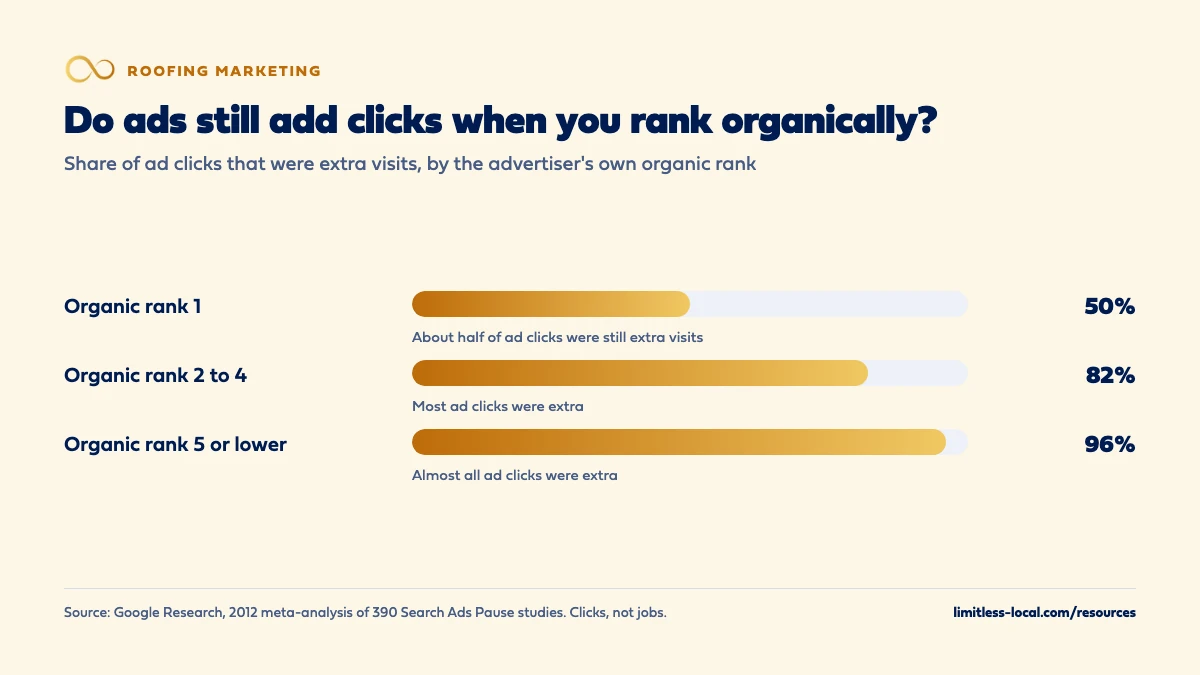
Often, yes. Google’s research team ran studies on advertisers who paused their search ads and measured how many of the lost ad clicks came back as organic clicks. In their 2012 follow-up, a meta-analysis of 390 of those studies, they reported:
- 89% of ad clicks were not replaced by organic clicks when ads were paused, in the original study.
- When the advertiser’s own organic result ranked first, about 50% of ad clicks were still extra visits.
- When it ranked second to fourth, 82% were.
- When it ranked fifth or lower, 96% were.
Those are averages across many advertisers, measured in clicks, not jobs, and more than a decade old. The researchers themselves said results for individual advertisers may vary and recommended running your own experiments. They weren’t roofing-specific, and search pages have changed a lot since.
The direction is still useful. Ranking well doesn’t mean ads are wasted, and ranking poorly makes ads matter more. The only way to know your own number is to test it in your own towns.
Do AI Overviews change what homeowners click?
They seem to reduce clicks on the regular results. Pew Research Center tracked the browsing of 900 U.S. adults in March 2025. When a Google search showed an AI summary, users clicked a traditional search result in 8% of visits, compared with 15% when there was no summary. Very few clicked the sources inside the summary.
The kind of search matters. In the same study, 60% of searches starting with question words like what or why produced an AI summary, compared with 8% of one- or two-word searches. So roofer near me usually still gets the classic page of ads, map and links, while how much does a roof replacement cost is more likely to get a summary first.
For a roofer, that means the short, ready-to-hire searches are still won in ads and Maps. The longer research questions are where being the company AI answers mention starts to matter. How a roofing company gets recommended by ChatGPT covers that side.
Does running ads help or hurt my organic rankings?
Neither, directly. Google keeps the two separate: advertisers don’t get ranking boosts in the organic results, and nobody can pay for better organic placement. Turning ads on won’t lift your website or your map pack spot, and turning them off won’t drop them.
There are indirect links. Ads can bring in jobs, jobs bring in reviews, and reviews help in the map pack. Ads also tell you which searches and towns turn into signed roofs, which is useful when you’re choosing what pages to build for SEO. But that’s your work connecting them, not Google rewarding the ad spend.
How do I see what homeowners click for my roofing company?
You don’t need an industry average when you can look at your own numbers. Three free places to start:
- Google Ads shows clicks, calls from ads and the estimate requests you’ve set up as conversions.
- Google Search Console shows how often your website appeared and was clicked in the regular results, and for which searches.
- Your Google Business Profile performance report shows calls, website clicks and direction requests from your profile. Google notes those numbers include actions from both the organic results and Google Ads, so they’re a mix.
Clicks are only the start, though. To know which source books roofs, every call and form needs a source attached and a note of whether it signed. How a roofer can track calls and forms from Google walks through the setup.
Should I put my money into ads or SEO based on what homeowners click?
Use clicks to spot gaps, and signed roofs to decide. A few common patterns:
- You’re not in the map pack yet. Ads and Local Services Ads fill the gap while you build reviews and your profile.
- You’re strong in the map pack in your home town. Ads still tend to add calls, especially for replacement searches and outlying towns.
- A storm just hit. Searches spike faster than SEO can react. Ads are the lever you can pull this week.
- Your ads are expensive and your organic results are weak. That’s the long-term case for SEO: every roof you sign from a free listing lowers your average cost per job.
Which roofing companies get the best results from SEO versus ads goes deeper on matching the mix to your company.
How do I find out what happens if I turn my ads down?
Run a simple test instead of guessing. Pick one town or one set of searches where you already rank well organically, turn the ads down or off there for a few weeks, and keep everything else the same. Then compare total calls and estimate requests from that area, from every source, with the same weeks before.
If total calls barely move, your organic listings were catching most of those homeowners anyway. If they drop, the ads were bringing extra work. Avoid running the test during a storm surge or the slowest month of winter, because the season will swamp the result.
Watch how often your ads were eligible to show, too. If they were already losing a lot of auctions, the test tells you less. What impression share means for roofing Google Ads explains how to read that.
Want to see where your company stands?
A free visibility audit shows where you show up on Google, Maps and AI answers, and what it's costing you in calls.
What's different for roofers
Urgency splits roofing searches in two. A leak during a storm and a planned replacement are different homeowners with different habits. The first wants a call button now; the second reads reviews for a week. Most trades have one kind of search; roofing has both, often in the same week.
Storm chasers make homeowners wary. After a big storm, out-of-town crews advertise heavily. Some homeowners respond by trusting local names in the map pack over ads. A local address, local reviews and photos of your own crews help you in both places.
Your own name gets searched. Yard signs, door hangers, a neighbor’s referral and a truck parked on the street all send homeowners to Google to look you up. Make sure you show up first on your own name, with a complete profile and, if other roofers are bidding on it, an ad of your own.
A worked example: clicks versus signed roofs
These numbers are made up to show why clicks alone mislead, not a benchmark for your market. Say a roofer looks at one month:
- Google Ads: 300 clicks, 24 calls and estimate requests, 5 signed roofs.
- Google Business Profile (map pack): 40 calls and website clicks, 18 real leads after spam and wrong numbers, 6 signed roofs.
- Website from the regular results: 120 clicks, 9 calls and forms, 3 signed roofs.
By clicks, the ads look like the big winner. By signed roofs, the map pack did slightly more, from far fewer clicks. And if the ads cost $3,000 that month, that’s $600 per signed roof from ads, which may be great or poor depending on your average job size.
That’s the comparison that matters. If you’d rather have it done for you, our Growth package is $4,500 a month and covers Google Ads, Local Services Ads and SEO with call tracking and attribution, so each signed roof can be traced back to where it came from. Ad spend is paid to Google separately.
Frequently asked questions
Do homeowners trust ads less than organic results?
Some do, especially after a storm when out-of-town crews advertise heavily. Others tap the first listing with a call button. A local name, real reviews and photos of your own crews help in both places.
Can I pay Google to rank higher in the map pack?
No. There’s no way to request or pay for a better local ranking. Local Services Ads and search ads are separate paid spots; the free map list depends mainly on relevance, distance and popularity.
Should I bid on my own company name?
If other roofers or lead sites show ads when homeowners search your name, it’s usually worth a small campaign so you’re the first thing they see. If nobody else is bidding, your profile and website may cover it on their own.
Are clicks from the map pack counted in Search Console?
Search Console reports clicks to your website from Google. Calls and direction requests from your Business Profile show up in the profile’s own performance report, not in Search Console.
Do Local Services Ads count as paid or organic?
Paid. You’re charged per lead rather than per click, but they’re ads. They don’t change your position in the free map pack.
Is it worth showing in the ads and the map pack at the same time?
Usually, for your most important searches. Showing twice on one page gives the homeowner two chances to pick you. Test it in one area to see how many extra calls it brings.
Key takeaways
- Homeowners click ads, the map pack and regular results, and urgent and research-minded homeowners behave differently.
- The map pack is free and can’t be bought; Local Services Ads look similar but are paid.
- Google’s ad-pause studies found most ad clicks weren’t replaced by organic clicks, even for advertisers ranked first.
- AI summaries show up far more on question-style searches than on short ready-to-hire searches, and people click fewer regular results when one appears.
- Compare every source by signed roofs, and test turning ads down in one area before cutting them everywhere.
Not sure what's working right now?
Start with a free visibility audit: rankings, Google profile, reviews and tracking, checked against your service area.
More in this section
- Which roofing companies get the best results from SEO versus ads?
- Why are my roofing ads getting clicks but no calls?
- What mistakes do roofers make choosing SEO, Google Ads or LSAs?
- Should roofing ads send people to my homepage or a landing page?
- Are Google Local Services Ads worth it for a roofing company?
Sources
- How ads work on Google Search — Google Search
- Impact of Organic Ranking on Ad Click Incrementality — Google Research
- Google users are less likely to click on links when an AI summary appears in the results — Pew Research Center
- Tips to improve your local ranking on Google — Google Business Profile Help
- Understand your Business Profile performance & insights — Google Business Profile Help
- What are impressions, position, and clicks? — Search Console Help