
How can written office procedures help an HVAC company book more?
- Which written procedures help an HVAC office book more calls, and how do you write them?
- Why do written procedures help an HVAC office book more?
- Which office procedures should an HVAC company write down first?
- What goes into a call-handling procedure?
- How do you write a procedure your team will actually follow?
- What should the procedures say about speed?
- How should follow-up be written down?
- How should the office mark calls that didn't book?
- How do written procedures help train new call-takers?
- How do recorded calls keep everyone on the procedure?
- When should you update your office procedures?
- Does a small HVAC shop need written procedures?
- What's different about office procedures for HVAC companies
- A worked example: what consistency is worth
- Frequently asked questions
- Key takeaways
- More in this section
- Sources
The short version
- Procedures make booking depend on the process, not on who picked up.
- Write the few that matter most: answering, pricing questions, booking, missed calls and follow-up.
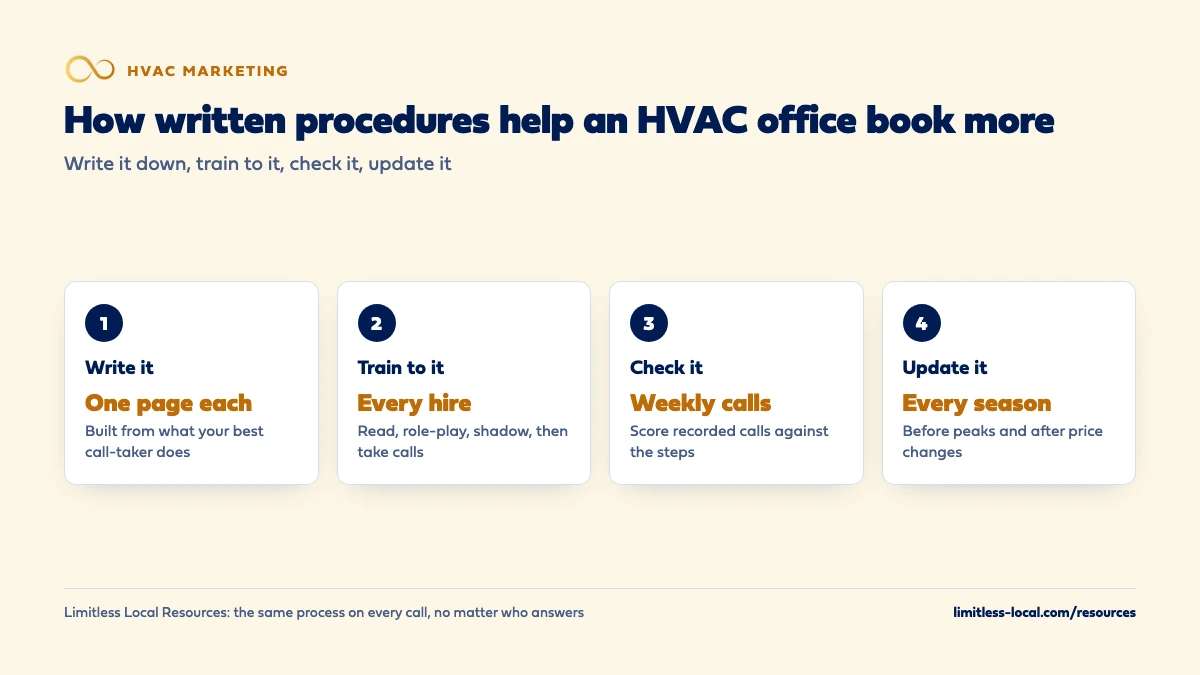
- One page each, built from what your best call-taker already does.
- Coach from recorded calls against the written standard every week.
For HVAC owners whose booking rate depends on who picked up the phone, and who want every call, text and web form handled the same way.
Get a free visibility audit · Book a growth call
Which written procedures help an HVAC office book more calls, and how do you write them?
Written office procedures help an HVAC company book more because every call, text and web form gets handled the same way no matter who answers: the same questions, the same way of offering appointment times, the same answer to “how much will it cost?” and the same follow-up schedule for leads that didn’t book. That consistency raises the booking rate of your weaker call-takers, gets new hires booking sooner, and lets you coach from recorded calls against a clear standard. Keep each procedure to one page, build it from what your best call-taker already does, and update it before every peak season.
Procedures work best with tools that make the right step the easy one. Every one of our packages includes call tracking with recording and transcription, so you can coach from real calls, and our automation add-ons, such as unified messaging, calendar and reminders, after-hours answering and a lead tracking dashboard, plug into any tier to back up what the office does by hand. Our HVAC marketing page shows how that fits the trade, the HVAC marketing guide covers every channel, and the HVAC marketing questions library goes question by question.
Why do written procedures help an HVAC office book more?
In most HVAC offices, the booking rate depends on who picked up. Your best call-taker books almost everyone with a real need. A newer one, or the tech who grabbed the phone between jobs, lets a few callers go with “we’ll call you back.” Same marketing, same homeowners, very different results.
Written procedures close that gap. When everyone asks the same questions, offers times the same way and follows up on the same schedule, the weaker calls start to look like the strong ones.
The scale of the gap shows up in software data. In a ServiceTitan data report from June 2022 covering more than 3,000 trade businesses that use its software, the typical shop booked 42% of calls and HVAC shops averaged 38%; shops with 25 or more techs averaged 59%, and shops with fewer than five averaged 24%. One of its industry advisors put part of that difference down to larger shops having training and processes in place. Those are averages across many trades, not a target for your shop, but the point holds at any size: a repeatable process books more calls.
Which office procedures should an HVAC company write down first?
Start with the moments where jobs are won or lost. For most HVAC offices, that’s this short list:
- Answering a new-customer call: greeting, questions, booking and confirmation.
- Telling an emergency from a routine call, and what happens with each.
- Answering “how much will it cost?” without losing the booking.
- Returning missed calls, texts and web forms, and how fast.
- Following up on leads that didn’t book and unsold replacement estimates.
- Closing out a call that didn’t book, with a reason.
- Handling after-hours calls, and who works that list in the morning.
Seven one-page procedures cover most of what decides your booking rate. Everything else, from refunds to warranty calls, can come later. The call itself is covered step by step in how your HVAC office should handle incoming calls; this page is about getting it on paper so everyone does it the same way.
What goes into a call-handling procedure?
The heart of it is a list of required questions, asked on every call. ServiceTitan’s Contractor Playbook chapter on required information suggests every company decide its required questions about the system and about the customer and add them to the call script. Its examples include:
- What’s going on with your system today, and how long has it been going on?
- Where is the system, and can we get to it?
- How many units or systems, and how old are the home and the system?
- Full name, address, phone, email and any other contacts.
- Do you own the property? Residential or commercial? Who’s responsible for payment?
Around those questions, a good call procedure spells out the greeting, how to confirm the address, how to offer two specific arrival windows, and what to read back before hanging up. Write the key phrases out, but let people say them in their own voice. A procedure that sounds like a robot reading a script loses calls too.
How do you write a procedure your team will actually follow?
Most office manuals fail because nobody reads them. A few rules keep yours useful:
- Start from your best call-taker. Listen to five or six of their booked calls and write down what they actually do. You’re capturing what works, not inventing something new.
- One page per procedure. Numbered steps, short lines, no paragraphs of explanation.
- Write the decision points. “If no heat and it’s below freezing, offer the first available slot today. If not, offer the next two openings.”
- Put it where the work happens. Pinned in your field software, on the desk or on the second monitor, not in a binder on a shelf.
- Let the team edit it. If the people on the phones help write it, they’ll use it.
Then test it. Have someone new follow the page on a few practice calls. Wherever they get stuck, the procedure needs another line.
What should the procedures say about speed?
Speed belongs in writing because it’s the first thing to slip on a busy day. Spell out who returns missed calls, how fast, and what happens to texts and web forms while everyone’s on the phone.
On Local Services Ads, slow phones cost money directly. Google’s page on how Local Services Ads leads work says a call you miss during business hours counts as a charged lead if the caller stays on the line for more than 20 seconds. Its page on ad rankings adds that missed calls may hurt your responsiveness, which affects where your ads show.
So the procedure should name a backup: when the main line is busy, it rolls to a second person; when both are busy, someone calls back within minutes. How fast an HVAC company should respond to new leads sets out the timings.
Curious what your marketing is actually booking?
Get a free visibility audit — no obligation, no sales pitch.
How should follow-up be written down?
Follow-up is where an unwritten process falls apart fastest, because it’s never urgent until the lead has booked with someone else. Write it as a schedule with a name next to it:
- Same day: call back every lead that didn’t book, and text if they don’t answer.
- Next day: a second call or text.
- Day three to five: a final check-in, then close the lead with a reason.
- Replacement estimates: a call within two days of the visit, then weekly until they decide.
Say who owns the list, when they work it each day, and where it lives. The payoff can be big. An HVAC client of ours got 47% more booked estimates from speed to lead, automated reminders and better follow-up. How an HVAC company should manage leads and follow-ups has a fuller follow-up plan.
How should the office mark calls that didn't book?
A call that ends without a booking should never just disappear. Write down that every unbooked call gets a reason before it’s closed: price, timing, out of service area, wrong number, vendor call, wants an estimate later, and so on.
Those reasons do two jobs. They separate real leads from calls that were never going to book, so your booking rate measures what it should. And they show you patterns. If “price” climbs after a rate change, or “no availability” spikes in July, you know what to fix.
Many field-software tools can require a reason before a call is closed. Classifying every call as a lead or not a lead also gives each call-taker an accurate booking rate, so you know who needs coaching. What percentage of calls your HVAC office should be booking explains how to read that number.
How do written procedures help train new call-takers?
Without procedures, training a new hire means “sit next to our best call-taker for a week.” That works when that person is great and has time, which is rarely both in July. With procedures, a new call-taker has something to learn from on day one.
A simple training plan:
- Read the one-pagers and listen to recorded calls that follow them well.
- Practice with role-play calls: an emergency, a price shopper, a caller who won’t commit.
- Shadow live calls, then take calls with someone listening in.
- Review their first week of recorded calls against the procedures, and coach one thing at a time.
Procedures also protect you when someone quits in the middle of peak season. The process stays even when the person goes.

How do recorded calls keep everyone on the procedure?
A procedure you never check slowly turns into a suggestion. Recorded calls are how you check. CallRail’s help page on inbound call recording lists training your sales and customer service teams with real examples as one of the uses, alongside classifying calls for reporting.
Keep the review small and regular. Each week, pull three or four calls per person, especially ones that didn’t book, and score them against the written steps: did they ask the required questions, offer two times, read back the booking? Coach one thing at a time.
Laws on call recording differ across U.S. states, and some states require both parties to consent. If yours does, turn on a short greeting that tells callers the line is recorded before you start.
When should you update your office procedures?
Treat them as living documents. Good times to revisit:
- Before each peak season: emergency rules, overflow, after-hours coverage and seasonal offers.
- After a price or policy change: the answer to “how much?” probably changed too.
- When you add a lead source: new ads, a lead platform or chat on the website all need a line on how those leads are handled.
- When the same mistake shows up in several recordings: the procedure is probably unclear.
Put a date and a version on each page so everyone knows they’re using the current one.
Does a small HVAC shop need written procedures?
Yes, maybe more than a big one. In a one- or two-truck shop, the person answering might be the owner on a ladder, a spouse at the kitchen table, or a part-timer. Each handles calls differently, and there’s no one to catch the leads that slip.
You don’t need a manual. Three pages cover it: how to answer and book, what to do with missed calls and forms, and the follow-up schedule. Write them before you hire your first full-time office person, and that hire will be booking calls in days instead of weeks.
Procedures are one link in a bigger chain. How to run an HVAC company so the phones keep ringing shows where they fit, and what software an HVAC company needs to handle leads covers the tools that support them.
Want to see where your company stands?
A free visibility audit shows where you show up on Google, Maps and AI answers, and what it's costing you in calls.
What's different about office procedures for HVAC companies
Emergencies need clear rules. No heat in freezing weather and no cooling in a heat wave aren’t the same as a tune-up request. Write down what counts as an emergency, what you charge for after-hours visits, and who gets the call.
Peak season breaks unwritten habits. When call volume jumps with the first heat wave, temporary help and techs on the phones need a page to follow. That’s when procedures earn their keep.
Repairs and replacements take different paths. A repair books into a tech’s schedule; a replacement lead may need a comfort advisor’s visit and weeks of follow-up. Each needs its own procedure.
Maintenance plan members get different treatment. Write down how members are identified on the call, what priority they get, and when to mention plan benefits to non-members.
A worked example: what consistency is worth
These numbers are made up to show the math, not a benchmark for your shop. Say two call-takers each handle 200 lead calls a month. One books 75%, which is 150 jobs. The other books 50%, which is 100 jobs.
You write down how the first one handles calls, train the second one on it, and coach from recordings for a couple of months. The second call-taker climbs to 65%, or 130 jobs a month. That’s 30 more booked jobs from calls you were already paying to get.
At a made-up average service ticket of $400, that’s $12,000 a month in extra revenue, before counting any replacements those service calls turn into.
Frequently asked questions
What is an SOP for an HVAC office?
An SOP, or standard operating procedure, is a short written set of steps for a task the office does over and over, like answering a new-customer call or following up on an estimate. The goal is that everyone does it the same way.
Should my call script be word for word?
Write out the required questions and a few key phrases, but let people use their own voice for the rest. Callers can tell when someone is reading.
How long does it take to write office procedures?
A first version of the core pages can be done in a few hours, especially if you build them from your best call-taker’s recorded calls. Expect to revise them after a few weeks of use.
Do written procedures help with after-hours answering services?
Yes. An answering service can only follow the instructions you give it, so a clear page on what counts as an emergency and how to book makes their calls more useful.
Where should office procedures live?
Wherever the office already works: pinned in your field software, a shared document, or printed at the desk. If it takes more than a few seconds to find, it won’t get used.
Key takeaways
- Written procedures make booking depend on the process, not on who picked up.
- Start with the few that decide most bookings: answering, pricing questions, booking, missed calls and follow-up.
- Build each one-page procedure from what your best call-taker already does.
- Close every unbooked call with a reason so the booking rate means something.
- Coach weekly from recorded calls, and update procedures before each peak season.
Not sure what's working right now?
Start with a free visibility audit: rankings, Google profile, reviews and tracking, checked against your service area.
More in this section
- What percentage of calls should my HVAC office be booking?
- How can an HVAC company get more leads?
- How should my HVAC office handle incoming calls from new customers?
- How do I keep HVAC calls coming in during slow months?
- How should an HVAC company manage leads and customer follow-ups?
Sources
- Data Report: Average Call Booking Rates — ServiceTitan
- Required Information: Chapter 8. Call Center Practices — ServiceTitan Contractor Playbook
- How leads work — Google Local Services Help
- About ad rankings — Google Local Services Help
- Inbound call recording — CallRail Help Center