
What should a roofer do when a new competitor opens nearby?
- A new roofing company just opened down the road: how do I protect my leads?
- Should I worry when a new roofer opens near me?
- Step 1: Where is the new roofer showing up?
- Step 2: How do I tighten my Google Business Profile?
- Step 3: How do I keep my reviews ahead?
- Step 4: How do I protect my best searches in ads?
- Step 5: How do I keep past customers and neighbors with me?
- Step 6: How fast do I need to answer now?
- Should I lower my prices to compete?
- What if the new roofer plays dirty?
- How do I tell if the new roofer is actually taking my work?
- What's different for roofers
- A worked example: is the newcomer taking calls, and from where?
- Frequently asked questions
- Key takeaways
- More in this section
- Sources
The short version
- Find out where the newcomer shows up before you change anything.
- Lean on what they can't copy fast: reviews, history, past customers and local proof.
- Tighten your Google profile and protect your best searches in ads.
- Judge the damage by calls by source against the same season last year.
For roofing company owners who’ve just spotted a new roofer’s trucks, signs or ads in their towns and want to keep the phone ringing without a price war.
Get a free visibility audit · Book a growth call
A new roofing company just opened down the road: how do I protect my leads?
Don’t panic and don’t cut prices. First check where the new roofer actually shows up for your main searches in each town: the map pack, the ads and Local Services Ads. Then shore up what a newcomer can’t copy quickly: your reviews, a complete Google profile, your past customers and your track record in those towns. Protect your best searches in ads, answer every call fast, and compare your calls by source with the same season last year so you know whether they’re taking work or just making noise.
This is the same groundwork our local SEO covers for roofers: a complete Google profile, your name, address and phone synced across 50+ directories, steady reviews, and tracking that shows where calls come from. One roofing client got 3x map pack visibility in its target towns; better presence and consistent info across the web increased inbound calls. Our roofing marketing page shows how it fits together, the roofing marketing guide covers every channel, and the roofing marketing questions library takes the follow-ups one at a time.
Should I worry when a new roofer opens near me?
Pay attention, but don’t panic. A new roofing company usually starts with no reviews, no past customers and no track record in your towns. What it often has is energy and a budget: fresh ads, a new Google profile, door hangers and canvassers.
That means it can win some searches quickly, especially paid ones, while it takes much longer to catch up on the things homeowners use to choose a roofer. Your job is to make sure those things are easy to see, and to keep your lead flow steady while the newcomer finds its feet.
The worst reactions are the expensive ones: slashing prices, pouring money into a bidding war, or changing everything at once. Start by finding out what’s actually happening.
Step 1: Where is the new roofer showing up?
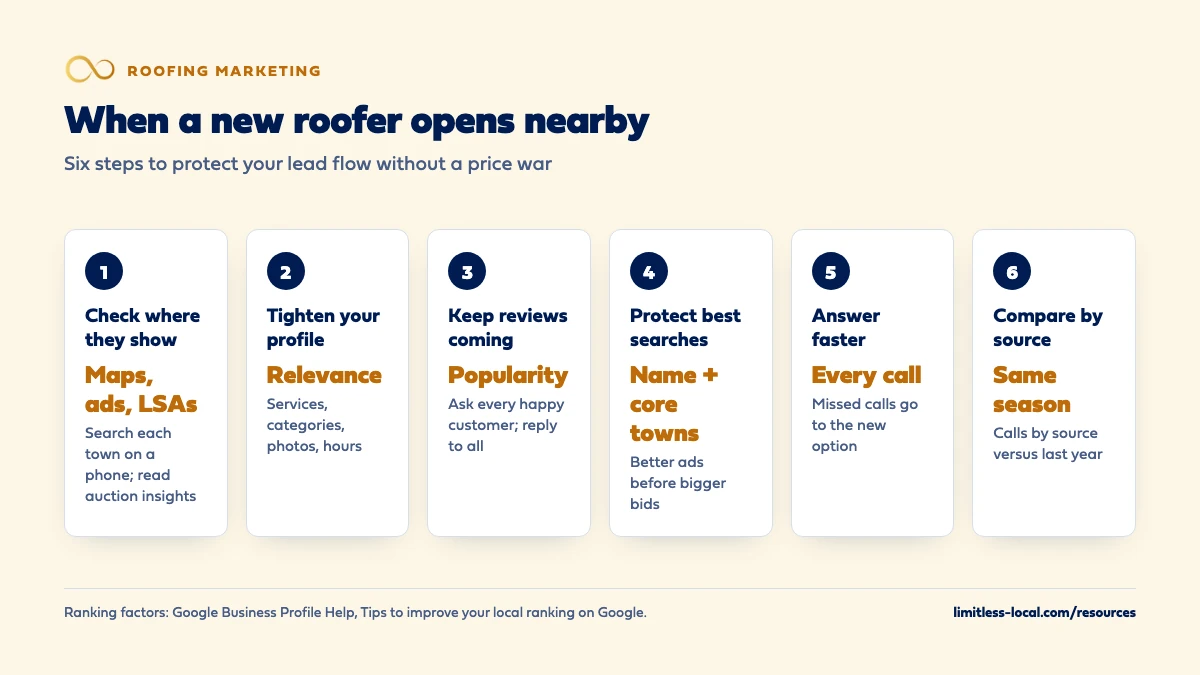
Search the way your homeowners do, on a phone, from each town you serve: roofer near me, roof replacement [town], roof repair [town]. Note who’s in the map pack, who’s in the ads and who’s in Local Services Ads, and where you sit compared with last time you checked.
If you run Google Ads, the auction insights report shows the other advertisers in the same auctions as you, with their impression share, how often their ads showed alongside yours, and how often they ranked above you. A new name there with a high overlap rate is the clearest sign they’re bidding on your searches.
How to tell how competitive roofing marketing is in your city walks through these checks in order, and what impression share means for roofing Google Ads explains how to read the numbers.
Step 2: How do I tighten my Google Business Profile?
Google says local results are based mainly on relevance, distance and popularity. You can’t change distance: if the new roofer’s shop is closer to some homeowners than yours, they’ll have an edge with those homeowners. But you can make sure you win on the other two.
- Relevance: complete every part of your profile, list the services you actually do, and pick your categories carefully. Which Google Business Profile categories a roofer should choose covers that.
- Popularity: how well known your business is, based on things like how many websites link to you and how many reviews and positive ratings you have. Years of jobs in the same towns are exactly what a newcomer doesn’t have yet.
Add fresh photos of your own crews on real roofs in the towns you serve, and make sure your hours, phone number and service areas are right. Small gaps that never mattered before matter when there’s a new option one tap away.
Step 3: How do I keep my reviews ahead?
Reviews are the one place a new company can’t catch up quickly. Make the most of that lead by keeping new ones coming, so your profile doesn’t look stale next to theirs.
Google’s tips for getting more reviews are simple: remind customers to leave one, with a link or QR code, and reply to reviews. Ask every happy customer when the job is done, while they’re still pleased. Reply to every review, good and bad, politely and specifically.
One rule matters more than usual when you’re under pressure: Google treats offering incentives such as discounts in exchange for reviews as fake and misleading content. Keep your review requests clean. How many Google reviews a roofer should get each month helps you set a steady target.
Curious what your marketing is actually booking?
Get a free visibility audit — no obligation, no sales pitch.
Step 4: How do I protect my best searches in ads?
A new roofer will often lean on ads, because ads work from day one. You don’t need to outbid them everywhere. Focus on the searches that matter most:
- Your own company name. If they or anyone else start showing ads when homeowners search your name, run a small campaign so you’re the first thing those homeowners see.
- Your best jobs in your core towns. Make sure roof replacement and your other high-value searches in your closest towns have enough budget not to run out early in the day.
- Better ads before bigger bids. Ad Rank depends on ad and landing page quality as well as your bid. Ads that name the job and the town, with a matching page, usually cost less to keep on top than a raised bid.
If you run Local Services Ads, keep your service area and job types tight, and make sure every lead call gets answered.
Step 5: How do I keep past customers and neighbors with me?
The new roofer has no past customers. You have years of them. They need gutters, repairs, inspections and, eventually, their next roof, and they talk to their neighbors.
- Check in with past roof customers, especially after a storm.
- Let neighbors know when you’re working on their street, with a door hanger or a yard sign where allowed.
- Make referrals easy: ask happy customers to pass your name along, and thank them when they do.
Keep it honest and simple. A reminder that you’re the local roofer who did their roof, and that you’re still here, is often enough.
Step 6: How fast do I need to answer now?
Faster than before. When a homeowner has a new company to call, a missed call or a slow callback is the easiest way to lose the job, and it costs nothing on your ad bill to fix.
Look at the last month honestly: how many calls went to voicemail, and how long did it take to call back form leads? If the answer is “hours” or “the next morning,” tighten it up before you spend another dollar on ads. How fast a roofing company should call back a new lead covers how to set that up.
Should I lower my prices to compete?
Usually not. A new roofer may price low to win its first jobs, and racing them to the bottom just makes both of you less profitable. Homeowners hiring a contractor are told to get written estimates from several firms and not to automatically choose the lowest bidder. That’s your opening.
Compete on what you can prove: your reviews, your warranty, your years in those towns, your photos and the homeowners who’d recommend you. Make sure your estimate explains what’s included, so a cheaper quote looks like what it is. How to stop price shoppers calling your roofing company has more on that.
What if the new roofer plays dirty?
Most new competitors are just competitors. Now and then you’ll see something that crosses a line, and there are proper ways to deal with it:
- Fake reviews on your profile. You can report a review for removal if it breaks Google’s policies, such as spam. Don’t report a review just because you dislike it.
- A fake or misleading listing. Google Maps lets you report a business with misleading info, and has a separate form for listings with misleading names, phone numbers or website links that suggest fraud.
- Bought reviews on their profile. Reviews posted in exchange for a payment, deal or discount are prohibited, and you can report a business you believe is offering them.
Whatever they do, don’t answer in kind. The FTC’s rule on fake reviews prohibits businesses from creating or selling fake reviews, from buying reviews they know or should know are fake, and from offering payment or incentives on the condition that a review says something positive or negative. Your clean record is worth more than winning one round.
How do I tell if the new roofer is actually taking my work?
Look at your own numbers, not the number of their trucks. Compare calls and estimate requests by source for the last few months against the same months last year, so the season doesn’t fool you:
- Google Business Profile calls and website clicks, from your profile’s performance report.
- Google Ads calls and form leads, plus impression share and auction insights.
- Referrals and repeat customers, from your job software’s lead source field.
If one source dropped and the others held, you know where to put your effort. If everything dropped, check the weather and your answer rate before you blame the competitor.
Not sure which of these is costing you jobs?
A free visibility audit checks the Google profile, reviews, site and tracking, and shows what to fix first.
What's different for roofers
Storm season brings new names every year. After a big hailstorm, out-of-town crews often open temporary offices or set up local listings. Many leave when the work dries up. Don’t rebuild your whole plan around a company that may not be there next year; protect your core towns and wait to see who stays.
Canvassing can look like a bigger threat than it is. A new roofer’s door knockers are visible in a way their ads aren’t. Measure what’s happening to your calls before you react to what you see in the neighborhood.
A roof lasts for years. Your past customers won’t need a new roof soon, but they need repairs, inspections and gutters, and they recommend you to neighbors. That relationship is the asset a newcomer can’t buy.
A worked example: is the newcomer taking calls, and from where?
These numbers are made up to show the math, not a benchmark for your market. A new roofer opens near the east side of your service area in March. In June, you compare the same three spring months with last year:
- Calls from your Google Business Profile: 120 last year, 96 this year. That’s down 20%.
- Calls and forms from Google Ads: about 45 both years.
- Referrals and repeat customers: about the same.
And when you check the map pack from the east-side towns, the new roofer now shows up there, while you still hold your spot in the west.
So the newcomer isn’t hurting your ads or referrals. It’s mostly the free map pack, in the towns closest to its shop. The fix isn’t higher bids everywhere. It’s reviews, photos and profile work aimed at the east side, plus a modest ad push for your best searches there while you rebuild.
If you’d rather hand that off, our Essentials package is $3,500 a month and includes business listing cleanup, Google Business Profile management, review response and basic review generation, and call tracking.
Frequently asked questions
Can I stop a new roofer from bidding on my company name?
You can’t stop other advertisers from entering the same auctions. What you can do is run your own ad on your name so you show first, and keep your profile strong so homeowners searching for you find you.
Will a new competitor knock me out of the map pack?
They might push you down for homeowners who are closer to their shop, because distance is one of Google’s main local factors. Strong reviews, a complete profile and relevance to the search help you hold your place.
Should I add more towns to my ads to make up for lost calls?
Not as a first move. Adding towns spreads the same budget over more searches. Protect your core towns first, then expand once your cost per signed roof there is steady.
Is it worth reporting a competitor's reviews?
Only if you have real reason to think they break Google’s rules, such as reviews tied to a payment or discount. Reporting reviews you simply dislike won’t get them removed and takes time away from your own reviews.
Should I change my ads to talk about the new competitor?
No. Don’t name or knock them. Talk about what you can prove: years in the area, reviews, warranty and local jobs.
How long before I know if the new roofer is hurting my business?
Give it a full season and compare with the same months last year. A single slow month after they open can be weather or chance.
Key takeaways
- Check where the new roofer actually shows up before you change your plan or prices.
- Win on what they can’t copy fast: reviews, history, past customers and local proof.
- Tighten your Google profile and protect your name and best searches in ads.
- Answer every call fast; it’s the cheapest way to keep work from walking.
- Measure calls by source against the same season last year, and report real violations instead of retaliating.
Want a second set of eyes on your setup?
We'll look at how you show up locally and where calls are leaking, then send you a plain-English breakdown.
More in this section
- How does a roofer get high-intent customers in their local area?
- How do I tell how competitive roofing marketing is in my city?
- How can my roofing company stand out from other roofers online?
- How does a roofer keep up with leads coming in fast?
- What can a roofer do this month to get more leads without waste?
Sources
- Tips to improve your local ranking on Google — Google Business Profile Help
- Tips to get more reviews — Google Business Profile Help
- Report inappropriate reviews on your Business Profile — Google Business Profile Help
- Report a business on Google Maps — Google Maps Help
- Use auction insights to compare performance — Google Ads Help
- Federal Trade Commission Announces Final Rule Banning Fake Reviews and Testimonials — Federal Trade Commission
- About Ad Rank — Google Ads Help
- Hiring a Contractor — Federal Trade Commission