
How many five-star reviews does an electrician need to raise prices?
- What rating and review count let an electrician charge more without losing the job?
- Is there a review count that lets an electrician charge more?
- Why do reviews matter more on bigger electrical jobs?
- What star rating should I have before I raise prices?
- How many reviews do I need to look established enough?
- Do my newest reviews matter when I raise prices?
- What should my reviews say to back up a higher price?
- How do I check where my reviews stand against other electricians?
- What else besides reviews helps a homeowner accept a higher price?
- How should I raise prices once my reviews are strong?
- How do I know if the higher price is costing me jobs?
- What if my rating is lower than the electricians around me?
- Can I get the reviews I need faster?
- What's different about reviews and pricing for electricians
- A worked example: a higher panel price with one fewer job
- Frequently asked questions
- Key takeaways
- More in this section
- Sources
The short version
- There's no review count that unlocks a price increase; your costs and your market set the price.
- Reviews make a higher quote easier to accept, especially on bigger jobs like panel upgrades, EV chargers and generators.
- Aim to match or beat the electricians beside you on rating, count and recency in your main towns.
- Raise one job type at a time and judge it by close rate and profit per job, not by complaints.
For electrical contractors who want to quote higher and are wondering whether their Google reviews can carry the new price.
Get a free visibility audit · Book a growth call
What rating and review count let an electrician charge more without losing the job?
No number of five-star reviews unlocks a price increase, because reviews don’t set what you can charge; they make a higher quote feel less risky to the homeowner comparing you. You’re ready to lean on them when your rating and review count are level with or better than the electricians showing beside you in your main towns, your newest reviews are weeks old rather than months, and the reviews mention what you charge more for. Raise prices one job type at a time, starting with bigger jobs like panel upgrades, and watch your close rate.
Reviews are one part of how you show up locally, next to your Google Business Profile, your service pages and the map pack. Review generation and review response are part of our local SEO work in every package, and our electrical contractor marketing page explains how we work with electrical shops. The rest of the electrical marketing questions library goes question by question.
Is there a review count that lets an electrician charge more?
No. Your price comes from what an hour of field time costs you, your overhead, the profit you want and what your market will bear. Reviews don’t change any of that. What they change is how a homeowner feels about saying yes to the higher number.
A homeowner has two or three quotes for a panel upgrade, and yours is a few hundred dollars more. If your Google profile shows a strong rating, plenty of recent reviews and customers describing clean work and clear explanations, the extra money looks like the price of less risk. If your profile is thin or stale, the same gap looks like you’re just expensive.
If you haven’t worked out your prices from your costs yet, start with what an electrician should charge per hour or per job, then come back to the reviews.
Why do reviews matter more on bigger electrical jobs?
The more a job costs, the more the customer worries about picking wrong, and reviews ease exactly that worry. The Medill Spiegel Research Center at Northwestern, studying online shopping in research first published in 2017, found reviews have a bigger effect on purchase likelihood for higher-priced items: showing reviews lifted conversion 190% for a lower-priced product and 380% for a higher-priced one. That’s retail data, not electrical work, so take the direction, not the percentages.
For an electrician, that points to where reviews earn their keep: the panel upgrades, whole-home generators and EV chargers where a homeowner reads reviews and compares shops, not the dead-outlet call where they want whoever can come today.
What star rating should I have before I raise prices?
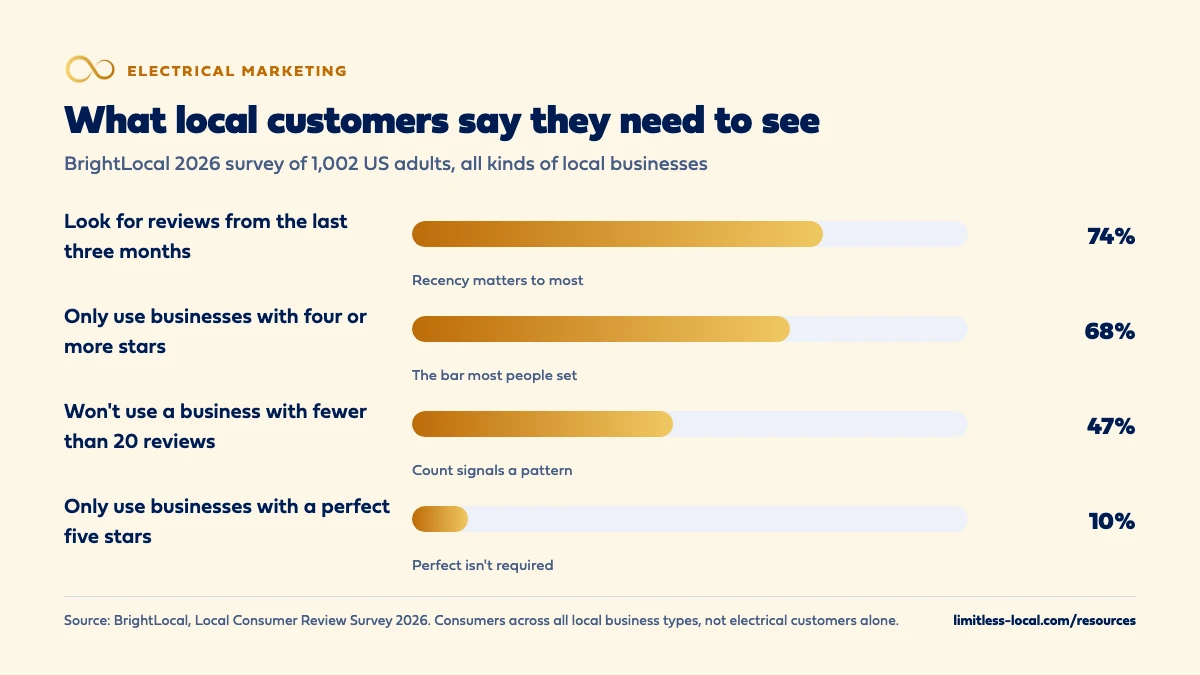
High, but not perfect. In BrightLocal’s Local Consumer Review Survey 2026, a panel of 1,002 US adults, 68% said they’d only use a business with four or more stars and 31% said they’d only use one with 4.5 stars or more. Only 10% said they’d only use a business with a perfect five-star rating. That survey covers all kinds of local businesses, not electrical customers alone, but the point holds: a 4.6 doesn’t scare anyone off, and a 3.9 rules you out for many people before they see your price.
A perfect score isn’t the goal anyway. In the retail research above, purchase likelihood typically peaked at ratings between 4.0 and 4.7 and then started to drop as ratings approached 5.0, because a perfect score can look too good to be true.
A practical floor: get to 4.5 or better, and be at least level with the electricians showing next to you in your main towns, before you lean on reviews to support a higher price. If you’re below that, spend the next few months on the rating, not the price book.
How many reviews do I need to look established enough?
Enough that a homeowner sees a pattern, not a handful. 47% of consumers said they won’t use a business with fewer than 20 reviews, and only 9% were willing to use one with five or fewer. The top factor people looked for was a review backed up by other reviews saying the same thing (56%).
That’s why the real target is local, not national. Look at the electricians in the map pack for your main jobs in your main towns. If they’re sitting at 80 to 150 reviews and you have 30, you’re asking a homeowner to pay more to the shop with the least proof. If you’re in the same range or ahead, the count stops being a reason to choose someone else. How many Google reviews an electrician needs walks through setting that target town by town.
Do my newest reviews matter when I raise prices?
Yes, a lot. 74% of consumers said they look for reviews written in the last three months. A profile with a great rating and nothing new since spring tells a homeowner your best work might be in the past, which is the opposite of what you want them thinking when your quote is the highest one on the table.
Recency is also the easiest part to fix. Asking every customer at the end of every job, with a link that opens straight to your review form, keeps new reviews coming in week after week. Automating Google review requests after each job covers setting it up so it doesn’t depend on anyone remembering.
Curious what your marketing is actually booking?
Get a free visibility audit — no obligation, no sales pitch.
What should my reviews say to back up a higher price?
Stars get you considered. The words are what justify the price. The reviews that do the most for a higher quote mention the things homeowners are actually paying extra for:
- Showed up when they said they would, and called ahead.
- Explained the options and the price before starting, with no surprises on the invoice.
- Pulled the permit and passed inspection.
- Kept the house clean and put things back the way they found them.
- Fixed it the first time, or came back fast if something wasn’t right.
- Named the tech, which tells the reader a real person did the work.
You can’t write reviews for customers, and you shouldn’t hand them a script. What you can do is make it easy for them to say something specific. When the tech asks for the review, a line like “if you can mention what we did today, it helps other homeowners know what to expect” tends to get you “they replaced our panel and walked me through everything” instead of “great service.” If none of your reviews mention the jobs you want to charge more for, that’s the gap to close.
How do I check where my reviews stand against other electricians?
- Search your two or three most valuable jobs in your main towns, the way a homeowner would: “panel upgrade” or “EV charger installer” plus the town.
- For each of the electricians showing in the map pack, write down the rating, the review count and the date of the newest review.
- Do the same for any Local Services Ads.
- Read the three or four newest reviews for each. Note what customers praise and complain about.
- Put your own numbers in the same row.
If you’re level or ahead on all three numbers, you have room to price above them. If you’re behind, you know what to work on first. Repeat it every quarter; the shops around you keep collecting reviews too.
What else besides reviews helps a homeowner accept a higher price?
The quote itself has to back the reviews up:
- A written quote that explains the work: what’s included, the permit, the inspection, the cleanup and the warranty.
- Options. A good, better and best version of the job lets the homeowner choose the level instead of choosing a cheaper electrician.
- Your license and insurance where they can see them, on the quote, the website and the truck.
- Speed. A quote out the same day or the next says a lot about how the job will go.
If price shoppers are eating your estimate time, stopping price shoppers from wasting your estimates covers screening them before anyone gets in the truck.
How should I raise prices once my reviews are strong?
- Pick one job type. Start with bigger, planned work like panel upgrades, EV chargers, generators or rewiring, where reviews carry the most weight and homeowners compare shops.
- Set the new price from your numbers. Your costs and target margin decide the increase; your review profile decides how confident you can be that the market will accept it.
- Update everything at once. The price book in your field software, any prices on your website and Google profile, and what the office says on the phone.
- Honor quotes already sent. Changing a number a customer already has in writing costs more goodwill than it earns.
- Give it time. Wait until you’ve sent enough quotes at the new price to see a pattern before judging.
- Then move to the next job type. Service calls and small jobs come last, because those customers mostly care about who can come today.
How do I know if the higher price is costing me jobs?
Watch your close rate for that job type, not your gut. Field software can show it: Housecall Pro’s estimate conversion rate reports show your estimate win rate, which estimates are still outstanding and how much revenue was lost to declined estimates.
Compare the same job type, the same lead sources and a similar number of quotes before and after the change. A small drop in close rate is often fine, because each job you win now leaves more profit; the worked example below shows the math. A big drop, or a pile of declined quotes that mention price, means you went too far or the profile isn’t strong enough yet. What a good close rate looks like for an electrical company covers how to read the number.
What if my rating is lower than the electricians around me?
Then fix that before you raise prices to win new customers. Raising prices because your costs went up is still fine; you just shouldn’t count on your reviews to soften the increase yet.
Reply to every review, good and bad, with a short, specific answer; how to respond to a negative Google review covers what to say. Then ask every customer, after every job, without picking only the happy ones. More honest reviews from your normal customers is the only reliable way a rating moves.
Expect it to take months. Google calculates your review score as the average of all your published ratings, and it can take up to two weeks after a new review for the score to update.
Can I get the reviews I need faster?
Only the honest way: ask more customers, more consistently, and make it easier for them. Every shortcut makes things worse. Google’s tips to get more reviews spell it out: offering incentives such as free or discounted goods or services in exchange for reviews, or to change or remove negative ones, is treated as fake and misleading content and is strictly prohibited. That rules out a discount on the next service call for a five-star review, gift cards for reviews and paying anyone to post them.
What works: a Google link or QR code that opens your review form, replies to reviews, and a tech who asks at the end of every job and sends the link before leaving the driveway. A mix of positive and negative feedback often feels more trustworthy anyway.
Not sure which of these is costing you jobs?
A free visibility audit checks the Google profile, reviews, site and tracking, and shows what to fix first.
What's different about reviews and pricing for electricians
Safety is part of the price. Homeowners know bad electrical work can be dangerous, so they’re more willing to pay for a shop that looks careful. Reviews that mention permits, inspections and clean, tidy panels speak directly to that.
Emergency calls and planned work behave differently. On a no-power call, speed beats price and reviews only need to clear a basic bar. On a panel upgrade or generator, the homeowner has time to compare, which is where your profile can carry a higher quote.
A worked example: a higher panel price with one fewer job
These numbers are made up to show the math, not a benchmark for your market. Say an electrician has a 4.8 rating with 140 reviews, the newest from this week, and the two shops beside them in the map pack sit at 4.4 and 4.6 with fewer reviews. They decide to raise the price of a standard panel upgrade.
- Before: $2,400 per panel upgrade, $1,450 in job costs, so $950 gross profit each. They win 10 a month: $9,500 gross profit.
- After: $2,600 per panel upgrade, same $1,450 in job costs, so $1,150 gross profit each.
- Break-even: $9,500 / $1,150 = 8.3, so they need 9 wins a month to come out ahead.
- If they win 9 instead of 10: 9 x $1,150 = $10,350 gross profit, $850 more than before, with one fewer job on the schedule.
In this example, the shop can lose one panel upgrade a month to the higher price and still make more money. If wins drop to 8, gross profit falls to $9,200 and the increase is costing them. A strong review profile is what keeps the wins from sliding past break-even.
Frequently asked questions
Should I raise prices on service calls or bigger jobs first?
Bigger, planned jobs like panel upgrades, EV chargers and generators. Homeowners compare quotes and read reviews more on those, so a strong profile carries more weight. Service-call customers mostly want whoever can come today.
Do reviews on Yelp or Facebook help me charge more too?
They can, if your customers look there. Google is where most homeowners will see your rating next to other electricians, so get that profile right first, then keep the others from going stale.
Will a couple of four-star reviews hurt my pricing?
Not much, and they can help. A perfect score can look too good to be true, and a mix of feedback with calm, specific replies reads as more honest.
Should I mention my reviews when I give a quote?
Yes, briefly. Sending the quote with a link to your Google reviews, or a line in the quote pointing homeowners to them, puts your proof next to your price instead of hoping they look it up.
Do commercial customers care about reviews when I raise rates?
Less than homeowners. Builders and property managers lean on references and how reliably you hit schedules.
Can I raise prices if I'm a new electrician with few reviews?
You can price from your costs from day one, and you should. Just don’t expect the review profile to do much persuading yet; lean on clear quotes, fast response and your license and insurance while the reviews build.
Key takeaways
- No review count unlocks a price increase; your costs and market set the price, and reviews make it easier to accept.
- Reviews matter most on bigger, planned jobs like panel upgrades, EV chargers and generators.
- Get to 4.5 or better and level with the electricians beside you on rating, count and recency before leaning on reviews.
- Reviews that mention permits, clean work and clear pricing do more for a higher quote than stars alone.
- Raise one job type at a time and judge it by close rate and profit per job.
- Never trade discounts or gifts for reviews; Google prohibits it.
Want a second set of eyes on your setup?
We'll look at how you show up locally and where calls are leaking, then send you a plain-English breakdown.
More in this section
- How many Google reviews does an electrician need to compete?
- What reviews and rating does an electrician need before local ads?
- How much can an electrician afford to pay to get a new customer?
- Should electricians show prices on their website?
- How many jobs a month does an electrician need to hit a revenue goal?
Sources
- Local Consumer Review Survey 2026 — BrightLocal
- How Online Reviews Influence Sales — Medill Spiegel Research Center, Northwestern University
- Tips to get more reviews — Google Business Profile Help
- Understand review scores for local places & businesses — Google Business Profile Help
- Conversion Rate Reporting — Housecall Pro Help Center