
What should an electrician charge per hour or per job?

- How do I set my hourly rate and flat-rate prices as an electrical contractor?
- Why isn't there one right hourly rate for electricians?
- Should I charge by the hour, by the job, or both?
- Step 1: What does an hour of field time really cost you?
- Step 2: How much overhead does each billable hour have to carry?
- Step 3: How much profit should I build in?
- Step 4: How do I turn my hourly rate into flat-rate prices?
- Should I charge a service call or trip fee?
- How do I check my prices against the local market?
- When should an electrician raise prices?
- How does marketing fit into my prices?
- What pricing mistakes cost electricians the most?
- What's different about pricing electrical work
- A worked example: building an hourly rate and one flat-rate price
- Frequently asked questions
- Key takeaways
- More in this section
- Sources
The short version
- Start from your costs, not from what someone else charges.
- Count only billable hours: drive time, callbacks and the office aren't billed.
- Add overhead per billable hour, then the margin you want.
- Turn the hourly rate into flat-rate prices for common jobs.
- Check the result against your local market and your close rate.
For electrical contractors setting or resetting their rates, who want a price built from their own costs instead of a number someone quoted online.
Get a free visibility audit · Book a growth call
How do I set my hourly rate and flat-rate prices as an electrical contractor?
An electrician should charge whatever covers the loaded cost of each billable hour, a share of overhead and the profit you want, and then check that against what your local market will pay. Work out what a field hour really costs you, including wages, taxes, benefits and the hours nobody pays for, add overhead per billable hour, then set your margin on top. Most electricians then turn that hourly number into flat-rate prices for common jobs, because homeowners prefer knowing the price up front and you get paid for doing the work efficiently.
Marketing is one of the costs your prices have to carry, so it should be judged the same way: by what each booked job costs and the profit that job leaves. Our packages list exactly what’s included and what they cost, every one comes with call tracking and a monthly report with a cost-per-lead breakdown, and our electrical contractor marketing page shows how it applies to electricians. The electrical marketing questions library covers the rest.
Why isn't there one right hourly rate for electricians?
Because the rate that works depends on numbers only you have: what you pay your electricians, how much of their day is actually billable, what your shop, trucks and insurance cost, and how much profit you need. Two shops in the same town can need very different rates and both be right.
National “average rate” figures are blends of very different markets, union and non-union shops, residential and commercial work. Copying one can leave you underpriced in a high-cost area or overpriced where customers expect less.
What you can find is the wage side. The Bureau of Labor Statistics puts the median wage for electricians at $30.38 an hour in May 2025. That’s what electricians earn as employees across the country, not what a contractor charges. Your rate has to cover a wage like that plus everything else it takes to put a licensed electrician in a customer’s house, which is why charged rates run so much higher than wages.
Should I charge by the hour, by the job, or both?
Most electrical contractors end up using all three, for different kinds of work:
- Flat rate (by the job) for common, repeatable work: adding a circuit, swapping a panel, installing an EV charger, replacing fixtures. The homeowner approves one price before you start.
- Hourly (time and materials) for work that’s hard to scope, like tracing an intermittent fault in an old house, or small commercial jobs where the customer expects it.
- A service call or diagnostic fee to cover getting a truck and a licensed electrician to the door, often credited toward the repair if they go ahead.
Flat rate tends to be easier to sell. The homeowner isn’t watching the clock, and you’re not penalized for being fast. Hourly protects you when nobody can know how long the job will take. Either way, the hourly number underneath has to be right, because flat-rate prices are built from it.
Step 1: What does an hour of field time really cost you?
Start with what each electrician costs you, not just what they’re paid. Jobber’s job costing guide says the labor cost you enter should include the employee’s wage, benefits and taxes. For an electrician that typically means:
- Hourly wage, including overtime.
- Payroll taxes and workers’ comp.
- Health insurance, retirement and paid time off.
- Tools, training and license renewals you pay for.
Then comes the step most owners skip: billable hours. You pay for every hour on the clock, but you can only bill for the hours spent working on a customer’s job. Drive time, shop time, supply-house runs, callbacks and slow days all come out of it. Take the loaded cost of a year of paid hours and divide it by the hours you actually billed. That’s your real labor cost per billable hour, and it’s usually a lot higher than the wage.
If you’re still on the tools yourself, put a realistic wage on your own hours. Otherwise your rate is quietly built on working for free.
Step 2: How much overhead does each billable hour have to carry?
Overhead is everything you pay whether you run ten jobs this month or forty: the shop, truck payments and fuel, insurance, office staff, software, phones, accounting and marketing.
Add up a year of it, then divide by the total billable hours across all your electricians. That’s the overhead each billable hour has to carry. Add it to the labor cost from Step 1 and you have your break-even cost per billable hour: charge less than that and every hour loses money.
The SBA’s break-even point calculator uses the same idea from the other direction: fixed costs divided by price minus variable costs tells you how many units, or here hours, you need to sell just to break even. Running it both ways is a good check on your numbers.
Step 3: How much profit should I build in?
That’s your decision, and it should be a real number, not “whatever’s left.” Profit pays for the next truck, the slow months, the callbacks you can’t bill and your own return for taking the risk.
Watch the difference between margin and markup, because mixing them up is one of the most common pricing mistakes:
- Markup is how much you add on top of cost, as a share of cost.
- Margin is how much of the selling price is left after cost, as a share of the price.
Jobber’s guide to markups on quotes calculates estimated margin as (price – cost) / price, and notes that the markup percentage will be more than the margin. So a 25% markup gives you a 20% margin, not 25%. If you want a 20% margin, divide your cost by 0.8 instead of multiplying it by 1.2.
Curious what your marketing is actually booking?
Get a free visibility audit — no obligation, no sales pitch.
Step 4: How do I turn my hourly rate into flat-rate prices?
For each common job, build the price from the same parts every time:
- Typical time for that job, from your own past jobs, not your best day.
- Times your hourly selling rate from Steps 1 to 3.
- Plus materials, at your cost plus your materials markup.
- Plus permits and inspection trips where the job needs them.
- Plus a cushion for the jobs that run long, if the work is the kind that sometimes does.
Put the result into your field software’s price book, so Jobber, Housecall Pro or ServiceTitan pulls the same price every time a tech quotes that job. Then review it: if a flat-rate job keeps running over the time you priced, raise it or split it into options.
Job types worth flat-rating first are the ones you do every week. Rarer, messier work can stay on time and materials until you have enough history to price it.
Should I charge a service call or trip fee?
For most residential electricians, yes. Every visit costs you a truck, fuel and a licensed electrician’s time before any work starts. A service call fee covers that, filters out people who only want free advice, and makes the small jobs worth sending a truck for.
Common ways to set it up:
- A flat fee that covers the trip and diagnosis, credited toward the repair if they approve it.
- A higher fee for after-hours and weekend calls.
- A clear line between a paid diagnostic visit and a free estimate for larger planned work, like a panel upgrade or generator.
Tell people the fee before you book, on the phone and on your website. A surprise fee is how good service calls turn into bad reviews. Whether electricians should show prices on their website covers how to present it.
How do I check my prices against the local market?
Your costs set the floor. The market tells you whether you can get the price. Ways to read your market:
- Your close rate. If you’re winning almost every estimate, you’re probably cheap. If you’re losing most of them on price, look at whether it’s the price or how it’s presented.
- Your schedule. Booked out for weeks with the phones still ringing usually means your prices are below what the market will pay.
- What customers say. “That’s more than I expected” now and then is normal. Hearing it on every call tells you something.
- Other contractors’ posted prices, where they show them, such as service call fees.
Don’t set your price by the cheapest electrician in town. Someone is always willing to work for less, and racing them leaves no room for good techs, good trucks or a warranty. What a good close rate looks like covers how to read that number.
When should an electrician raise prices?
Look at your prices at least once a year, and sooner when any of these happen:
- Wages, insurance or material costs have gone up.
- You’re booked out for weeks and turning work away.
- Your close rate is high and nobody pushes back on price.
- Your flat-rate jobs keep running over the time you priced.
- Your profit at the end of the year didn’t match what your prices were supposed to produce.
When you raise prices, update the price book, the website and the scripts your office uses on the phone all at once, and honor quotes you’ve already sent. Most customers notice good work and quick service more than a modest price change.
How does marketing fit into my prices?
Marketing belongs in overhead, so it’s already built into your hourly rate if you counted it in Step 2. The question is whether what you spend to win each job fits inside the profit that job leaves.
Look at it per booked job. If you know what your marketing cost last month and how many jobs it booked, you know your cost per booked job. Compare that with the gross profit on the jobs you’re winning. A $150 marketing cost on a service call that clears $140 in gross profit loses money; the same $150 on a panel upgrade that clears over $1,000 is easy to justify.
That’s why your pricing and your marketing decisions have to talk to each other. Working out profit per job and customer value and what a good cost per booked job looks like cover both sides of that math.
What pricing mistakes cost electricians the most?
- Pricing from the wage. Charging double what you pay a tech sounds safe and often isn’t once billable hours and overhead are counted.
- Counting every paid hour as billable. Drive time and callbacks are real hours nobody pays for.
- Confusing markup and margin. A 25% markup is a 20% margin.
- Leaving your own labor out. If you’re on the tools, your hours cost something.
- Pricing permits and inspections at zero. Fees and return trips are real job costs.
- Never updating. Prices set three years ago were built on three-year-old costs.
Talk it through with someone who runs this every day
A 15-minute growth call: your market, your numbers, and what a realistic budget looks like. No pressure.
What's different about pricing electrical work
Huge spread of job sizes. The same truck can run a quick troubleshooting call in the morning and a service change in the afternoon. One hourly rate applied to both rarely works; flat-rate prices by job type handle that better.
Permits and inspections. Panel upgrades, service changes, generators and many EV charger installs need permits and inspections, and requirements vary by state and town. The fees and the return trip for inspection belong in the price.
Troubleshooting is hard to scope. An intermittent fault in an old house can take twenty minutes or most of a day. That’s where a paid diagnostic visit or time-and-materials pricing protects you.
Licensed labor costs more. Licensing, continuing education and apprentice ratios shape your labor costs, so price from your own crew structure, not from another trade’s rates.
A worked example: building an hourly rate and one flat-rate price
These numbers are made up to show the math, not a benchmark for your market.
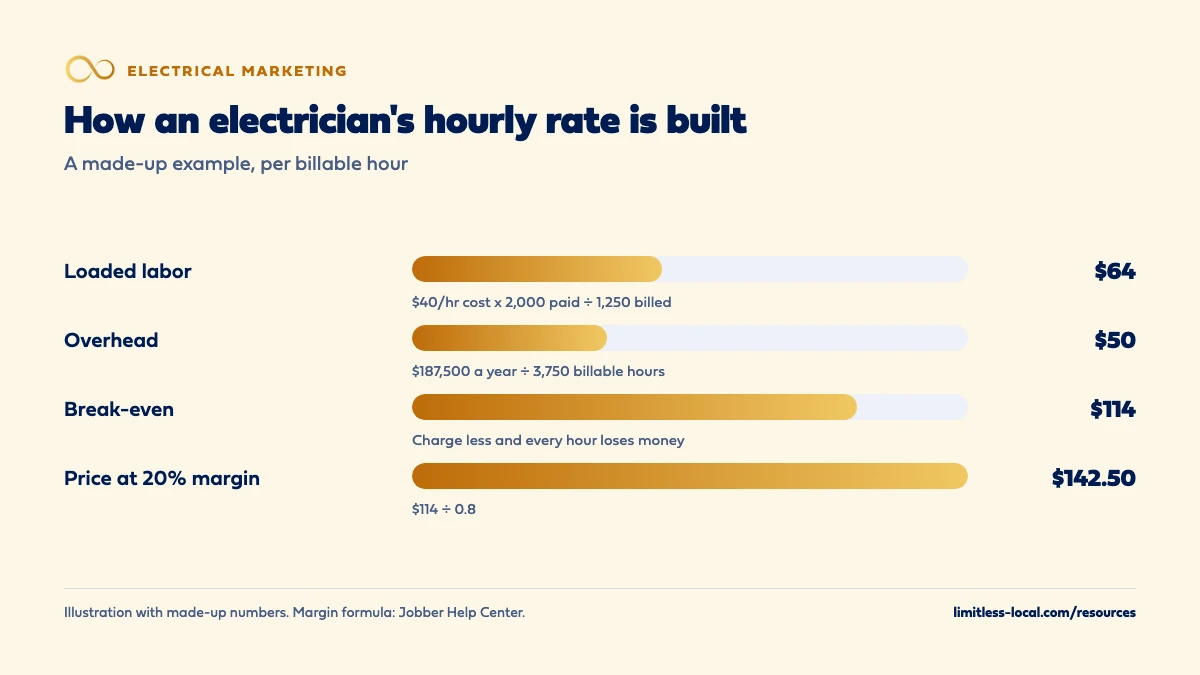
Labor. Your electricians cost you $40 an hour once wages, payroll taxes, workers’ comp and benefits are counted. Each is paid for 2,000 hours a year but bills 1,250 of them. So labor per billable hour is $40 times 2,000, divided by 1,250: $64.
Overhead. With three electricians, you have 3,750 billable hours a year. Your overhead is $187,500 a year, so each billable hour carries $50 of it. Break-even is $64 plus $50: $114 per billable hour.
Profit. You want a 20% margin, so you divide by 0.8: $114 divided by 0.8 is $142.50 an hour. That’s the same as a 25% markup on cost.
A flat-rate job. A dedicated circuit for a new appliance takes you about 2.5 hours on a typical house. Labor is 2.5 times $142.50, or $356.25. Materials cost you $80, and at a 25% markup they go on the price at $100. The flat rate is about $456, before any permit fee.
Where marketing sits. If that $187,500 of overhead includes our Essentials package at $3,500 a month, that’s $42,000 a year, or about $11.20 of every billable hour, with ad spend paid to Google on top. Seeing marketing as a per-hour cost makes it easy to judge against the jobs it brings in.
Frequently asked questions
What do most electricians charge per hour?
There’s no reliable single number, because rates swing with local wages, costs and the kind of work. Build your rate from your own loaded labor, overhead and margin, then check it against your close rate and how booked out you are.
Is flat-rate pricing better than hourly for electricians?
For common, repeatable residential jobs, flat rate is usually easier to sell and rewards efficient crews. Keep hourly or a paid diagnostic for work that’s hard to scope, like tracing faults in older homes.
Should I charge more for emergency and after-hours calls?
Yes. Night and weekend calls cost you more in overtime and disruption, and customers calling then generally expect a higher fee. Tell them the after-hours rate before you dispatch.
Should apprentices and journeymen be billed at different rates?
If you bill hourly, many shops do, because their labor cost differs. With flat-rate pricing, the crew mix is built into the job price instead, which is simpler for the customer.
Should I mark up materials?
Yes. Buying, picking up, storing and warrantying materials costs you time and money. Set a materials markup and apply it consistently in your price book.
How often should I update my electrical prices?
At least once a year, and whenever wages, insurance or material costs move, or your flat-rate jobs keep running over the time you priced.
Key takeaways
- Build your rate from loaded labor per billable hour, overhead and the margin you want.
- Billable hours are fewer than paid hours; count only what you actually bill.
- Markup and margin aren’t the same: a 25% markup is a 20% margin.
- Use flat-rate prices for common jobs and hourly or a diagnostic fee for hard-to-scope work.
- Check your prices against your close rate and schedule, and review them at least yearly.
Ready to compare options?
Book a short growth call and we'll walk through the math for your service area, including when we're not the right fit.
More in this section
- How do electricians work out profit per job and customer value?
- How should an electrical contractor bid a job?
- Should electricians show prices on their website?
- How many jobs a month does an electrician need to hit a revenue goal?
- Should electricians pay for leads from Angi or Thumbtack?
Sources
- Electricians: Occupational Outlook Handbook — U.S. Bureau of Labor Statistics
- Job Costing — Jobber Help Center
- Markups on Quotes — Jobber Help Center
- Break-even point calculator — U.S. Small Business Administration