
How should an electrical contractor bid a job?
- What are the steps to price and win an electrical bid without leaving money on the table?
- Should I bid every electrical job I'm asked to bid?
- Step 1: Get the scope in writing before you price anything
- Step 2: Count and price the materials
- Step 3: Estimate labor hours honestly
- Step 4: Add permits, equipment, subcontractors and overhead
- Step 5: Set your margin on purpose
- Step 6: Write the bid so it's easy to say yes
- Step 7: Follow up until you get a yes or a no
- How is bidding to a general contractor different from quoting a homeowner?
- How do I get better at bidding over time?
- What bidding mistakes cost electrical contractors the most?
- What's different about bidding electrical work
- A worked example: bidding a panel upgrade
- Frequently asked questions
- Key takeaways
- More in this section
- Sources
The short version
- Only bid work that fits your crews, schedule and the customers you want.
- Get the scope in writing before you count anything.
- Materials + labor + permits and subs + overhead = your cost; then add margin.
- Make the bid easy to approve: clear scope, exclusions, options and terms.
- Follow up on every bid, and check actual cost against the bid afterward.
For electrical contractors who want bids that win the right jobs and still make money when the work is done, whether the bid goes to a homeowner or a general contractor.
Get a free visibility audit · Book a growth call
What are the steps to price and win an electrical bid without leaving money on the table?
Bid a job in the same order every time: decide whether it’s worth bidding, pin down the scope in writing, count materials and estimate labor hours from that scope, add permits, equipment, subcontractors and your share of overhead, then set your margin on purpose. Write the bid so it’s easy to say yes to, with clear inclusions, exclusions, options and payment terms, and follow up until you get an answer. After the job, compare what you bid with what it actually cost, so the next bid is sharper.
Bids only matter if enough of the right ones come in, which is where marketing comes in: the cost of winning each job has to fit inside the margin you just built. Every one of our packages includes call, web and form tracking with a monthly cost-per-lead breakdown, so you can see what each bid opportunity cost to get. Our electrical contractor marketing page shows how that works for electricians, and the electrical marketing questions library covers the rest.
Should I bid every electrical job I'm asked to bid?
No. Every bid costs you time: the walkthrough, the takeoff, the write-up and the follow-up. Bidding everything means less time for the jobs you actually want, and more jobs won that you’d rather not have.
Before you start counting, ask a few quick questions:
- Is it work we’re good at and want more of? A tenant build-out, a generator install and a service change are different businesses.
- Do we have the crew and the calendar? Winning a job you can’t staff hurts more than losing it.
- Is the customer a good fit? Builders who pay slowly or homeowners who’ve already had five quotes are a different bet than a repeat customer.
- Can we make our margin at a price that wins? If the market rate for this work is below your cost, it’s not a bidding problem.
If two or more answers are no, decline politely and keep the relationship. A quick “we’re not the right fit for this one, but call us for the next” goes a long way. Stopping price shoppers from wasting your estimates covers screening on the residential side.
Step 1: Get the scope in writing before you price anything
Most bids that lose money were lost here, not in the math. Before you count a single fixture, know exactly what you’re being asked to do:
- Plans and specs, if there are any, and which revision you’re bidding.
- A walkthrough or photos of the existing conditions: the panel, the attic, the crawlspace, the run from the panel to where the work is.
- Who supplies what. Fixtures, appliances, chargers and generators are often bought by the customer or the general contractor. Find out.
- Access and timing. Occupied home, finished walls, working hours, other trades on site.
- Who pulls the permit and who schedules the inspection.
Write down every assumption you make. Those assumptions become your exclusions and allowances in Step 6, which is what protects you when the job turns out different from what you were told.
Step 2: Count and price the materials
Do a takeoff from the scope: every device, fixture, breaker, run of wire and conduit, box and fitting. Use your past jobs as a check: if similar jobs usually need more wire than your takeoff shows, your takeoff is probably light.
Price materials at what they’ll cost you when you buy them, not what they cost last year:
- Get a current price from your supply house for anything big or volatile, like panels, gear, generators and large runs of copper.
- For jobs that won’t start for weeks, ask how long the supplier’s price holds, and say in the bid how long yours does.
- Add the small stuff that never makes the line items: connectors, straps, labels, tape.
Then add your materials markup. Buying, picking up, storing and standing behind the materials costs you time and money, so the customer pays for that, not you.
Step 3: Estimate labor hours honestly
Labor is where bids go wrong most often, because it’s the easiest number to be optimistic about.
- Break the job into tasks: demo, rough-in, setting the panel, trim-out, testing, inspection visits. Estimate each one.
- Use your own history. If your field software tracks time by job, look at what similar jobs actually took, not what they were supposed to take.
- Adjust for conditions: plaster walls, tight attics, occupied homes, a long trench, a second floor with no access from below.
- Count the trips: material runs, inspection visits and the callback you hope won’t happen.
- Match the crew to the work. A journeyman and an apprentice cost you different amounts per hour.
Multiply hours by your loaded labor cost: wages plus payroll taxes, workers’ comp and benefits. If you haven’t worked that number out yet, what an electrician should charge per hour or per job walks through it.
Step 4: Add permits, equipment, subcontractors and overhead
These are the costs that get forgotten on a busy Friday night estimate:
- Permit and inspection fees.
- Equipment rental: a lift, a trencher, a boring machine.
- Subcontractors: patching and painting, trenching, concrete for a generator pad, utility coordination.
- Disposal of old panels, wire and fixtures.
- Overhead: your share of the shop, trucks, insurance, office and marketing for the hours this job takes.
Overhead is the one owners leave out most. The simplest way to include it is a fixed overhead amount per labor hour, worked out once a year from your total overhead and your total billable hours. Add materials, labor, these costs and overhead together, and you have what the job costs you to do.
Curious what your marketing is actually booking?
Get a free visibility audit — no obligation, no sales pitch.
Step 5: Set your margin on purpose
Now decide what you want to make. That’s a choice, not a leftover. Some things to weigh:
- Risk. Old houses, unclear plans and tight schedules deserve more margin than a clean, repeatable job.
- How much you want the work. A job that fills a slow month or opens the door to a new builder might justify a thinner margin. A job you’d only take at a good price should be priced that way.
- Who you’re bidding against. Some bids are three electricians and a homeowner; some are a dozen subs on a public bid list.
Be careful with the math. Margin and markup aren’t the same thing, and Jobber’s guide to markups on quotes calculates margin as (price – cost) / price, noting that the markup percentage will be more than the margin. A 25% markup on cost gives you a 20% margin. If you want a 20% margin, divide your cost by 0.8.
Step 6: Write the bid so it's easy to say yes
A good bid answers the customer’s questions before they ask them, and protects you if the job changes. Include:
- Scope, in plain words: what you’ll do and where.
- Exclusions: what isn’t included, such as patching, painting, utility fees or work behind walls you haven’t opened.
- Allowances for things the customer hasn’t picked yet, like fixtures.
- Options, where they make sense. Jobber’s optional line items let a customer tick add-ons, or choose between package levels, and the quote total adjusts automatically. For an electrician, that might be a surge protector with a panel upgrade, or a higher-capacity EV charger circuit.
- Timeline and how long the price holds.
- Payment terms, including any deposit. Most field software can collect a required deposit when the customer approves the quote online.
- Your license number and proof of insurance.
Send it fast, ideally the same day as the walkthrough. A homeowner comparing quotes often goes with the first clear, professional one that arrives.
Step 7: Follow up until you get a yes or a no
A bid with no follow-up is a bid you’ve mostly given away. Plenty of customers who don’t respond haven’t decided against you; they’re busy, comparing or waiting on money.
- Call within a couple of days on bigger jobs. Ask if they have questions, not “are you ready to sign?”
- Automate the reminders on smaller ones. ServiceTitan’s Marketing Pro, for example, can run unsold estimate campaigns by text that let customers accept an estimate from a text message, and Jobber and Housecall Pro have their own quote follow-ups.
- Ask why when you lose. Price, timing, scope or trust: each tells you something different.
- Close out bids that go cold, so your open list shows real opportunities.
Following up on electrical quotes automatically covers the setup in detail.

How is bidding to a general contractor different from quoting a homeowner?
The math is the same; the process isn’t.
- Deadlines are hard. A late bid usually isn’t considered at all.
- Follow their format. Use the bid form, break out alternates and unit prices exactly as asked, and list your exclusions clearly. A general contractor comparing several electrical bids side by side needs to compare like with like.
- Read every addendum. Bidding an old revision is an easy way to win a job you’ll lose money on.
- Payment terms and retainage change your cash flow. Factor them into how much margin you need.
- Get on the lists. Many general contractors invite subs through bid platforms. BuildingConnected’s help on getting more bid invites points to a complete company profile, accurate work-performed keywords, the right service area and reaching out to general contractors you’ve worked with.
Getting general contractors to send you steady electrical work covers the relationship side.
How do I get better at bidding over time?
Two habits do most of the work.
Compare bid to actual on every job. When the job closes, put what you bid next to what the materials, hours, permits and subs really cost. Field software with job costing makes this quick. If your labor runs over on a certain kind of job every time, fix your estimate for that job type, not just the one job.
Track your win rate. Count bids sent and won by job type, by customer type and by where the lead came from. A win rate that’s very high often means you’re priced too low. A very low one can mean price, slow follow-up, or leads that were never a good fit. What a good close rate looks like for an electrical company helps you read that number.
What bidding mistakes cost electrical contractors the most?
- Bidding from memory. A number you “usually charge” for a job you haven’t costed in two years.
- Vague scope. No exclusions means every surprise is on you.
- Optimistic labor. Bidding the hours a job takes on your best day.
- Leaving out overhead. Pricing materials and labor only, then wondering where the profit went.
- Confusing markup and margin.
- Price holds that last forever. Material prices move; say how long yours is good for.
- Never following up. The work you did on the bid is wasted if nobody asks for the decision.
Not sure which of these is costing you jobs?
A free visibility audit checks the Google profile, reviews, site and tracking, and shows what to fix first.
What's different about bidding electrical work
Hidden conditions. Electrical work lives behind walls, above ceilings and in old panels. A bid on an older home should be clear about what’s assumed and what happens if you open a wall and find something else.
Permits and inspections drive the schedule. Panel upgrades, service changes and generators often need utility coordination, permits and inspections, and requirements vary by state and town. Build the fees and the extra trips into the bid, and say in writing who’s responsible for each.
Customer-supplied equipment. EV chargers, fixtures and generators are often bought by the homeowner or builder. Say who supplies what, and whether you warranty equipment you didn’t provide.
Material prices move. Copper and electrical gear can change price between the bid and the job. Short price holds and current supplier quotes protect your margin on bigger jobs.
A worked example: bidding a panel upgrade
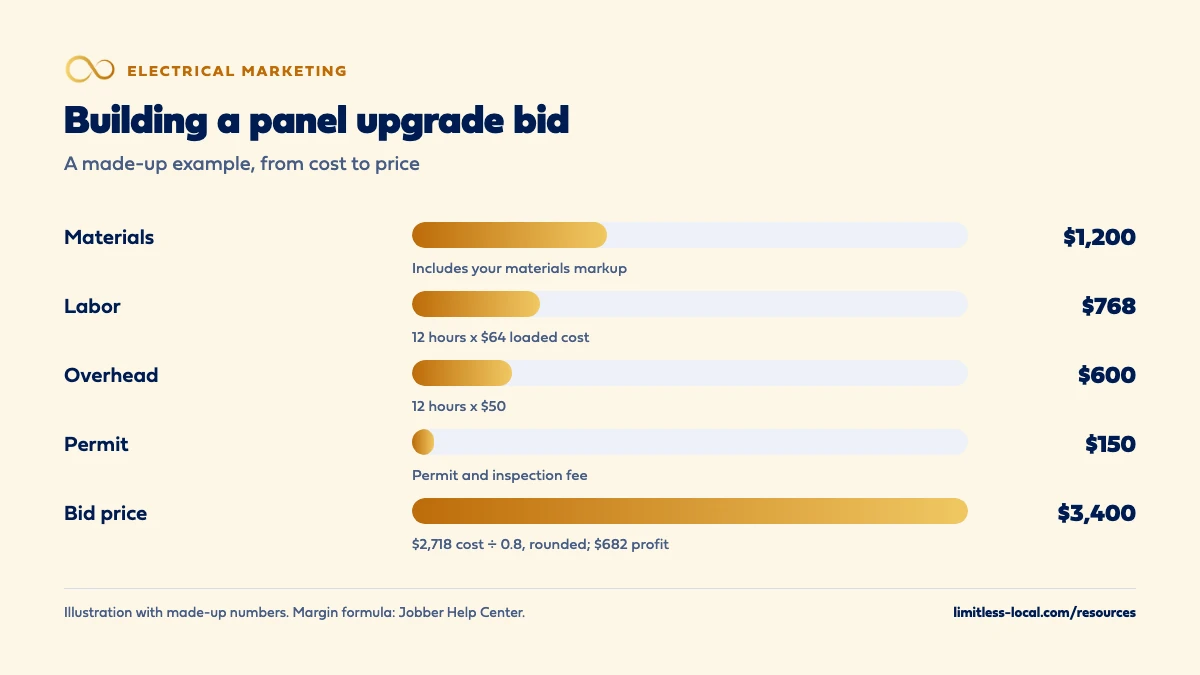
These numbers are made up to show the math, not a benchmark for your market.
Costs. Materials for the job cost you $1,200, already including your materials markup. You estimate 12 labor hours at a loaded labor cost of $64 an hour, so labor costs $768. The permit is $150. Your overhead works out to $50 per labor hour, so this job carries $600 of it (12 times $50). Your total cost is $2,718.
Price. You want a 20% margin, so you divide $2,718 by 0.8, which gives $3,397.50. You bid $3,400. If it goes as planned, the job leaves you $682 ($3,400 minus $2,718).
What happens if labor runs long. Say the old panel is worse than it looked and the job takes 4 extra hours. Each hour costs you $64 in labor plus $50 in overhead, so those 4 hours cost $456. Your profit drops from $682 to $226. That’s why labor estimates and clear exclusions for hidden conditions matter so much: one bad morning can take two-thirds of the profit.
Frequently asked questions
Should I charge for estimates on electrical jobs?
Many electricians charge for diagnostic visits and give free estimates on larger planned work. A fee, credited toward the job if they go ahead, is a reasonable way to screen out people who are only collecting prices.
How long should my electrical bid be valid?
Long enough for the customer to decide, short enough that material prices can’t move far, often a few weeks. State it on the bid, and re-price anything that comes back after it expires.
Should I give one price or good, better, best options?
Options often help on residential work, because the customer chooses between your prices instead of between you and another electrician. On general contractor bids, stick to the scope and break out alternates only when asked.
Should I ask for a deposit on electrical jobs?
For larger jobs, especially when you’re buying expensive equipment, a deposit protects you. Most field software can collect it when the customer approves the quote online.
What win rate should I aim for on bids?
It depends on the work and where the bids come from. A very high rate usually means you’re cheap; a very low one can mean price, slow follow-up or bids that were never a good fit. Track it by job type and lead source.
Should I lower my price if a customer says someone else is cheaper?
Not by reflex. Ask what the other bid includes, because the scope is often different. If you lower the price, take something out of the scope so the margin stays intact.
Key takeaways
- Decide whether a job is worth bidding before you spend hours on it.
- Get the scope in writing and turn every assumption into an exclusion or allowance.
- Cost = materials + loaded labor + permits, equipment and subs + overhead; then set margin on purpose.
- Make bids easy to approve with options, clear terms and a fast turnaround.
- Follow up on every bid and compare actual cost with the bid after every job.
Want a second set of eyes on your setup?
We'll look at how you show up locally and where calls are leaking, then send you a plain-English breakdown.
More in this section
- How should an electrical contractor market to commercial customers?
- How should a new electrical contractor get its first customers?
- How can an electrical contractor get more leads?
- How does an electrical contractor scale past one or two crews?
- What should an electrician charge per hour or per job?
Sources
- Markups on Quotes — Jobber Help Center
- Optional Line Items on Quotes — Jobber Help Center
- Create Unsold Estimates Campaigns using SMS — ServiceTitan Help
- Why am I not getting bid invites and what can I do about it? — BuildingConnected Support