
How can an electrical contractor get more leads?

- What's the best order to build lead sources for an electrical contracting business?
- Where do an electrical contractor's leads actually come from?
- Step 1: Decide which electrical jobs and towns you want more of
- Step 2: Stop losing the leads you already get
- Step 3: Get your Google Business Profile complete and accurate
- Step 4: Make asking for reviews part of every job
- Step 5: Give each kind of electrical work its own page
- Step 6: Add Local Services Ads and Google search ads when you can handle the calls
- Step 7: Bring past customers back and make referrals easy
- Step 8: Go after builder, contractor and commercial work if you want it
- Should I buy leads from lead marketplaces?
- How do I know which lead sources are worth more money?
- What's different about getting leads for an electrical business
- A worked example: comparing two lead sources by cost per booked job
- Frequently asked questions
- Key takeaways
- More in this section
- Sources
The short version
- Fix the leaks first: answer every call and follow up on every quote.
- Get your Google Business Profile complete and keep reviews coming in.
- Give each kind of electrical work its own page on your website.
- Add Local Services Ads and search ads when you can handle more calls.
- Judge every source by cost per booked job, not by lead count.
For electrical contractors who want the phone ringing more often, and want to know which lead sources to build first, which to add later and which to skip.
Get a free visibility audit · Book a growth call
What's the best order to build lead sources for an electrical contracting business?
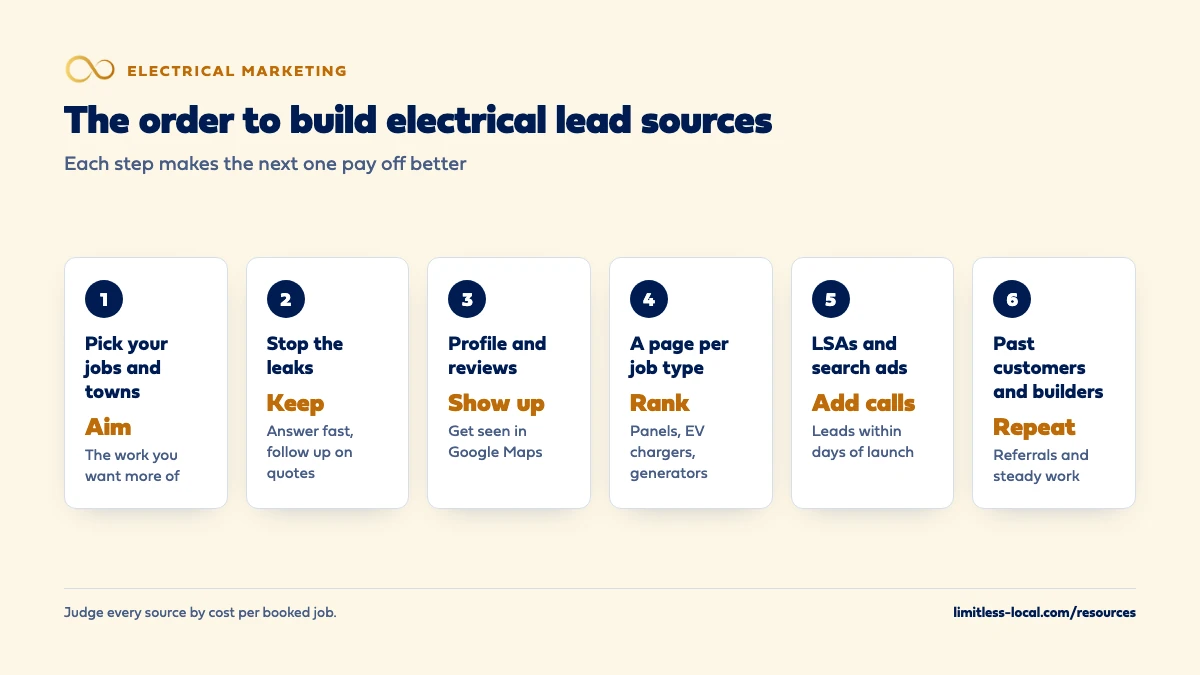
An electrical contractor gets more leads by showing up where homeowners and businesses already look for an electrician, then keeping more of the leads that come in. Build it in order: decide the jobs and towns you want, answer every call fast, get a complete Google Business Profile and a steady flow of reviews so you show in Maps, give your website a page for each kind of work, then add Local Services Ads and Google search ads for calls on demand. Past customers, referrals and builders round it out, and tracking each lead to a booked job tells you which sources deserve more money.
This is the same order we build in: tracking and follow-up first, then a clean Google presence, then local SEO and ads aimed at the towns and jobs you want, then monthly tuning based on calls, leads and revenue. Our local SEO work covers the Google profile, Maps and reviews, and our electrical contractor marketing page shows how it fits an electrical business. The rest of the electrical marketing questions library goes channel by channel.
Where do an electrical contractor's leads actually come from?
Almost every lead an electrician gets comes through one of a handful of doors:
- Google Maps and your Google Business Profile. Someone searches “electrician near me” and calls straight from the map listing.
- Paid search. Local Services Ads and regular Google search ads at the top of the results.
- Your website, found through regular search results or after someone saw your truck or your name.
- Past customers and referrals. The people you’ve already done work for, and the neighbors, friends and family they send.
- Builders, general contractors and property managers, if you take that kind of work.
- Lead marketplaces, where you pay for leads that are often sent to more than one contractor.
You don’t need all of them at once. The steps below are the order that usually makes sense, because each one makes the next one pay off better. If you want a channel-by-channel rundown of paid placements, where to advertise an electrical business covers that.
Step 1: Decide which electrical jobs and towns you want more of
“More leads” is too vague to act on. More of what? A shop that wants more panel upgrades and EV charger installs needs different pages, ads and reviews than one that wants more after-hours service calls or more tenant build-outs.
Write down three things before you spend anything:
- Your best two or three job types. The ones with good margins that your crews like doing.
- The towns or neighborhoods you want to drive to. Not everywhere you could drive. Where you’d be happy sending a truck on a Tuesday afternoon.
- How many more jobs a week you can actually handle. If you’re booked out three weeks already, more leads just means more people waiting, and some of them will call someone else.
That list shapes every step that follows: which Google categories you pick, which pages you build, which searches you pay for and where your ads show.
Step 2: Stop losing the leads you already get
This is the cheapest lead you’ll ever get: the one that already called you. Before you pay for more, look at where current leads leak out:
- Missed calls. You’re in an attic or on a ladder and the phone rings out. A homeowner with a dead circuit calls the next electrician on the list.
- Slow callbacks. A web form that sits until tonight is often a job someone else already booked this afternoon.
- Quotes nobody follows up on. The panel upgrade you priced last week didn’t say no. They just never heard from you again.
Fixing these doesn’t take a big budget. Have someone answer during business hours, or a service that answers for you. Set a rule that every form gets a reply the same hour. Send every quote from Jobber, Housecall Pro or ServiceTitan and turn on its follow-up reminders. How fast your office needs to answer calls goes deeper on the phone side.
Every later step sends more leads through this same process, so leaks here get more expensive as you grow.
Step 3: Get your Google Business Profile complete and accurate
For most residential electricians, the map listing is the single biggest source of free calls. Google’s tips to improve your local ranking say local results are mainly based on relevance, distance and popularity, and the parts you control are mostly about relevance and popularity:
- Verify the profile and make sure your name, phone number and service area are right.
- Pick the right primary category (Electrician, for most shops) and add only the secondary categories for work you really do.
- List your services in plain words: panel upgrades, EV charger installation, generator installation, lighting, troubleshooting.
- Add real photos of your trucks, crews and finished work.
- Keep your hours accurate, including whether you take emergency calls.
Distance you can’t change much. You’ll show up more easily near your address than across town, which is normal. Getting into the Google map pack covers the rest of what moves your Maps ranking.
Step 4: Make asking for reviews part of every job
Reviews do two jobs. They help you show up, because Google counts how well known you are, and they help the homeowner pick you once they see you next to two other electricians.
The trick is consistency, not a burst. A shop that gets a couple of new reviews every week looks alive. A shop with a pile from two years ago and nothing since looks like it might have closed.
- Ask at the right moment: when the lights come back on, the charger works or the panel passes inspection.
- Make it one tap. Send your Google review link by text the same day.
- Reply to reviews, good and bad, briefly and in your own words.
- Never pay or offer discounts for reviews. Google’s tips to get more reviews say offering incentives for reviews counts as fake and misleading content.
If your field software can send the review request automatically when a job closes, turn it on.
Curious what your marketing is actually booking?
Get a free visibility audit — no obligation, no sales pitch.
Step 5: Give each kind of electrical work its own page
A single “Services” page that lists everything from ceiling fans to commercial service upgrades won’t show up for most of what people search. Someone looking for a panel upgrade wants a page about panel upgrades, and so does Google.
Build one page for each job type on your list from Step 1, and make each one useful:
- What the job involves, in plain words, and the signs a homeowner needs it.
- Roughly what affects the price, even if you don’t post a number.
- The towns you serve for that work.
- A tap-to-call button and a short quote form near the top.
These pages also make your ads work better, because you can send someone who searched “EV charger installer” to the EV charger page instead of your home page. What an electrician’s website needs to get more calls covers the rest of the site.
Search rankings from pages like these build over months. SEO typically takes 3-6 months to show meaningful organic growth, so start the pages early even if ads are carrying the load for now.
Step 6: Add Local Services Ads and Google search ads when you can handle the calls
Paid search is the fastest way to add leads, because ads can generate leads within days of launch. Two options sit at the top of Google for electricians:
- Local Services Ads. You pay per lead, not per click, and the homeowner calls or messages you straight from the ad. Google is moving these into Google Ads as Performance Max campaigns with pay-per-lead goals, and its transition page lists electrical in the first phase that began in August 2026 for select advertisers in the United States.
- Google search ads. You pick the searches, you usually pay per click, and you send people to the right page on your site. They give you more control over which jobs you chase, like generator installs before storm season.
Turn them on when Steps 2 to 5 are in decent shape. Ads send people to your profile, your reviews and your website, and they all reward the shop that answers fast. Paying for clicks into a site with no panel-upgrade page, or for calls nobody picks up, is how owners decide “ads don’t work.” Whether to start with LSAs, Google Ads or SEO covers which to turn on first.
Step 7: Bring past customers back and make referrals easy
Your customer list is a lead source you’ve already paid for. The house that needed a new circuit two years ago may need a panel, a charger or a generator now.
- Stay in touch a few times a year with something useful: a reminder before storm season, a note when EV charger rebates change in your area, a safety check for older homes.
- Ask for referrals by name. “If your neighbors ever need an electrician, here’s my card” works better at the end of a good job than in a mass email.
- Record who referred whom, so you can thank them and see how much work referrals bring in.
Referral leads tend to close well because someone they trust already vouched for you.

Step 8: Go after builder, contractor and commercial work if you want it
Some electrical contractors want nothing but residential service. Others want steady work from builders, remodelers, general contractors and property managers to fill the schedule between service calls.
That work doesn’t come from Google Maps. It comes from relationships: getting on bid lists, showing up where builders meet, and turning the first job into the reason they call you for the next one. Track it as its own lead source, because its main cost is your time and its timeline is longer.
Should I buy leads from lead marketplaces?
They can fill gaps, especially when you’re new, but they’re rarely the foundation. The usual pattern: you pay for a lead that may also be sent to other contractors, you race to call first, and you’re competing on price with whoever answers fastest.
If you use them, treat them like any other paid source. Track every lead from them to a booked job, work out what each job cost you, and compare that with what your own Google profile and ads bring in.
How do I know which lead sources are worth more money?
Count booked jobs and revenue by source, not leads. A source that sends 30 leads a month and books 4 jobs can be worse than one that sends 10 and books 5.
Three habits make this possible:
- Ask and record “how did you hear about us?” on every call and form, and put the answer on the customer record.
- Use tracking numbers for your ads and your Google profile, so calls are tagged by source automatically.
- Run your field software’s lead source report. Jobber’s lead source report, for example, shows leads by channel and the revenue tied to them.
Once you have a few months of data, move money toward the sources with the lowest cost per booked job for the work you want. Tracking which marketing brings real jobs covers the setup.
Not sure which of these is costing you jobs?
A free visibility audit checks the Google profile, reviews, site and tracking, and shows what to fix first.
What's different about getting leads for an electrical business
Emergency and planned work need different doors. A homeowner with no power calls whoever answers first in Maps or the ads. A homeowner planning a panel upgrade or a whole-home generator reads reviews, looks at your website and may get two or three quotes. Your lead sources should cover both, and your phone process has to handle the first kind without dropping the second.
Job size varies wildly. A troubleshooting call and a service change can come from the same search. If you count every lead the same, you’ll pour money into whatever brings the most calls instead of whatever brings the jobs you want.
New demand keeps showing up. EV chargers, battery backup, generators and smart-home work give electricians reasons to reach past customers and new homeowners that most trades don’t have. Each is worth its own page and, in season, its own ads.
A worked example: comparing two lead sources by cost per booked job
These numbers are made up to show the math, not a benchmark for your market.
Say you spend $1,800 a month on Google search ads and get 36 leads. That’s $50 per lead. Of those, 12 book a job, so each booked job cost $150 ($1,800 divided by 12).
In the same month you pay $600 for marketplace leads and get 20 of them, or $30 per lead. Only 3 book, because the same leads went to other electricians. Each booked job from that source cost $200 ($600 divided by 3).
On cost per lead, the marketplace looks cheaper. On cost per booked job, it costs more.
If you’d rather have someone run it, our Essentials package is $3,500 a month and includes Google Ads management up to $2,500 a month in ad spend, Google Business Profile management, review response and basic review generation, and call, web and form tracking. Growth, at $4,500 a month, adds Local Services Ads management. Ad spend is paid to Google directly on top of either.
Frequently asked questions
What's the fastest way for an electrician to get more leads?
Paid search. Local Services Ads and Google search ads can bring in leads within days of launch, while SEO typically takes 3-6 months. They work best once someone’s answering the phone fast and your Google profile and reviews are in shape.
Do I need a website if I have a Google Business Profile?
You can get calls from a profile alone, but a website with a page for each kind of work helps you show up for more searches, gives your ads somewhere to send people and helps homeowners compare you with the other electricians they’re looking at.
Is social media a good source of electrical leads?
It’s usually a supporting channel rather than a main one. People rarely scroll social media looking for an electrician; they search Google. It’s most useful for staying in front of past customers and neighbors.
How many lead sources should a small electrical shop run?
Three or four done well beats eight done badly. For most small shops that’s the Google profile and reviews, a website with job pages, one paid search channel, and past customers and referrals.
Should I offer discounts to get more electrical leads?
Sparingly, and for a reason, like filling a slow month with planned work. A standing discount attracts price shoppers. A clear reason to call now, such as getting a generator in before storm season, usually works better.
Why am I getting more leads but not more jobs?
Usually it’s one of three things: the leads are for work or areas you don’t want, calls and quotes aren’t being followed up fast enough, or the leads are being sent to other contractors too. Tracking leads to booked jobs by source shows which one it is.
Key takeaways
- Decide which jobs and towns you want more of before spending anything.
- Fix missed calls and quote follow-up first; every new lead flows through them.
- A complete Google Business Profile and steady reviews are the base for most residential electricians.
- A page per job type helps you rank and gives your ads the right place to send people.
- Add LSAs and search ads for leads within days, and start SEO early because it takes months.
- Compare sources by cost per booked job, not cost per lead.
Want a second set of eyes on your setup?
We'll look at how you show up locally and where calls are leaking, then send you a plain-English breakdown.
More in this section
- How should a new electrical contractor get its first customers?
- How should an electrical contractor market to commercial customers?
- How do I get more referrals from past electrical customers?
- What should an electrician's website have to get more calls?
- How can I get general contractors to send me steady electrical work?
Sources
- Tips to improve your local ranking on Google — Google Business Profile Help
- Tips to get more reviews — Google Business Profile Help
- Local Services Ads transition to Performance Max campaigns with pay-per-lead goals — Google Ads Help
- Lead Source Report — Jobber Help Center