
How do electricians work out profit per job and customer value?

- How do I calculate average profit per job and what a customer is worth to my electrical business?
- What's the difference between profit per job and customer value?
- Step 1: Which jobs should I pull, and how should I group them?
- Step 2: What's my average invoice for each job type?
- Step 3: What goes into the cost of each job?
- Step 4: What about overhead like the shop, trucks and office?
- Step 5: How often do my customers come back?
- Step 6: How do I calculate customer value?
- Step 7: Should referrals count toward customer value?
- Step 8: How much can I afford to pay to win a new customer?
- What mistakes throw these numbers off?
- What's different about these numbers for electricians
- A worked example: two job types and one customer
- Frequently asked questions
- Key takeaways
- More in this section
- Sources
The short version
- Gross profit per job = invoice minus loaded labor, materials, permits and subs, by job type.
- Customer value = average profit per job x jobs per year x years they stay, plus agreements.
- Use profit, not revenue, for both numbers.
- Let the first job carry most of what you pay for a customer; lifetime value is your stretch.
For electrical contractors who want to know what a job and a customer are really worth before deciding what to pay to win the next one.
Get a free visibility audit · Book a growth call
How do I calculate average profit per job and what a customer is worth to my electrical business?
Profit per job is the invoice minus everything it took to do that job: loaded labor, materials, permits and subcontractors, worked out separately for each job type because a service call and a panel upgrade are worlds apart. Customer value is the gross profit a customer brings over the whole relationship, roughly average profit per job times jobs per year times the years they stay with you, plus any maintenance agreement. The two together tell you what you can afford to pay to win a new customer: the first job should carry most of it, and the lifetime number tells you how far past that you can safely stretch.
These two numbers are what we’d judge any marketing by, including ours, because they turn a cost per lead into a yes or no. Every one of our packages includes call tracking and a monthly report with a cost-per-lead breakdown, which is the other half of this math. Our electrical contractor marketing page shows how it applies to electricians, and the rest of the electrical marketing questions library goes question by question.
What's the difference between profit per job and customer value?
Profit per job looks at one visit. Customer value looks at the whole relationship.
- Profit per job is what’s left from one invoice after the direct costs of doing that job. It tells you whether the work itself pays.
- Customer value, often called lifetime value, adds up the profit from every job a customer gives you while they stay with you: the first call, the panel upgrade two years later, the generator after the next outage, the maintenance agreement. Canada’s business development bank, BDC, defines customer lifetime value as the amount, after expenses, a business can expect from a specific customer over the course of the relationship.
You need both. Profit per job keeps you from winning work that loses money. Customer value keeps you from walking away from customers who are worth far more than their first small ticket.
Step 1: Which jobs should I pull, and how should I group them?
Pull every completed job from the last six to twelve months out of Jobber, Housecall Pro, ServiceTitan or your accounting software. A full year smooths out storm weeks and slow months, but six months is enough to start.
Then sort them into a short, fixed list of job types, such as:
- Service calls and troubleshooting
- Panel upgrades and service changes
- EV charger installs
- Generators and transfer switches
- Remodel and rewiring work
- Commercial work
Keep the list short enough that every job fits one bucket. If half your jobs end up in “other,” your list is wrong. One blended average across all of them will hide what’s actually making you money.
Step 2: What's my average invoice for each job type?
Add up what you invoiced for each job type and divide by the number of jobs. Use what the customer actually paid, after discounts, not your price sheet.
A few things to watch:
- Warranty callbacks bring in nothing but still cost labor. Count them against the original job type, or you’ll overstate the profit on that work.
- Diagnostic fees that became bigger jobs belong with the bigger job, not as a separate tiny ticket.
- A few huge jobs can drag the average up. If one commercial job was ten times your usual size, look at the average with and without it.
This average is also the starting point for working out how many jobs a month you need to hit a revenue goal, so it’s worth getting right once.
Step 3: What goes into the cost of each job?
Everything that goes up or down because you did that job:
- Loaded labor. Hours on the job times what each person really costs you. Jobber’s job costing guide says the labor cost should include the employee’s wage, benefits and taxes, not just the hourly wage.
- Materials, at what you paid, including the wire and fittings that never make it onto a line item.
- Permits and inspection fees.
- Subcontractors and equipment rental, such as a trencher for a generator run.
- Drive time, if it’s significant for that kind of job.
Subtract the total from the average invoice and you have gross profit per job. Divide gross profit by the invoice and multiply by 100 for your gross margin, which makes job types easy to compare. Most field software can do this for you once it’s set up; Housecall Pro, for example, has job costing reports that show costs and profitability across jobs.
Curious what your marketing is actually booking?
Get a free visibility audit — no obligation, no sales pitch.
Step 4: What about overhead like the shop, trucks and office?
Leave it out of the job cost, but don’t forget it. Overhead is the rent, insurance, office staff, software, truck payments and everything else you pay whether you run ten jobs this month or forty.
Gross profit from jobs has to cover all of it before you make a dollar. The SBA’s break-even point calculator uses the same idea: fixed costs divided by what each unit sells for minus its variable costs gives you the number of units, or here jobs, you need just to break even.
That’s also why marketing doesn’t belong in the job cost. It’s what you spend to win the job, and it has to come out of the gross profit along with overhead. Keeping it separate is what lets you ask the real question: how much of each job’s gross profit can I spend to win it and still cover the shop?
Step 5: How often do my customers come back?
Now look past the single job. In your field software, find the customers whose first job was at least two or three years ago, and count how many jobs each has given you since. That tells you two things:
- Jobs per year for a typical returning customer.
- How long they stay, meaning how many years until they stop calling, move away or switch to someone else.
Most electricians find a split. Some customers call once and never again. Others call every time something flickers, refer their neighbors and upgrade the panel when they add a charger. Look at both groups, because an average that mixes them can mislead you.
If your records don’t go back that far, start tracking now. Lead source and job type on every job is the habit that makes this possible, which is covered in what first-party data means for an electrical business.
Step 6: How do I calculate customer value?
A simple lifetime value formula from the same bank works well: the average value of a sale times the average number of repeat transactions times the average retention period, plus any maintenance or after-sale service.
For an electrician, use gross profit instead of the invoice, so you’re counting what you keep:
- Average gross profit per job across what returning customers buy.
- Times jobs per year.
- Times the years they typically stay.
- Plus the gross profit from a maintenance agreement, if they have one, for each year they keep it.
Run it separately for residential and commercial customers, because the numbers rarely look alike. If you sell agreements, selling maintenance agreements to past customers is one of the most direct ways to raise this number.

Step 7: Should referrals count toward customer value?
Only if you can count them. A customer who sends you two neighbors is clearly worth more than one who doesn’t, but adding a guessed referral value to every customer inflates the number and makes expensive marketing look affordable.
The careful approach:
- Record “referred by” on every new customer, with the name of who sent them.
- After a year, see what share of customers sent anyone, and what those referrals were worth.
- Add that as a separate line you can see, not baked into the main number.
Until you have that data, leave referrals out and treat them as upside. Getting more referrals from past customers covers how to make that upside bigger.
Step 8: How much can I afford to pay to win a new customer?
Use both numbers, in this order.
Start with the first job. Decide what share of that first job’s gross profit you’re willing to spend to win it. A ceiling based on the first job keeps cash flow safe, because you get the money back on day one. What a good cost per booked job looks like walks through setting that ceiling by job type.
Then use customer value as your stretch. The bank’s lifetime value article adds what it calls a very general guideline, depending on the benchmark you look at: lifetime value should be 2.5 to 3 times what it costs to acquire a customer. That’s not a rule for electricians, but it’s a sane check: if your lifetime value is three times what you’re paying, you have room; if it’s barely above it, you’re betting on repeat work you may not get.
The gap between the two is a decision. Paying more than the first job earns makes sense for job types that clearly lead to more work, like a first service call in an older home. It makes less sense for one-off work in a market where people rarely call back.
What mistakes throw these numbers off?
- Using revenue instead of profit. A $2,000 lifetime revenue customer is not worth $2,000 to you.
- Leaving your own labor out. If you’re still on the tools, put a wage on your hours, or every job looks better than it is.
- One average for everything. Service calls and panel upgrades blended together tell you nothing about either.
- Counting a year of hope. Use the repeat rate you can see in your records, not the one you’d like.
- Forgetting callbacks and warranty work. They cost labor and earn nothing.
- Never updating. Material prices and wages move. Re-run it at least once a year, and whenever you raise prices.
Not sure which of these is costing you jobs?
A free visibility audit checks the Google profile, reviews, site and tracking, and shows what to fix first.
What's different about these numbers for electricians
A huge spread of job sizes. The same truck may run a small troubleshooting call in the morning and a service change in the afternoon. That’s why profit per job has to be worked out by job type before it means anything.
The house keeps needing work. Older homes add circuits, panels, chargers and generators over the years, so a good residential customer can come back several times as the house changes. That repeat pattern is where most of an electrician’s customer value comes from.
Permits and inspections are real job costs. On panel, service and generator work, fees and return trips for inspection belong in the job cost, or those jobs look more profitable than they are.
Commercial customers behave differently. A property manager or business owner may give you steady work for years, or none after one bid. Calculate commercial customer value on its own, over a longer period.
A worked example: two job types and one customer
These numbers are made up to show the math, not a benchmark for your market.
Profit per job. Your service calls average $350 invoiced, with $210 in loaded labor and materials, so gross profit is $140, a 40% margin. Your panel upgrades average $2,800, with $1,650 in labor, materials and permits, so gross profit is $1,150, about a 41% margin. Similar margins, very different dollars.
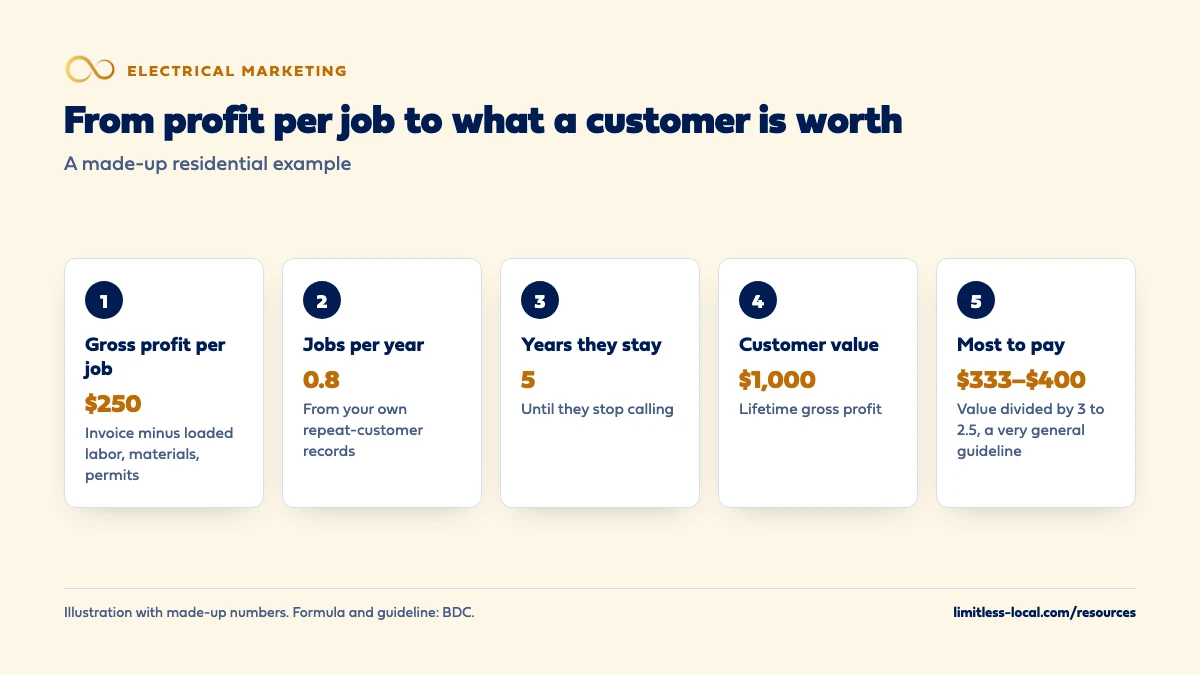
Customer value. Across all their jobs, your returning residential customers average $250 gross profit per job, give you 0.8 jobs a year and stay about 5 years. That’s $250 times 0.8 times 5, or $1,000 in lifetime gross profit.
What you can pay. If you want the first job to pay for itself and that first job is usually a service call, your ceiling sits below the $140 it earns. Using the very general 2.5 to 3 times guideline on lifetime value, $1,000 divided by 3 is about $333, and divided by 2.5 is $400. So paying up to around $333 to $400 for a new residential customer is defensible, as long as the repeat work you’re counting on really shows up in your records.
Put marketing costs into the same math. Our Essentials package is $3,500 a month, with ad spend paid directly to Google on top. At $400 per new customer, the fee alone needs about 9 new customers ($3,500 divided by $400, rounded up) a month to stay inside that limit, before any ad spend. Running that math on your own numbers is what a growth call is for.
Frequently asked questions
Is profit per job the same as gross margin?
Close. Gross profit per job is the dollar amount left after direct job costs; gross margin is that amount divided by the invoice, times 100. Dollars tell you what a job is worth, the percentage lets you compare job types.
Should I use revenue or profit for customer lifetime value?
Profit. Revenue makes every customer look more valuable than they are, and it’s profit that pays for marketing and overhead.
How do I count a maintenance agreement in customer value?
Add the yearly gross profit from the agreement, meaning the fee minus the cost of the visits you promised, for each year a customer typically renews.
What if I'm too new to know my repeat rate?
Use only the first job’s gross profit to decide what you can pay for now, and start recording lead source and job type on every job. After a year or two, you’ll have real repeat numbers.
Should commercial customers get their own numbers?
Yes. Commercial jobs, payment terms and repeat patterns rarely look like residential ones, so a blended number misleads you on both.
Does my own time on the tools count as a job cost?
Yes. Put a realistic wage on your hours. Otherwise every job you work yourself looks more profitable than it would with a hired tech.
Key takeaways
- Work out gross profit per job by job type, using loaded labor, materials, permits and subs.
- Keep overhead and marketing out of job cost; gross profit has to cover both.
- Customer value is average profit per job x jobs per year x years they stay, plus agreements.
- Let the first job carry most of what you pay for a customer, and use lifetime value as your stretch.
- Leave referrals out until you can count them, and re-run the numbers at least once a year.
Want a second set of eyes on your setup?
We'll look at how you show up locally and where calls are leaking, then send you a plain-English breakdown.
More in this section
- How many jobs a month does an electrician need to hit a revenue goal?
- Should electricians show prices on their website?
- What is a good cost per booked job for electrical marketing?
- Should an electrician optimize for calls or form fills?
- What website content helps electrician customers choose me?
Sources
- Customer lifetime value — BDC
- Do you know the lifetime value and cost of acquisition of your customers? — BDC
- Gross profit margin — BDC
- Break-even point calculator — U.S. Small Business Administration
- Job Costing — Jobber Help Center
- Job Costing Reports — Housecall Pro Help Center