
What does an agency do in month one for an electrician?

- What work should a marketing agency finish in an electrician's first 30 days?
- What should an agency's first month look like for an electrician?
- What will the agency need from me in week one?
- How does the agency set up call and form tracking?
- What happens to my Google Business Profile in month one?
- Will they fix my business listings across the web?
- What website fixes come first?
- When do my Google search ads go live?
- Why might Local Services Ads take longer to start?
- What should I see by day 30 if calls haven't started?
- What do I need to do during month one?
- What's different about month one for electricians
- A worked example: what a day-30 work log might show
- Frequently asked questions
- Key takeaways
- More in this section
- Sources
The short version
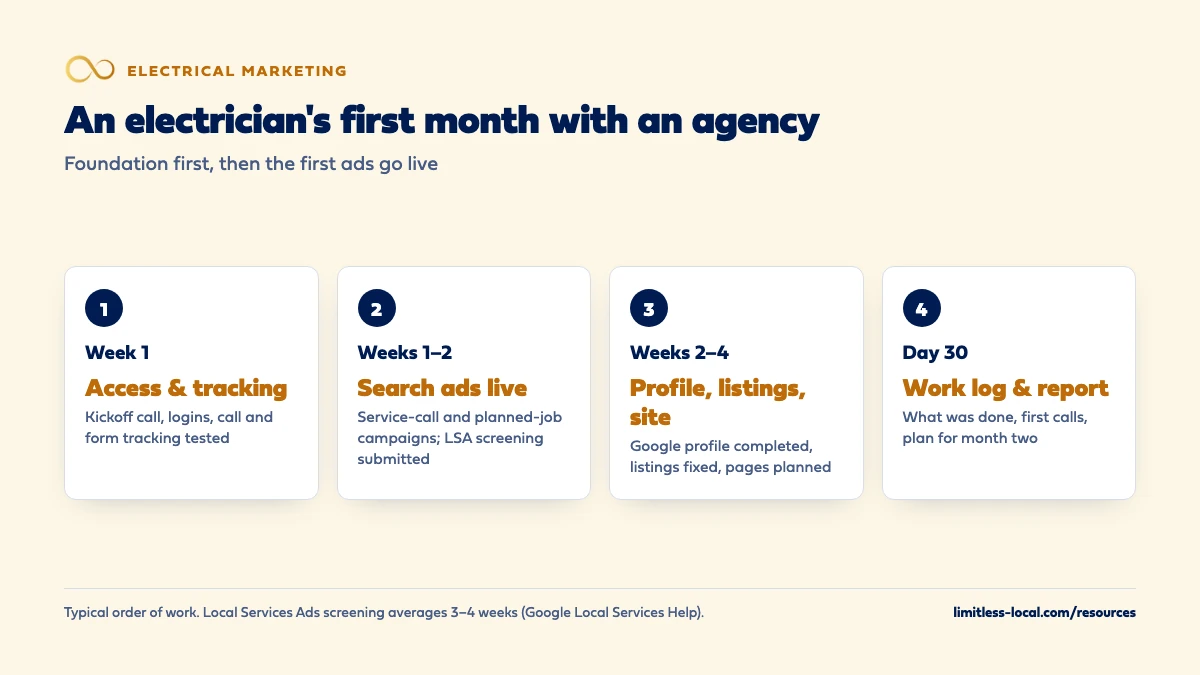
- Week one: access, a kickoff call and tracking set up.
- Weeks one and two: first Google search ads built and live.
- Through the month: Google profile, listings and website fixes.
- Day 30: a work log, working tracking and a first report, even if calls are slow.
For electrical contractors who just signed with an agency, or are about to, and want to know what the first month’s work should be when the phone hasn’t started ringing yet.
Get a free visibility audit · Book a growth call
What work should a marketing agency finish in an electrician's first 30 days?
In month one, a marketing agency should mostly build the foundation for an electrician: get access to your accounts, set up call and form tracking, clean up your Google Business Profile and directory listings, fix what stops your website from turning visitors into calls, and launch your first Google search ads. Search ads can bring calls within days of going live, but SEO typically takes 3 to 6 months, and Local Services Ads screening for electricians takes weeks. By day 30, even if calls are still slow, you should have a written log of what was done, tracking you’ve tested, ads running and a first report.
That’s how our first month runs too: a 15-minute discovery call, about 2-3 hours of your team’s time for onboarding, and campaigns live in weeks 1-2, with tracking, follow-up and a clean online presence built first. After that it’s monthly reviews based on calls, leads and revenue. See what each tier includes on our packages page, how it works for electrical shops on our electrical contractor marketing page, or browse more electrical marketing questions.
What should an agency's first month look like for an electrician?
Mostly setup, with the first ads going live partway through. Month one is foundation work: tracking, your Google profile, your listings and the pages that turn a visitor into a call. Everything later builds on it, so a first month that skips it tends to show up as confusing reports and wasted spend in month three.
A good agency runs it roughly in this order:
- Access and kickoff so nothing waits on a password.
- Tracking before any money is spent, so the first call is counted.
- Google search ads built and live, because they’re the fastest channel.
- Google Business Profile, listings and website fixes through the rest of the month.
- A first report at the end, with a list of what was done and what’s next.
Ours follows the same three phases: build the foundation, turn on lead flow with local SEO and ads around the towns and jobs you want, then improve and scale month by month.
What will the agency need from me in week one?
Access and answers. Expect a kickoff call and a list of logins. The goal is to get everything in one sitting so the agency doesn’t have to chase you while you’re on jobs.
Access, with you staying the owner:
- Google Ads (or permission to create an account in your name)
- Your Google Business Profile, with the agency added as a manager
- Your website and domain logins
- Google Search Console and Analytics, if you have them
- Read access to your field software, or a monthly export of booked jobs
Answers about the business: which jobs you want more of, which towns you serve and which you skip, your hours and after-hours policy, where you’re licensed, and what your average service call and panel upgrade bring in.
Keep ownership of every account and give access, never the other way around. What to look for in an electrical contractor marketing agency covers why that matters before you sign.
How does the agency set up call and form tracking?
Before any ads run, so the first call counts. For an electrician, most leads are phone calls, so call tracking does the heavy lifting:
- Tracking numbers on the website, the Google profile and the ads, so each call shows where it came from.
- Ad call tracking in Google Ads. Google’s page on phone call conversion tracking notes that tracking calls from ads and from a website requires Google forwarding numbers, and that call tracking helps you find which keywords, ads and campaigns drive the most valuable calls.
- Form tracking on quote and contact forms.
- Recording, so you can tell a real customer from a robocall.
Then test it. A good agency places test calls and form fills and shows you they landed in the right place. Ask to see that. Tracking that’s broken in month one makes every report after it wrong. Which conversion tracking an electrician should set up first goes step by step.
What happens to my Google Business Profile in month one?
It gets cleaned up and filled in. If it isn’t verified, that comes first: verifying your business is what gives you ownership of the profile and lets you edit your business info, and Google decides which verification methods you can use.
Then the profile gets completed:
- The right primary category, and secondary ones only for work you really do
- Services listed one by one: panel upgrades, EV charger installs, generators, lighting, troubleshooting
- Service areas drawn to where your trucks actually go
- Hours that match when someone answers the phone
- Real photos of your team, trucks and finished work
- Review replies, starting with any that were left unanswered
Google’s tips to improve your local ranking say businesses with complete and accurate info are more likely to show up in local results, and that those results are mainly based on relevance, distance and popularity. Month one handles the parts you control. How to optimize an electrician’s Google Business Profile has the full list.
Curious what your marketing is actually booking?
Get a free visibility audit — no obligation, no sales pitch.
Will they fix my business listings across the web?
They should start in month one. Your business name, address and phone number show up on directories, map apps and data sites, and old or mismatched versions creep in when you move, change numbers or rebrand. Cleaning them up so every listing says the same thing is unglamorous work that supports your Google profile.
When we take this on, your name, address and phone get synced across 50+ directories. Whoever does it, ask for a list of which listings were updated, so you can spot-check a few yourself.
If you’re a service-area business that doesn’t want its home address public, say so before any listing goes out. Which local directories matter for electricians explains which ones are worth the effort.
What website fixes come first?
The ones that stop a visitor from calling. Before sending paid traffic to your site, an agency should check:
- The phone number is at the top of every page and tappable on a phone.
- The jobs you want each have a page: panel upgrades, EV chargers, generators, troubleshooting, commercial work.
- The towns you serve are named, so both Google and homeowners know where you work.
- Forms work and land in an inbox someone checks.
- The site loads fast on a phone.
Not every page gets built in week one. Our Essentials package, for example, includes a content sprint of up to 10 pages and one landing page, and those roll out as the foundation comes together. What you should see in month one is the plan for which pages come first and the fixes to anything that’s actively losing calls.
When do my Google search ads go live?
Usually in the first week or two, once tracking is in place. That’s how ours run: campaigns go live in weeks 1-2. Search ads are the fastest channel, because they can bring leads within days of launch.
Building them well takes some care:
- Separate campaigns or ad groups for urgent service calls and planned jobs like panel upgrades.
- Location targeting matched to your real service area.
- Negative keywords for job seekers, do-it-yourselfers and services you don’t offer.
- Ad schedules that match when someone can answer.
Google reviews new ads before they run, and its page on the ad review process says most ads are reviewed within one business day, though some take longer. By the end of month one, ask to see the search terms that triggered your ads. It’s the fastest way to know whether the money is reaching the right people.
Why might Local Services Ads take longer to start?
Because electricians go through extra screening. Google treats the electrician category as urgent, since people often call about things like exposed wiring, so electricians get an additional level of screening that includes background checks, alongside license, insurance and business checks for select users. Its screening and verification requirements say the process takes 3–4 weeks on average after you submit your documents, and that you need a public, verified Google Business Profile to advertise.
So a good month one starts screening early: the agency gathers your license, insurance and business details in week one and submits them, while search ads carry the load. If LSAs aren’t live by day 30, that’s normal. If nobody has started the paperwork, it isn’t.
Local Services Ads management is part of our Growth and Scale tiers; Essentials covers Google search ads.
What should I see by day 30 if calls haven't started?
Proof of work, even if the phone is still quiet. By the end of month one you should be able to see:
- A work log: what was set up, changed and published, with links.
- Tracking that works: test calls and forms that showed up correctly.
- Ads running, with the search terms they showed for and any calls they brought.
- A completed Google profile you can look up yourself.
- Listings and pages either done or on a dated list.
- LSA screening submitted, with its status.
- A first report and a plan for month two.
Search ads that are live and getting impressions but no calls point to a problem worth fixing now: the wrong searches, a weak page or a phone nobody answers. SEO calls being slow at day 30 is expected, because Google’s SEO Starter Guide says some changes take effect in a few hours and others could take several months. How to know if your electrical SEO provider is doing anything shows what to look for in the work log.
What do I need to do during month one?
Less than you’d think, but not nothing. With us, onboarding takes your team about 2-3 hours in total. After that, your jobs are:
- Answer the phone. A tracked call that rings out is a lead you paid for and lost.
- Mark which calls booked. In your field software or a simple list, so cost per booked job can be worked out later.
- Send photos of real jobs for the Google profile and website.
- Start asking for reviews after every good job.
- Show up to the first review and ask questions.
If you’re spending hours a week on the agency in month one, something’s off. If you’re spending none at all, you’ll miss whether it’s working. What to expect from electrical marketing in the first 90 days covers what months two and three should add.
Not sure which of these is costing you jobs?
A free visibility audit checks the Google profile, reviews, site and tracking, and shows what to fix first.
What's different about month one for electricians
Screening runs alongside setup. Electricians’ extra Local Services Ads screening means that channel usually starts later than search ads. Plan for it instead of waiting on it.
Two kinds of calls need two setups. Urgent no-power calls and planned panel or EV charger jobs need different ads, pages and hours. Month one is when that split gets built.
Licensing goes on the record early. License details feed Local Services Ads screening and belong on your website and Google profile, so have them handy at kickoff.
Quoted jobs show up late. A panel-upgrade lead from week three may not sign until month two, so month one’s booked jobs will mostly be service calls.
A worked example: what a day-30 work log might show
This is a made-up log for a small electrical shop, to show what you should be able to see at the end of month one. It isn’t a forecast for your business.
- Tracking: tracking numbers on the website, Google profile and ads; 4 test calls and 2 test forms landed correctly.
- Google search ads: one campaign for service calls and one for panel upgrades and EV chargers, live from day 9; 37 negative keywords added after reviewing search terms.
- Google profile: primary category corrected, 11 services listed, 24 job photos added, 6 old reviews answered.
- Listings: name, address and phone fixed on the main directories; the rest on a dated list.
- Website: phone number added to the header, a broken quote form fixed, panel-upgrade and EV charger pages drafted for approval.
- Local Services Ads: documents submitted on day 4, background checks in progress.
- Results so far: 19 tracked calls, 8 real leads, 3 booked service calls, and 2 panel-upgrade quotes out.
Three booked jobs in month one isn’t a verdict either way. What matters is that every line is something the owner can check, and the next month’s plan follows from it.
Frequently asked questions
Should I expect booked jobs in month one?
Some, if search ads go live early and someone answers the phone. Don’t judge the agency on month one’s job count, though; judge it on whether the foundation work got done.
Is it normal to pay a full fee in month one when there's mostly setup?
Yes. The setup is real work, and it’s what every later month builds on. Ask for the work log so you can see what the fee paid for.
Should the agency rebuild my website in month one?
Not usually. A full rebuild takes longer than a month. Month one should fix what’s losing calls now and plan any new pages.
What if my old agency still controls my accounts?
Tell the new agency at kickoff. Getting ownership back of your Google Ads account, Google profile and domain comes before anything else, because everything else depends on it.
How often should I hear from the agency in month one?
Enough to know what’s happening: a kickoff, a heads-up when ads go live, and a first review at the end of the month. You shouldn’t have to chase them for updates.
Key takeaways
- Month one is mostly foundation: access, tracking, Google profile, listings and website fixes.
- Google search ads usually go live in the first week or two and are the fastest source of calls.
- Local Services Ads screening for electricians includes background checks and averages 3–4 weeks, so it should start in week one.
- By day 30, expect a work log, tested tracking, live ads and a first report, even if calls are slow.
- Your part: answer the phone, mark booked jobs, send photos and ask for reviews.
Want a second set of eyes on your setup?
We'll look at how you show up locally and where calls are leaking, then send you a plain-English breakdown.
More in this section
- How many leads per month before an electrician hires an agency?
- What does a marketing agency do for an electrician I can't?
- How many extra leads must an electrician get to pay for an agency?
- Should an electrician hire a full-service agency or one specialist?
- How much does a marketing agency cost for an electrician?
Sources
- About phone call conversion tracking — Google Ads Help
- Tips to improve your local ranking on Google — Google Business Profile Help
- Verify your business on Google — Google Business Profile Help
- About the ad review process — Google Ads Help
- Business screening and verification requirements – United States — Google Local Services Help
- SEO Starter Guide: The Basics — Google Search Central