
Which local citations and directories matter for electricians?
- Which online directories should an electrical contractor be listed on first?
- What is a citation, and what does NAP mean?
- Do citations still help an electrician show up on Google?
- Step 1: Write down your official name, address and phone
- Step 2: Fix your Google Business Profile first
- Step 3: Claim Apple Business and Bing Places
- Step 4: Get the sites homeowners check right
- Step 5: Add the trade and local listings that fit your work
- Step 6: Find and fix the wrong listings and duplicates
- Should I use a call tracking number on my directory listings?
- Are lead sites like Angi and Thumbtack worth listing on?
- Should I pay for a citation-building service?
- What's different about citations for electricians
- A worked example: a first cleanup list
- Frequently asked questions
- Key takeaways
- More in this section
- Sources
The short version
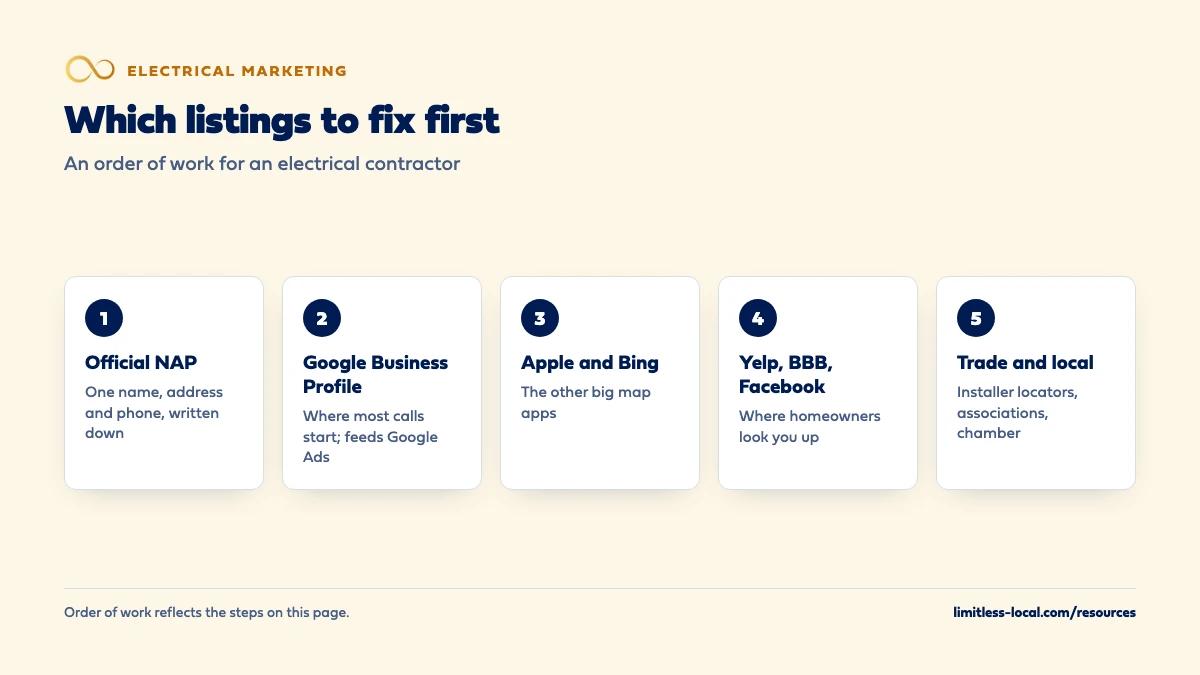
- Start with Google, then Apple Business, Bing Places, Yelp, BBB and Facebook.
- Write your name, address and phone the same way everywhere.
- Add trade and local listings that fit your work: installer locators, associations, chamber.
- Fix wrong and duplicate listings before adding new ones.
For electrical contractors cleaning up their listings beyond Google, and deciding which directories are worth the time.
Get a free visibility audit · Book a growth call
Which online directories should an electrical contractor be listed on first?
The listings that matter most for an electrician are the ones that feed maps and the ones homeowners actually check: your Google Business Profile first, then Apple Business, Bing Places, Yelp, the Better Business Bureau and Facebook, with your business name, address and phone (NAP) written the same way on each. After that, add the trade and local listings that fit your work, such as manufacturer installer locators, trade associations and your chamber of commerce. Fixing wrong or duplicate listings matters more than adding hundreds of new ones.
Listing cleanup and buildout is part of every package we run, and we sync name, address and phone across 50+ directories so the details match wherever homeowners look. Our local SEO page explains how that fits with your Google profile and website, and our electrical contractor marketing page shows how it applies to electricians. The full electrical marketing questions library covers the rest of local search.
What is a citation, and what does NAP mean?
A citation is any place online that lists your business name, address and phone number together: your Google profile, Yelp, the BBB, a chamber of commerce directory, a manufacturer’s installer locator. Owners and agencies shorten name, address and phone to NAP.
Citations matter for two reasons. Homeowners see them when they look you up by name, and the companies that run maps and search use outside data to decide what’s true about your business. Google’s page on how it sources business information says profiles are compiled from several sources, including publicly available web content, licensed data from third parties and information contributed by users. If those sources disagree, you can’t always be sure which version shows.
Do citations still help an electrician show up on Google?
They’re part of the picture, not the whole of it. Google’s tips to improve your local ranking say local results are mainly based on relevance, distance and popularity. Google describes how well-known a business is as based partly on information like how many websites link to it and how many reviews it has.
Google doesn’t publish a list of directories that count, and no number of listings will make up for a thin Google profile, few reviews or a website without pages for the work you do. In our judgement, citations mostly protect you: they keep wrong numbers and old addresses from sending customers elsewhere, and they back up the details on your Google profile. Getting your electrical company into the map pack covers the factors that carry more weight.
Step 1: Write down your official name, address and phone
Before you touch a single listing, decide the exact version you’ll use everywhere and write it down:
- Business name: the name on your trucks, invoices and license paperwork. Google’s guidelines for representing your business say your name should reflect how you’re known in the real world, without extra keywords like “24-Hour Electrician” or a city name you don’t actually use.
- Address: one format, including any suite number. If you work from home and go to customers, you’re a service-area business, and Google’s guidelines say to hide the address and show a service area instead.
- Phone: one main local number you control.
- Website and hours: not strictly NAP, but fix them in the same pass.
In our judgement, small differences like “Street” versus “St.” matter far less than a wrong phone number or an old address. Spend your time on errors that would send a customer to the wrong place.
Step 2: Fix your Google Business Profile first
Google comes first because, for most electricians, it’s where the most calls start, and because your profile now feeds Google’s ads too. Under Google’s move of Local Services Ads into Google Ads, which started in August 2026 for select advertisers including electrical, your business name, address and hours sync from your Business Profile into Google Ads.
Check the name, address or service area, phone, hours, website and categories, and fix anything out of date. Optimizing your electrician Google Business Profile covers the profile itself in detail; this page is about everywhere else.
Step 3: Claim Apple Business and Bing Places
These two feed the other big map apps, and many owners have never claimed them.
- Apple Business controls your place card in Apple Maps. Apple’s page on keeping location information accurate says customers can report problems with a place card directly to Apple, that Apple reviews those reports and may edit the card, and that your organization gets an email when it does.
- Bing Places for Business feeds Bing search and maps. Bing’s help on managing your listing says it pulls business information from Bing Places and multiple third-party data sources, and that changes to basic details are only applied if they align with trusted external data. If the rest of the web shows an old number, your update may not publish.
That Bing rule is the clearest statement you’ll find of why consistency across directories matters.
Curious what your marketing is actually booking?
Get a free visibility audit — no obligation, no sales pitch.
Step 4: Get the sites homeowners check right
In our judgement, these are the places homeowners most often land when they look up an electrician by name, so a wrong number there costs real calls:
- Yelp. Claim your page through Yelp for Business and keep the basics current.
- The Better Business Bureau. The BBB publishes free business profiles with ratings, reviews and complaint history. Its FAQ notes that it isn’t a government agency and that dues from accredited businesses fund its work, so accreditation is a choice, not a requirement for having a profile.
- Facebook. Your page’s name, phone and hours should match everything else.
- Nextdoor, if neighbors in your area recommend trades there.
Step 5: Add the trade and local listings that fit your work
After the big platforms, add listings that say something about your work and your town. In our judgement, these are worth more to an electrician than generic directories nobody visits:
- Manufacturer installer and dealer locators for the EV chargers, generators, panels or lighting systems you’re trained or certified on. Homeowners use them to find an installer.
- Trade associations you belong to, if they publish a member directory.
- Your chamber of commerce and local business groups.
- Builder, remodeler and property-manager associations if you want commercial and new-construction work.
- Utility or local program contractor lists, where your area has them and you qualify.
Each one should show your exact official name, address and phone.
Step 6: Find and fix the wrong listings and duplicates
Search your company name, then search each of these on its own, in quotes: every phone number you’ve used for the business (old cell numbers, numbers from past ad campaigns), every past address, and any former business name. List every result in a spreadsheet: site, what it shows, and whether you can log in. That’s your to-do list.
Duplicates need care. Google’s guide to resolving duplicate profiles allows one Business Profile per business, and a second pin for your company on Google Maps is a problem to fix, not a bonus listing. If you moved or changed your name, follow each platform’s own rule rather than assuming they work the same way. Google says to update the existing profile after a move rather than create a new one. If you’ve already lost ground in Maps, what to fix first after losing your map pack spot covers where listing problems fit in.

Should I use a call tracking number on my directory listings?
Be careful. Tracking numbers tell you which marketing made the phone ring, but a different number on every directory works against consistency. Google’s guidelines say the phone number on your profile must be under your direct control and reach your business, and allow additional numbers beyond the main one.
In our judgement, the safer setup is to keep your main local number on Yelp, BBB, Facebook and the other directories, so the citations agree, and use tracking numbers on ads and your website, where they’re easier to manage. Whether you need call tracking numbers covers how to set them up without causing a mismatch.
Are lead sites like Angi and Thumbtack worth listing on?
They’re a different decision. A basic profile on a lead marketplace can act as one more citation, but the main reason electricians join them is to buy leads, and that’s a cost question, not a listings question. Before you pay, compare what a booked job from those leads costs you against your other channels. Whether electricians should pay for leads on Angi or Thumbtack works through that choice.
Whatever you decide, keep your name, address and phone on those profiles identical to everywhere else.
Should I pay for a citation-building service?
It depends on what you’re buying. In our judgement, paying to submit your business to hundreds of low-quality directories adds little, and can leave you with listings you can’t log in to later. What’s worth paying for, by you or someone you hire, is the cleanup: finding the wrong and duplicate listings, fixing the major platforms and keeping them current.
Ask any service which directories it covers, whether you’ll own the logins, and what happens to the listings if you stop paying. In our judgement, listing changes also take time to spread: some platforms update within days, while smaller directories that copy their data from other sources can take weeks or months. Like the rest of SEO, which typically takes 3-6 months to show meaningful growth, this is a ramp, not a switch.
Not sure which of these is costing you jobs?
A free visibility audit checks the Google profile, reviews, site and tracking, and shows what to fix first.
What's different about citations for electricians
Your license and your business name should agree. Homeowners and general contractors may check your license before hiring. Using the same business name on your listings as on your license paperwork avoids confusion. Licensing rules vary by state, so check yours directly.
Installer locators bring buyers, not just links. Someone searching a manufacturer’s site for an EV charger or generator installer is close to buying. If you’re eligible, those listings can be worth more than any general directory.
Commercial work has its own directories. Builders, general contractors and property managers find electricians through associations and plan rooms, not through Yelp. Pick listings to match the work you want.
Emergency calls punish wrong numbers. Someone with no power who reaches a dead number from an old listing calls the next electrician. Old numbers are the first thing to fix.
A worked example: a first cleanup list
This is a made-up shop to show the order of work, not a benchmark. Say a two-truck electrical contractor moved its office two years ago and changed phone providers once.
- Week one: write down the official name, address and phone; fix the Google Business Profile; claim Apple Business and Bing Places.
- Week two: fix Yelp, BBB and Facebook; search the old phone number and old address and list every listing that still shows them.
- Weeks three and four: update or remove those old listings, report any duplicate pin on Google Maps, and add the manufacturer locator and chamber listings the shop qualifies for.
That’s six major platforms plus a handful of trade listings, which covers most of the places homeowners look. The long tail of small directories can follow over the next few months, or be handled by whoever manages your local SEO.
Frequently asked questions
How many citations does an electrician need?
There’s no magic number, and Google doesn’t publish one. Accurate listings on the major platforms and the sites your customers use matter more than a large count.
Do I need to be BBB accredited to have a BBB profile?
No. The BBB publishes free business profiles; accreditation is a separate, paid membership. Whether it’s worth paying for is your call.
Can I remove a listing I didn't create?
Often you can claim it and correct it, or ask the site to close it. Google lets you report duplicates through Google Maps and request ownership of a profile someone else controls.
Should every listing link to my homepage?
Usually, yes, unless you have separate location pages for separate offices. Use the same website address everywhere.
Do directory reviews matter, or just Google reviews?
Google reviews matter most for Google, but homeowners also read Yelp, BBB and Facebook. In our judgement, replying to reviews on those sites is worth the few minutes it takes.
Is listing cleanup part of your packages?
Yes. Business listing cleanup and buildout is included in every package, and we sync name, address and phone across 50+ directories.
Key takeaways
- Fix your Google Business Profile first, then Apple Business and Bing Places.
- Get Yelp, BBB and Facebook right; that’s where homeowners look you up.
- Add trade and local listings that match your work, like installer locators and associations.
- Use one official name, address and phone everywhere; fix old numbers first.
- Cleanup beats volume: wrong and duplicate listings cost more than missing small ones.
Want a second set of eyes on your setup?
We'll look at how you show up locally and where calls are leaking, then send you a plain-English breakdown.
More in this section
- What should an electrician's website have to get more calls?
- Where should I advertise my electrical business?
- Which Google Business Profile categories should an electrician choose?
- Are Google Local Services Ads worth it for electricians?
- Which electrical services can I advertise on Local Services Ads?
Sources
- Tips to improve your local ranking on Google — Google Business Profile Help
- Understand how Google sources & uses info in Business Profiles & local search results — Google Business Profile Help
- Guidelines for representing your business on Google — Google Business Profile Help
- Resolve duplicate profiles & ownership issues — Google Business Profile Help
- Local Services Ads transition to Performance Max campaigns with pay-per-lead goals — Google Ads Help
- Maintain location information accuracy with Apple Business — Apple Support
- Bing Places for Business: Manage your listing — Bing Places for Business
- BBB FAQ — Better Business Bureau