
Which Google Business Profile categories should an electrician choose?

- What primary and additional categories should an electrical contractor use on Google?
- What does a Google Business Profile category do for an electrician?
- What should an electrician's primary category be?
- Should I add additional categories, and how many?
- Which extra categories make sense for an electrical contractor?
- Which categories should an electrician avoid?
- Where do panel upgrades and EV charger installs go if not in categories?
- Do residential and commercial electrical work need different categories?
- Should I copy the categories my competitors use?
- Will changing my category trigger anything?
- Are my Business Profile categories the same as my LSA categories?
- How do I know if my categories are working?
- What's different about categories for electricians
- A worked example: deciding categories for a mixed electrical shop
- Frequently asked questions
- Key takeaways
- More in this section
- Sources
The short version
- Primary: the most specific category that describes the whole business, usually electrician.
- Additional: only for genuine divisions; Google says use as few as possible.
- Panel upgrades, EV chargers and rewiring go in the services list.
- Changing a category can trigger re-verification, so change it once, on purpose.
For electrical contractors setting up or cleaning up their Google Business Profile who want the categories right before working on anything else.
Get a free visibility audit · Book a growth call
What primary and additional categories should an electrical contractor use on Google?
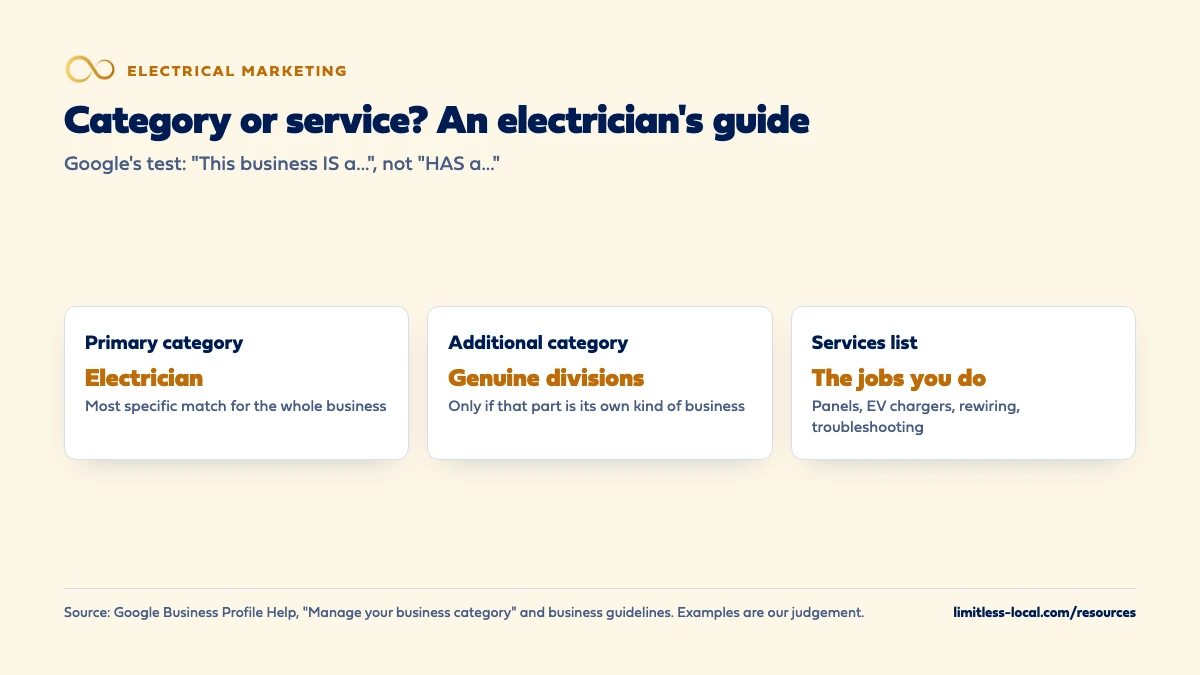
Most electricians should choose an electrician category as their primary category, picked from the list Google shows, because Google says to pick the most specific category that describes the whole business and that categories affect local ranking. Add another category only for a genuine division that passes Google’s “this business is a” test, such as a real generator or solar operation, and keep the total small. Jobs like panel upgrades, EV charger installs and rewiring belong in your services list, not in extra categories.
Getting the category right is the first thing we’d check on an electrical contractor’s profile, because it’s quick to fix and everything else builds on it. Google Business Profile management is part of our local SEO for electrical contractor marketing, and the rest of the electrical marketing questions library takes the rest of the profile one question at a time.
What does a Google Business Profile category do for an electrician?
Your category tells Google, and the homeowner looking at your profile, what kind of business you are. Google says categories help connect you with customers searching for your products or services, and that the categories you select affect your local ranking. Its example: a business whose primary category is “Pizza restaurant” might show up for searches like “Restaurants”, “Italian Restaurants” or “Pizza”. Depending on your business type, your categories can also be used to assign a label to your business and can open up category-specific features on the profile. Source: Manage your business category.
For an electrician, the category is the base layer of relevance, one of the three things Google says local results are mainly based on, next to distance and popularity. It won’t make up for a thin review count or a shop thirty minutes from the searcher, but the wrong one can keep you off searches you should be in. Source: Tips to improve your local ranking on Google.
What should an electrician's primary category be?
Google’s rule is to pick a primary category that best describes your business, as specific as the list allows, chosen from the list that appears as you type. If the specific one you want isn’t there, pick a more general one that still describes you. You can’t create your own. Its guidelines add a useful test: choose categories that complete the sentence “This business is a”, not “This business has a”. Sources: Manage your business category and Guidelines for representing your business on Google.
For most electrical contractors, that points to an electrician category as the primary. In our judgement, the only reason to pick something else as primary is when another category describes the whole business better: a company that is mainly a solar installer with some electrical service work, for example, is a different business from an electrician who installs the occasional solar tie-in. Type “electric” into the category box and read what Google offers; the list is Google’s, it changes, and the right answer is whichever entry passes the “is a” test for most of your work.
Should I add additional categories, and how many?
Google’s guidelines say to use as few categories as possible to describe your overall core business, and to choose ones that are as specific as possible but still representative. Google adds that when you pick a specific category, it implicitly includes the more general ones behind the scenes, so you can skip anything that’s redundant with a more specific choice. Additional categories are for special departments or services, and Google says not to add a category for every product or service. Sources: Guidelines for representing your business on Google and Manage your business category.
So the honest number for most electricians is small: the primary, plus an additional category only for each genuine division that passes the “is a” test on its own. There’s no prize for filling every slot. In our view, a profile with one accurate category beats one with six that make the business look like it does everything.
Which extra categories make sense for an electrical contractor?
In our judgement, an additional category earns its place when you could describe that part of the business to a stranger as its own kind of company. Some electrical examples:
- A real solar or battery division, with its own crew or its own sales process, may fit a solar-related category if the list offers one.
- A generator business that sells, installs and services standby generators as a line of its own, not just the occasional install.
- A low-voltage or security division that runs as its own operation.
- A lighting showroom customers can actually visit, if you have one.
If the work is something you do as an electrician, such as panel upgrades, EV charger installs, rewiring or troubleshooting, it’s a service, not a category. That’s a common mistake, and the next sections cover where that work belongs instead.
Which categories should an electrician avoid?
Google’s guidelines rule out a few patterns that tempt service businesses:
- Categories used as keywords or to describe attributes of the business.
- Categories for nearby or related businesses, such as a business physically inside yours or one that contains yours. If you share a building with a supply house, its category isn’t yours.
- A category for every service. Google says not to.
- Categories for a co-located business you don’t own and operate. If two businesses need both categories at one location, Google says they get two profiles with different names.
Source: Guidelines for representing your business on Google.
For an electrician, in our judgement, that also means avoiding a category that describes a place rather than a contractor. A category for somewhere customers go to charge a car, buy fixtures or rent equipment describes a different business from the company that installs the charger at their house.
Curious what your marketing is actually booking?
Get a free visibility audit — no obligation, no sales pitch.
Where do panel upgrades and EV charger installs go if not in categories?
In your services list. Google says that when local customers search for an offering you provide, that service may be highlighted on your profile, and customers can see your full list under Services in the Google Maps app. When you add services, Google suggests options tailored to your business type, and you can add custom services, group them into categories and add descriptions. Custom service names can’t include prices, phone numbers or other content that breaks policy. Source: Manage your services on your Business Profile.
So the category says you’re an electrician, and the services list says you do panel upgrades, EV charger installation, generator installs, rewiring, lighting and troubleshooting. That’s the split Google’s own rules point to, and it keeps your category clean while still matching the specific jobs people search for. Optimizing your electrician Google profile covers how to write the services list and the rest of the profile.
Do residential and commercial electrical work need different categories?
Usually not, in our judgement. A company that does both is still one electrical contractor, and the “is a” test gives the same answer either way. Say what mix you do in your description and services list, and let your website carry the detail for each kind of customer.
The exception is a commercial division that’s genuinely separate, with its own location, staff and service area. Google allows a separate profile for each location of a service business with separate service areas and separate staff at each, but not extra profiles for one operation. Source: Guidelines for representing your business on Google. How commercial buyers find electricians in the first place is covered in marketing to commercial customers.
Should I copy the categories my competitors use?
Look, but don’t copy blindly. Seeing which category the electricians above you in Maps show is a fair way to check that you haven’t picked something odd. But their categories may be wrong, may describe a different business mix, or may break Google’s guidelines and put their own profile at risk. Google doesn’t publish how much each category weighs, so a competitor’s ranking doesn’t prove their categories are what’s working.
In our judgement, the category is rarely the whole story when a competitor outranks you. Distance, reviews, links and the rest of the profile usually matter as much. Why a competitor ranks above you walks through the full comparison, and getting into the map pack covers the bigger picture.
Will changing my category trigger anything?
It can. Google says that if you add or edit a category, you might be asked to verify your business again. And because categories affect local ranking, a change can move where you show up, in either direction. Source: Manage your business category.
If you run Local Services Ads, there’s another reason to be careful. After LSAs move into Google Ads, your business name, address and hours sync from your Business Profile, and Google says significant updates to your business name, storefront address or primary category require verification. Your campaign may pause while Google reviews the change, which typically takes 24 to 48 hours. Source: Local Services Ads transition to Performance Max campaigns with pay-per-lead goals.
So change a primary category on purpose, once, at a quiet time, and then leave it alone long enough to judge. If your map pack spot dropped right after a category change, what to fix after losing it covers the checks.
Are my Business Profile categories the same as my LSA categories?
No. Local Services Ads have their own settings for industries, job types and service areas, managed in the ads account. Google says adding a new industry there sends you to upload additional verification for that industry, and that LSAs opt you into your industry’s general category searches, such as “plumber near me”, unless you turn off the broad search setting. Source: Edit your industries, service areas, and job types.
The two still interact, because the pay-per-lead campaign pulls core details from your Business Profile and a primary category change can trigger a review. Keep them consistent: if your profile says you’re an electrician, your LSA industry should say the same. Which electrical jobs you can turn on there is covered in which services LSAs allow.
How do I know if my categories are working?
Watch the searches people use to find you. In your Business Profile Performance report, Searches shows the terms people used to find your business, updated at the start of each month. If those terms are mostly general electrical searches and your own name, the category is doing its basic job. If you’ve added a generator category and never appear for generator searches, it may not be pulling its weight, or your services and reviews may not back it up yet. Performance data includes activity from both organic results and Google Ads, so read it with your ad spend in mind. Source: Understand your Business Profile performance & insights.
Want to see where your company stands?
A free visibility audit shows where you show up on Google, Maps and AI answers, and what it's costing you in calls.
What's different about categories for electricians
The job mix is wide, but the business is one thing. An electrical company can do service calls, panel upgrades, EV chargers, generators, lighting and commercial work in the same week. That variety belongs in the services list. The category answers a narrower question: what kind of business is this?
Homeowners compare you with handymen. A clear electrician category, matched by a description that says you’re licensed and insured, helps the homeowner see what kind of business they’re calling. Licensing rules vary by state, so describe your own credentials, not anyone else’s.
Specialty divisions are real for some shops. Solar, battery backup, generators and low-voltage work are separate businesses for some electrical contractors and side jobs for others. In our judgement, the test is whether you’d still be in that business if you stopped doing general electrical work. If yes, it may deserve a category. If no, it’s a service.
A worked example: deciding categories for a mixed electrical shop
These numbers are made up to show the reasoning, not a benchmark. Say an electrical contractor’s work last year broke down like this: about 70% residential service and upgrades (troubleshooting, panels, EV chargers, rewiring), about 20% standby generator sales, installs and maintenance run by a dedicated two-person team, and about 10% small commercial tenant work.
- Primary category: electrician. It passes “this business is a” for the bulk of the work.
- Additional category: a generator-related one, if the list offers a fit, because the generator side has its own team, its own sales and would exist without the rest.
- No separate category for EV chargers, panels or commercial work. Those are services the electrician does, so they go in the services list and the description.
The same shop at 98% general work with an occasional generator install would stop at one category. The percentages aren’t a Google rule; they’re a way to see which parts of the business stand on their own.
On our side, Google Business Profile management, with a weekly post, is part of every package, starting with Essentials at $3,500 a month for one location. A free visibility audit is a good place to check your categories against the searches you want to win.
Frequently asked questions
Can I create a custom category like "EV Charger Installer"?
No. Google says you can’t create your own category; you choose from the list that appears. You can add a custom service, though, which is where EV charger installation belongs if it isn’t suggested.
Does adding more categories help me show up for more searches?
Google says to use as few categories as possible and not to add one for every service. Extra categories that don’t describe the business can mislead customers and break the guidelines.
Can I put "Electrician" in my business name instead?
Only if it’s part of your real name, the one on your trucks and paperwork. Google says unnecessary information in a business name isn’t permitted and could get the profile suspended.
Will I have to verify again if I change my category?
You might. Google says adding or editing a category can prompt a request to verify the business again.
Do categories affect my Local Services Ads?
Indirectly. LSAs have their own industry and job type settings, but after the move into Google Ads, a significant change to your profile’s primary category requires verification and can pause the campaign while Google reviews it.
Should a home-based electrician choose a different category?
No. Where you work from affects whether you show an address or hide it as a service-area business, not which category describes you.
Key takeaways
- Pick the most specific primary category that describes the whole business; for most electrical contractors that’s electrician.
- Add categories only for genuine divisions that pass Google’s “this business is a” test, and keep the list short.
- Panel upgrades, EV chargers, generators and rewiring go in the services list, which Google can highlight in search.
- Never use categories as keywords or borrow a neighboring business’s category.
- Category changes can trigger re-verification and, with LSAs, a campaign review, so change them once, on purpose.
Not sure what's working right now?
Start with a free visibility audit: rankings, Google profile, reviews and tracking, checked against your service area.
More in this section
- How do I optimize my electrician Google Business Profile?
- Which keywords should an electrician bid on in Google Ads?
- What Google Ads campaigns work best for electricians?
- How do electricians get verified for Google Local Services Ads?
- Are Google Local Services Ads worth it for electricians?
Sources
- Manage your business category — Google Business Profile Help
- Guidelines for representing your business on Google — Google Business Profile Help
- Tips to improve your local ranking on Google — Google Business Profile Help
- Manage your services on your Business Profile — Google Business Profile Help
- Local Services Ads transition to Performance Max campaigns with pay-per-lead goals — Google Ads Help
- Edit your industries, service areas, and job types — Google Local Services Help
- Understand your Business Profile performance & insights — Google Business Profile Help