
How many leads per month before an electrician hires an agency?

- At what point does hiring a marketing agency make more sense than keeping electrical marketing in-house?
- Is there a lead count that means it's time to hire an agency?
- How many extra jobs would an agency need to bring in to pay for itself?
- Do I have room on the schedule for more work?
- How much of my week is marketing taking?
- What if I'm only getting a few leads right now?
- What if leads are coming in but I can't keep up with them?
- What if I'm already running Google Ads myself?
- Which signs say it's time to hand marketing off?
- Which signs say it's too early?
- Should I hire an agency or a marketing person?
- What should I have ready before I talk to an agency?
- How soon should an agency be paying for itself?
- What's different about this decision for electricians
- A worked example: the break-even lead count
- Frequently asked questions
- Key takeaways
- More in this section
- Sources
The short version
- No fixed lead count works; the threshold is break-even jobs, crew capacity and hours.
- Break-even jobs = (agency fee + ad spend) / profit per job.
- Break-even leads = break-even jobs / the share of leads that book.
- If your schedule is full or calls go unanswered, fix that before hiring an agency.
For electrical contractors doing their own marketing who want a clear way to tell when handing it off will pay for itself.
Get a free visibility audit · Book a growth call
At what point does hiring a marketing agency make more sense than keeping electrical marketing in-house?
There’s no lead count that means it’s time; the threshold is jobs and capacity, not leads. An electrician is ready to hire an agency when the extra booked jobs needed to cover the fee and ad spend look reachable, the crews have room to do that work, and marketing is eating hours you’d rather spend on jobs or isn’t getting done. Work out your break-even: monthly cost divided by profit per job gives the extra jobs you need, and dividing that by how often leads book gives the extra leads.
That break-even math is how we’d want any electrician to decide, including about us. Our packages are priced in the open so you can run it: Essentials is $3,500 a month and Growth is $4,500 a month, with ad spend paid to Google separately. Our electrical contractor marketing page explains how we work with electrical shops, and the rest of the electrical marketing questions library goes question by question.
Is there a lead count that means it's time to hire an agency?
No, and a fixed number would steer you wrong. Twenty leads a month can be plenty for a shop that does panel upgrades and whole-home generators, and not nearly enough for one that lives on small service calls. A lead count also says nothing about whether you can take on more work, or whether the leads you get now are real ones.
Three numbers decide it instead:
- Break-even jobs: how many extra booked jobs a month the agency fee and ad spend would need to cover.
- Capacity: whether your crews have room for those extra jobs.
- Hours: how much of your week marketing is taking now, and what’s getting dropped because of it.
When all three line up, you’re ready, whatever your lead count is today. The sections below show how to work out each one.
How many extra jobs would an agency need to bring in to pay for itself?
Start with what one average job leaves you after materials and labor, not the invoice total. Then divide what you’d spend each month, the agency fee plus ad spend, by that number. The answer is how many extra booked jobs a month you need just to break even.
Then work backward to leads. If about 1 in 3 of your real leads books, you need three times that many extra leads. That’s the honest version of “how many leads before I hire an agency”: it’s the number of extra leads the agency has to produce to pay its way, and you can work it out for your own shop in five minutes. The worked example below runs it with made-up numbers, and working out profit per job and customer value shows how to get the inputs right.
If that break-even number looks easy for your market and your schedule, the math supports hiring help. If it looks out of reach, start smaller or keep doing the basics yourself for now.
Do I have room on the schedule for more work?
More leads only help if someone can do the jobs. If your crews are booked out three weeks and you’re already turning down work, an agency will just add calls you can’t take, and a homeowner who has to wait weeks for a panel upgrade often books someone else.
In that spot the first hire is usually an electrician, not an agency. Once you’ve got the extra crew or know when they start, it makes sense to line up the marketing so the phone ramps up as the schedule opens. Whether to pause marketing while you’re hiring electricians covers that timing.
The opposite is the clearer signal. If you’ve got trucks sitting idle on weekday afternoons and the slow weeks keep coming, unused capacity is costing you money every day, and that’s when outside help tends to pay off fastest.
How much of my week is marketing taking?
Add up the real hours: updating the Google profile, asking for reviews, adjusting Google Ads, fixing the website, chasing down where calls came from. Then be honest about what isn’t getting done because there’s no time left.
Hours matter in two ways. If marketing eats evenings you’d rather spend at home, or pulls you off billable work, it has a cost even though it doesn’t show up on a bill. And if the important parts are getting skipped, like ad accounts nobody has checked in a month, it’s costing you in a different way. How many hours DIY electrical marketing takes each week breaks the time down task by task.
What if I'm only getting a few leads right now?
Low volume isn’t a reason to hire an agency on its own, and it isn’t a reason not to. It depends on why it’s low.
If you’ve got no Google profile to speak of, a handful of reviews and a one-page website, the first fixes are cheap and you can do much of it yourself. Google’s own advice on hiring an SEO says that if you run a small local business, you can probably do much of the work yourself, and it suggests a great time to hire help is when you’re planning a redesign or a new site. Set up and verify the profile, start asking every customer for a review, and make sure the phone gets answered.
If you’ve already done the basics and leads are still thin, that’s the point where outside help can make sense, because the next steps (ads, service pages, tracking) take more skill and more hours.
Curious what your marketing is actually booking?
Get a free visibility audit — no obligation, no sales pitch.
What if leads are coming in but I can't keep up with them?
Then the bottleneck is probably not marketing. If calls roll to voicemail while you’re on a job, quotes go out days late, and nobody follows up on the ones that didn’t book, more leads will just mean more of them slipping away.
Fix the response first: someone who answers live, same-day callbacks and a follow-up on every open quote. Closing those holes often turns up more work than you knew you had. An agency can help here too, but only if what they set up covers call tracking and follow-up, not just more leads.
What if I'm already running Google Ads myself?
This is one of the clearest signs it may be time. Ad money goes out every day, and an account that’s set up loosely can spend a lot on searches that never book: the wrong towns, the wrong jobs, people looking for jobs at your company instead of an electrician.
Ask yourself three questions. Do you check the search terms report and add negative keywords at least every couple of weeks? Can you see which calls from ads turned into booked jobs? Do you know your cost per booked job from ads? If the answer to any of them is no and your spend is growing, a managed account usually saves more than it costs. If your spend is small and steady and you can answer yes to all three, you may be fine on your own for now.
Which signs say it's time to hand marketing off?
- Your break-even job count looks reachable, and you have crew capacity to do the work.
- Ad spend is growing and nobody can say what it costs per booked job.
- The basics are done, and the next steps need skills or hours you don’t have.
- Marketing tasks keep sliding to the next week, and the slow weeks keep coming.
- You want to push one kind of work, like panel upgrades or EV chargers, and need pages, ads and tracking aimed at it.
- You’re opening a second service area or adding a crew and want the calls to arrive when the capacity does.

Which signs say it's too early?
- Your schedule is full and you’re turning work away.
- You haven’t set up and verified a Google profile, and you aren’t asking for reviews yet.
- Calls are going unanswered and quotes aren’t followed up.
- The break-even job count would take most of your current capacity, or you can’t fund the fee for a few months while things ramp up.
- You don’t know your average job value or how many leads book, so you couldn’t judge results even if they came.
None of these is permanent. Each one is a step to take before you sign anything, and some of them cost nothing.
Should I hire an agency or a marketing person?
For most electrical shops below a few crews, a full-time marketing hire is a lot of salary for one person who has to know Google Ads, SEO, your website and tracking all at once. An agency gives you a team for a monthly fee; an employee gives you someone in the building who knows the business. Some larger shops do both: an office person who handles reviews, photos and follow-up, with an agency on ads and SEO. Hiring an agency versus doing your own electrical marketing compares the options in more detail.
What should I have ready before I talk to an agency?
- Your numbers: average job value, rough profit per job, and how many leads book.
- Where jobs come from now. Housecall Pro’s lead source field tracks where customers found you, and Jobber’s Lead Source Report ties revenue to each source. Even a rough month of this beats guessing.
- Capacity: how many more jobs a week you could take, and which kinds you want more of.
- Your accounts in your name. As the owner of your Google Business Profile you can add or remove users, so add the agency as a manager instead of handing over your login (Google Business Profile Help). For Google Ads, a manager account that creates a new account automatically becomes its owner, so ask to have the account set up in your name and linked, not created by the agency (Google Ads Help).
What a marketing agency costs an electrician covers fees and contract terms to compare.
How soon should an agency be paying for itself?
It depends on the channel. Ads can generate leads within days of launch; SEO typically takes 3-6 months to show meaningful organic growth. So in the first months, judge the paid side on booked jobs and judge the SEO side on direction: more calls from search and your profile each month, even if they aren’t covering the fee yet.
Run your break-even number every month. If paid search is clearing it after a couple of months and SEO is trending up, it’s working. If neither is moving and the agency can’t tell you why, that’s the conversation to have.
Not sure which of these is costing you jobs?
A free visibility audit checks the Google profile, reviews, site and tracking, and shows what to fix first.
What's different about this decision for electricians
Job values swing widely. A service call, a panel upgrade, an EV charger and a whole-home generator leave very different amounts behind. Run the break-even on the jobs you actually want more of, not your overall average, or a pile of small calls can make the math look better than it is.
Capacity is tied to licensed hands. You can’t add electrical capacity as fast as you can add leads, so the crew question often decides the timing more than the marketing question does.
Residential and commercial work need different marketing. If most of your work comes from builders and property managers, search ads and the map pack matter less, and an agency built around homeowner calls may not be the right fit for that side of the business.
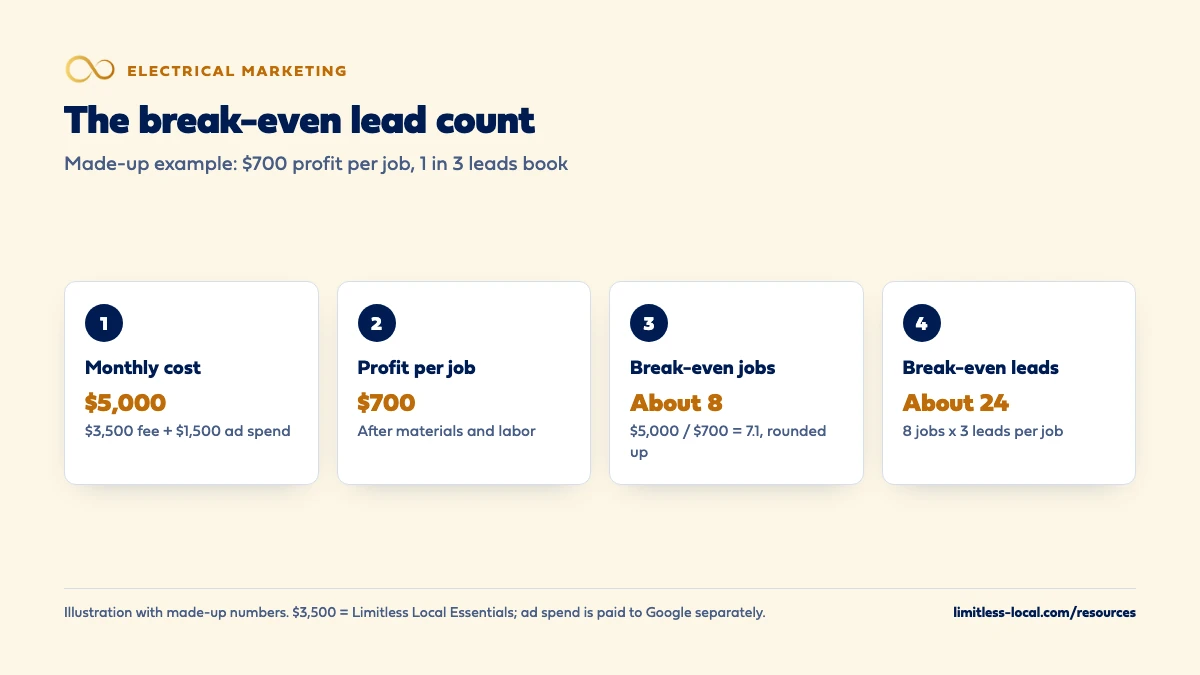
A worked example: the break-even lead count
These numbers are made up to show the math, not a benchmark for your market. Say an average job leaves you $700 after materials and labor, and about 1 in 3 of your real leads books.
- Agency fee: $3,500 a month, the price of our Essentials package.
- Ad spend: a made-up $1,500 a month, paid to Google.
- Total monthly cost: $5,000.
- Break-even jobs: $5,000 / $700 = 7.1, so about 8 extra booked jobs a month.
- Break-even leads: 8 jobs x 3 = about 24 extra real leads a month.
So for this shop, “how many leads before I hire an agency” really means: can an agency add about 24 real leads a month, and do the crews have room for 8 more jobs? If yes, it pays its way, and every job past that is profit. If an average job left $1,400 instead, break-even would drop to about 4 jobs, and the decision gets much easier.
Frequently asked questions
Is 10 leads a month too few to hire an agency?
Not necessarily. If those leads are mostly high-value jobs and you have room for more, the break-even may be easy to reach. If they’re small service calls, start with the free basics first.
Should I count every call as a lead?
No. Count real leads: people who want work you do, in towns you serve. Spam, sales calls and existing customers calling about a scheduled job don’t count.
Can I hire an agency for just one channel?
Yes. Some owners hand off Google Ads, where money moves every day, and keep the Google profile and reviews themselves. It’s a reasonable way to start.
What if I don't know my close rate?
Track it for a month first. Mark every real lead in your field software with where it came from and whether it booked. Without that number, you can’t judge any marketing, agency or not.
Do I need a new website before hiring an agency?
Not always. Many sites can be fixed. A good agency will tell you what’s holding your current site back before recommending a rebuild.
Will an agency lock me into a long contract?
Some do, so read the terms. We ask for three months in our contract because SEO needs time to ramp, but if you want to leave, we won’t make you stay.
Key takeaways
- The threshold is break-even jobs, crew capacity and hours, not a fixed lead count.
- Break-even jobs = monthly cost / profit per job; break-even leads = jobs / the share of leads that book.
- If the schedule is full or calls go unanswered, fix that before hiring.
- Growing ad spend without cost-per-booked-job tracking is one of the clearest signs to hand off.
- Keep your Google profile and Google Ads account in your own name whoever runs them.
Want a second set of eyes on your setup?
We'll look at how you show up locally and where calls are leaking, then send you a plain-English breakdown.
More in this section
- How much does a marketing agency cost for an electrician?
- How can an electrical contractor get more leads?
- Should I hire an agency or DIY my electrical marketing?
- How many jobs a month does an electrician need to hit a revenue goal?
- Should an electrician hire a full-service agency or one specialist?
Sources
- Do You Need an SEO? Tips for Hiring an SEO — Google Search Central
- Manage your Business Profile owners & managers — Google Business Profile Help
- Manager Accounts (MCC): About ownership of client accounts — Google Ads Help
- How to Use Lead Sources — Housecall Pro Help Center
- Lead Source Report — Jobber Help Center