
How much should an electrician spend on a logo and branding?
- What's a sensible one-time branding budget for an electrical business?
- What does branding actually cover for an electrical business?
- How big should the logo budget be next to the rest of my marketing?
- What should a logo budget actually buy?
- Can I use AI or a cheap logo site to make my logo?
- What makes a logo work on a truck, a shirt and a Google profile?
- Should I trademark my electrical company's name and logo?
- Where does the branding money really go after the logo?
- When is it worth paying more for branding?
- When is a new logo a waste of money?
- Will a better logo bring in more calls?
- What's different about branding for electricians
- A worked example: what a logo costs per month
- Frequently asked questions
- Key takeaways
- More in this section
- Sources
The short version
- A logo is a one-time cost; spread it over the years you'll use it.
- It should buy vector files, a one-color version, a square icon and the rights in writing.
- The bigger branding money goes on trucks, uniforms, your Google profile and your website.
- Spend more when you're adding trucks or moving into bigger work, not when the phone is quiet.
For electrical contractors pricing a new logo, a refresh or a full brand kit, and wondering how much of the marketing money it deserves.
Get a free visibility audit · Book a growth call
What's a sensible one-time branding budget for an electrical business?
A logo and basic brand kit is a one-time cost, so keep it small next to what you spend on marketing in a year, and judge it by what it buys: a simple mark that reads on a truck from across the street and as a tiny square on Google, plus the files and the rights in your name. Most of the branding money belongs where the logo gets seen, on trucks, uniforms, your Google Business Profile and your website. Pay more only once the name is settled for the long haul and you’re adding trucks, moving into bigger work, or fixing a name that gets confused with someone else’s.
Once the logo is done, it has to go to work on the pages and ads that bring in calls. Our packages put your brand on your Google Business Profile, your website and your ads, and the Growth package at $4,500 a month includes ad design and creative (limits apply) along with Google Ads and Local Services Ads management. If the website itself needs rebuilding around a new look, a themed site is $3,750, or $3,000 with any Limitless Engine package. Our electrical contractor marketing page shows how we work with electrical shops, and the electrical marketing questions library goes question by question.
What does branding actually cover for an electrical business?
For a local electrical shop, branding is a short list of things you pay for once and then use for years:
- The logo: your business name set in a particular way, sometimes with a simple symbol.
- Colors and fonts: two or three colors and one or two typefaces, written down so every printer and sign shop uses the same ones.
- A few versions of the logo: wide for trucks and letterhead, stacked for shirts and hats, and a square icon for your Google profile and social accounts.
- A one-page guide that says which version goes where.
Everything after that, like truck lettering, uniforms, yard signs, door hangers and invoices, is where the brand gets used. Those are separate costs, and they’re usually bigger than the logo itself.
Reviews, how fast you answer the phone and how your crews leave a job site shape what homeowners think of you far more than any logo. A clean logo just makes them easier to remember.
How big should the logo budget be next to the rest of my marketing?
Treat it like a tool purchase, not a monthly bill. A logo you’ll use for five or more years costs very little per month once you spread it out, so the useful question isn’t whether the price sounds high. It’s whether that money would book more jobs somewhere else right now.
A simple rule of thumb: the one-time logo and brand kit should be a small slice of one year’s marketing, and it should never squeeze out the channels that bring calls this month. If paying a designer means turning off the ads that keep your schedule full, wait. If your schedule is full and your trucks still have mismatched magnets on them, the logo is overdue.
To size the rest of the budget first, start with how much an electrical contractor should spend on marketing, and treat the logo as a one-time line in it.
What should a logo budget actually buy?
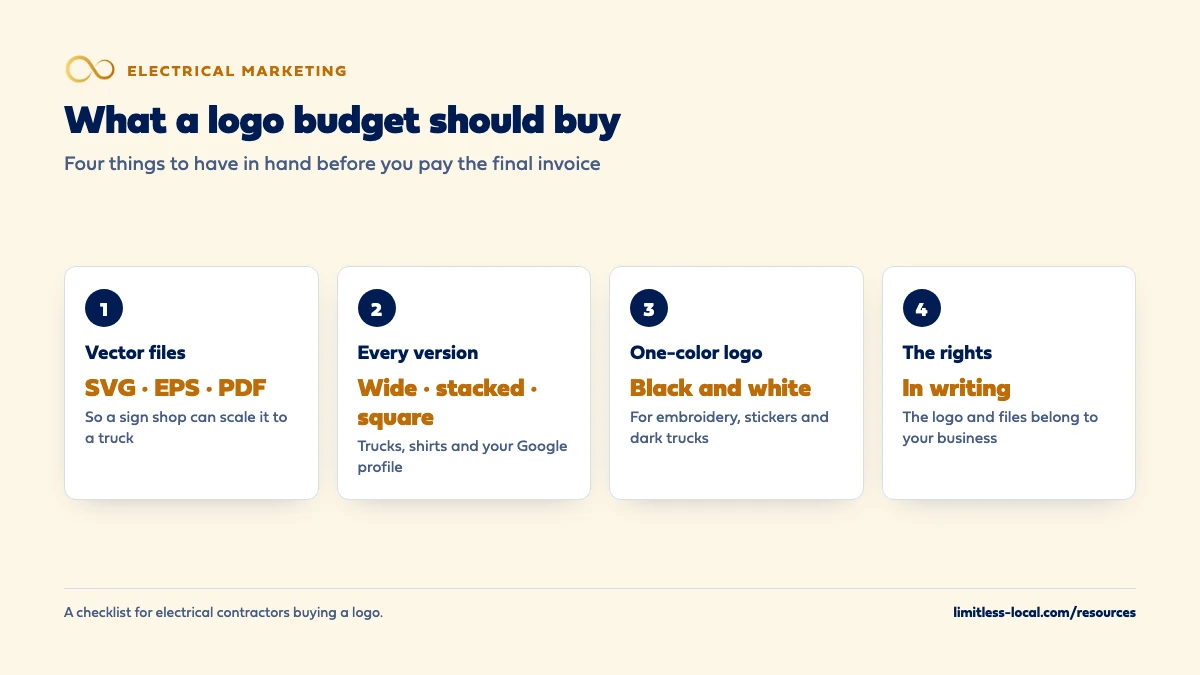
Whatever you pay, make sure you walk away with all of this:
- Vector files (SVG, EPS or PDF). Sign shops and wrap installers need these to scale the logo to a box truck without it going fuzzy.
- PNG files with a clear background, for your website, estimates and email signature.
- A one-color version that works in plain black and plain white, for embroidery, stickers and a dark truck.
- A wide version, a stacked version and a square icon.
- Exact color codes for print and screen, so your shirts and your website match.
- The rights in writing. A short line in the agreement saying the logo and all its files belong to your business.
If a quote doesn’t include those, ask for them before you pay. A cheap logo that arrives as one small JPG often costs more later, when the wrap shop has to redraw it. Then save every file somewhere the business controls, so the only copy never lives in a designer’s or agency’s account.
Can I use AI or a cheap logo site to make my logo?
For ideas, sure. Typing a few prompts is a fast way to see what kind of mark you like. The catch is ownership. The U.S. Copyright Office’s registration guidance on AI-generated material says that when an AI tool receives solely a prompt from a person and produces the work, the traditional elements of authorship come from the technology, and the Office won’t register work that lacks human authorship. It also says a person who selects, arranges or modifies AI material enough can claim their own contribution.
For an electrical shop, that points to a simple path: use AI or a template site to explore directions, then have a person draw the final version, and keep the files and the agreement that show who made it. You’ll get a logo that’s yours, plus the vector files a sign shop needs, which many quick generators don’t hand over.
AI is handier for ads, and using AI to create ads that bring in leads covers where it helps and what a person still has to check.
Curious what your marketing is actually booking?
Get a free visibility audit — no obligation, no sales pitch.
What makes a logo work on a truck, a shirt and a Google profile?
Your logo has to work at three very different sizes: the side of a van, the chest of a work shirt, and a thumbnail on a phone. Test every design at all three before you pay for the final files.
- Readable from a distance. A homeowner should be able to read your name on a moving truck. Thin script fonts and long taglines fail this test first.
- One or two colors. Fewer colors means cheaper embroidery and cleaner lettering, and the logo still works in black and white.
- A square version. Google’s Business Profile photo guidelines recommend images 720 pixels tall and 720 pixels wide, with a minimum of 250 by 250, as JPG or PNG files between 10 KB and 5 MB. The little icon beside your website in Google results is square too; Google’s favicon guidelines require a 1:1 shape and recommend a favicon larger than 48 by 48 pixels.
- No fine detail. Tiny wires, outlets or text inside a lightning bolt turn into a smudge at small sizes.
If the stacked version still reads when you shrink it to the size of your thumbnail, it’ll work everywhere else.
Should I trademark my electrical company's name and logo?
It depends on how far you plan to take the name. The U.S. Patent and Trademark Office explains in why register your trademark that filing is your choice. Without registering, you may have common law rights based on using the mark in a particular area, which you may only be able to enforce where you use it. A state registration covers that state only. A federal registration covers the whole United States and lets you use the ® symbol.
The other factor is how protectable the name is to begin with. The USPTO’s page on strong trademarks says invented, arbitrary and suggestive names are strong, while names that merely describe the service are weak and often not federally registrable. “Smith Electrical Services” is mostly descriptive. A distinctive word plus “Electric” is a stronger starting point.
Factors that push owners toward registering: plans to grow into new states or open more locations, a name you’ve already spent years building, or a competitor using something close. Talk it through with a trademark attorney if any of those apply. What to name your electrical business covers picking a name worth protecting.
Where does the branding money really go after the logo?
The logo is the smallest bill. These are the bigger ones, roughly in the order most shops pay for them:
- Truck lettering or a wrap, seen by every neighbor while you work.
- Uniforms: shirts, jackets and hats, so homeowners know who’s at the door.
- Your Google Business Profile: logo, cover photo and real photos of your crews and work. Updating it costs nothing.
- Your website, in the same colors, fonts and logo as the trucks.
- Printed pieces: yard signs, door hangers, estimate folders and invoices.
Pay for these as you can, not all at once. How much to spend on wraps, uniforms and flyers goes through each one and how to track whether they bring in work.

When is it worth paying more for branding?
A bigger branding budget makes sense when the business is changing in a way people can see:
- You’re adding trucks. Every new van multiplies how often the logo is seen, so a mark that holds up at size starts paying back.
- You’re moving into bigger work. Generators, whole-home rewires, solar tie-ins and commercial jobs come with longer sales conversations. A clean look on estimates, proposals and bid packages helps when a homeowner or general contractor is comparing three companies.
- You bought another shop. Two names and two looks confuse customers. One brand across both is usually cleaner.
- Customers mix you up with someone else. If people keep calling a competitor thinking it’s you, or the other way round, the name and logo are costing you jobs.
In each case, price the rollout (trucks, shirts, signs, website, Google profile) before you pay the designer.
When is a new logo a waste of money?
When the real problem is somewhere else. A new logo won’t fix calls going to voicemail, a Google profile with few recent reviews, ads nobody tracks, or estimates nobody follows up on. If the phone has gone quiet, check those first.
A rebrand also has hidden costs. Every truck, shirt, sign and listing has to change, and for a while you’ll have two looks on the road. If your current logo is readable, consistent and yours, a tidy-up (cleaner files, one color palette, a proper square icon) often gets most of the benefit for a fraction of the cost.
Changing the business name is a much bigger job than changing the logo. Your name on Google, your website and every directory listing has to match what’s on the trucks, so leave the name alone unless there’s a real reason to move.
Will a better logo bring in more calls?
Not by itself. Google’s local ranking help says local results are mainly based on relevance, distance and popularity, and a logo isn’t one of the things it lists. Reviews, a complete profile and links to your site do more for where you show up on Maps.
Where a good logo helps is after someone finds you. A homeowner scrolling three electricians on Maps sees your logo, your photos and your reviews side by side. A sharp, readable mark next to real photos of your crews looks like a company that shows up on time; a blurry clip-art bolt looks like a side job. That can decide who gets the call, once you’re in the list.
So put the logo on everything, keep it consistent, and spend the bigger effort on what gets you into the list. Optimizing your electrician Google Business Profile covers the parts that move rankings.
Talk it through with someone who runs this every day
A 15-minute growth call: your market, your numbers, and what a realistic budget looks like. No pressure.
What's different about branding for electricians
Your trucks sit in driveways. Panel upgrades, EV charger installs and rewires keep a van parked in one spot for hours, often on a street full of older homes with the same problems. Lettering that’s readable from the street does a lot of work for an electrician.
Homeowners let you into their homes and panels. A uniform with the logo, a lettered truck and a name that matches the Google profile tell the homeowner the person at the door is the company they called.
Lightning bolts are everywhere. If every electrician in town uses one, a distinctive name set cleanly will stand out more than another bolt.
Commercial work runs on paperwork. If you bid for general contractors or property managers, a clean letterhead and proposal template are worth adding to the brand kit. And since many electricians show a license number on trucks and estimates, with rules that vary by state, leave room for it in the truck layout.
A worked example: what a logo costs per month
These numbers are made up to show the math, not a price list for your market. Say a two-truck electrical shop spends $2,000 a month on marketing, or $24,000 a year, and gets a quote of $1,200 for a logo with a full set of files and the rights in writing.
- Spread over the five years the shop expects to use it, the logo costs $1,200 divided by 60 months, or $20 a month.
- Against one year of marketing, the $1,200 is 5% of the $24,000.
Now the decision is easy to see. At $20 a month, a logo that holds up on both trucks for five years is cheap. But if paying the $1,200 up front means pausing ads that book several jobs a month, the shop should wait a month or two and pay it out of a strong week instead. The bigger number to plan for is the rollout: lettering on two trucks and a round of shirts will cost more than the logo, so price those before signing with the designer.
Frequently asked questions
Should my electrical logo include a lightning bolt?
It can, but it doesn’t have to. Bolts are common in the trade, so check the logos of the electricians in your town first. If most of them use one, a distinctive name set in a clean typeface may stand out more.
Do I need separate logos for residential and commercial work?
Usually not. One logo keeps your reviews, trucks and Google profile tied to one name. If you split the two sides, do it in your ads, website pages and proposals, not with two logos.
Should I put my phone number or website in the logo?
Keep them next to the logo, not inside it. Phone numbers and web addresses change, and a logo with them built in has to be redrawn when they do.
Can I change the logo on my Google Business Profile without hurting my ranking?
Yes. Google lets you change the logo from the Photos section of your profile. Keep the business name the same as it is everywhere else, because the name matters far more than the picture.
How often should an electrical company update its logo?
Only when something real changes, like adding trucks, merging with another shop or moving into new work. A small tidy-up every several years, with cleaner files and a fixed color palette, is usually enough.
Key takeaways
- A logo and brand kit is a one-time cost; spread it over the years you’ll use it before deciding it’s too expensive.
- Whatever you pay, get vector files, a one-color version, a square icon and the rights in writing.
- Use AI for ideas, but have a person finish the logo and keep proof of who made it.
- The bigger branding spend is trucks, uniforms, your Google profile and your website, so price the rollout first.
- A new logo won’t fix a quiet phone; check calls, reviews and tracking before you rebrand.
Ready to compare options?
Book a short growth call and we'll walk through the math for your service area, including when we're not the right fit.
More in this section
- How much should electricians spend on wraps, uniforms and flyers?
- How much should an electrical contractor spend on marketing?
- How much does a marketing agency cost for an electrician?
- What should electricians include in their monthly marketing budget?
- How much does a website cost for an electrical business?
Sources
- Copyright Registration Guidance: Works Containing Material Generated by Artificial Intelligence — U.S. Copyright Office
- Manage your Business Profile photos & videos — Google Business Profile Help
- Define Website Favicon for Search Results — Google Search Central
- Why register your trademark? — U.S. Patent and Trademark Office
- Strong trademarks — U.S. Patent and Trademark Office
- Tips to improve your local ranking on Google — Google Business Profile Help