
What should an electrician do when Google reviews drop?
- My electrical company's Google reviews dropped: what do I check first?
- Which number dropped: the count, the rating or the new reviews?
- Why would Google remove reviews from my electrical business?
- Could the way I asked for reviews have caused the drop?
- Can I get removed reviews back?
- What if my rating dropped because of new bad reviews?
- What if someone is demanding money to remove bad reviews?
- What if Google put a restriction or warning on my profile?
- Are my review requests still going out?
- How do I rebuild reviews when I have no time to chase them?
- Will fewer reviews hurt my Maps ranking and my calls?
- What's different about review drops for electricians
- A worked example: how long a review gap takes to close
- Frequently asked questions
- Key takeaways
- More in this section
- Sources
The short version
- Find out which number fell: count, rating or new reviews per month.
- Removed reviews are usually filtered as spam or fake, and policy removals don't come back.
- Report reviews from people who never hired you; report extortion separately and never pay.
- Check that your review requests are still going out after every job.
- Rebuild with honest asks, never bought, swapped or employee reviews.
For electrical shop owners who opened their Google profile and found fewer reviews, a lower star rating, or a review flow that has gone quiet, and want to know what happened and what to do next.
Get a free visibility audit · Book a growth call
My electrical company's Google reviews dropped: what do I check first?
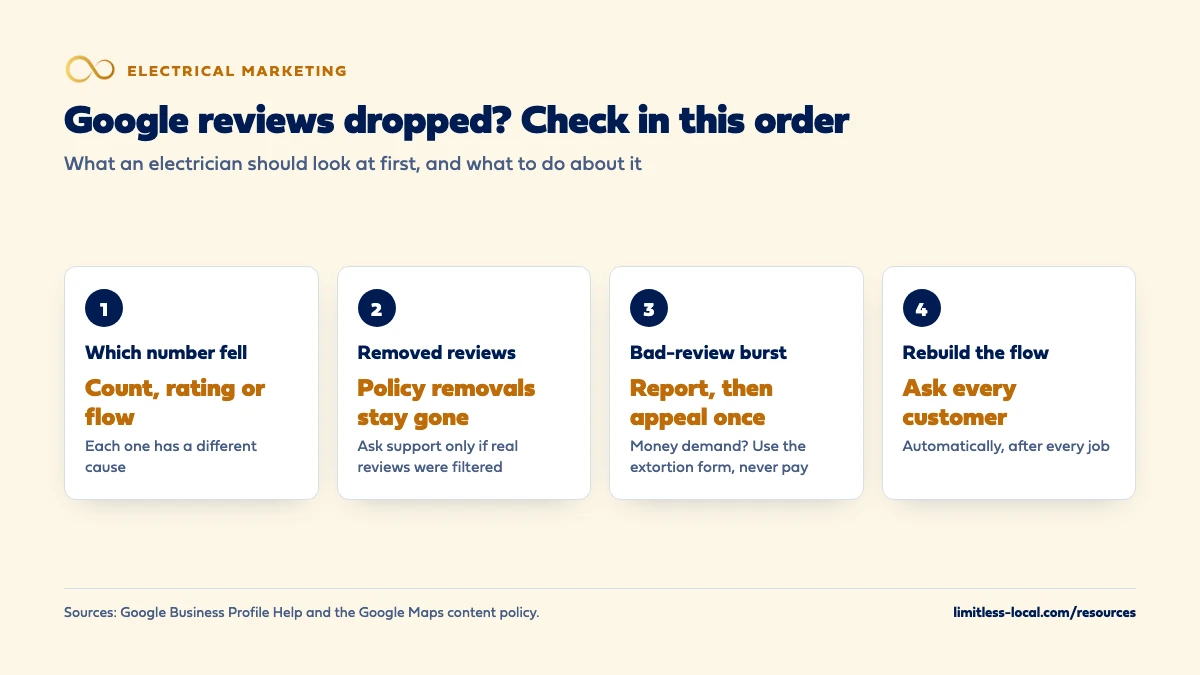
First work out what dropped: the review count, the star rating, or the number of new reviews coming in each month, because each one has a different cause. A falling count usually means Google removed reviews it judged to be spam, fake or incentivized, and reviews removed for a policy violation won’t be restored, though Google says its spam filter occasionally removes real ones and you can ask support to look. A sudden run of 1- and 2-star reviews from people who never hired you should be reported, and if someone then asks for money to take them down, report that as extortion and don’t pay. Then rebuild the flow the slow, safe way: ask every customer after every job, automatically, and never fill the gap with paid, swapped or employee reviews.
Keeping reviews steady is part of how we build Maps visibility for electricians: review response and basic review generation come with our Essentials package, Growth adds advanced review generation, and automated review requests are part of Scale. Our local SEO page shows how reviews fit with your Google profile, citations and site, and our electrical contractor marketing page covers the whole picture for electrical shops. The rest of the electrical marketing questions library goes question by question.
Which number dropped: the count, the rating or the new reviews?
Owners say “my reviews dropped” about three different things, and each has its own cause and its own fix. Before you change anything, write down which one you’re looking at.
- The total count went down. Reviews you had last month are gone. That almost always means reviews were removed or are being held back, which the next sections cover.
- The star rating went down. The count may have gone up, but new low ratings pulled the average down. Read each new one and decide whether it’s a real customer or someone who never hired you.
- The new reviews slowed down. Nothing was removed, but last quarter you got several a month and now you get one, or none. That’s nearly always a change on your side: someone stopped asking.
Screenshot your profile now, with the count, rating and newest reviews showing, so you have a record if more disappear or you need to contact Google.
Why would Google remove reviews from my electrical business?
Google’s help page on missing or delayed reviews says reviews are usually removed for policy violations like spam or inappropriate content. It also lists reasons that have nothing to do with you breaking a rule:
- New reviews are still being checked. Reviews are checked against Google’s policies, which can take a few days, so a review a customer just left may not show yet.
- You merged two profiles. After a merge, it can take a few days for reviews from both profiles to show on Search and Maps.
- The customer’s phone or app is out of date. People on older phones or software can have trouble posting, and Google suggests they update the Maps app.
- Google switched reviews off for a while. In certain situations Google may temporarily disable reviews for some profiles or business categories.
- Your profile was suspended and reinstated. Reviews can drop off after a reinstatement, and Google’s tip is to contact support if that happens.
If none of those fits, Google’s filters probably decided some reviews weren’t genuine, and the pattern will repeat unless you change what caused it.
Could the way I asked for reviews have caused the drop?
Often, yes, and usually without the owner meaning any harm. Google’s Maps content policy treats these as fake engagement or biased reviews, and they get removed:
- Offering anything for a review. A discount on the next service call, a gift card or a free surge protector in exchange for posting, changing or removing a review.
- Asking only the happy customers. Selectively asking for positive reviews, or discouraging negative ones, isn’t allowed.
- Reviews with a conflict of interest. Current or former employees, family, and people you have a business relationship with, such as a builder you sub for.
- Review quotas and scripts. Telling techs to collect a set number of reviews, or asking customers to mention a tech’s name or specific wording.
- Review swaps. Trading reviews with the HVAC company or plumber you share jobs with.
If any of that happened, stop it now and tell the office and the techs why. Why cheap backlinks and fake reviews backfire for electrician SEO covers the longer-term cost.
Can I get removed reviews back?
Reviews removed for policy violations won’t be restored, so don’t spend weeks trying. There are two narrow exceptions worth one try each:
- Real reviews caught by the spam filter. Google uses automated spam detection and admits it occasionally removes legitimate reviews. If you’re sure the missing reviews came from real customers who hired you, with invoices to match, contact Google Business Profile support and explain.
- Reviews lost after a reinstatement or merge. Give a merge a few days first. If reviews are still missing after a reinstatement, contact support.
What you can do in every case is ask the customers who left those reviews whether they’d be willing to post again, in their own words. Keep it to a plain request with your review link, no incentive and no suggested wording. The steady flow you rebuild from here matters more than any single review.
Curious what your marketing is actually booking?
Get a free visibility audit — no obligation, no sales pitch.
What if my rating dropped because of new bad reviews?
Split them into two piles.
Real customers with real complaints. These stay up, and Google won’t remove them just because you disagree. Reply once, calmly and specifically, and offer to sort it out offline. A good reply often does more for the next homeowner reading your profile than the star does harm. How an electrician should respond to a negative Google review walks through what to say about price, workmanship and safety complaints.
People who never hired you. A name you can’t match to any invoice, a review about a job you don’t do, or a competitor or former employee. Google’s page on reporting inappropriate reviews lays out the process:
- Report each review from your Business Profile, or from the Reviews Management Tool, choosing the reason, such as spam.
- Give it time. Review evaluation typically takes several days, and you can check the status in the Reviews Management Tool.
- If the result is “no policy violation” and you disagree, you can submit a one-time appeal, choosing up to 10 reviews at once.
Report only the ones that break the rules; flagging every critical review changes nothing.
What if someone is demanding money to remove bad reviews?
That’s an extortion scam, and Google treats it as a serious policy violation. Google’s guidance on negative review extortion scams describes the pattern: a sudden increase in 1-star and 2-star reviews, followed by someone asking for money, goods or services to remove them.
- Don’t reply to them, don’t pay, and don’t offer a free service call to make it go away. Paying can bring more attempts and doesn’t guarantee the reviews come down.
- Screenshot every message right away, with the date, time and the sender’s email, number or profile.
- Copy the links to each suspicious review and note when the bad reviews started and when the demand arrived.
- Submit it all through Google’s merchant extortion report form. That form is only for direct demands; ordinary spam reviews go through the normal reporting process.
Google investigates and tells you the outcome, though not the details. In the meantime, keep replying calmly to real customers and keep asking for reviews, so the honest ones keep landing.
What if Google put a restriction or warning on my profile?
If Google decides an owner broke its fake engagement policy, it can do more than remove the reviews. Google’s page on Business Profile restrictions gives examples:
- The profile can’t receive new reviews or ratings for a set period.
- Existing reviews and ratings are unpublished for a set period.
- The profile shows a warning telling people that fake reviews were removed.
Google says it will email the owner before it applies a restriction, so check the inbox tied to your profile, including spam folders. If you believe Google got it wrong, you can appeal and add context, and Google re-reviews the profile.
If Google got it right, stop whatever caused it, whether a review vendor, a swap group or an incentive, and let the restriction run its course.
Are my review requests still going out?
When nothing was removed but the flow of new reviews slowed, the cause is usually inside the business. Check these, in this order:
- The automation. Open your field software, whether that’s Jobber, Housecall Pro or ServiceTitan, and confirm review requests are switched on and actually sending. A changed setting, a new job status or an expired connection can stop them quietly.
- The link. If you merged profiles, changed your business name or set up a new profile, the old review link on texts, invoices and leave-behind cards may point to the wrong place. Click it yourself.
- The people. The tech who always asked has left, or the office manager who sent the follow-up texts is on leave.
- The jobs. A month heavy on builder and commercial work produces fewer homeowner reviews than a month of service calls, even if revenue held up.
Once you’ve found the gap, take people out of it. A request that goes out automatically when a job is marked complete doesn’t depend on anyone’s memory. How to automate Google review requests after each job covers the setup.
How do I rebuild reviews when I have no time to chase them?
You don’t chase. You build one routine that runs itself and check it once a month.
- One link, everywhere. Google lets you create a review link or QR code from your Business Profile. Put it in the job-complete text, the invoice email and on a card left by the panel.
- One moment. Ask when the problem is solved: the power’s back on, the charger is charging, the inspection passed. The customer is happiest then, and the job is fresh.
- Every customer. Ask everyone, not just the ones who seemed pleased. It keeps you inside Google’s rules, and the occasional honest three-star review makes the rest look real.
- One reminder. A single follow-up a few days later catches people who meant to and forgot. More than that starts to annoy.
Keep replying to new reviews as they come in, too. It shows homeowners someone is paying attention, and it takes a few minutes a week. How to get more Google reviews for an electrical business has more on wording and timing.
Will fewer reviews hurt my Maps ranking and my calls?
It can. Google’s local ranking tips say local results are mainly based on relevance, distance and popularity, and that more reviews and positive ratings can help your local ranking. Losing a batch of reviews, or going months without new ones, weakens one of those signals while your competitors keep adding to theirs.
The bigger hit is often to the homeowner comparing you with the electrician next to you in the map pack, where a stale newest review or a slipped rating makes them look like the safer call. Watch the trend over a couple of months, not one week: calls from your Google profile, where you show up for your main jobs, and new reviews per month. If your Maps position has clearly fallen, what an electrician should fix first after losing a map pack spot goes through the other causes to check.
Not sure which of these is costing you jobs?
A free visibility audit checks the Google profile, reviews, site and tracking, and shows what to fix first.
What's different about review drops for electricians
A lot of your work never reaches Google. Builder, remodeler and commercial jobs rarely produce a homeowner review, so a shift toward that work can look like a drop when nothing is wrong. Compare reviews against residential jobs completed, not total revenue.
Reviews can name the job. When a customer reviews a service business, Google’s page on managing customer reviews says they may be asked to pick the service you provided. A profile with recent reviews tagged with panel upgrades, EV chargers and generator installs tells homeowners you do that work. Keep your service list complete so those choices show up.
One tech can carry the flow. In a small shop, one tech who always asks may bring in most of the reviews, so when that tech leaves, the count stalls.
A worked example: how long a review gap takes to close
These numbers are made up to show the math, not a benchmark for your market. Say an electrical shop had 84 Google reviews in the spring and now has 71, so 13 are gone. The owner checks the dates and finds most of the missing ones were posted in the same few weeks, when the office was handing out a discount code for reviews. Those won’t come back, and the discount stops today.
- Residential jobs a month: 40.
- Share who leave a review when asked automatically after every job: say one in five, so 8 new reviews a month.
- Time to replace the 13 lost reviews: 13 divided by 8 is a little over 1.6 months, so roughly two months.
Now flip it. If nobody is asking and reviews trickle in at one or two a month, the same gap takes the better part of a year to close, while competitors keep adding theirs. The removal hurt, but the missing routine is what decides how long it hurts.
Frequently asked questions
Why did a review disappear and then come back?
New reviews are checked against Google’s policies, and that can take a few days, so a review can be missing for a while before it shows. After a profile merge, reviews from both profiles can also take a few days to appear.
Should I ask a customer to update a bad review after I fix the problem?
You can let them know the issue is resolved, but never offer anything in exchange for changing or removing it. Google’s policy treats an incentive for revising or removing a negative review as fake engagement.
Does replying to reviews help get my rating back up?
Replies don’t change the star average, but they show the next homeowner how you handle problems. Google says helpful replies can make your business stand out.
Can my reviews drop because of something a competitor did?
A competitor posting negative content to undermine you is against Google’s policy. Report those reviews; if it comes with a demand for money, use the extortion report form instead.
Is it worth paying someone who promises to remove bad reviews?
Only reviews that break Google’s policies can be removed, and you can report those yourself for free. Anyone promising to delete honest reviews is promising something Google doesn’t allow.
Key takeaways
- Start by naming what dropped: the review count, the star rating, or new reviews per month.
- Reviews Google removes for policy violations don’t come back; real reviews caught by the spam filter are worth one request to support.
- Report reviews from people who never hired you, appeal once if needed, and send extortion demands to Google’s separate form without paying.
- Check that review requests still go out automatically after every job, with a working link.
- Never refill the count with bought, swapped, employee or incentivized reviews; that’s what gets profiles restricted.
Want a second set of eyes on your setup?
We'll look at how you show up locally and where calls are leaking, then send you a plain-English breakdown.
More in this section
- How should an electrician respond to a negative Google review?
- Can an electrician automate Google review requests after each job?
- How many Google reviews does an electrician need to compete?
- How do I get more Google reviews for my electrical business?
- Does review velocity matter for electrician Google rankings?
Sources
- About missing or delayed reviews — Google Business Profile Help
- Report inappropriate reviews on your Business Profile — Google Business Profile Help
- Prohibited & restricted content — Maps User Generated Content Policy Help
- Business Profile restrictions for policy violations — Google Business Profile Help
- Report negative review extortion scams on your Business Profile — Google Business Profile Help
- Tips to improve your local ranking on Google — Google Business Profile Help
- Create a Google link or QR code to request reviews — Google Business Profile Help
- Manage customer reviews — Google Business Profile Help