
Is $2,500 a good monthly starting budget for HVAC PPC?

- Is $2,500 a month in Google Ads spend enough for an HVAC company to start with?
- What does $2,500 a month look like inside Google Ads?
- How many clicks and calls can $2,500 buy?
- Is $2,500 enough to tell whether Google Ads works for my HVAC company?
- When is $2,500 too little for an HVAC company?
- When is $2,500 more than I need to start?
- Should my first $2,500 go to repair or replacement ads?
- How should I set up a $2,500 campaign so it isn't spread thin?
- Does the $2,500 include an agency's management fee?
- How much do I need to spend before I book my first HVAC install?
- When should I raise the budget above $2,500?
- What's different about a starting PPC budget for HVAC companies
- A worked example: what $2,500 a month can book
- Frequently asked questions
- Key takeaways
- More in this section
- Sources
The short version
- $2,500 a month is an average daily budget of about $82 in Google Ads.
- What it buys depends on click prices in your towns; Keyword Planner shows the range before you spend.
- Focus it on fast-booking repair work in your core towns so you get enough calls to read.
- Raise it only when booked jobs come in under your cost ceiling and the schedule has room.
For HVAC owners weighing a first Google Ads budget of $2,500 a month in ad spend, before any management fee, and wondering what it can realistically book.
Get a free visibility audit · Book a growth call
Is $2,500 a month in Google Ads spend enough for an HVAC company to start with?
For many single-location HVAC companies, $2,500 a month in ad spend is a workable start, as long as it’s focused: one or two services, your core towns, and the hours someone answers the phone. Spread across every service and a wide area, the same money tends to run out early each day and buy too few calls to judge. Check it with your own numbers first: $2,500 divided by what a click costs in your towns, times the share of clicks that call, times the share of calls your office books, should come to enough booked jobs to read the results within a month or two.
It’s also the ad-spend ceiling in our Essentials package, which includes Google Ads management for up to $2,500 a month in ad spend, with call tracking so every dollar can be followed to a booked job. Ad spend is paid directly to Google, and we recommend a budget after a quick audit of your market. Our HVAC marketing packages and local ads pages list what each tier covers. The HVAC marketing guide covers every channel, and the rest of the HVAC marketing questions library goes question by question.
What does $2,500 a month look like inside Google Ads?
Google Ads doesn’t take a monthly number. Budgets are set per campaign as an average daily budget, and Google’s page on average daily budgets says to divide a monthly amount by 30.4, the average number of days in a month. So $2,500 a month is about $82 a day.
Two limits keep it inside that number. For most campaigns, a single day can spend up to twice the average daily budget, about $164 here, so Google can catch a busy afternoon. Over the month, you won’t be charged more than 30.4 times the daily budget.
That flexibility helps an HVAC company: a heat-wave Tuesday can spend more than a mild Sunday without breaking the monthly number. It also means $82 a day is an average, not a fixed daily amount. Check the budget report each week rather than reading one day’s spend.
How many clicks and calls can $2,500 buy?
It depends almost entirely on what a click costs in your towns, and that varies a lot by market, season and service. Here’s the range, using made-up click prices:
- At $12.50 a click, $2,500 buys about 200 clicks.
- At $25 a click, about 100 clicks.
- At $40 a click, about 62 clicks.
Before you commit, look up your own range in Keyword Planner. Google’s notes on Keyword Planner forecasts describe the top-of-page bid columns as roughly the 20th and 80th percentile of what advertisers have historically paid for a top spot in the locations you choose, and warn that results are less accurate for small geographic areas.
Then turn clicks into calls. If one in five clicks calls you, 100 clicks is 20 calls. If your office books half, that’s 10 booked jobs. The worked example below walks through it.
Is $2,500 enough to tell whether Google Ads works for my HVAC company?
Usually, if it’s focused. The question is whether a month of spend produces enough calls that one good or bad week doesn’t decide the verdict.
Google’s page on Smart Bidding learning says new campaigns without conversion history may see temporary performance swings, that performance typically settles within one to two conversion cycles, and that results should be judged over two conversion cycles or a two-week window, whichever is longer. It also lists low daily budgets and narrow targeting among the settings that can slow a campaign’s ramp-up.
So $2,500 spread across five services and twenty towns can leave each part of the account too thin to learn from. The same $2,500 on one service in your core towns gives you a readable answer much sooner.
When is $2,500 too little for an HVAC company?
Google will usually tell you. Watch for:
- A “Limited by budget” status on the campaign. Google’s help page on that status says it appears when a campaign is underperforming because of a limited budget, and Google may offer a recommended budget.
- A high “Search lost IS (budget)”, the share of time your ads didn’t show because the budget ran out. If your ads stop by noon on most days, you’re missing the afternoon calls.
- Expensive keywords only. If the plan is mostly system replacement keywords in a crowded metro, $2,500 may buy too few clicks to produce even a handful of estimates.
None of these on its own means spend more. If cost per booked job is already high, more budget buys more of the same. Fix the ads, pages and booking rate first. If more HVAC companies have started bidding in your towns, see how competitors bidding on HVAC keywords affect your budget.
Curious what your marketing is actually booking?
Get a free visibility audit — no obligation, no sales pitch.
When is $2,500 more than I need to start?
In a small town with low search volume, you may not be able to spend it well. Keyword Planner’s average monthly searches show how often people in your area search your main jobs. If the numbers are small, your campaign may never reach its daily budget, and Google won’t show a recommended budget for campaigns that rarely hit theirs.
That isn’t a problem: unspent budget stays in your pocket. But it does mean the $2,500 figure is irrelevant; the market sets the ceiling, not the budget. In that case, a smaller budget, a wider look at nearby towns you’d actually drive to, or putting more into your Google Business Profile and reviews may make more sense than chasing a number.
The other case is capacity. If your crews are already booked two weeks out, a budget that brings in more calls than you can run just sends homeowners to the next company.
Should my first $2,500 go to repair or replacement ads?
For most HVAC companies starting out, repair first. Repair and no-cool or no-heat searches tend to book the same day or the next, so you see calls, bookings and paid jobs inside the month. That’s the data you need to judge the budget.
Replacement ads are a longer test. A replacement lead needs an estimate visit, often a second conversation about financing, and sometimes weeks before anyone signs. On a $2,500 budget, a replacement-only campaign can spend the whole month and still have nothing signed to show for it when you review it.
Once repair ads are booking at a cost you’re happy with, carve out a separate replacement campaign with its own budget, so the expensive keywords can’t drain the money your repair calls need. Which HVAC services to advertise first covers the order in more detail.
How should I set up a $2,500 campaign so it isn't spread thin?
- One campaign, one or two services. AC repair and furnace repair, for example, each in its own ad group with its own ad.
- Your core towns. Target where your trucks get fastest, not every town you’d ever drive to.
- Your answering hours. If nobody picks up after 7 p.m., don’t pay for clicks then.
- Negative keywords from day one. Google’s page on negative keywords describes them as a way to exclude search terms so you focus on the keywords that matter. For HVAC, that usually means searches for jobs, careers, parts, manuals and do-it-yourself fixes.
- Call tracking and booked-job tagging. Without them, $2,500 buys clicks you can’t connect to jobs.
Each step makes the same money cover fewer, better auctions, which is what a starting budget needs.
Does the $2,500 include an agency's management fee?
It shouldn’t. Ad spend is what Google charges for clicks; a management fee pays someone to build, run and report on the campaigns. When an owner says “$2,500 for PPC,” it’s worth being clear which one is meant, because $2,500 all in is a very different budget once a fee comes out of it.
Our setup keeps them apart. Essentials is $3,500 a month and includes Google Ads management for up to $2,500 a month in ad spend; Growth is $4,500 a month, with Google Ads management up to $5,000 a month in spend plus Local Services Ads management. Ad spend isn’t included in any package and is paid directly to Google. Whether the next dollar should go to a fee or to more ads is covered in whether to pay an HVAC agency fee or spend more on ads.
How much do I need to spend before I book my first HVAC install?
There’s no fixed amount, but you can estimate it. Made-up numbers: say replacement clicks cost $40, so $2,500 buys about 62 clicks. If one in five calls, that’s about 12 calls. If half book an estimate, that’s six estimates, and if you close one in three, two installs.
Change any one input and the answer moves a lot. Closing one in five estimates instead of one in three gets you one install, not two. Higher click prices, a weaker landing page or slow callbacks can take it to zero in a given month. That’s why a first install can take one month or several, and why your close rate on estimates matters as much as the ad budget. What a good close rate for HVAC replacement estimates is helps you plug in a realistic number.
When should I raise the budget above $2,500?
When three things are true at once: booked jobs are coming in under the cost per job your margins can carry, your schedule has room, and Google shows the campaign is losing searches to budget. If only the first two are true, the extra money may have nowhere useful to go.
Raise it in steps and give each step a fair window to read. Budget changes take effect in the next auction and don’t trigger a “Learning” status, so you can raise or lower the budget without restarting anything. When to raise, lower or pause HVAC ad spend goes through each of those decisions.
Want to see where your company stands?
A free visibility audit shows where you show up on Google, Maps and AI answers, and what it's costing you in calls.
What's different about a starting PPC budget for HVAC companies
The season changes what $2,500 buys. The same budget buys more clicks in a mild shoulder month than in the first heat wave, when every HVAC company in town turns its ads up. If you start in peak season, expect fewer clicks per dollar and plan the first review around that. If you start in spring or fall, expect the cost per click to rise when the weather turns.
Emergency calls favor focused budgets. No-cool and no-heat searches are urgent, and the homeowner often calls the first company that answers. A $2,500 budget spent on emergency repair during the hours you answer can book more jobs than one spread around the clock.
Your office is part of the budget. At $2,500 a month, a few missed calls a week can be the difference between a campaign that pays and one that doesn’t. Raising your booking rate lowers your cost per job as surely as cheaper clicks do, and it costs nothing at Google. For the full budgeting math, see how much an HVAC company should spend on Google Ads.
A worked example: what $2,500 a month can book
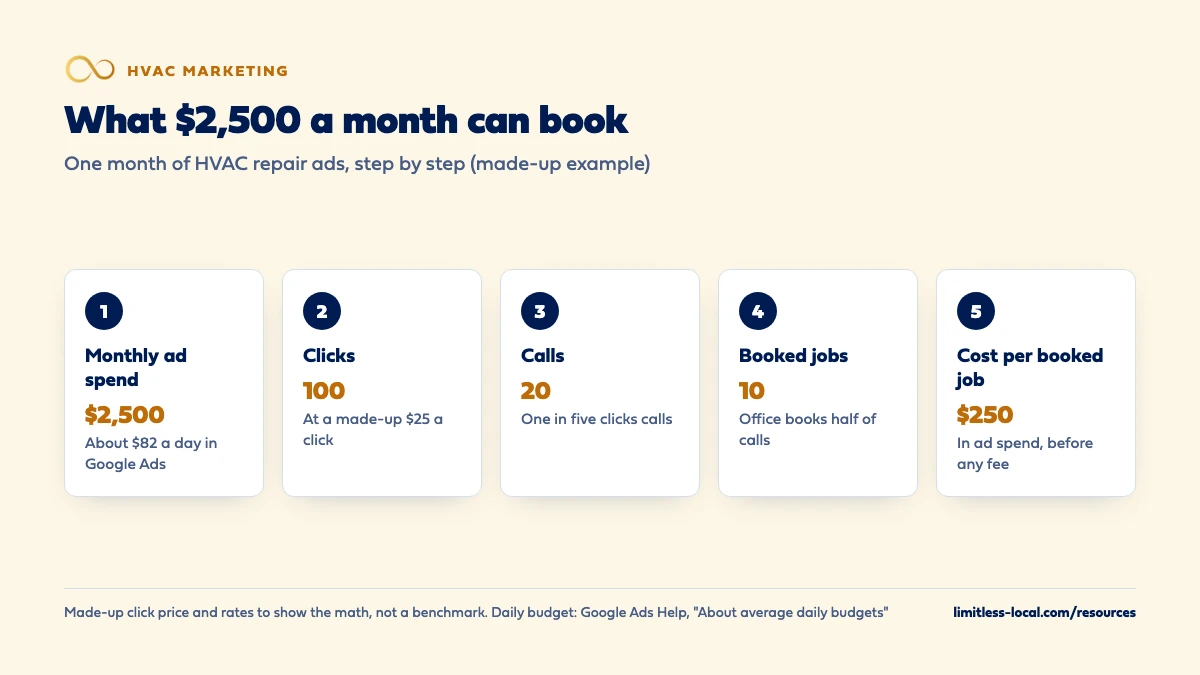
These numbers are made up to show the math, not a benchmark for your market. Say Keyword Planner puts a click for AC repair in your towns around $25. Your $2,500 buys about 100 clicks. One in five people who click calls you: 20 calls. Your office books half: 10 booked jobs, or $250 in ad spend per booked job.
Is $250 a booked job good? That depends on what a repair leaves you after parts and labor, and how many booked calls turn into paid work. If most do and an average repair leaves comfortably more than $250, the budget is working, and you have a case for more. If not, look at the inputs before the budget: a landing page that turns more clicks into calls, or an office that books 7 in 10 calls instead of half, would turn the same 20 calls into 14 booked jobs.
Now stress-test it at $40 a click: about 62 clicks, roughly 12 calls and six booked jobs for the same money. Running both ends of Keyword Planner’s range through this math before you start is the fastest way to know whether $2,500 fits your market, and it’s part of a free visibility audit.
Frequently asked questions
Is $2,500 a month enough for a brand-new HVAC company?
It can be, if the area and services are kept tight. A new company has no conversion history, so expect the first weeks to swing more. Whether Google Ads work for a new HVAC company covers the extra setup.
Will Google spend more than $2,500 in a month?
Not on a campaign set to an average daily budget of about $82. A single day can run up to twice that, but over the month you won’t be charged more than 30.4 times the daily budget.
Should I split $2,500 between Google Ads and Local Services Ads?
You can, but splitting a starting budget leaves each channel thinner. Many owners start one, read a month or two of booked jobs, then add the other.
Should I run ads all day and night on $2,500?
Only if someone answers the phone all day and night. If calls after hours go to voicemail, an ad schedule that matches your answering hours keeps the budget for calls you can book.
What should I do if $2,500 runs out before noon every day?
Narrow before you raise: fewer towns, fewer services, tighter keywords and negative keywords. If it still runs out while booking jobs at a good cost, that’s a case for more budget.
Key takeaways
- $2,500 a month is about $82 a day in Google Ads; a single day can spend up to twice that, but the month stays capped.
- Look up your own click prices in Keyword Planner and run the low and high end through the math before you start.
- Focus a starting budget on fast-booking repair work in your core towns during your answering hours.
- Judge it on cost per booked job over at least two weeks, not on clicks or a single day’s spend.
- Keep ad spend and any management fee separate when you talk about a $2,500 budget.
Not sure what's working right now?
Start with a free visibility audit: rankings, Google profile, reviews and tracking, checked against your service area.
More in this section
- How much revenue should I expect from my HVAC marketing budget?
- Should I raise HVAC ad spend to $10,000 a month or fix conversion?
- How do I get HVAC calls coming back on a tight budget?
- How much does HVAC SEO cost per month?
- How much should an HVAC company spend on Google Ads?
Sources
- About average daily budgets — Google Ads Help
- About Keyword Planner forecasts — Google Ads Help
- About Smart Bidding learning — Google Ads Help
- Fix "Limited by budget" status — Google Ads Help
- Get impression share data — Google Ads Help
- About negative keywords — Google Ads Help