
Does a bigger, tougher local market slow HVAC marketing results?

- How do market size and competition change how fast HVAC marketing works?
- What makes an HVAC market big or tough?
- Does a tougher market slow down SEO and map rankings?
- Does a bigger market slow down Google Ads?
- What about Local Services Ads in a crowded market?
- Can a bigger market ever make results come faster?
- How does market size change the ramp for ads versus SEO?
- How should I adjust my plan for a tough market?
- How long should I give marketing in a crowded market before judging it?
- How do I tell a slow market from marketing that isn't working?
- Does a small town mean fast, cheap results?
- Should a small HVAC shop stay out of big, crowded markets?
- What's different about tough markets for HVAC companies
- A worked example: the same ad budget in two markets
- Frequently asked questions
- Key takeaways
- More in this section
- Sources
The short version
- A tougher market mostly slows SEO and map rankings, because you're climbing past competitors' head start.
- Ads still start fast; in a crowded auction they mostly cost more per lead.
- A big market isn't automatically tough, and a small town isn't automatically easy.
- In a tough market, narrow the towns and jobs, lean on ads while SEO builds, and push reviews.
For HVAC owners in crowded metros, or small towns with one entrenched competitor, wondering whether their timeline should look different.
Get a free visibility audit · Book a growth call
How do market size and competition change how fast HVAC marketing works?
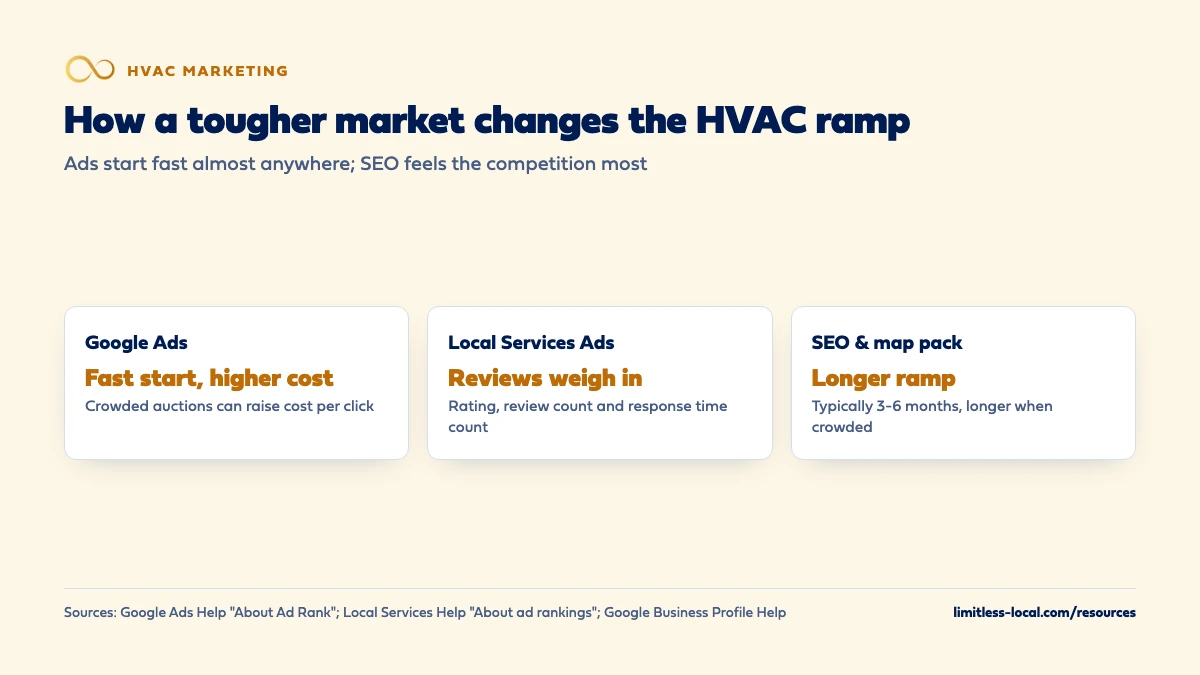
Yes, mostly for SEO and the map pack, and mostly in cost for ads. In a market full of established HVAC companies with years of reviews and links, climbing in Maps and the regular results takes longer, so the typical 3-to-6-month SEO ramp tends to run toward the long end. Ads can still bring calls within days of launch in almost any market, but a crowded auction usually means you pay more for each click or lead, so a tough market changes how fast marketing pays for itself more than how fast the phone starts ringing.
Size and competition are the first things we look at before setting a plan or a budget, because they decide the mix of ads and SEO that makes sense. That’s how every HVAC marketing plan we build starts, with local SEO for the long climb and ads for calls now. The HVAC marketing guide covers every channel, and the rest of the HVAC marketing questions library goes question by question.
What makes an HVAC market big or tough?
Two different things get lumped together. Size is how many homes and how many searches there are. Toughness is how strong the companies you’re up against already are: how many reviews and what rating they carry, how long they’ve had a website people link to, how much they spend on ads and how many towns they cover.
They don’t always go together. A big metro can have whole suburbs where nobody has a decent Google profile. A small town can be brutal if one family-owned shop has been there thirty years and owns the map pack. How competitive HVAC marketing is in your area walks through checking both, town by town, before you set expectations.
Does a tougher market slow down SEO and map rankings?
Yes, and this is where competition bites hardest. Google’s local ranking help says local results are mainly based on relevance, distance and popularity, and that the popularity side draws on things like how many websites link to your business and how many reviews you have. Your competitors built those over years. You’re not climbing a fixed hill; you’re climbing past whatever they already have.
Google’s SEO Starter Guide says some changes take effect in a few hours and others can take several months, and suggests waiting a few weeks to judge whether a change helped. In a crowded market more of the early work is catch-up: cleaning up the profile, building the pages, collecting the reviews just to get level with the shops already on page one. That’s why the ramp runs longer, not because the work is different.
Does a bigger market slow down Google Ads?
Not in speed. Ads can generate leads within days of launch in a small town or a big metro. What changes is price. Google’s Ad Rank help lists the competitiveness of the auction as one of the factors that decides where your ad shows, and says that as the gap between two advertisers grows, the higher-ranked ad is more likely to win but may pay a higher cost per click for that certainty. More HVAC companies bidding on “AC repair” in your area means a pricier auction.
The startup period doesn’t stretch with market size either. A new or reactivated Smart Bidding strategy can show a Learning status for up to seven days while your ads keep running as normal. After that, the question in a big market is whether the cost per booked job works, not whether calls come.
What about Local Services Ads in a crowded market?
Local Services Ads are also an auction, but reviews weigh in directly. Google’s Local Services ranking help says listings are ordered by your bid and how likely your ad is to produce a lead, and that profile quality counts: your rating, number of reviews, average response time, photos and the verification checks you’ve completed. It also says higher-quality profiles may rank higher and may pay lower costs per lead.
In a market where the top three shops each have hundreds of reviews, a newer profile tends to sit lower until its reviews catch up, no matter the budget. That makes answering every call and asking for every review even more important there. Setting an HVAC Local Services Ads budget without junk calls covers the settings side.
Can a bigger market ever make results come faster?
In a few ways, yes:
- More searches means faster feedback. A busy market produces enough calls in a few weeks to see which ads and jobs book. A small town might take a whole season to tell you the same thing.
- Density works for you. In a packed metro, the few miles around your shop hold a lot of homes. You can stay tight, close to where distance favors you in Maps, and still have plenty of work.
- More room to pick a corner. Big markets have more neighborhoods, more job types and more homeowners searching for something specific, like a heat pump install or a second-opinion estimate, where the big shops aren’t paying attention.
Curious what your marketing is actually booking?
Get a free visibility audit — no obligation, no sales pitch.
How does market size change the ramp for ads versus SEO?
Put side by side, the pattern looks like this:
- Small, quiet market: ads start fast and usually cost less per lead; SEO tends to move toward the early end of the ramp, but search volume caps how many calls either can bring.
- Small market, one strong competitor: ads start fast; the map pack can be slow to crack because one shop holds a big review lead.
- Big market, room to grow: ads start fast at a middle price; SEO moves at a normal pace in the neighborhoods nobody has worked.
- Big, crowded market: ads start fast but cost more per lead; SEO usually runs toward the long end, and further in the most contested towns.
In every case, SEO typically takes 3 to 6 months to show meaningful organic growth. Market toughness moves you around inside that range, and sometimes past it, without changing the shape: ads first, SEO building underneath.
How should I adjust my plan for a tough market?
- Go narrow on towns. Work the few towns closest to the shop before spreading out. How many towns an HVAC company should try to rank in covers how to pick and when to add one.
- Go narrow on jobs. Pick the work you want most, such as replacements or heat pumps, and build pages and ads around it before going after every HVAC search.
- Lean on ads while SEO builds. In a crowded market the SEO ramp is longer, so ads carry more of the load early.
- Make reviews a daily habit. The review gap is often the biggest thing between you and the shops above you, and it closes one job at a time.
- Watch cost per booked job, not cost per click. Pricier clicks can still be fine if your office books them and the tickets are big enough.
How long should I give marketing in a crowded market before judging it?
Give ads a few weeks of steady spend before you judge the cost per booked job, longer in a slow month. Give SEO at least the full 3-to-6-month ramp, and judge it on early signs before you judge it on calls: more profile views, more searches finding you, pages starting to show up in the results.
Compare each month with the same month last year, not the month before, so a heat wave or a mild spring doesn’t fool you. What HVAC marketing results to expect in month 1, 3 and 6 lays out what each stage should look like.

How do I tell a slow market from marketing that isn't working?
A slow market still shows movement. Rankings creep up, profile views and searches rise, ad leads come in at a price that’s high but steady, and the booked jobs from each channel are traceable. It’s slow, and you can see why.
Marketing that isn’t working looks different: nothing moves after months, the calls are mostly junk, nobody can tell you which jobs came from which channel, or the reports are full of impressions and clicks with no booked jobs in them. A tough market is a reason for a longer timeline. It isn’t a reason for no tracking. How to know if your HVAC marketing agency is getting results covers what a monthly report should show either way.
Does a small town mean fast, cheap results?
Not always. Small towns have fewer searches, so even a top spot brings a limited number of calls, and ads can run out of searches to show on before they run out of budget. And a single strong competitor can make a small town as hard to crack in Maps as a metro.
Small towns do tend to be cheaper per click. Google’s guide to using Keyword Planner notes that keywords with high search volume may also have a lot of competition, raising the suggested bid, and that for small businesses it’s generally recommended to filter for medium to low competition, which tends to carry a lower suggested bid. Check your own town’s numbers there before assuming either way.
Should a small HVAC shop stay out of big, crowded markets?
No, but it should pick its corner. A two-truck shop doesn’t need the whole metro. It needs enough of a few neighborhoods close to the shop, a few job types it does better than anyone, and a review count that grows every week. If you already run Google Ads, the auction insights report shows which other advertisers show up alongside you and how often your ad outranks theirs, which tells you where the big shops are spending and where they aren’t.
How a small HVAC company can compete with big companies goes deeper on picking the fights you can win.
Want to see where your company stands?
A free visibility audit shows where you show up on Google, Maps and AI answers, and what it's costing you in calls.
What's different about tough markets for HVAC companies
Peak season crowds the auction. When the first heat wave hits, every HVAC company in town turns its budget up at once, and clicks and leads get pricier. The shoulder seasons are cheaper for building reviews, pages and ad data, so a tough market rewards starting before the rush.
Replacements draw the biggest spenders. System replacement searches are where large shops put their money because the tickets are big. Repair, maintenance and second-opinion work is often less contested and builds the customer base that replacements come from later.
Your own customers don’t care how crowded the market is. Maintenance members and past customers call you directly. In a tough market, a strong maintenance plan and steady follow-up keep the trucks busy while the rankings climb.
A worked example: the same ad budget in two markets
These numbers are made up to show the math, not a benchmark for any market. Two HVAC shops each spend $2,000 a month on Google Ads, and both book 35% of their leads.
- Small-town shop: leads cost $50, so $2,000 buys 40 leads, and 14 of them book. Cost per booked job: about $143.
- Big-metro shop: leads cost $100, so $2,000 buys 20 leads, and 7 of them book. Cost per booked job: about $286.
Both shops get their first ad calls in the first week. The difference is what each booked job costs. If the metro shop’s average ticket covers $286 comfortably, the tougher market is just a higher cost of doing business. If it doesn’t, the fix is to narrow: fewer towns, the job types that book best, a sharper landing page, more reviews to lift the click-to-call rate.
For scale, our Essentials package is $3,500 a month and covers Google Ads management up to $2,500 a month in ad spend, which Google bills separately. A free visibility audit can show where your own market falls.
Frequently asked questions
Will spending more make up for a tough market?
For ads, partly: a bigger budget buys more of the auction, at whatever the market’s price is. For SEO and the map pack, money mostly buys more work, and the climb still depends on reviews, links and pages building up over time.
Is my metro too competitive for a new HVAC company?
Rarely. It usually means starting with ads for the jobs you want most, working the neighborhoods closest to your shop, and accepting a longer SEO climb rather than staying out.
Do I need more reviews in a big market?
Usually, because the shops you’re up against tend to have more. The number that matters is how you compare with the companies showing above you, not a fixed target.
Does a tough market change what I should spend?
It changes what each lead costs, so the same budget buys fewer leads. Start from the booked jobs you want and what each one is worth to you, then see what budget that takes in your market.
Can I see how crowded my Google Ads market is before I start?
Yes. Keyword Planner, set to your area, shows a low, medium or high competition rating and a suggested bid for each search. Once ads are running, auction insights shows who you’re competing against.
Should I pick an easier town next door instead?
If it’s close enough to serve well, it can be a smart first target while you build reviews. Just don’t pick it only because it’s easier; it still has to be a town where you want the work.
Key takeaways
- A tougher market mostly slows SEO and the map pack, because you’re climbing past competitors’ reviews and links.
- Ads still bring calls within days; in a crowded auction they cost more per lead.
- Big and tough aren’t the same thing: check your own towns before setting expectations.
- In a tough market, narrow the towns and jobs, lean on ads early and make reviews a habit.
- Judge a crowded market on cost per booked job and early SEO signs, compared with the same month last year.
Not sure what's working right now?
Start with a free visibility audit: rankings, Google profile, reviews and tracking, checked against your service area.
More in this section
- How do I grow my HVAC company with marketing?
- How do I scale my HVAC business with marketing?
- How competitive is HVAC marketing in my area, and how do I check?
- Does my marketing history affect selling my HVAC business?
- Should an HVAC company spend the same on marketing year round?
Sources
- Tips to improve your local ranking on Google — Google Business Profile Help
- SEO Starter Guide: The Basics — Google Search Central
- About Ad Rank — Google Ads Help
- About Smart Bidding learning — Google Ads Help
- About ad rankings — Google Local Services Help
- How to use the Keyword Planner tool effectively — Google Ads
- Use auction insights to compare performance — Google Ads Help