
How do I get more HVAC leads in Las Vegas?
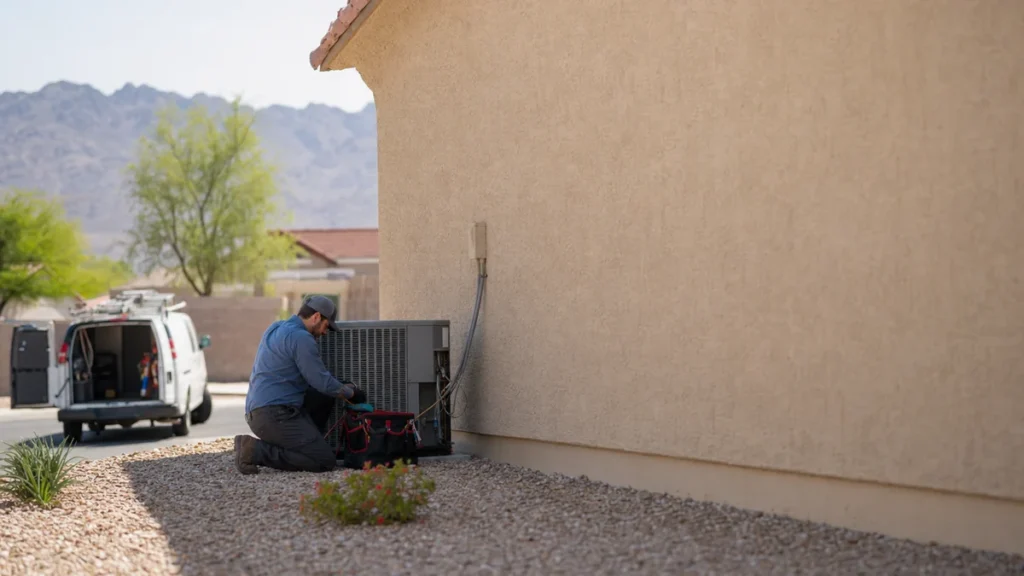
- How does an HVAC company get more leads in Las Vegas, step by step?
- What's different about getting HVAC leads in Las Vegas?
- Step 1: Are you catching the calls you already get?
- Step 2: Is your Google profile set up for the valley?
- Step 3: How do you build reviews fast enough to matter?
- Step 4: Should you run Local Services Ads in Las Vegas?
- Step 5: Where do Google search ads fit?
- Step 6: What should your website say to Las Vegas homeowners?
- Step 7: How do you turn past customers into spring work?
- What does Nevada require in your HVAC ads?
- How do you plan your marketing around the Las Vegas heat?
- How do you tell which channel to grow next?
- What's different for HVAC companies in the desert
- A worked example: comparing two paid channels
- Frequently asked questions
- Key takeaways
- More in this section
- Sources
The short version
- Fix missed calls and after-hours coverage before buying more leads.
- Set your Google profile to the parts of the valley you can reach fast.
- Add Local Services Ads and search ads once reviews and phones are ready.
- Show your Nevada license number on every ad, truck and web page.
For HVAC owners in the Las Vegas Valley who want more calls and need to know which channels to work on first, and what the desert heat changes.
Get a free visibility audit · Book a growth call
How does an HVAC company get more leads in Las Vegas, step by step?
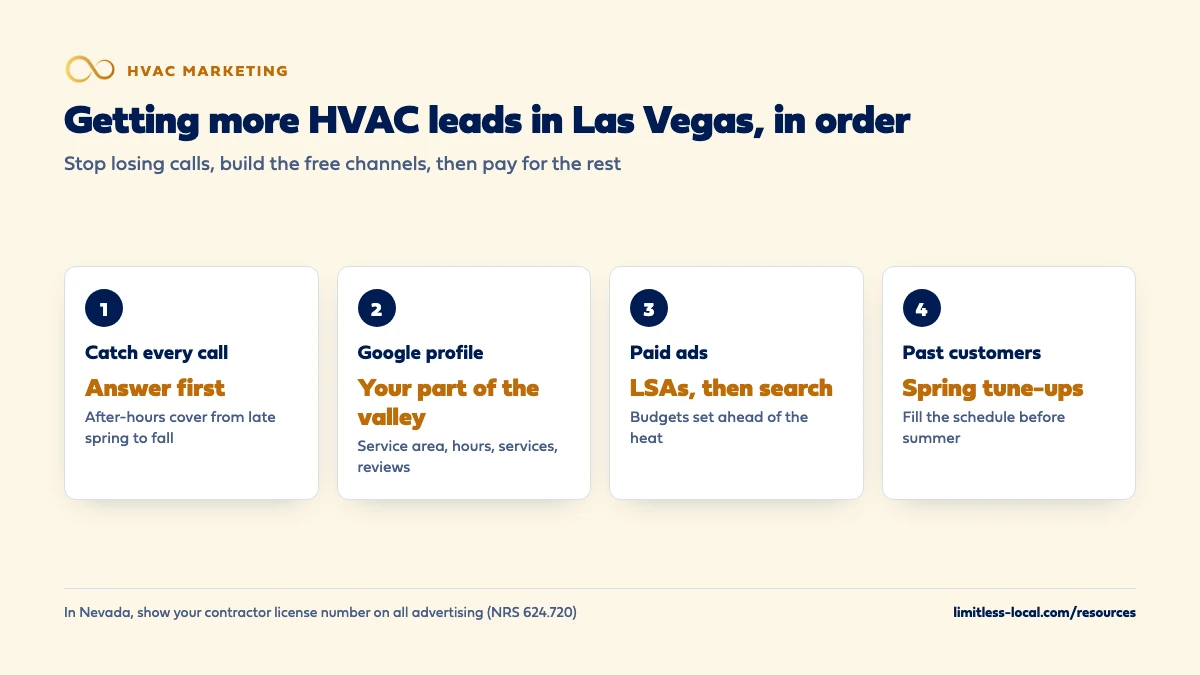
Start by catching every call you already get, because in summer heat a homeowner with a dead AC calls the next company if you don’t answer. Then set up your Google Business Profile for the parts of the valley your trucks reach fast, collect reviews every week, and add Local Services Ads and Google search ads for the jobs and areas the free listings don’t cover yet. Plan budgets and staffing around the forecast, and keep your Nevada license number on every ad, truck and web page.
That order, answering first and then building the free and paid channels around the jobs you want, is how we run HVAC marketing, with local SEO and local ads built around your service area. The HVAC marketing guide covers every channel, and the rest of the HVAC marketing questions library goes question by question.
What's different about getting HVAC leads in Las Vegas?
The channels are the same ones that work anywhere. What changes is the calendar and the map. The National Weather Service’s climate summary for Las Vegas describes hot summers that reach into the triple digits, winter nights that can drop into the twenties, and a valley floor of about 600 square miles. That gives you three things to plan around:
- A long, urgent cooling season. When an AC quits in triple-digit heat, the homeowner calls whoever answers first. Speed matters more here than almost any ad setting.
- A real heating season. Cold nights mean furnace and heat pump calls, so winter isn’t a dead month unless you let it be.
- A big valley. A company based on one side can spend a lot of the day in traffic if it markets to the whole metro. Where you show up should match where your trucks can get to quickly.
The order below is the same one in how an HVAC company gets more leads, tuned for a desert metro: stop losing calls first, then build the free sources, then pay for the rest.
Step 1: Are you catching the calls you already get?
Before you buy a single new lead, check what happens to the ones you already have. Pull last July’s call log and count the calls that went to voicemail, the ones that came in after hours, and the estimates nobody followed up on. In a heat wave, a missed call isn’t a lead you’ll get back tomorrow. That homeowner has already called the next company on the list.
Fixes, roughly in order of cost:
- Someone answers every call during business hours, including lunch.
- After-hours calls reach a person or an answering service, at least from late spring through early fall.
- Every missed call gets a callback within minutes, not at the end of the day.
- Open estimates get a follow-up call and a text within a couple of days.
This is where most companies find their cheapest leads. One HVAC client got 47% more booked estimates from speed to lead, automated reminders and better follow-up.
Step 2: Is your Google profile set up for the valley?
Your Google Business Profile decides whether you show up in the map pack, the free listings with a map near the top of the results. For a Las Vegas HVAC company, the settings that matter most are about place:
- Service area. List the cities and ZIP codes you serve, such as Las Vegas, Henderson and North Las Vegas, up to 20 of them. Google’s help on service areas says the overall area shouldn’t be more than about 2 hours of driving from where you’re based, and in a valley this size you’ll want it much tighter than that.
- Address. If customers don’t come to your shop, remove the address from your profile so you’re listed as a service-area business.
- Hours. Match them to when someone really answers. If you take after-hours AC calls in summer, say so.
- Services. Name the work separately: AC repair, AC replacement, heat pump service, furnace repair, maintenance.
If you’ve never managed your profile, how your Google Business Profile affects map pack rankings covers what each setting does.
Step 3: How do you build reviews fast enough to matter?
Reviews do two jobs. They help your map ranking, and they’re what a homeowner reads before choosing between the three companies on the screen. In a metro this size you’re rarely the only option a homeowner sees, so a steady flow of recent reviews matters more than a big total from years ago.
The busy season is your best chance to collect them, because that’s when you’re fixing the most urgent problems for the most grateful people. Make the ask part of every job: the tech asks at the door once the air is blowing cold, and a text with your review link goes out the same day. Reply to every review, good or bad, with a short note that mentions the job.
Step 4: Should you run Local Services Ads in Las Vegas?
For most HVAC companies with solid reviews and a phone that gets answered, yes. Local Services Ads show prominently in Google Search results, you pay for leads instead of clicks, and there are no keywords to manage. To start getting leads, Google’s getting started guide asks for your license or business registration, reviews where your category requires them, and billing set up.
Two things to know before you start:
- They’re moving into Google Ads. HVAC is one of the categories in the first phase of Google’s move of Local Services Ads into Google Ads, which began in August 2026. Budgets become daily, and your business name, address and hours sync from your Google Business Profile, so fix the profile first.
- Missed calls cost you twice. If you regularly fail to answer calls or reply to messages, your ad ranking may be affected. In a heat wave, that’s exactly when the phones are hardest to keep up with.
Whether they pay off comes down to cost per booked job, which whether Local Services Ads are worth it for HVAC works through.
Curious what your marketing is actually booking?
Get a free visibility audit — no obligation, no sales pitch.
Step 5: Where do Google search ads fit?
Search ads give you control Local Services Ads don’t: you choose the searches, write the ad and send people to a page you built. Use them for the work you want more of, such as system replacements and heat pump installs, and for the parts of the valley where you aren’t showing up in the map yet.
Check one location setting before you launch. By default, Google Ads can show your ads to people who are in your area or who have shown interest in it, even from another state, according to its help on location targeting. For a residential HVAC company, people who are in or regularly in your service area are usually the ones who book. Some legitimate callers do search from elsewhere, such as an owner arranging repairs on a rental, so let your call log decide which option you keep.
Target by ZIP code or city rather than one big circle around the Strip. That keeps your budget on the neighborhoods your trucks can reach fast.
Step 6: What should your website say to Las Vegas homeowners?
Your site doesn’t need to be fancy. It needs to do four things on a phone, fast:
- Show a tap-to-call number at the top of every page.
- Give each main service its own page: AC repair, AC replacement, heat pumps, heating, maintenance.
- Name the parts of the valley you actually serve, with real jobs and photos from those areas instead of a pasted list of cities.
- Show your Nevada contractor license number, as the Nevada section below explains.
Those pages are what your Google profile, your search ads and AI answers all point back to. They’re also the slowest channel to pay off, so start them early and let ads carry the calls while they build.
Step 7: How do you turn past customers into spring work?
Spring and fall are usually the mildest months in Las Vegas, and that’s your window to fill the schedule before the heat. Text and email past customers in spring with a tune-up offer, and push maintenance agreements so the work is on the books before the first triple-digit week. A tech who finds a weak capacitor in April has booked a repair you’d otherwise have fought for in July.
After answering the phone, this is the cheapest lead source on the list. Getting tune-up bookings from past HVAC customers covers the messages and timing.
What does Nevada require in your HVAC ads?
In Nevada, your license number has to be on your advertising. The Nevada State Contractors Board’s page on advertising requirements says all forms of business advertisements must display your license number clearly, and lists vehicles, business cards, letterhead, signage, online or print directories, newspapers and your website. The statute itself, NRS 624.720, says all advertising by a licensed contractor must include the company name and the license number, and its definition of advertising includes the internet.
It also makes it unlawful for a licensed contractor to put false or misleading statements of material fact in advertising meant to win the job. In practice, that means:
- Put the license number in the footer of every page of your website.
- Put it on every truck and yard sign.
- Include it in directory listings and any print or mail pieces.
- Keep offers, prices and claims in your ads true and specific.
How do you plan your marketing around the Las Vegas heat?
Use the forecast as your marketing calendar. The National Weather Service issues an Extreme Heat Watch when conditions are favorable for an extreme heat event, and an Extreme Heat Warning when extremely dangerous heat is expected or happening, as its page on heat alerts explains. A watch is your signal to get ready, a few days before the phones light up:
- Raise ad budgets ahead of the heat, not in the middle of it.
- Line up after-hours coverage and extra phone help.
- Hold a few slots each day for no-cool emergencies.
- If the schedule is already full, lower budgets so you aren’t paying for calls you can’t run.
How to scale up HVAC ads for peak season goes through the budget settings step by step.
How do you tell which channel to grow next?
Track every lead to its source and to whether it booked, then compare cost per booked job across channels. A separate tracking number for your Google profile, your website and each ad campaign makes that possible, and your field software, whether it’s ServiceTitan, Housecall Pro or Jobber, holds the booked side. Grow the channel with the lowest cost per booked job until it stops scaling, then move to the next.
If you want to see how crowded your corner of the valley is before you spend, how to check how competitive HVAC marketing is in your area walks through the free checks.
Not sure which of these is costing you jobs?
A free visibility audit checks the Google profile, reviews, site and tracking, and shows what to fix first.
What's different for HVAC companies in the desert
No-cool calls can’t wait. In triple-digit heat a dead AC is an emergency, not an appointment. Your marketing should say plainly whether you offer same-day and after-hours service, and the phone has to back it up.
Dust is part of the job. Strong spring and fall winds bring blowing dust and sand into the valley. That gives spring tune-up and filter offers a reason homeowners recognize, without inventing urgency.
Winter still has work. Cold nights bring furnace and heat pump calls. Keeping some ads and your profile active through winter is cheaper than restarting from nothing every spring.
A worked example: comparing two paid channels
These numbers are made up to show the math, not a benchmark for Las Vegas or any other market. Say you spend $4,000 on ads in a July, split evenly between two channels.
- Local Services Ads: $2,000 at $50 per charged lead buys 40 leads. Your office books 16 of them, or $125 per booked job.
- Search ads for replacements: $2,000 brings 25 calls and 10 booked estimates, or $200 per booked estimate.
The search ads look more expensive until you add what each job is worth. If a few of those estimates become system replacements, they can easily out-earn a month of repair calls. That’s why you compare cost per booked job against the value of the job, not just against the other channel.
Our Growth package, at $4,500 a month, includes Local Services Ads management and Google Ads management up to $5,000 a month in spend, along with local SEO and review generation. Ad spend is paid to Google separately. Essentials, at $3,500 a month, covers Google Ads up to $2,500 in spend but not Local Services Ads.
Frequently asked questions
Is Las Vegas too competitive for a small HVAC company to get leads?
Not if you narrow it. A small company can win the map and the phone in the neighborhoods closest to its shop, answer faster than bigger companies and focus ads on a few ZIP codes, instead of trying to cover the whole valley.
Should I advertise in Henderson and North Las Vegas too?
Only where your trucks can get to quickly and you’re willing to run the calls. Add areas one at a time, and check that each one books jobs at a cost per job you’re happy with before adding the next.
Do I need a Spanish-language website in Las Vegas?
It depends on who calls you and who in your office can answer in Spanish. If your techs and office can serve Spanish-speaking homeowners, a few Spanish pages for your main services are worth testing; if nobody can take the call, wait.
Should I stop advertising in winter?
Usually not completely. Cold nights still bring heating calls, and a profile and ads that stay active through winter keep your reviews and data building. Lower budgets to match demand instead of switching everything off.
Does my license number have to be in my Google ads?
Nevada’s statute says all advertising by a licensed contractor must include the company name and license number, and it defines advertising to include the internet. The simplest habit is to show it everywhere you advertise, and on your website, where the ad sends people.
How long until new marketing brings more calls in Las Vegas?
Ads can generate leads within days of launch. SEO typically takes 3 to 6 months to show meaningful organic growth, so start it before the summer you want it to help.
Key takeaways
- Catch every call first; in summer heat a missed call goes to the next company.
- Set your Google profile to the parts of the valley your trucks reach fast.
- Add Local Services Ads and search ads once reviews and phones are ready.
- Plan budgets and staffing from the heat forecast, before the phones light up.
- In Nevada, show your license number on every ad, truck and web page.
- Grow the channel with the lowest cost per booked job, then the next.
Want a second set of eyes on your setup?
We'll look at how you show up locally and where calls are leaking, then send you a plain-English breakdown.
More in this section
- How can an HVAC company get more leads?
- Which marketing channels give an HVAC company the best leads?
- How do I grow my HVAC company with marketing?
- What content does my HVAC website need to attract leads?
- How do I get more repeat customers and referrals for my HVAC company?
Sources
- Climate of Las Vegas — National Weather Service, Las Vegas
- Understanding Heat Alerts — National Weather Service
- Advertising Requirements — Nevada State Contractors Board
- Unlawful Advertising (NRS 624.720) — Nevada State Contractors Board
- Manage your service areas for service-area & hybrid businesses — Google Business Profile Help
- Getting started with Local Services Ads — Google Local Services Help
- Local Services Ads transition to Performance Max campaigns with pay-per-lead goals — Google Ads Help
- About targeting geographic locations — Google Ads Help