
How do I get tune-up bookings from my past HVAC customers?
- How can an HVAC company turn its existing customer list into booked tune-ups every spring and fall?
- Why are past customers the easiest tune-ups to book?
- When should I send tune-up reminders?
- Which past customers should I contact first?
- How do I pull the list from ServiceTitan, Housecall Pro or Jobber?
- What should the tune-up message say?
- Should I discount tune-ups to get past customers to book?
- Should I use email, text, phone calls or postcards?
- What rules apply to tune-up emails and texts?
- How do I make it easy for past customers to book?
- How do I turn tune-ups into maintenance plan members?
- How do I know if the tune-up campaign worked?
- What's different about tune-up campaigns for HVAC companies
- A worked example: one spring campaign to a past-customer list
- Frequently asked questions
- Key takeaways
- More in this section
- Sources
The short version
- Start with the list you already have: customers, equipment and last service date.
- Reach out in spring for cooling and fall for heating, before the busy season.
- Email first, text those who agreed to texts, then have the office call.
- Make booking easy, and sell a plan at the visit so it repeats.
For HVAC owners sitting on years of customers in ServiceTitan, Housecall Pro or Jobber who want those names turned into tune-ups before the rush, not after it.
Get a free visibility audit · Book a growth call
How can an HVAC company turn its existing customer list into booked tune-ups every spring and fall?
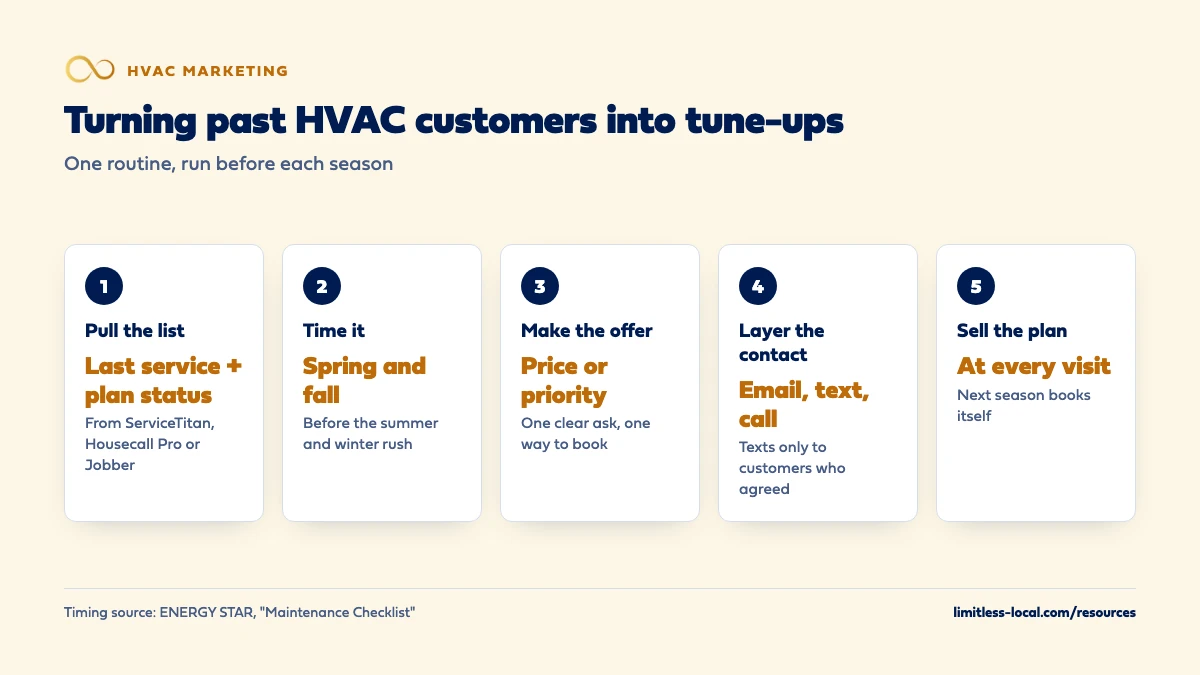
Pull every past customer from your field-service software, sort them by when they last had service and whether they’re on a maintenance plan, and contact them a few weeks before cooling season in spring and heating season in fall. Lead with a clear offer, such as a set tune-up price or priority scheduling, and send it as an email, then a text to customers who agreed to texts, then a phone call from the office to anyone who hasn’t booked. Make booking take one reply or one call, and offer a maintenance plan at every visit so next season’s tune-up books itself.
Past customers are the cheapest tune-ups you’ll ever book, as long as someone actually works the list. Our automation add-ons, including unified messaging and calendar and reminders, plug into any of our HVAC marketing packages, with pricing shared on the discovery call. One HVAC client got 47% more booked estimates from speed to lead, automated reminders and better follow-up. For the bigger picture, see the HVAC marketing guide and the HVAC marketing questions library.
Why are past customers the easiest tune-ups to book?
They already know your trucks, your techs and your prices. You have their address, their equipment and their service history on file. No ad click to pay for, no stranger to win over.
Tune-ups also land at the right time for the schedule. They fill the shoulder months in spring and fall, when the phones are quieter and techs are easier to keep busy. And a tune-up puts a tech in front of the equipment, which is where repair work and replacement conversations start.
Most shops have the list. What they don’t have is a routine for working it. That’s what the steps below set up. If you want the wider view on repeat business and referrals, how to get more repeat customers and referrals covers maintenance plans and referral asks in more depth.
When should I send tune-up reminders?
Before the season, not during it. ENERGY STAR’s maintenance checklist tells homeowners to check the cooling system in the spring and the heating system in the fall, because contractors get busy once summer and winter come. It even suggests planning check-ups around the time changes. That’s handy for you: two built-in dates homeowners already know.
A simple calendar:
- Late winter to early spring: cooling tune-up reminders go out, so visits happen before the first heat wave.
- Late summer to early fall: heating tune-up reminders, ahead of the first cold snap.
- Heat pump customers: both seasons, since the same system heats and cools.
Start early enough that you can still fit people in. A reminder that lands when every truck is booked for two weeks turns a tune-up into a frustrated customer.
Which past customers should I contact first?
Not everyone on the list is worth the same call. Work it in this order:
- Maintenance plan members who are due. They’ve already paid or agreed. Getting them booked is service, not marketing.
- Lapsed members. People whose plan ran out. They liked you enough to sign up once.
- Repair customers from the last few years with no plan. The biggest group for most shops, and the best place to sell plans.
- Customers you installed a system for. Regular maintenance protects the system you put in, and it keeps you as their company.
- Older one-time customers. Worth a message, lower priority for phone time.
Leave off anyone who asked not to be contacted, anyone with an open complaint, and addresses where you know the homeowner moved. Fix the complaint first; a tune-up offer won’t.
How do I pull the list from ServiceTitan, Housecall Pro or Jobber?
Your field-service software is the list. Filter it by:
- Last service date, so you can sort recent customers from older ones.
- Plan status: active, due, expired or none.
- Equipment type, if you track it, so heat pump, furnace and AC customers get the right message.
- Contact permissions: who has an email on file and who agreed to texts.
Most of these tools can also send the messages. Jobber’s Campaigns, for example, include an automated campaign that emails clients who haven’t booked in a while. Housecall Pro’s Campaigns include one-time email and text campaigns and campaign flows, with daily or monthly message limits that depend on your plan. Check your plan’s limits before you build a big send.
If your list has years of duplicates and missing emails, spend an afternoon cleaning it first. What to look for in a CRM for your HVAC company covers keeping that data clean going forward.
What should the tune-up message say?
Short, specific and about them. A message that works has five parts:
- Who you are, in the first line, so they don’t mistake it for spam.
- Why now: the season’s coming, and you’re booking tune-ups before the rush.
- Their system, if you know it: “your heat pump we serviced last spring.”
- The offer: the price, what’s included, or the perk.
- One easy way to book: reply with a day that works, tap a link, or call.
Something like: “Hi Maria, it’s Desert Air. Cooling season’s close, and we’re booking spring tune-ups now before the schedule fills. Want us to check the AC we serviced last May? Reply with a day that works and we’ll send two times.”
Skip the newsletter. One clear ask books more visits than a page of tips.
Curious what your marketing is actually booking?
Get a free visibility audit — no obligation, no sales pitch.
Should I discount tune-ups to get past customers to book?
Not necessarily. Past customers already trust you, so you often don’t need a deep discount to get them back. Offers that work without training people to wait for a coupon:
- A set, published tune-up price, so nobody has to call to find out.
- Priority scheduling before the rush.
- Member pricing: the tune-up is cheaper if they join the plan today.
- A small add-on, like a filter, instead of money off.
Be careful with very cheap or free tune-up offers. They can fill the schedule with visits that don’t cover the truck’s time, and they pull in price shoppers you’ll fight with later. Which promotions and offers work for an HVAC company goes deeper on pricing offers.
Should I use email, text, phone calls or postcards?
Use them in layers, cheapest first:
- Email to the whole list. It’s the cheapest to send, and some people will book right away.
- Text a few days later, only to customers who agreed to get texts from you. Texts get noticed fast.
- A phone call from the office to members and recent repair customers who haven’t booked. It takes the most time and books the best.
- A postcard for customers with no email or mobile number on file.
Stop the sequence for anyone who books. A customer who already booked and still gets three more reminders feels like a number. Your software should drop them from the campaign automatically; check that it does.
What rules apply to tune-up emails and texts?
For email, the FTC’s CAN-SPAM compliance guide lays out the main requirements for commercial messages, including messages to former customers:
- Honest sender information and a subject line that matches the message.
- Your valid physical postal address in the email.
- A clear way to opt out, honored within 10 business days.
- Maintenance plan members can opt out of marketing emails too, even though they’re members.
For texts, the FCC’s guide on unwanted robocalls and texts says its rules ban texts to a mobile phone sent with an autodialer unless the phone owner gave consent first, and that commercial texts require written consent. Prerecorded telemarketing calls need prior written consent too. In practice: text only customers who agreed to texts, keep a record of that consent in your software, and have real people make the calls.
Email setup itself, from your sending domain to staying out of spam folders, is covered in how to set up email marketing for your HVAC company.

How do I make it easy for past customers to book?
Every extra step loses people. Make sure:
- Replies go to someone who answers them the same day. A “yes” that sits for three days is a lost visit.
- The office knows the campaign is running, the price and what’s included, so a caller gets a straight answer.
- Booking offers two specific times, not “when works for you?”
- Online booking, if you use it, shows real tune-up slots, not your whole calendar.
Block tune-up capacity on the schedule before you send, so you know how many you can take each week. Then send in waves sized to that capacity instead of blasting the whole list at once.
How do I turn tune-ups into maintenance plan members?
The tune-up is the best moment to sell the plan, because the customer just watched your tech work on their system. Have the tech or the office offer it at every visit, with the price of today’s tune-up credited if they join.
Once someone joins, set the next visits up front. In Housecall Pro, for example, selling a service plan fills in the month and year of each included visit based on the plan’s start date. That turns next spring’s tune-up into a scheduled visit instead of another campaign.
Over a few seasons, the goal is a list where more and more of your tune-ups come from members, and reactivation campaigns are for the rest.
How do I know if the tune-up campaign worked?
Tag every booking from the campaign with its own source in your software, so you can count:
- Tune-ups booked, by channel: email, text, call, postcard.
- Repairs found on those visits, and what they were worth.
- Plans sold at those visits.
- Replacement estimates that came out of them.
Then compare that revenue to what the campaign cost: software, postage and office time. Run it again next season, change one thing, and compare. If you’re also trying to fill the slow months generally, how to keep HVAC calls coming in during slow months covers the other levers.
Not sure which of these is costing you jobs?
A free visibility audit checks the Google profile, reviews, site and tracking, and shows what to fix first.
What's different about tune-up campaigns for HVAC companies
Two seasons, two campaigns. Most trades get one shot a year at past customers. HVAC gets two natural reasons to call, cooling in spring and heating in fall, and heat pump customers fit both.
Weather moves the window. An early heat wave can bury the spring campaign under repair calls. Send early, and pause the campaign when the emergency board fills up, so tune-ups don’t crowd out no-cool calls.
The visit leads to bigger work. A tune-up on an older system is often where the replacement conversation starts. Track which tune-ups turned into replacement estimates, because that’s often where most of a campaign’s money shows up.
Your techs sell the next season. In HVAC, the plan is usually sold in the driveway. Give techs a simple, one-line way to offer it at every visit.
A worked example: one spring campaign to a past-customer list
These numbers are made up to show the math, not a benchmark for your market. Say you pull 600 past customers without a maintenance plan who had service in the last few years.
- Email, text and calls book 48 tune-ups, or 8 in every 100 customers.
- At a made-up tune-up price of $129, that’s $6,192 in tune-up revenue.
- Say 1 in 6 of those visits turns up a repair the customer approves, at an average of $450: that’s 8 repairs and $3,600.
- And say 1 in 4 joins the maintenance plan, which makes 12 new members whose next tune-up is already on the calendar.
That’s $9,792 of work from customers you already had, booked in the shoulder season when trucks would otherwise sit. Your own numbers will be different. The point is to measure them, then run it again in the fall.
Frequently asked questions
How far back should I go on my customer list?
Start with customers from the last few years, since their contact details and equipment are most likely still current. Older customers can get a single email; save office calls for recent ones.
What if a past customer had a bad experience with us?
Leave them off the tune-up campaign and call them separately to fix it. A cheerful promo email to someone with an open complaint makes it worse.
Can I send tune-up reminders to homeowners who rented the house?
If you know the customer was a renter or has moved, leave them off and focus on the address. The new homeowner isn’t on your list yet, so reach them another way, such as a postcard to the address.
Should the tune-up email come from me or the company?
Either works, as long as the company name is clear in the sender and first line. A note signed by the owner can feel more personal for a small shop.
Can I run tune-up campaigns in the middle of summer?
You can, but you’ll be booking tune-ups into a schedule full of repair calls. Pre-season works better for you and for the customer.
Do tune-up reminders count as marketing emails?
If the email’s main purpose is to promote a service, treat it as a commercial message under CAN-SPAM, with your address and an opt-out. The exception for transactional messages is read narrowly, so don’t count on it.
Key takeaways
- Your past customers are the cheapest tune-ups you’ll book, and the list is already in your software.
- Contact them before cooling season in spring and heating season in fall, not during the rush.
- Lead with a clear price or priority scheduling, and one easy way to book.
- Email first, text only those who agreed, then have the office call.
- Sell a maintenance plan at every tune-up so next season books itself.
Want a second set of eyes on your setup?
We'll look at how you show up locally and where calls are leaking, then send you a plain-English breakdown.
More in this section
- How do I get more repeat customers and referrals for my HVAC company?
- How do I keep HVAC calls coming in during slow months?
- How can an HVAC company get more leads?
- How should my HVAC office handle incoming calls from new customers?
- How do I get my HVAC techs to ask customers for Google reviews?
Sources
- Maintenance Checklist — ENERGY STAR
- CAN-SPAM Act: A Compliance Guide for Business — Federal Trade Commission
- Stop Unwanted Robocalls and Texts — Federal Communications Commission
- Campaigns | Marketing Tools — Jobber Help Center
- Campaigns: Overview and FAQ — Housecall Pro Help Center
- How to Sell A Service Plan — Housecall Pro Help Center