
What promotions and offers work for an HVAC company?
- Which HVAC specials actually book jobs: tune-ups, maintenance plans, financing or discounts?
- What makes an HVAC offer actually work?
- Do tune-up specials still work for HVAC companies?
- Are maintenance plans the best offer an HVAC company can make?
- Should I offer financing on HVAC replacements?
- Do free estimates and free service calls work?
- Which seasonal offers make sense for HVAC?
- What offers work for HVAC system replacements?
- When do discounts hurt an HVAC company?
- Where should I run my HVAC promotions?
- How do I keep a promotion from turning into bait and switch?
- How do I tell if an HVAC offer is paying off?
- What's different about HVAC offers
- A worked example: a tune-up special vs a repair coupon
- Frequently asked questions
- Key takeaways
- More in this section
- Sources
The short version
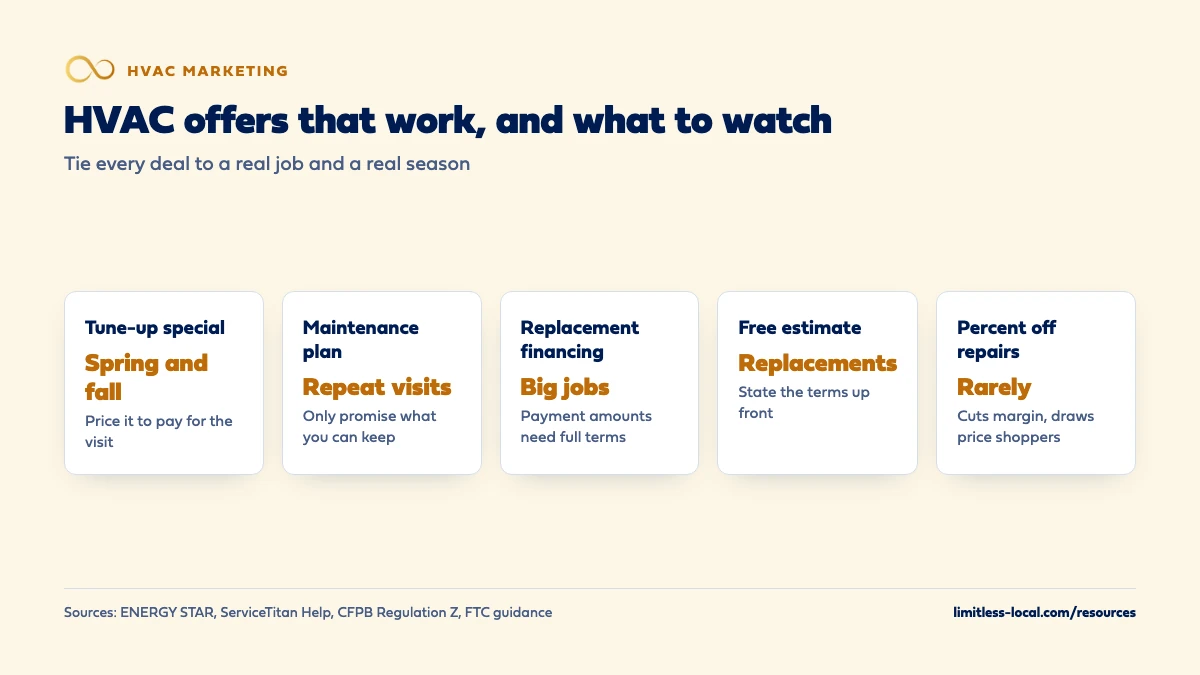
- Best bets: pre-season tune-ups, maintenance plans, replacement financing and free replacement estimates.
- Time offers to the spring and fall shoulder seasons, when the schedule has room.
- Avoid percent-off repair discounts; they cut margin and pull in price shoppers.
- Keep every offer honest: clear terms on anything free, full terms when you quote payments.
For HVAC owners choosing what to put in their ads, mailers and emails this season, and wondering which deals pay for themselves.
Get a free visibility audit · Book a growth call
Which HVAC specials actually book jobs: tune-ups, maintenance plans, financing or discounts?
The offers that work best for most HVAC companies are tied to a real job and a real season: a pre-season tune-up special, a maintenance plan with priority scheduling, financing on system replacements, and a free in-home estimate for new equipment. They work because they fill slow weeks, bring you back into homes and make big jobs easier to say yes to. Straight percent-off discounts on repairs work least well, because they cut margin on work people need anyway and attract price shoppers.
An offer only pays if it reaches the right homeowners and you can see what it booked. Google Ads management is part of every one of our HVAC marketing packages, and Growth ($4,500 a month) adds Meta remarketing and ad design and creative (limits apply), all run through our local ads work. Essentials ($3,500 a month) includes a 3-email welcome flow, and Growth a 5-email flow. The HVAC marketing guide covers how offers fit with SEO and reviews, and the rest of the HVAC marketing questions library goes question by question.
What makes an HVAC offer actually work?
A good HVAC offer does three jobs at once. It gives the homeowner a clear reason to book now instead of later. It fills your schedule when you have room, not when you’re already slammed. And it leaves you with something worth more than the discount: a visit to the home, a plan member, or a replacement conversation.
The offers that fail usually miss one of those. A coupon on AC repair in July gives money away on calls you’d get anyway. A deal with fine print nobody can follow feels like a trick. A tune-up priced so low it only makes sense if the tech sells something turns into a pressure visit, and homeowners can tell.
So before you pick a deal, decide what you want it to do: fill March and October, sign plan members, or move replacements. The rest of this page goes offer by offer with that in mind.
Do tune-up specials still work for HVAC companies?
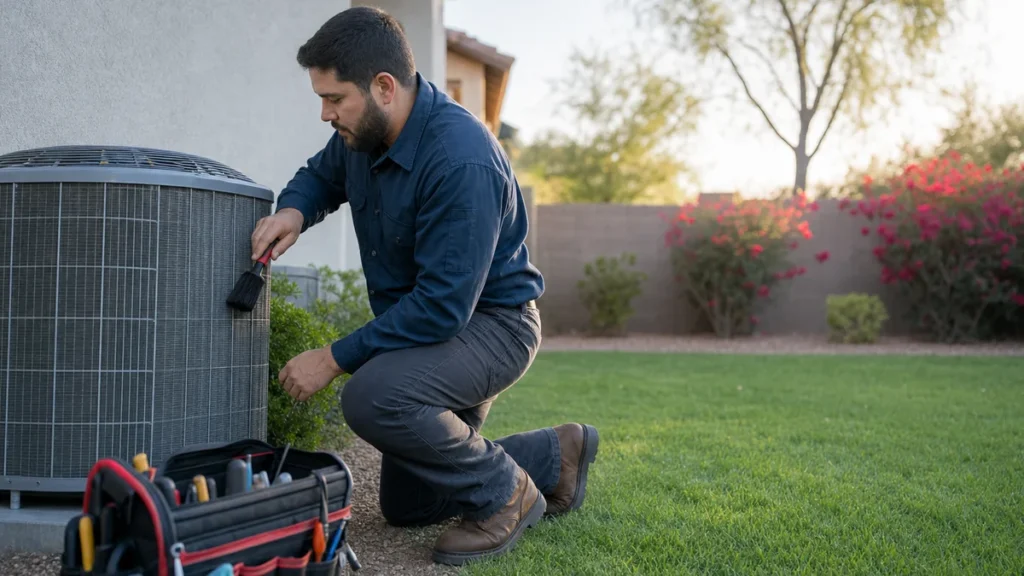
Yes, especially when you time them right. ENERGY STAR tells homeowners to have a contractor check the cooling system in spring and the heating system in fall, because contractors get busy once summer and winter arrive. That’s the window your tune-up special belongs in: the shoulder weeks when your techs have open slots.
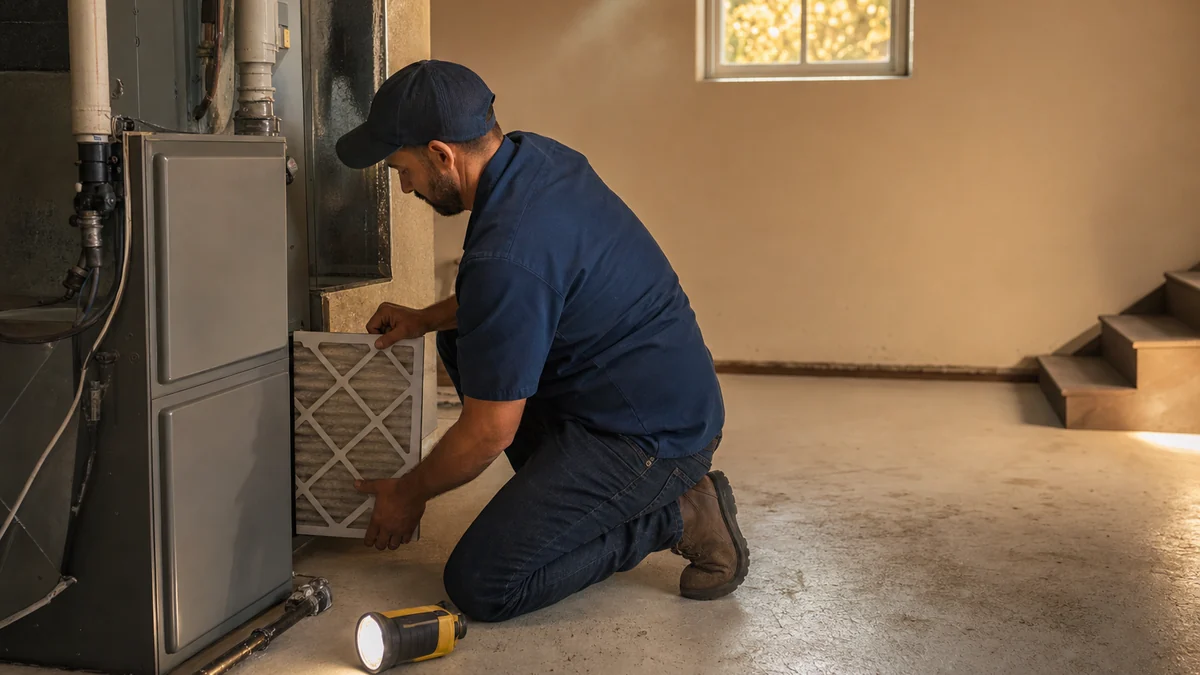
Price it so the visit pays for itself. A tune-up that loses money on every call only works if the tech turns it into repairs, and that’s the road to pushy visits and bad reviews. A fair price, a clear checklist of what’s included, and a tech who reports honestly on what they found will still turn up real repair and replacement work, without the pressure.
Run it to past customers first, then to the neighborhoods around them. A tune-up is the easiest yes in HVAC, so it’s also the best way to meet homeowners who’ll call you when something breaks.
Are maintenance plans the best offer an HVAC company can make?
For most residential shops, they’re the offer that keeps paying. ServiceTitan’s help center says memberships are designed to provide a steady flow of income in addition to getting technicians back on site to identify upsell and replacement opportunities.
The plans that sell are simple. Two visits a year, priority scheduling in the hottest week of the year, a repair discount members can actually use, and maybe no overtime charge on emergency calls. Keep the benefits to what you can deliver on your busiest day, because a “priority” promise you break in a heat wave costs you the member.
Offer the plan on every residential service call and tune-up, and make it easy to say yes on the spot. Getting more repeat customers and referrals covers what to put in the plan and who should offer it.
Should I offer financing on HVAC replacements?
On system replacements, financing is often what turns “we’ll think about it” into a signed proposal, because it turns a large one-time bill into a monthly number the homeowner can plan around. Advertising it is where owners get into trouble.
Under the federal rule on advertising credit (Regulation Z, section 1026.24), certain terms in an ad trigger extra disclosures. If your ad states the down payment, the number of payments or repayment period, the amount of any payment, or the amount of any finance charge, it also has to state the down payment, the terms of repayment and the annual percentage rate, using that term. “As low as $99 a month” is a triggering term. “Financing available” isn’t.
So keep ads to “financing available” or “ask about financing” unless you’re ready to print the full terms, and check any payment wording with your financing company before it runs.
Do free estimates and free service calls work?
A free in-home estimate on a replacement is close to expected in HVAC, and it works because the homeowner is about to make a big decision and wants a real number. A free service call with a repair can work too, as long as the conditions are clear.
The word “free” comes with rules. The Federal Trade Commission’s guide on the word “free” says all the terms and conditions for getting the free item should be set out clearly and conspicuously at the outset of the offer. Its advertising guidance for small business adds that when a free offer is tied to buying something else, the price of that purchase shouldn’t be raised from its regular price.
In practice: if the service call is free only when the homeowner approves the repair, say so right next to the word “free”, and don’t quietly pad the repair price to cover it.
Curious what your marketing is actually booking?
Get a free visibility audit — no obligation, no sales pitch.
Which seasonal offers make sense for HVAC?
Match the offer to what the homeowner is thinking about and what your schedule can handle:
- Early spring: AC tune-up specials and maintenance plan sign-ups, before the first hot week.
- Peak summer and winter: usually no discount at all. Lead with availability, reviews and fast scheduling instead.
- Fall: furnace and heat pump tune-ups, plus plan renewals.
- Shoulder seasons: replacement offers, like a free estimate with flexible install dates, when your install crews have room.
The idea is to use offers to pull demand into the quiet weeks, not to sweeten jobs that would call you anyway. Keeping HVAC calls coming in during slow months has more on filling the shoulder seasons.
What offers work for HVAC system replacements?
Replacement buyers compare companies over days or weeks, so the offer needs to lower the risk of choosing you, not just the price:
- A free in-home estimate with a written proposal they can compare.
- Financing, advertised in compliant wording.
- Good-better-best options, so they choose between your systems instead of between you and a competitor.
- A labor warranty you’re proud of, if you offer one. An ad that mentions a warranty should clearly disclose how to get the details and any conditions or limits.
- A first-year maintenance plan included with the install.
Replacements sell differently from repairs at every step, and marketing HVAC replacements differently from repairs goes deeper on the ads and pages behind them.
When do discounts hurt an HVAC company?
Discounts hurt when they land on work you’d get anyway. A no-cool call in July doesn’t need 15% off to book; the homeowner needs help today. Taking the percentage off just lowers your margin on the busiest weeks of the year.
They also attract the wrong customers. A lead who called because of a coupon is more likely to shop the next job too, and a steady diet of discounts teaches your market to wait for the next one.
If you want a deal for repair work, make it something that costs you little and the homeowner values: a waived trip fee for members, or a tune-up added at cost when they book a repair. Attracting fewer price shoppers to your HVAC company covers the wording and settings that keep bargain hunters away.
Where should I run my HVAC promotions?
Start with the people who already know you. Your past-customer list is the cheapest place to run a tune-up or plan offer, by email, text or postcard, and they’re the most likely to say yes.
On Google search ads, promotion assets can show a dollar or percentage discount under your ad, with the dates or days and times you choose, so you don’t have to rewrite your ads each season. On Facebook and Instagram, seasonal tune-up and plan offers to past customers and website visitors tend to beat cold audiences.
Wherever it runs, the offer should look the same: one clear deal, a real end date, and one way to book. What good HVAC advertising looks like shows how to write the ad around it.
How do I keep a promotion from turning into bait and switch?
It’s illegal to advertise something you have no intention of selling when the plan is to sell the customer something else, usually at a higher price. That’s bait and switch, and a cheap tune-up can drift toward it if the real plan is to show up and push a new system.
Three habits keep you clear. Sell the advertised offer to anyone who asks for it, as advertised. Give techs a checklist so every tune-up gets the same real work, whether or not anything else sells. And when a tech recommends a repair or replacement, back it with what they found, in writing, and let the homeowner decide without a countdown.
It’s good business as much as good practice. The homeowners who trust your tune-up are the ones who call you for the replacement, often years later.
How do I tell if an HVAC offer is paying off?
Give every offer a way to be counted: a promo code, a tracked phone number or a landing page used nowhere else. Then tag each booking with the offer in your field software.
Judge it on what it led to, not just what it booked. For a tune-up special, count the repairs, plan sign-ups and replacement estimates that followed. For a plan offer, count members and renewals. For a replacement offer, count signed jobs and their value. An offer that books a lot of cheap visits and nothing after them isn’t working, however busy it keeps the board.
Which numbers an HVAC owner should track every week has a short scorecard that makes this quick.
Want to see where your company stands?
A free visibility audit shows where you show up on Google, Maps and AI answers, and what it's costing you in calls.
What's different about HVAC offers
Two peaks and two valleys. Most trades have one busy season. HVAC has a cooling peak and a heating peak, with shoulder seasons in between. That gives you two natural windows a year for tune-up and plan offers, and two peaks where discounts mostly give money away.
Every tune-up is an inspection. A tech on site sees the age and condition of the equipment. That’s why tune-ups and plans are worth more to an HVAC company than their sticker price suggests, and why they must be run honestly.
Replacements are a considered purchase. Homeowners take time, get more than one quote and think in monthly payments. Offers that lower the risk of choosing you, like financing, written options and warranties, matter more than a price cut.
A worked example: a tune-up special vs a repair coupon
These numbers are made up to show the math, not a benchmark for your market.
Tune-up special. You run an $89 spring tune-up and book 100 of them: $8,900 in revenue. Each visit costs you about $70 in tech time and truck, or $7,000 in total, leaving $1,900. Then the follow-on work: say 14 of those homes need a repair your tech documents, at an average gross profit of $400, adding $5,600, and 12 homeowners join your maintenance plan.
Repair coupon. You run 15% off repairs in July and 40 customers use it on an average $500 repair. That’s $75 off each, or $3,000 handed back on calls that were mostly coming anyway, and no new plan members.
Two offers, very different results. A free visibility audit looks at how your current offers are tracked and what they’re really booking.
Frequently asked questions
Should I put prices in my HVAC promotions?
For tune-ups and plans, yes; a clear price is the whole point. For replacements, lead with the free estimate and financing, and quote the real number in the home.
How long should an HVAC promotion run?
Long enough to fill the window it’s meant for, usually a few weeks in a shoulder season, with a real end date. An offer that never ends stops working as an offer.
Do referral rewards count as a promotion?
They can. A thank-you credit for customers who send a neighbor who books is a low-cost offer. Tag those jobs so you can see what the program brings in.
Can I advertise rebates or tax credits on new equipment?
Only ones you’ve confirmed are current for the equipment and your area, with the conditions spelled out. Check the program’s own website before each season, because the rules change.
Should my techs sell maintenance plans or the office?
Both. Techs can offer it at the end of every visit, when the homeowner has just seen the value, and the office can offer it when booking tune-ups.
Is a "free" service call misleading if they have to buy a repair?
Not if you say so clearly, right next to the offer, from the start. The trouble starts when that condition is hidden or the repair price is raised to cover it.
Key takeaways
- Tune-ups, maintenance plans, replacement financing and free replacement estimates are the offers that usually pay off.
- Run offers in the spring and fall shoulder seasons, not in the middle of a heat wave or cold snap.
- Percent-off repair discounts mostly cut margin on work you’d get anyway.
- Quoting a monthly payment in an ad means also stating the down payment, repayment terms and APR; “financing available” doesn’t.
- Judge offers by what follows: repairs, plan members and replacements, not just bookings.
Not sure what's working right now?
Start with a free visibility audit: rankings, Google profile, reviews and tracking, checked against your service area.
More in this section
- How should a commercial HVAC company market itself?
- How can an HVAC company get more leads?
- Which HVAC services should I advertise first?
- What does good HVAC advertising look like?
- Which marketing channels give an HVAC company the best leads?
Sources
- Maintenance Checklist — ENERGY STAR
- Understand differences between memberships and service agreements — ServiceTitan Help Center
- § 1026.24 Advertising (Regulation Z) — U.S. Government Publishing Office (govinfo), Code of Federal Regulations
- Guide Concerning Use of the Word "Free" and Similar Representations — Federal Trade Commission
- Advertising FAQ's: A Guide for Small Business — Federal Trade Commission
- About promotion assets — Google Ads Help