
How does a roofer set up a funnel for roofing leads?
- What are the steps in a roofing lead funnel, from first call to signed roof?
- What is a lead funnel for a roofing company?
- Step 1: Where do roofing leads enter the funnel?
- Step 2: What should happen the moment a lead calls or fills out a form?
- Step 3: How do I capture every lead and where it came from?
- Step 4: How fast should someone reach a new roofing lead?
- Step 5: How do I turn conversations into booked inspections?
- Step 6: What should happen between the inspection and the estimate?
- Step 7: How do I follow up on estimates that don't sign right away?
- Step 8: What happens after the roof is signed and finished?
- Which funnel numbers should a roofer track each month?
- What tools does a roofing lead funnel actually need?
- Where do roofing lead funnels usually break?
- What's different about a roofing funnel
- A worked example: finding the leak in a roofing funnel
- Frequently asked questions
- Key takeaways
- More in this section
- Sources
The short version
- Map the path: found, first contact, captured, reached, inspection, estimate, follow-up, signed.
- Give every stage an owner and a time limit.
- Log every lead in one place with its source, even callers who aren't ready to book.
- Count how many leads reach each stage, and fix the biggest drop-off first.
For roofing owners who have leads coming in from a few places and want one clear path that takes each of them to a signed job.
Get a free visibility audit · Book a growth call
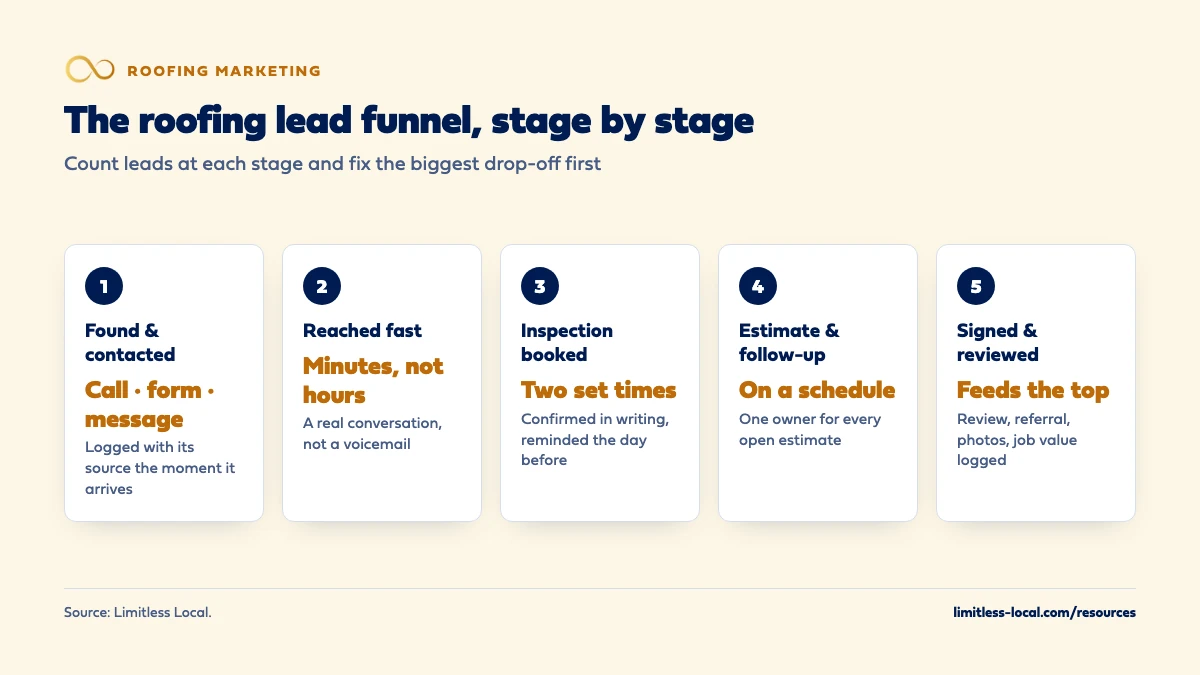
What are the steps in a roofing lead funnel, from first call to signed roof?
A roofing lead funnel is the set path every lead follows: get found, make first contact, get captured with its source, get reached fast, book an inspection, receive an estimate, get followed up, and sign. To set one up, decide what happens at each stage and who owns it, log every call and form in one system with the lead source attached, and track how many leads move from each stage to the next. The stage where the most leads drop off is the one to fix first, before you spend more to bring in new leads.
Most of the money in a roofing funnel is lost in the middle, between the first call and the signed contract. Every one of our roofing marketing packages includes call tracking with recording, form and chat lead tracking and source tagging, so you can see where each lead came from and where it stalled. Calendar reminders, unified messaging, after-hours answering and AI website chat are automation add-ons that plug into any tier, with pricing shared on the discovery call. For the top of the funnel, the roofing lead generation guide covers where leads come from, and the roofing marketing questions library has the rest.
What is a lead funnel for a roofing company?
A funnel is just the path a homeowner takes from never having heard of you to signing a contract, with a count at each step. It’s called a funnel because the numbers shrink as you go: plenty of people see you, fewer call, fewer still get an inspection, and some of those sign.
For a roofer, a working funnel has eight stages:
- Get found: Google, Maps, ads, referrals, yard signs.
- First contact: a call, form, text or ad message.
- Captured: the lead is logged with its source.
- Reached: someone actually talks with the homeowner.
- Inspection booked: it’s on the calendar.
- Estimate sent: the homeowner has a price in hand.
- Followed up: open estimates get worked on a schedule.
- Signed: then finished, reviewed and referred.
Setting up a funnel means writing down what happens at each stage, who’s responsible, and how you’ll count it. Most roofers already have all eight stages. What they’re missing is the counting and the hand-offs between them.
Step 1: Where do roofing leads enter the funnel?
List every way a homeowner can find you today. For most roofers that’s some mix of:
- Your Google Business Profile and the map results
- Your website, from regular Google search
- Google Ads and Local Services Ads
- Referrals from past customers, realtors and other trades
- Yard signs, truck wraps and door hangers near jobs
- Lead-selling sites and social media
You don’t need every source. You need to know which ones you have, because each one becomes a lead source label later in the funnel. If you can’t name where a lead came from, you can’t tell which source to spend more on.
Step 2: What should happen the moment a lead calls or fills out a form?
This is where most funnels quietly leak. A homeowner who decides to contact you should be able to do it in one tap, and someone should know about it right away.
- Calls: a phone number on every page of your website and your Google profile, routed to someone who answers during business hours.
- Forms: short, with the questions you actually need for a roof: address, what’s going on, how soon, and a photo if they have one.
- Notifications: every form and message should land on a phone that someone checks, not an inbox nobody reads until Friday.
Job software can help here. Jobber’s request forms, for example, let homeowners request work through your website, notify you as soon as it happens, and can collect details like photos up front. Your team can also create requests by hand for leads that come in by phone, email or in person, so everything lands in the same list.
Step 3: How do I capture every lead and where it came from?
Every lead gets logged, with its source, the moment it comes in. That includes callers who say they’re just getting prices, homeowners waiting on an insurance adjuster, and the ones who want an inspection in a month. Those are leads too, and they’re the ones that disappear if nobody writes them down.
Most field and roofing software has a place for this. ServiceTitan’s roofing help center describes capturing leads from incoming calls so you can track and follow up on inquiries that don’t immediately turn into jobs. Housecall Pro’s lead source field lets you record where each customer found you, so reporting can show which sources bring you good jobs.
Two rules make this stage work. First, the source gets picked from your fixed list, never typed freehand, so “Google,” “google ads” and “GOOGLE” don’t end up as three sources. Second, the person who takes the call asks “how did you hear about us?” every time, even when you have call tracking, because some homeowners saw your truck before they searched.
Step 4: How fast should someone reach a new roofing lead?
As fast as you possibly can, and the clock starts when the lead comes in, not when someone notices it. A homeowner with a leak often contacts more than one roofer. The one who calls back first and offers an inspection time usually gets in the door.
Set a rule your team can actually hit:
- Calls during business hours get answered live.
- Missed calls, forms and ad messages get a call back within minutes, not hours.
- After-hours leads get an automatic reply that night and a call first thing in the morning.
Then measure it. Pull a week of leads, note when each came in and when someone first reached the homeowner, and look at the gap by source. How fast a roofing company should call back a new lead sets targets for each lead type.
Curious what your marketing is actually booking?
Get a free visibility audit — no obligation, no sales pitch.
Step 5: How do I turn conversations into booked inspections?
Treat every first conversation as a booking call. Ask a few quick questions to make sure it’s a job you want, then offer two specific inspection times instead of asking when they’re free. Confirm it in writing right away, and send a reminder the day before.
Decide who books inspections. In a small company that might be the owner, but whoever it is needs the calendar in front of them and the authority to fill it. Leads that bounce between people (“let me check with the boss and call you back”) lose momentum fast.
Also decide which leads don’t get an inspection. Areas you don’t serve, jobs you don’t do, and homeowners who only want a phone quote can be handled differently so your estimators spend their time where it pays. How to turn more roofing leads into booked inspections covers the call itself, word for word.
Step 6: What should happen between the inspection and the estimate?
The inspection is where the homeowner decides whether they trust you, so it belongs in the funnel just as much as the ad that brought them in. A few things keep leads moving at this stage:
- Show up on time. Give a tight arrival window and text when you’re on the way.
- Show them what you found. Photos from the roof make the problem real for a homeowner who can’t see it from the driveway.
- Get the estimate out fast. Same day, or the next day at the latest. An estimate that takes a week to arrive gives the homeowner time to sign with someone else.
- Offer clear options. A repair and a replacement, or good-better-best materials, lets the homeowner choose instead of comparing your one number to someone else’s.
Step 7: How do I follow up on estimates that don't sign right away?
Most roofing estimates don’t sign on the spot, and that’s where a funnel either pays off or falls apart. Put follow-up on a schedule, not a feeling: a call within a day or two, a useful text about a week later, another call around two weeks out, and a last check-in about a month after the estimate before you close it out.
Your software can keep that schedule for you. Housecall Pro’s Pipeline lays open leads out on a board with columns for new leads, first contact, second contact, third contact, won and lost, so it’s obvious which ones are overdue. Most roofing CRMs have something similar.
Give one person ownership of every open estimate. When everyone owns follow-up, nobody does. How a roofing company should follow up on unsigned estimates has the full schedule and what to say at each step.

Step 8: What happens after the roof is signed and finished?
A funnel doesn’t end at the signature. The last stage feeds the first one:
- Ask for a review at the final walk-through, in person, and follow up with a text link the same day. Reviews help the next homeowner pick you.
- Ask for referrals while the homeowner is happiest, and make it easy for neighbors who stop by to see the work.
- Take photos of the finished roof for your Google profile and website.
- Record the job value against the lead, so you know what each source actually brought in.
This is the cheapest marketing a roofer has, and the stage most often skipped when crews move straight to the next job. How to get more Google reviews after a roof replacement covers the review ask.
Which funnel numbers should a roofer track each month?
Count leads at each stage, by the month they came in and by source:
- New leads
- Leads reached
- Inspections booked and completed
- Estimates sent
- Roofs signed, and their total value
From those, work out the rate between each pair of stages, and your cost per lead and cost per signed roof for each paid source. The biggest drop between two stages tells you where to work next.
For ads, connect the two ends. Google Ads can track phone calls from your ads as conversions, including calls from call assets and calls to a forwarding number on your website, and you can set a minimum call length so short hang-ups don’t count. Google can also import offline conversions, which lets you tell Google which clicks and calls later became a sale at your office or over the phone. How to track which roofing leads turn into signed jobs goes through the full setup.
What tools does a roofing lead funnel actually need?
Less than most software salespeople will tell you. At minimum:
- One place where every lead lives, with a source field and a stage. That can be a CRM, your job-management software or, for a very small shop, a well-kept spreadsheet.
- Call tracking, so calls from each source are counted and recorded without relying on memory.
- A calendar the person booking inspections can see.
- Reminders, so follow-ups happen on schedule without someone remembering them.
Automated texts, online booking and chat help once the basics run every day. If you’re weighing software, what roofing business management software does and whether you need it explains where job software ends and lead-follow-up tools pick up.
Where do roofing lead funnels usually break?
The same few places, over and over:
- Calls that ring out while the crew is on a roof and nobody is assigned to answer.
- Forms that sit in an inbox until the end of the day or the end of the week.
- Leads that never get logged because the caller wasn’t ready to book.
- Estimates that go out and are never followed up.
- No source on the lead, so you can’t tell which marketing signed roofs.
Notice that none of these is about bringing in more leads. That’s the main reason to set up a funnel before you raise your ad budget: fixing a leak in the middle gets you more signed roofs from the leads you’re already paying for.
Not sure which of these is costing you jobs?
A free visibility audit checks the Google profile, reviews, site and tracking, and shows what to fix first.
What's different about a roofing funnel
Retail and insurance leads move at different speeds. A retail replacement can sign within days of the estimate. A claim-related job can sit open for weeks while the homeowner works through their insurance. Give them separate stages or tags so slow insurance leads don’t make your whole funnel look stalled, and don’t close them out too early.
Storms flood the top of the funnel. After a hailstorm, leads can arrive faster than anyone can reach them. Decide ahead of time who answers, how inspections get prioritized, and which leads wait, so the surge doesn’t break every stage below it.
The inspection does the selling. For most roofing jobs, the visit is the moment the homeowner decides. Treat inspection-to-estimate as a funnel stage worth measuring, not just a job on the calendar.
A worked example: finding the leak in a roofing funnel
These numbers are made up to show the math, not a benchmark for your market. Say a roofer spends $6,000 in a month on marketing and gets 40 leads. That’s $150 per lead.
Counting each stage shows 30 of those leads were reached, 18 booked an inspection, 12 got an estimate and 5 signed. Cost per signed roof: $6,000 divided by 5, or $1,200.
Look at the drop-offs. Ten leads were never reached at all, a quarter of everything they paid for. If faster callbacks reached 8 of those 10, and they moved through the rest of the funnel at the same rates, that’s roughly one more signed roof a month for the same spend. Six signed roofs on $6,000 is $1,000 each, and nobody bought a single extra lead to get there.
Frequently asked questions
Do I need special funnel software to set this up?
No. A CRM or job-management system makes it easier, but a small roofer can run a funnel with a shared spreadsheet, a calendar and a habit of logging every lead the same day.
Should insurance and retail roofing leads use the same funnel?
The same stages work for both, but tag them separately. Insurance-related jobs often take much longer to sign, and mixing them in makes retail numbers look worse than they are.
What's a landing page, and does my funnel need one?
It’s a web page built for one offer, usually where an ad sends people. It helps if you run ads, because the page can match the ad and make calling easy, but it isn’t required to start a funnel.
How often should I look at my funnel numbers?
Glance weekly at new leads and open estimates so nothing goes stale, and review the full stage-by-stage numbers once a month by lead source.
Should I send my funnel data back to Google Ads?
Once you’re logging which leads sign, yes, it’s worth setting up. Telling Google which clicks and calls became real jobs gives it better information than counting every call the same.
Who should own the funnel at a small roofing company?
One person, usually the office manager or the owner. Different people can work different stages, but one person should check every week that no lead is stuck.
Key takeaways
- A roofing funnel is the set path every lead follows, from first contact to signed roof.
- Log every lead with its source the moment it arrives, even callers who aren’t ready to book.
- Give each stage an owner and a time limit, especially callbacks and estimate follow-up.
- Count leads at each stage by source and fix the biggest drop-off before buying more leads.
- The last stage, reviews and referrals, feeds the first one.
Want a second set of eyes on your setup?
We'll look at how you show up locally and where calls are leaking, then send you a plain-English breakdown.
More in this section
- How does a roofer keep up with leads coming in fast?
- How does a roofer generate transactional roofing leads?
- How does a roofing leads program work for a roofing company?
- What is the fastest way for a roofer to get leads online?
- How does a roofer see which searches and pages bring leads?
Sources
- Request Basics — Jobber Help Center
- Capture a lead from an incoming call — ServiceTitan Help Center
- How to Use Lead Sources — Housecall Pro Help Center
- Getting Started with Pipeline — Housecall Pro Help Center
- About phone call conversion tracking — Google Ads Help
- About offline conversion imports — Google Ads Help