
What is the average profit on one plumbing job?

- How much profit does a typical plumbing job really leave after labor and overhead?
- What does profit on one plumbing job actually mean?
- Why is there no single average profit for plumbing jobs?
- Step 1: Which jobs should I use to work it out?
- Step 2: What goes into the direct cost of a plumbing job?
- How do I work out the real cost of a tech's hour?
- What about the trucks, the office and the rest of the overhead?
- Should I work out profit separately for each kind of plumbing job?
- Where do I find these numbers in my field software?
- How does profit per job set what I can spend on marketing?
- Does the first job's profit tell the whole story?
- What mistakes throw the profit number off?
- What's different about job profit for plumbers
- A worked example: two jobs, one shop
- Frequently asked questions
- Key takeaways
- More in this section
- Sources
The short version
- Gross profit = invoice − parts − loaded labor − job-only fees.
- Net profit = gross profit − the job's share of overhead.
- Work it out by job type, not as one blended average.
- Gross profit per job sets the most you can spend to win that job.
For plumbing owners who know what their jobs bring in, but not what’s left after parts, labor, trucks and overhead, or what that means for marketing.
Get a free visibility audit · Book a growth call
How much profit does a typical plumbing job really leave after labor and overhead?
There’s no single average profit on a plumbing job, because it swings with the job type, your prices and your costs, so you work it out from your own invoices. Take the invoice, subtract parts and the loaded cost of every paid hour the job took, including drive time, to get gross profit; then subtract the job’s share of overhead, like trucks, the office, insurance and marketing, to get net profit. Do it separately for service calls, drain work and big jobs like water heaters, because gross profit per job is what sets how much you can afford to spend to win each kind of work.
Profit per job is half the math; the other half is what each booked job cost to win, and that’s what our reporting shows. Every one of our packages includes call tracking and monthly reports with a cost-per-lead breakdown, so you can set what each booked job cost against what it left you, channel by channel. Our plumbing marketing page shows how we work with plumbing companies, and the plumbing marketing questions library goes question by question.
What does profit on one plumbing job actually mean?
There are two numbers, and owners mix them up all the time.
- Gross profit per job is the invoice minus the direct costs of doing that job: parts, the tech’s paid time and anything else you spent only because of that job. The Business Development Bank of Canada’s glossary entry on gross profit margin describes it as net sales minus the cost of goods sold, and the margin as that figure divided by net sales, times 100.
- Net profit per job is what’s left after you also take out that job’s share of overhead: trucks, the office, insurance, software, the owner’s pay and marketing. Operating and net margins tell you more than gross margin about how profitable the business really is, because they account for those fixed costs.
You need both. Gross profit per job tells you what one more job is worth, which is the number that decides marketing spend. Net profit tells you whether the business as a whole is making money.
Why is there no single average profit for plumbing jobs?
Because almost everything that sets it is yours, not the trade’s. Profit per job swings with:
- Job type. A drain clearing, a leak repair, a water heater replacement and a sewer line are different businesses with different margins.
- How you price. Flat-rate pricing and time-and-materials pricing leave different profit on the same job.
- Your labor costs, which depend on your market, your techs’ experience and how many hours they’re paid but not billing.
- Drive time and service area. A wide area means more paid hours in the truck for every hour on a job.
- Callbacks and warranty work, which cost labor and parts but bring in no new invoice.
Any national average for plumbing profit blends all of that together. Your own number, worked out from your own invoices, is the only one worth using to make decisions.
Step 1: Which jobs should I use to work it out?
Pull every completed, paid job from the last full twelve months. A full year smooths out freeze season, slow summers and the odd huge job. If you’re newer than that, use what you have and redo it later.
- Include every paid job, small and large, so the average isn’t flattered.
- Charge callbacks to the job that caused them. If a tech goes back to fix a leak on Tuesday’s repipe, that trip is a cost of the repipe.
- Keep free estimates that didn’t close on a separate list. They’re a cost of winning the jobs that did close, and they belong in overhead.
- Group by job type before you average anything: service and repair calls, drain work, water heaters, repipes, sewer and excavation work.
Step 2: What goes into the direct cost of a plumbing job?
Everything you spent because of that job, and only that job:
- Parts and materials at what you paid for them, including the fittings and extras that walked off the truck for that job.
- Labor for every paid hour the job took, including drive time to and from it, at your loaded labor cost (more on that below).
- Permits, inspection and disposal fees, like hauling away an old water heater.
- Equipment rental and subcontractors, such as an excavator or a concrete cutter on a sewer job.
Subtract those from the invoice and you have gross profit for that job. Divide gross profit by the invoice and multiply by 100 for the gross margin, which makes jobs of different sizes easier to compare.
How do I work out the real cost of a tech's hour?
Not by looking at the wage alone. The U.S. Bureau of Labor Statistics puts the median pay for plumbers, pipefitters and steamfitters at $30.67 an hour in May 2025, but what you pay per hour is more than the wage. In its June 2026 employer cost release, the BLS reported that across private industry, wages and salaries made up 70.0% of what employers spent on compensation, and benefits the remaining 30.0%. That’s an average across all private employers, not a plumbing figure, but it shows why the wage alone understates your labor cost.
To get your own loaded hourly cost, add up a tech’s yearly wages, payroll taxes, benefits, workers’ comp and paid time off, then divide by the hours they’re actually on jobs, not the hours they’re paid. Time spent at the supply house, in the shop or waiting on a callback still has to be paid for by the hours you bill.
Field software expects this number. Jobber’s job costing guide says the labor cost you enter for each employee should include their wage, benefits and taxes.
Curious what your marketing is actually booking?
Get a free visibility audit — no obligation, no sales pitch.
What about the trucks, the office and the rest of the overhead?
Overhead is what you’d pay this month even if no job came in: truck payments and insurance, fuel you can’t tie to one job, the shop, office staff, software, licenses, your own salary and marketing. To get a per-job share, divide a typical month’s overhead by the number of jobs you complete in a month.
For example, a shop with $30,000 a month in overhead that completes 150 jobs a month carries $200 of overhead per job. That’s a made-up figure to show the math. Use your own profit and loss statement.
The per-job overhead number is what turns gross profit into net profit. It’s also a reminder that a job leaving $150 of gross profit isn’t a winner if every job has to carry $200 of overhead.
Should I work out profit separately for each kind of plumbing job?
Yes. A single average across all your work hides the jobs that make your month and the ones that barely cover their own costs. A small drain call might leave a little after overhead, while a water heater replacement or a sewer job might carry a week’s overhead by itself. Blended together, they look like one middling job that doesn’t exist.
Split it at least into service and repair calls, drain work and big-ticket replacements. If you already track your revenue per job by type, what an average plumbing job ticket brings in covers that side; profit per job is the same split, one step further down the invoice.
Where do I find these numbers in my field software?
Most of it is already sitting in your system if your techs log their time and your parts go on the invoice:
- Jobber calculates job profit from timesheets, line item costs and expenses logged on each job.
- Housecall Pro has job costing reports that track job costs and profitability across jobs once you’ve turned on its job costing feature.
- ServiceTitan users should check which job costing reports their account is set up with.
Whatever you use, the report is only as good as what goes in: parts entered at cost, every hour logged against a job, and labor rates set to the loaded cost, not the wage. If your techs don’t clock time to jobs, start there.

How does profit per job set what I can spend on marketing?
This is where the number earns its keep. The most you can sensibly spend to win a job is a share of the gross profit that job leaves. If a drain call leaves $225 of gross profit, paying $300 to win one loses money on the first visit, however good the lead looked. If a water heater replacement leaves $960, the same $300 is easy to carry.
So work out cost per booked job for each channel and compare it with gross profit for that job type. How much you can afford to pay for a plumbing lead turns profit per job into a ceiling for each lead type, and whether $75 per lead is too high for plumbing ads runs that test on one price. For the business as a whole, marketing sits in overhead, so it’s already in your net profit per job; just don’t count it twice when you judge one channel.
Does the first job's profit tell the whole story?
Not quite. A new customer who calls you again next year, buys a maintenance plan or sends a neighbor is worth more than one invoice. That’s a good reason to accept a thin first job from a channel that brings in customers who come back.
But count it from your records, not from hope. Look at last year’s new customers and see how many booked again, and what that repeat work left in gross profit. If it’s real, you can afford to pay a bit more to win the first job. Working out your plumbing customer acquisition cost shows how to set that against what you spend to win each new customer.
What mistakes throw the profit number off?
- Using the wage, not the loaded cost. Taxes, benefits and unbilled hours all have to be covered by billed hours.
- Leaving out drive time. An hour on the road to a job is an hour of that job’s labor.
- Forgetting callbacks. A job that needs a second free trip made less than its invoice says.
- Counting the owner’s time as free. If you run calls yourself, price your hours like a tech’s. Owners who leave their own time out end up with a gross margin that looks better than it is.
- One blended average. Split by job type, or the big jobs hide the weak ones.
- Working it out once. Parts prices and wages move, so redo it every year, and after any price change. If profit per job is thin across the board, how profitable a plumbing business is and where marketing fits is worth a read before you spend more to win work.
Want to see where your company stands?
A free visibility audit shows where you show up on Google, Maps and AI answers, and what it's costing you in calls.
What's different about job profit for plumbers
Huge spread between job types. Plumbing runs from quick drain calls to water heaters, repipes and sewer lines. That spread can land in a single week, which makes a blended average especially misleading.
Emergency and after-hours work. Night and weekend calls often carry higher rates, but also overtime or on-call pay. Work out after-hours jobs on their own so the premium and the extra labor cost both show up.
Permits, disposal and excavation. Water heater swaps and sewer work carry costs a service call doesn’t: permits, hauling the old tank, digging and restoring a yard. Leave them out and your biggest jobs look more profitable than they are.
Service calls lead to big tickets. A leak call often turns up a failing water heater or tired pipes. Track which big jobs started as small calls, so the small call gets credit for what it led to.
A worked example: two jobs, one shop
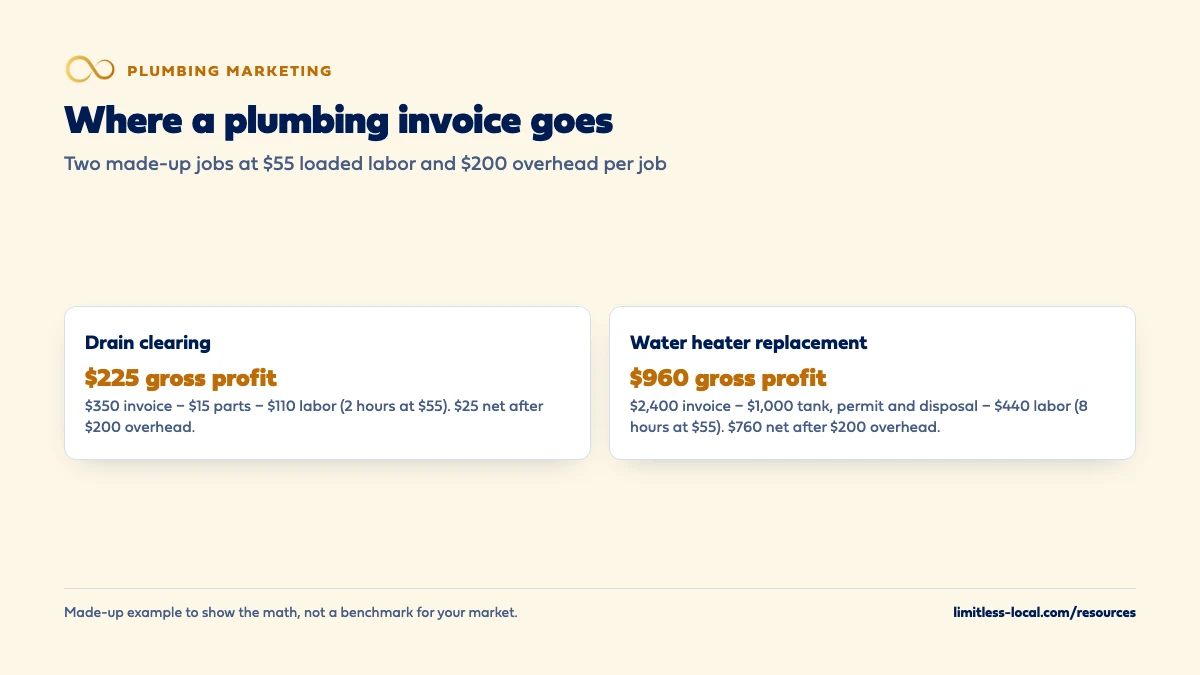
These numbers are made up to show the math, not a benchmark for your market. Say a plumbing shop’s loaded labor cost is $55 per paid hour, and it carries $200 of overhead per job ($30,000 a month across 150 jobs).
- Drain clearing: invoice $350. Parts $15. Two paid hours including the drive, $110 of labor. Gross profit is $225. After $200 of overhead, net profit is $25.
- Water heater replacement: invoice $2,400. Tank, fittings, permit and disposal $1,000. Two techs for four hours, eight paid hours, $440 of labor. Gross profit is $960. After $200 of overhead, net profit is $760.
The drain call is worth doing, especially if it leads to bigger work, but it can’t carry much marketing: spending more than $225 to win one loses money on the first visit. The water heater job can carry several times that. That’s why one marketing budget, judged on one blended cost per job, can make good channels look bad and bad ones look good.
Frequently asked questions
Is gross profit the same as what I take home from a job?
No. Gross profit is before overhead like trucks, the office, insurance and your own pay. What’s left after those is net profit, and that’s closer to what the business actually keeps.
Should drive time count as labor on the job?
Yes. If the tech is paid for the drive, it’s part of what that job cost. Leaving it out flatters small jobs most, because the drive is a bigger share of a short call.
How often should I recalculate profit per job?
At least once a year, and again after a price change, a raise, or a jump in parts costs. Field software that tracks job costing lets you watch it monthly.
What if I only know my revenue, not my costs per job?
Start with a sample. Take a few dozen recent jobs of each type, add up the parts and hours from the invoices and timesheets, and work out the average from those while you set up proper job costing.
Do maintenance plans change profit per job?
They can. A plan visit may leave a small profit on its own, but members who call you first when something breaks bring in jobs you didn’t pay to win. Track plan members’ repeat work separately to see it.
Should marketing cost be included in profit per job?
In net profit, yes, as part of overhead. When you’re judging one channel, compare its cost per booked job with gross profit instead, so the marketing isn’t counted twice.
Key takeaways
- Gross profit per job is the invoice minus parts, loaded labor including drive time, and job-only fees.
- Net profit per job also takes out that job’s share of overhead: trucks, office, insurance, your pay and marketing.
- A tech’s real hourly cost is well above the wage once taxes, benefits and unbilled hours are counted.
- Work it out by job type; one blended average hides the jobs that make or lose money.
- Gross profit per job sets the most you can spend to win that kind of job.
Not sure what's working right now?
Start with a free visibility audit: rankings, Google profile, reviews and tracking, checked against your service area.
More in this section
- How much does an average plumbing job ticket bring in?
- How long until plumbing marketing hits a profitable cost per job?
- What is a realistic cost per booked plumbing job by channel?
- How much should a plumber budget to book a set number of jobs?
- How do I work out my plumbing customer acquisition cost?
Sources
- What is the gross profit margin — Business Development Bank of Canada
- Plumbers, Pipefitters, and Steamfitters: Occupational Outlook Handbook — U.S. Bureau of Labor Statistics
- Employer Costs for Employee Compensation Summary — U.S. Bureau of Labor Statistics
- Job Costing — Jobber Help Center
- Job Costing Reports — Housecall Pro Help Center