
How much should a plumber budget to book a set number of jobs?

- How do I set a monthly marketing budget to book a predictable number of plumbing jobs?
- What's the formula for a plumbing budget built on booked jobs?
- How many of my jobs does marketing actually need to buy?
- How do I estimate cost per booked job before I have my own numbers?
- Should emergency calls and big-ticket jobs get separate budgets?
- What fixed costs belong in the budget?
- How do I turn a monthly budget into a Google Ads daily budget?
- Why does the first month cost more per job?
- How do I know the budget is worth spending?
- What if my crew can't handle the jobs the budget would bring?
- How should the budget change with the seasons?
- How do I track whether the budget is booking the jobs it should?
- What's different about budgeting for plumbing jobs
- A worked example: budgeting for 30 more booked jobs a month
- Frequently asked questions
- Key takeaways
- More in this section
- Sources
The short version
- Budget = jobs marketing has to buy x cost per booked job + fixed costs.
- Cost per booked job = cost per lead divided by the share of leads that book.
- Give emergency calls and big-ticket jobs their own lines, because they cost and earn very different amounts.
- Expect a pricier first month or two, then re-set the budget from your own tracked numbers.
For plumbing owners who’d rather set the budget from the jobs they want on the board than from a percentage someone read online.
Get a free visibility audit · Book a growth call
How do I set a monthly marketing budget to book a predictable number of plumbing jobs?
Work it backward: take the number of extra booked jobs you want from marketing each month, multiply it by what a booked job costs in each channel you’ll use, and add your fixed costs like management fees and call tracking. Cost per booked job is your cost per lead divided by the share of leads that book, so a $50 lead that books half the time costs about $100 per job. Check that figure against the gross profit those jobs bring in, and plan for a higher cost per job in the first month or two while campaigns settle.
Working back from booked jobs is how we set every plumbing marketing budget, and every one of our packages includes call tracking and a monthly report with a cost-per-lead breakdown, so the math runs on your real numbers after the first month. For the bigger question of total spend, see how much a plumbing company should spend on marketing, and the rest of the plumbing marketing questions library goes one question at a time.
What's the formula for a plumbing budget built on booked jobs?
Three pieces, in this order:
- Jobs marketing has to buy. Your target number of new booked jobs a month, minus the jobs that already come in without paid marketing.
- Cost per booked job, by channel. What it costs you to book one job from Local Services Ads, from Google search ads, from mailers, from whatever you’re running.
- Fixed costs. The things you pay whether the phone rings or not: management fees, call tracking, software, the website.
Multiply the first by the second for each channel, add them up, then add the third. That’s your monthly marketing budget. It’s simple math, and the hard part is getting honest numbers for each piece, which is what the rest of this page covers.
Notice what’s missing: a percentage of revenue. That’s a common starting point, and it can tell you whether a number is in a sane range. It can’t tell you how many jobs that money will put on the board, and that’s the question you’re actually asking.
How many of my jobs does marketing actually need to buy?
Fewer than you think, usually. Before you price anything, count the jobs that already come in on their own over a normal month:
- Repeat customers and maintenance members.
- Referrals from past customers, realtors, property managers and contractors.
- Calls from your Google profile and website that you’re not paying per lead for.
Subtract those from your target. If you want 60 booked jobs a month and 25 already come in without paid marketing, the budget only has to buy 35. Count new booked jobs, not calls, and leave out the callbacks and warranty visits that fill a schedule without paying for a truck.
If you’re starting from a daily target instead, like keeping two trucks busy, what marketing gets a plumbing company to two jobs a day turns a schedule into a call count first.
How do I estimate cost per booked job before I have my own numbers?
Start from the two numbers you can find, and be pessimistic about both.
- Cost per lead. For search ads, Google’s Keyword Planner gives forecasts of clicks and cost for a set of keywords at a given bid and budget, drawing on historical search data and taking seasonality into account (About Keyword Planner forecasts). Treat it as a rough range, not a quote. For Local Services Ads you pay per lead, and lead prices may vary by location, job type, type of lead and your bidding (How leads work), so your first two or three weeks of real leads will tell you more than any estimate.
- Booking rate. The share of real new-customer leads that turn into a booked job. If you already answer every call, track your own for a month. If you don’t know it, assume lower than you’d like.
Then divide: cost per lead divided by booking rate gives cost per booked job. Run it at a high and a low lead price so the budget has a range, not one hopeful number. What a qualified plumbing lead costs in your market covers how to size up local lead costs before you spend.
Should emergency calls and big-ticket jobs get separate budgets?
Yes. A drain clearing and a sewer line replacement aren’t the same purchase, and lumping them together hides what’s happening.
- Service and emergency calls (clogs, leaks, running toilets, no hot water) usually book quickly and often, at a lower ticket. The customer wants someone today.
- Planned big-ticket work (water heater replacements, repipes, sewer lines, water treatment) books less often per lead, because homeowners compare a few companies, but one job can carry the cost of many leads.
Give each its own line: its own target number of jobs, its own cost per booked job and its own ceiling. A water heater line can afford a much higher cost per booked job than a drain line and still be the better deal. How much you can afford to pay for a plumbing lead shows how to set each ceiling from your gross profit.
What fixed costs belong in the budget?
Everything you pay to get and handle the jobs, even if it isn’t billed per lead:
- Management. An agency fee, a freelancer, or your own hours if you run the ads at night.
- Tracking. Call tracking numbers and the software that ties a call to a booked job.
- The website. Hosting and upkeep, plus a build if you’re paying it off.
- Answering. An answering service or the share of an office person’s time spent on new calls.
For reference, our Essentials package is $3,500 a month and includes Google Ads management for up to $2,500 a month in ad spend; Growth is $4,500 a month and adds Local Services Ads management and room for up to $5,000 a month in Google Ads spend. Ad spend isn’t included in either one; it’s paid straight to Google. When the ad spend is only a few hundred dollars a month, a full management fee will swamp it, and doing the basics yourself first is the smarter move.
Curious what your marketing is actually booking?
Get a free visibility audit — no obligation, no sales pitch.
How do I turn a monthly budget into a Google Ads daily budget?
Google Ads campaigns run on an average daily budget, so divide your monthly number for that channel by 30.4, the average number of days in a month. Google’s page on average daily budgets explains what happens next: spend can run higher on busy days and lower on quiet ones, but for most campaigns you won’t pay more than two times your average daily budget on any one day, or more than 30.4 times it in a month.
That flex is useful for plumbing. A cold snap or a rainy weekend can push spend up on the days people are searching, without blowing the month. Local Services Ads that have moved into Google Ads switch from a weekly budget to a daily one with the same 30.4-day monthly cap (Local Services Ads transition to Performance Max campaigns), so the same division applies there.
Why does the first month cost more per job?
Because a new campaign pays to learn. Ads can generate leads within days of launch, but the first weeks catch searches you’d never want (parts shoppers, do-it-yourself questions, towns you don’t serve), and the fixes come from seeing those searches. SEO typically takes 3 to 6 months to show meaningful organic growth, so it won’t carry its share of jobs at the start either.
Plan for it in two ways:
- Budget the first month or two at a higher cost per booked job than your target, and call it a test.
- Decide in advance when you’ll judge it. A single slow week tells you almost nothing.
How long until plumbing marketing hits a profitable cost per job goes through what brings the number down after launch.
How do I know the budget is worth spending?
Compare the cost per booked job for each line with the gross profit from that kind of job. If a drain call leaves you more after parts and labor than it cost to book, the line pays. If it doesn’t, you have three levers before you cut the budget:
- Booking rate. Answering faster and quoting better lowers cost per job without touching ad spend.
- Job mix. Shift spend toward the job types with more margin.
- Repeat value. A first visit that turns into a maintenance member or a future water heater is worth more than the first invoice. Count it, but count it carefully.
If the math still doesn’t work, lower the job target for that line rather than paying more per job than the work earns.

What if my crew can't handle the jobs the budget would bring?
Then the budget is set by your trucks, not your ambitions. Paying for calls you can’t run in a reasonable time wastes money twice: once on the lead, and again on the review from the customer who waited three days.
Set the job target at what your crew can actually handle, including the emergency calls that land on top of the schedule. If the schedule is full most weeks and you’re still turning work away, spend the money on the next plumber before the next ad. When a new hire is on the way, raise the budget a few weeks ahead of their start date, not the day they show up.
How should the budget change with the seasons?
Plumbing demand moves with the weather: freezes bring burst pipes, heavy rain brings sewer backups and sump calls, and holidays bring kitchen drain calls. Your cost per booked job usually drops when demand is high and climbs when it’s quiet.
Set a base budget for normal months and a higher one for the weeks you know are coming. In slow months, resist the reflex to cut everything. The U.S. Small Business Administration warns about exactly that cycle: sales drop, you cut marketing, and sales fall further. A smaller budget aimed at your best job types often keeps the trucks busier than zero.
How do I track whether the budget is booking the jobs it should?
Mark the lead source on every new job, then once a month divide what each channel cost by the jobs it booked. Most field software can do this: Jobber’s lead source report, for example, shows leads, leads with a job and the first invoice value for each source.
Three numbers per channel, every month: what you spent, how many jobs it booked, and what those jobs paid. If a channel’s cost per booked job beats your target two months running, give it more. If it misses for three, fix it or move the money. How to track which plumbing marketing books jobs covers call tracking and ServiceTitan, Housecall Pro and Jobber setup.
Talk it through with someone who runs this every day
A 15-minute growth call: your market, your numbers, and what a realistic budget looks like. No pressure.
What's different about budgeting for plumbing jobs
Emergencies don’t keep office hours. Plenty of plumbing calls come in at night and on weekends. If nobody answers then, your booking rate drops, and every booked job costs more. Before you raise the budget, make sure after-hours calls reach a person.
One big ticket can pay for a month. A water heater replacement, repipe or sewer line job can carry the cost of a stack of smaller calls. Budget lines for those jobs can afford a much higher cost per booked job, as long as you track them separately.
Weather sets the calendar. Freezes and storms create sudden spikes you can’t fully plan, so keep some budget in reserve rather than spending it all in the first week of the month.
A worked example: budgeting for 30 more booked jobs a month
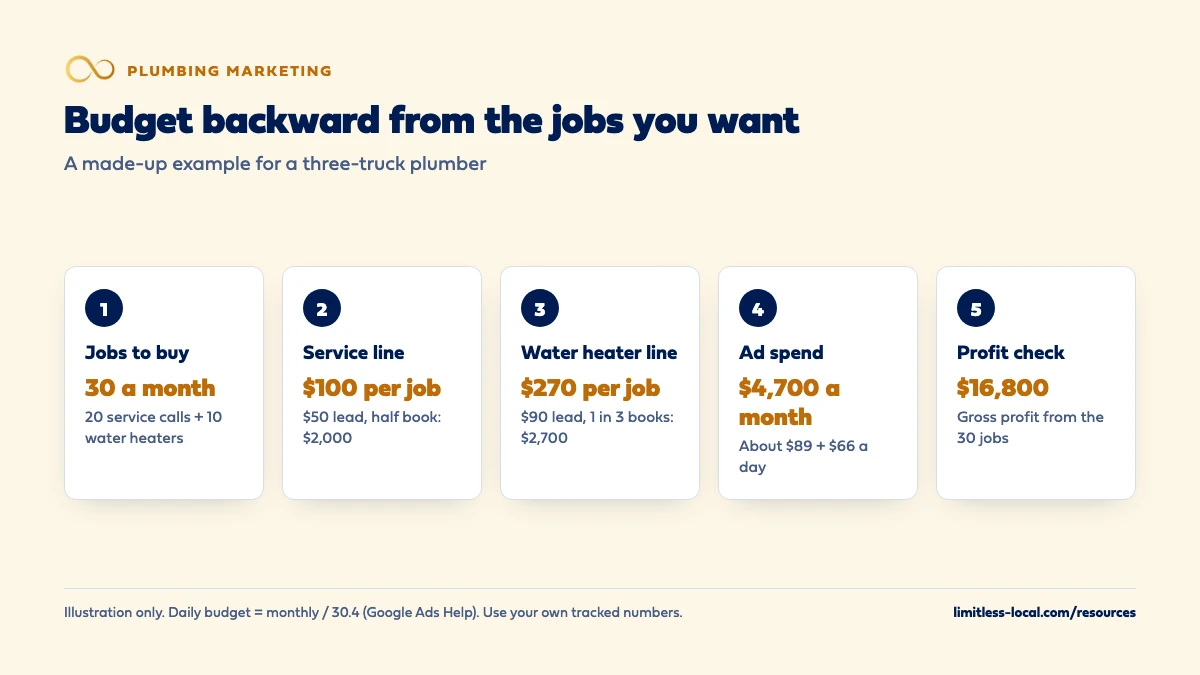
These numbers are made up to show the math, not a benchmark or a forecast for your market. A three-truck plumber wants 30 more new booked jobs a month from marketing: 20 service and drain calls and 10 water heater replacements.
- Service calls from Local Services Ads: leads cost about $50 and half of them book, so each booked job costs about $100. Twenty jobs x $100 = $2,000 a month.
- Water heaters from Google search ads: leads cost about $90 and 1 in 3 books, so each booked job costs about $270. Ten jobs x $270 = $2,700 a month.
- Ad spend: $2,000 + $2,700 = $4,700 a month, paid to Google.
- Daily budgets: $2,700 / 30.4 is about $89 a day for search ads; $2,000 / 30.4 is about $66 a day for Local Services Ads.
Now the check. If a service call leaves about $240 of gross profit and a water heater about $1,200, the 30 jobs bring $4,800 + $12,000 = $16,800 in gross profit against $4,700 in ad spend. Add a management fee, like our Growth package at $4,500 a month, which covers Local Services Ads and Google Ads, and the total is $9,200, still well inside what the jobs earn. If the water heater line came in at half the profit, the owner would cut that line’s target, not the service line’s.
Frequently asked questions
Is a percentage of revenue a better way to set my plumbing budget?
It’s a useful sanity check, not a plan. A percentage can’t tell you how many jobs the money will book; working back from cost per booked job can.
What booking rate should I assume if I've never tracked one?
Track your own for a month before you commit a big budget. Until then, run the math at a low rate and a higher one, and spend at the low end.
Can I buy an exact number of Local Services Ads leads?
No. You set a budget and each charged lead counts toward it, but lead prices vary by location, job type, type of lead and bidding, so the count moves from month to month.
Does the budget include ad spend and the agency fee?
Count both. Ad spend is paid straight to Google or Meta, and the management fee is separate, but they’re both part of what each booked job costs you.
How soon can I tell if my budget is right?
Ads can bring leads within days, but give each line a month or two of tracked results before you judge cost per booked job. SEO typically takes 3 to 6 months to show meaningful growth.
What if booking my target number of jobs costs more than they're worth?
Fix the booking rate first, then shift spend toward higher-margin job types. If it still doesn’t work, lower the target for that line instead of overpaying for jobs.
Key takeaways
- Set the budget from the jobs marketing has to buy, not from a percentage of revenue.
- Cost per booked job = cost per lead divided by booking rate; estimate it pessimistically until you have your own numbers.
- Budget service calls and big-ticket jobs as separate lines with separate ceilings.
- Divide a channel’s monthly budget by 30.4 for its Google Ads daily budget.
- Your trucks cap the budget: don’t buy jobs your crew can’t run.
- Re-set the budget monthly from tracked spend, jobs booked and what they paid.
Ready to compare options?
Book a short growth call and we'll walk through the math for your service area, including when we're not the right fit.
More in this section
- What percentage of plumbing leads should turn into booked jobs?
- How much should I budget for marketing to start a plumbing company?
- How much can I afford to pay for a plumbing lead?
- How much should a plumbing company spend on marketing each month?
- How long until plumbing marketing hits a profitable cost per job?
Sources
- About Keyword Planner forecasts — Google Ads Help
- How leads work — Google Local Services Help
- About average daily budgets — Google Ads Help
- How to Get the Most From Your Marketing Budget — U.S. Small Business Administration
- Lead Source Report — Jobber Help Center
- Local Services Ads transition to Performance Max campaigns with pay-per-lead goals — Google Ads Help