
What percentage of plumbing leads should turn into booked jobs?

- What conversion rate should I expect from plumbing leads to booked jobs?
- What is a good booking rate for plumbing leads?
- What counts as a lead when I work out my booking rate?
- Should calls, forms and Local Services leads have different booking rates?
- Why do small plumbing shops book fewer of their calls?
- How do I work out my own booking rate?
- Is a booked job the same as a sold job?
- What should I do if my booking rate is low?
- Can my booking rate be too high?
- How does booking rate change what my marketing costs?
- What's different about booking rates for plumbers
- A worked example: what raising the booking rate is worth
- Frequently asked questions
- Key takeaways
- More in this section
- Sources
The short version
- ServiceTitan's data put plumbing at about 43% of calls booked; the all-trades average was 42%.
- Small shops booked far less: 24% under five techs, against 59% at 25 or more.
- Count only real lead calls, then aim well above half and work toward the top shops.
- A low rate is usually an answering, scripting or coverage problem, not a marketing one.
For plumbing owners who want a booking-rate number to aim at, a fair way to measure their own, and what to fix when it comes up short.
Get a free visibility audit · Book a growth call
What conversion rate should I expect from plumbing leads to booked jobs?
In ServiceTitan’s published data, plumbing shops booked about 43% of their calls in June 2022, the highest of the trades it measured, and its industry advisors said 90% is attainable with trained call takers. Treat the low forties as the line to beat, aim for well above half of real lead calls, and push toward the top shops’ 70s and higher once your office has a script, coverage and coaching. Measure it only on genuine new-work calls, not every call, or the number means nothing.
Booking rate is where marketing spend turns into jobs or leaks away, which is why our automation add-ons focus on the follow-up side: CRM and lead tracking, after-hours answering, AI website chat and automated follow-up on estimates and unclosed jobs, on top of the call tracking with recording that every package includes. See how we approach plumbing marketing, or browse the rest of the plumbing marketing questions library.
What is a good booking rate for plumbing leads?
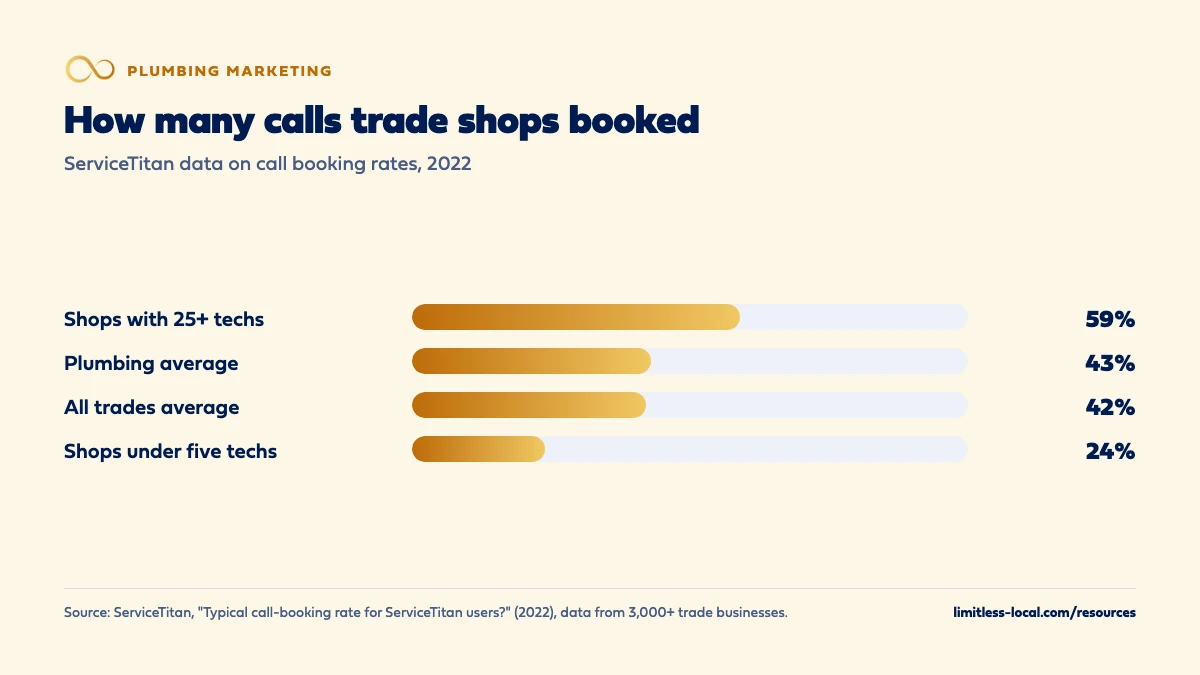
The most useful public number we’ve found comes from ServiceTitan, which studied calls at more than 3,000 trade businesses in the US and Canada using its software. Its call booking rate report found:
- A typical shop booked 42% of calls in June 2022, across all trades.
- Plumbing had the highest average booking rate that month, at 43%, and saw little variation through the year.
- Businesses with 25 or more technicians booked 59%; those with fewer than five booked 24%.
- Its industry advisors said a 90% booking rate is attainable, and one plumbing and mechanical company in the data was in the 77% range.
ServiceTitan’s own experts called the average shocking, so don’t treat it as a target. In our judgement, a plumbing company should treat the low forties as the floor, aim for well above half of its genuine lead calls, and work toward the top shops over time. The data is from 2022 and from one software’s customers, so use it as a rough yardstick, not a rule.
What counts as a lead when I work out my booking rate?
Only calls and messages from someone who might book new work. If you divide booked jobs by every call that rang, your rate will look terrible and tell you nothing, because a plumbing phone also rings with existing customers moving an appointment, suppliers, job applicants, wrong numbers and spam.
ServiceTitan’s call classifications page shows how one system handles it: an answered call over 60 seconds with no job booked counts as an unbooked lead, calls such as rescheduling are excused, and a call reason marked “not a lead” stays out of the rate. It warns that if you don’t set up call reasons first, any call longer than 60 seconds is classed as a lead, which skews the conversion rate.
Whatever tool you use, decide in writing what a lead is, then have the office mark every call the same way. In our judgement, a plumbing lead is any new or returning customer asking for a visit, a quote or an emergency call-out, whatever channel it comes from.
Should calls, forms and Local Services leads have different booking rates?
Expect them to, and track them separately. In our judgement:
- Phone calls book the highest share, because the caller is talking to you now and often has a problem today.
- Web forms and texts book lower, because the person may have filled in three plumbers’ forms and gone with whoever called first. Speed matters more here than anywhere.
- Local Services Ads leads sit in between, and you can dispute some invalid ones with Google. Disputing bad LSA leads covers which ones qualify.
- Bought leads from lead-selling sites are often shared with other plumbers, so in our judgement expect them to book lowest.
Housecall Pro’s conversion rate reporting lets you break lead conversion down by lead source, by employee and by day, week or month, which is the view you want: a single blended rate can hide one channel that books almost nothing.
Why do small plumbing shops book fewer of their calls?
ServiceTitan’s data showed booking rates rising with company size, from 24% for shops under five technicians to 59% for 25 or more. One of its advisors put the gap down to scale: bigger shops have repeatable training, processes and people to oversee them.
In our judgement, the usual causes in a small plumbing shop are practical:
- The owner or a plumber answers between jobs, so calls ring out or get rushed.
- Nobody answers after hours, and the report found booking rates fall sharply in the evening, from a 26% peak (mornings booked best) to 9% after 6 p.m. for small businesses.
- There’s no script, so price questions end the call instead of leading to a booked visit.
- Nobody reviews lost calls, so the same mistakes repeat.
The advisors were clear that being small isn’t an excuse: training and expectations can be set in any shop. How fast your office should answer covers the answering side in detail.
Curious what your marketing is actually booking?
Get a free visibility audit — no obligation, no sales pitch.
How do I work out my own booking rate?
Take one full month and do it by hand if your software doesn’t:
- List every inbound call, form, text and chat for the month.
- Mark each one as a lead or not a lead, using your written definition.
- Mark each lead as booked, not booked, or still open.
- Divide booked by leads. That’s your booking rate.
- Split it by channel, by person answering and by time of day.
ServiceTitan’s dashboard CSR metrics page shows the shape of this report: for each office employee it lists calls, leads (calls of at least 60 seconds that aren’t excused), booked jobs and the percent of lead calls booked. You want the same columns whatever you use.
Then listen to a sample of the unbooked calls. ServiceTitan’s advisors suggest spot-checking recordings and even calling your own business now and then to hear what customers hear.
Is a booked job the same as a sold job?
No, and it helps to track both. A booked job means a visit is on the calendar. Then the plumber has to arrive, diagnose and sell the work. For service calls those are close; for bigger work they aren’t.
In our judgement, a plumbing company should watch three rates in a row:
- Leads to booked visits: how well the office turns calls into appointments. This page is about this one.
- Booked visits to completed jobs: cancellations and no-shows. Reminders help here.
- Estimates to sold work: for water heaters, repipes, sewer lines and other quoted jobs, how many quotes turn into signed work. Follow-up on open estimates matters most here.
A high booking rate with a low close rate on estimates points to the sales visit or follow-up, not the phone. Whether you need a CRM for follow-up covers keeping open estimates from going cold.
What should I do if my booking rate is low?
Fix the cheapest causes first. In our judgement, in roughly this order:
- Coverage. Look at when unbooked and missed calls happen. If they cluster at lunch, after 5 p.m. or while the owner is under a house, that’s a staffing or answering-service fix, not a marketing one.
- A short call script. Name, address, the problem, how urgent it is, then offer two time slots. ServiceTitan describes built-in call scripts and required fields that make call takers gather the right details every time.
- A price-question answer. Decide what the office says when someone asks “how much?”, such as your service call fee and what it covers, so the call doesn’t end there.
- Weekly call review. ServiceTitan’s advisors describe weekly one-on-ones and 30-minute debriefs reviewing calls with call takers. One company in the report went from the 60s to regularly hitting 90 after training and monthly targets.
- Fast follow-up on forms and missed calls, within minutes where you can.
Only after these, look at whether the marketing is sending the wrong callers. Cutting down on junk leads covers that side.
Can my booking rate be too high?
It can look too high if the count is off. A rate close to perfect usually means leads are being marked “not a lead” after the fact, or only the calls someone answered are counted. ServiceTitan’s call classifications page warns that abandoned and unanswered calls hurt the accuracy of reporting, and that misclassified calls should be corrected.
A genuinely high rate can also mean you’re booking work you shouldn’t take: jobs outside your service area, work you don’t do well, or low-value calls that crowd out better ones. In our judgement, once your rate is healthy, the better question is which booked jobs earned the most per hour of a plumber’s time. ServiceTitan’s report notes that one company with a high booking rate could afford to be more selective about which calls mattered most.
How does booking rate change what my marketing costs?
Directly. Your cost per booked job is your cost per lead divided by your booking rate. If a lead costs the same but you book twice as many of them, each booked job costs half as much. ServiceTitan’s report found that for shops with five to 14 technicians, every 5% increase in booking rate was worth roughly $100,000 in extra revenue by its estimate, which it said took less than one extra booked call per weekday.
That’s why, in our judgement, a plumbing company with a low booking rate should fix the phone before it raises the ad budget. More leads into a leaky office mostly buys more lost calls. Working out customer acquisition cost shows how to carry the booking rate through to cost per new customer.
What's different about booking rates for plumbers
Plumbing calls are urgent, which helps. ServiceTitan found plumbing had the highest average booking rate of the trades it measured and little change through the year. One of its advisors put it simply: when you need a plumber, you need one now. A caller with water on the floor is ready to book; the job is not to lose them.
Urgency also punishes a slow answer. The same caller will ring the next plumber if you don’t pick up. In our judgement, that makes coverage and speed bigger levers in plumbing than in trades with longer decisions.
Quoted work runs on a second rate. Water heaters, repipes and sewer replacements often start as a booked visit and end as an estimate. Track estimate-to-sold separately, or a strong phone team can hide weak follow-up.
Not sure which of these is costing you jobs?
A free visibility audit checks the Google profile, reviews, site and tracking, and shows what to fix first.
A worked example: what raising the booking rate is worth
These numbers are made up to show the math, not a benchmark for your market. Say your plumbing company gets 100 inbound calls in a month. After marking them, 20 are not leads: reschedules, suppliers and spam. That leaves 80 lead calls, and the office books 36 of them, a 45% booking rate.
Now say you add after-hours answering, a short script and a weekly call review, and the following months the office books 52 of the same 80 leads, a 65% booking rate. That’s 16 more jobs a month without a single extra lead. At a made-up average ticket of $350, that’s $5,600 a month in extra revenue from the same marketing spend.
Your cost per booked job falls in the same proportion, because the spend is the same and the jobs went up.
Frequently asked questions
Is booking half my leads good for a plumber?
It beats the averages in ServiceTitan’s data, but in our judgement it leaves room to grow. Top shops in that report booked in the 70s and higher.
Should emergency calls book at a higher rate?
Usually, because the caller needs help now. If your emergency calls book poorly, check whether they’re reaching a person quickly, especially at night.
Do price shoppers drag my booking rate down?
They can. Count them as leads anyway, then give your office a clear answer about your service call fee. If the rate is still low, look at whether your ads invite price shoppers.
How often should I check my booking rate?
Weekly for the office team, monthly by channel. ServiceTitan’s dashboard shows it per call taker in real time, which keeps it in view.
Who should be measured: the office or the plumbers?
The booking rate belongs to whoever answers the phone. What happens after the visit, such as estimates sold, belongs to the plumbers and the follow-up.
Does an answering service help or hurt booking rate?
It helps if it can book or dispatch, and hurts if it only takes messages that nobody returns quickly. Judge it by how many of its calls became jobs.
Key takeaways
- ServiceTitan’s data put plumbing at about 43% of calls booked, the highest of the trades it measured.
- Treat the low forties as the floor, aim well above half of real lead calls, and work toward the top shops.
- Count only genuine new-work leads, and split the rate by channel, person and time of day.
- Most low rates come from coverage, scripting and call review, not from marketing.
- Track booked-to-completed and estimate-to-sold separately for quoted plumbing work.
- A higher booking rate lowers your cost per booked job without adding a single lead.
Want a second set of eyes on your setup?
We'll look at how you show up locally and where calls are leaking, then send you a plain-English breakdown.
More in this section
- How do I get more plumbing leads?
- How long does plumbing SEO take to bring in calls?
- How do I keep plumbing calls coming in during slow months?
- How do I track which plumbing marketing books jobs?
- How much can I afford to pay for a plumbing lead?
Sources
- Typical call-booking rate for ServiceTitan users? The number might shock you into action — ServiceTitan
- Understand call classifications — ServiceTitan Help Center
- Dashboard CSR metrics — ServiceTitan Help Center
- Conversion Rate Reporting — Housecall Pro Help Center