
What does a qualified plumbing lead cost in my market?

- How much does one qualified plumbing lead cost in my area, and how do I find out?
- Why is there no single price for a plumbing lead?
- What counts as a qualified plumbing lead?
- What makes plumbing leads cost more in some markets?
- How can I estimate lead costs in my area before I spend anything?
- How do I work out my real cost per qualified lead?
- How does each channel price a plumbing lead?
- Should emergency and planned plumbing jobs have different lead costs?
- Why does my booking rate matter more than my lead cost?
- What if my lead costs are higher than other plumbers say they pay?
- How often should I recheck what leads cost in my market?
- What's different about lead costs for plumbers
- A worked example: three numbers from the same month
- Frequently asked questions
- Key takeaways
- More in this section
- Sources
The short version
- Lead prices vary by job type, competition in your area and channel.
- Write down what counts as qualified before you count anything.
- Cost per qualified lead = a month's spend on a channel / qualified leads from it.
- The number that decides profit is one step further: cost per booked job.
For plumbing owners who keep hearing lead prices quoted and want their own number, from their own market and their own calls.
Get a free visibility audit · Book a growth call
How much does one qualified plumbing lead cost in my area, and how do I find out?
There’s no honest national price for a qualified plumbing lead, because the cost depends on the job type, how many plumbers compete for it where you work, and the channel it comes from. Google says Local Services Ads lead prices may vary by location, job type, lead type and bidding, and Keyword Planner shows what advertisers have paid for top-of-page clicks on plumbing searches in the area you choose. Your real number comes from your own records: decide what counts as qualified, then divide a month’s spend on each channel by the qualified leads it produced.
Knowing your own cost per qualified lead, and then per booked job, is the number we build reporting around. Every package includes call tracking with recording and a monthly report with a cost-per-lead breakdown, and our local ads work covers Google Ads on every package and Local Services Ads from the Growth tier up. How that fits a plumbing shop is on our plumbing marketing page, and the rest of the plumbing marketing questions library goes question by question.
Why is there no single price for a plumbing lead?
Because the platforms that sell leads price them by market and by job. Google’s Local Services Ads help says lead prices may vary depending on your location, the job type, the type of lead and your bidding mode. Thumbtack says its prices vary because a job’s value changes with the type and size of the job, how many pros are available and your market.
So a “cost per plumbing lead” quoted in an article or a sales pitch is, at best, an average across markets that may look nothing like yours. A drain-cleaning lead in a small town with three plumbers and a water heater lead in a crowded metro aren’t the same purchase. In our judgement, the only lead price worth planning around is one you’ve measured in your own service area, on your own job types.
What counts as a qualified plumbing lead?
Decide this before you count anything, and write it down so your office and anyone running your ads use the same rule. A reasonable definition for a plumbing shop: a real homeowner or business, in your service area, asking about a job type you do, that you could reach. That leaves out wrong numbers, sales calls, job seekers, existing customers asking about an invoice, out-of-area callers and people who only wanted to know how to fix it themselves.
The platforms count differently, so don’t take their “lead” or “conversion” as qualified. In Google Ads call conversion tracking, you set a minimum call length, and every call that lasts at least that long counts as a conversion, whatever it was about. Local Services Ads charge for valid leads, which include answered calls, messages, voicemails and booking requests. Call tracking can close the gap: CallRail, for example, lets you mark each call or form as qualified or not qualified, by hand or with automation rules. If junk is a big share of what you’re counting, cutting down on junk plumbing leads is the place to start.
What makes plumbing leads cost more in some markets?
In our judgement, four things move the price most:
- Competition. The more plumbers bidding on the same searches in the same towns, the more each click or lead costs. Google’s Keyword Planner shows a competition level for each keyword, specific to the location you select.
- Job type. Water heater replacements, repipes and sewer work are worth more to every plumber in town, so they usually cost more to win than a faucet repair.
- Urgency and timing. Emergency searches spike in freezes and storms, and so does the competition for them.
- How wide you draw the map. A bigger service area brings more leads, but more of them are far away, harder to book and less likely to count as qualified.
Your own setup matters too. A shop that answers fast, has strong reviews and sends ad traffic to a page that matches the search can pay less per qualified lead in the same market as one that doesn’t.
How can I estimate lead costs in my area before I spend anything?
Start with Google’s own data. Keyword Planner shows a top-of-page bid low range, roughly the 20th percentile of what advertisers have historically paid for a top-of-page spot on a keyword, and a high range, roughly the 80th percentile, based on your location and network settings. Google says bid range figures come from the last 30 days, and you need to finish setting up an account, including billing details, to use it.
That gives you a click price, not a lead price. To turn one into the other you need the share of clicks that become calls or forms, and you won’t know your own until ads have run. Treat any estimate made before then as a range, not a quote. What a Google Ads click costs for plumbing keywords goes deeper on the click side.
For Local Services Ads there’s no public price list. You learn your lead prices by running the campaign and watching what you’re charged.
Curious what your marketing is actually booking?
Get a free visibility audit — no obligation, no sales pitch.
How do I work out my real cost per qualified lead?
- Pick one month and one channel. Mixing channels hides the ones that lose money.
- Add up the spend. Google Ads cost, Local Services Ads charges after credits, marketplace lead charges, and any management fee tied to that channel.
- Count every lead from that channel: calls, forms, messages and booking requests, with duplicates removed.
- Mark each one qualified or not, using your written definition. Listening to recorded calls is the most reliable way.
- Divide spend by qualified leads. That’s your cost per qualified lead for that channel, in your market, that month.
- Repeat monthly and compare the same month across years, because plumbing demand moves with the weather.
Expect the number to be higher than what the platform reports, because the platform’s count includes leads you’d never call qualified.
How does each channel price a plumbing lead?
- Local Services Ads charge per valid lead. Google says message leads are typically priced lower than phone leads, although that’s not always the case. Since Local Services Ads began moving into Google Ads, Google says the Cost / conv. column shows your average cost per lead, and manual bidding, such as setting a maximum cost per lead, is no longer supported there.
- Google search ads are mostly paid per click, so cost per lead is something you work out: spend divided by the calls and forms the clicks produced.
- Marketplaces like Thumbtack let you set lead prices, which Thumbtack says are the exact amount you’ll pay for each lead.
- Your Google Business Profile and SEO have no per-lead charge. The cost is the work or fees that build them, spread over the calls they bring in.
Because the pricing models differ, compare channels on the same footing: total spend for the month divided by qualified leads, never one platform’s lead price against another’s click price.
Should emergency and planned plumbing jobs have different lead costs?
Yes. A burst-pipe call and a repipe estimate can both count as one qualified lead, but they’re worth very different amounts to you and they book at different rates. Track cost per qualified lead by job type as well as by channel, at least for your two or three biggest job types.
The settings help. Local Services Ads let you choose which job types you appear for, and in Google Ads you can split emergency and planned work into separate campaigns with separate budgets. Then compare each job type’s lead cost with what you can afford for it. How much you can afford to pay for a plumbing lead shows how to set a ceiling for each one from your margins.

Why does my booking rate matter more than my lead cost?
Because a qualified lead still has to become a booked job. Divide your cost per qualified lead by the share of those leads that book, and you have cost per booked job, which is the number that decides whether a channel makes money.
For context only: ServiceTitan reported that among more than 3,000 trade businesses using its software in the US and Canada, plumbing had the highest average call booking rate of the trades it measured in June 2022, at 43%. That’s one software company’s data for its own users in one month, not a benchmark for your market. What percentage of plumbing leads should turn into booked jobs covers how to measure your own rate.
The practical point: lifting your booking rate lowers your cost per booked job without touching the lead price.
What if my lead costs are higher than other plumbers say they pay?
Check that you’re comparing the same thing first. Another owner’s “lead” may be every call that rang, and yours may be qualified leads only. Their market, job mix and service area may be nothing like yours.
If the comparison holds, look at the usual causes in order: junk or out-of-area leads you’re paying for, a service area drawn wider than you serve, missed calls, and ad traffic sent to a page that doesn’t match the search. Then ask the bigger question: does the cost per booked job still fit your margins? A high lead price that books well can beat a cheap one that doesn’t. Whether it is worth paying for plumbing leads walks through that test for bought leads.
How often should I recheck what leads cost in my market?
Monthly for the working number, with a closer look each season. Keyword Planner notes that search traffic shifts with seasonality and current events, and for plumbers a hard freeze can change demand and competition in a week. New competitors opening, an existing one raising its budget and changes in how a platform bids can all move your price too.
Platform changes are worth watching now. As Local Services Ads move into Google Ads, budgets become daily instead of weekly and manual bidding goes away. In our judgement, it’s sensible to recheck your cost per qualified lead in the first few months after your account moves. Keeping the lead source on every job in your field software makes that a five-minute check; tracking which plumbing marketing books jobs covers the setup.
Talk it through with someone who runs this every day
A 15-minute growth call: your market, your numbers, and what a realistic budget looks like. No pressure.
What's different about lead costs for plumbers
In our judgement, three things set plumbing lead costs apart.
Many searches are emergencies. Someone with no hot water or a backed-up drain often calls the first plumber who looks able to come today. That can make emergency leads book well, but it also means they’re contested, and a missed call is often a lost job.
Do-it-yourself searches look like leads. Plenty of plumbing searches come from homeowners trying to fix it themselves. Those clicks cost money and rarely become qualified leads, which is why blocking them in your ads changes your cost per qualified lead.
Ticket sizes vary widely. A clogged sink and a sewer line replacement may cost a similar amount to win as leads, but one is worth many times the other. Lead cost only means something next to the job type it brought in.
A worked example: three numbers from the same month
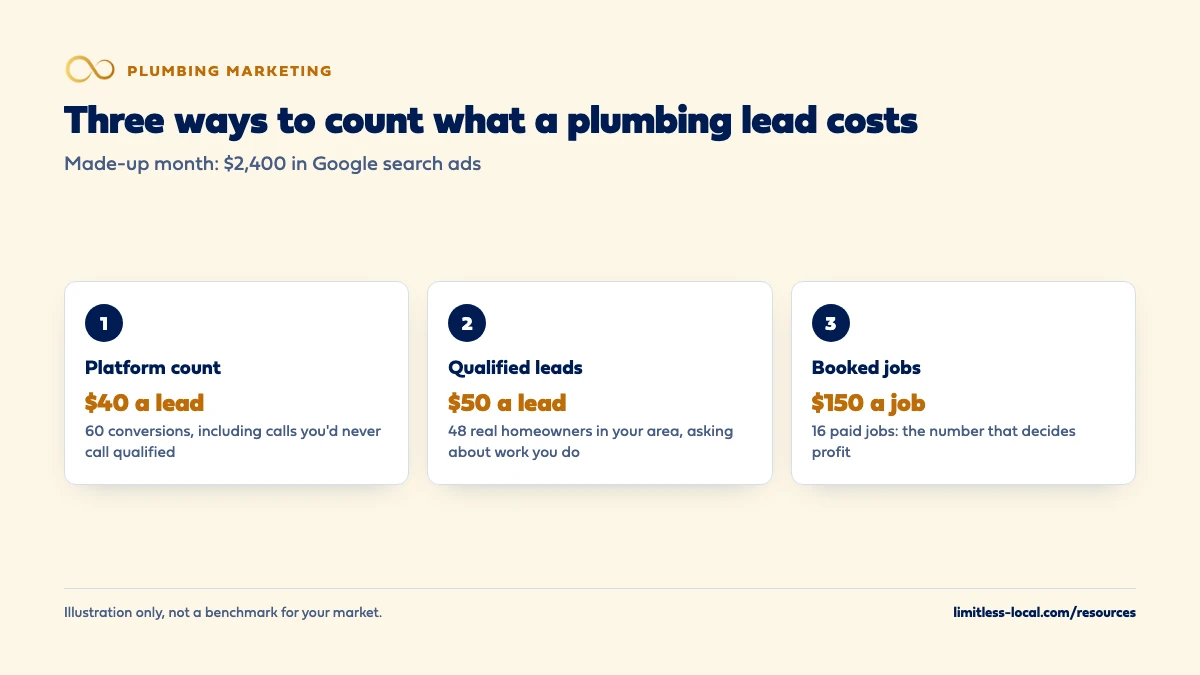
These numbers are made up to show the math, not a benchmark for your market. Say a plumbing company spends $2,400 on Google search ads in a month and the account reports 60 call and form conversions.
- The platform’s number: $2,400 divided by 60 is $40 per lead.
- Cost per qualified lead: the office listens to the recordings and finds 48 were real homeowners in the area asking about work the company does. $2,400 divided by 48 is $50 per qualified lead.
- Cost per booked job: 16 of those became paid jobs. $2,400 divided by 16 is $150 per booked job.
All three numbers are true. Only the last one tells the owner whether the month made money, by comparing it with the gross profit on those 16 jobs.
For reference, our Essentials package is $3,500 a month and includes Google Ads management for up to $2,500 a month in ad spend, which is paid to Google separately. A free visibility audit is a simple way to see your own three numbers.
Frequently asked questions
Is a Local Services Ads lead the same as a qualified lead?
Not necessarily. Google charges for valid leads, which include answered calls, messages, voicemails and booking requests, and it doesn’t charge for leads it judges invalid or low quality. A valid lead can still be a job you don’t want, so mark qualified leads yourself.
Can I see what other plumbers in my area pay per lead?
Not directly. Keyword Planner shows historical top-of-page bid ranges and a competition level for keywords in the location you choose, which hints at how contested your market is, but no platform publishes what individual competitors pay.
Are message leads cheaper than phone leads?
Often. Google says Local Services Ads message leads are typically priced lower than phone leads, although that isn’t always the case.
Should I count repeat customers as new leads?
Keep them separate. A repeat customer who calls through an ad still costs you the click or lead, but mixing them in makes a channel look better at finding new customers than it is.
How many leads do I need before the number means anything?
In our judgement, at least a full month per channel, and more for slow channels. A handful of leads can swing the average a long way.
Does a higher lead cost mean my ads are badly run?
Not on its own. Check that you’re comparing qualified leads to qualified leads and booked jobs to booked jobs, in a similar market, before judging the account.
Key takeaways
- No national price fits your market; lead prices vary by job type, competition and channel.
- Write down what counts as qualified before you measure anything.
- Cost per qualified lead = a month’s spend on one channel / qualified leads from it.
- Platform counts include leads you’d never call qualified, so your number will usually be higher.
- Track the number by job type, and recheck it monthly and after platform changes.
- Booking rate turns lead cost into cost per booked job, the number that decides profit.
Ready to compare options?
Book a short growth call and we'll walk through the math for your service area, including when we're not the right fit.
More in this section
- How much can I afford to pay for a plumbing lead?
- Is it worth paying for plumbing leads?
- How do I get more plumbing leads?
- When should a plumbing company stop spending on a lead source?
- Which plumbing channel brings the highest-quality leads?
Sources
- How leads work — Google Local Services Help
- Local Services Ads transition to Performance Max campaigns with pay-per-lead goals — Google Ads Help
- About Keyword Planner forecasts — Google Ads Help
- About phone call conversion tracking — Google Ads Help
- How much do I pay for leads and opportunities? — Thumbtack Help
- How to qualify leads in CallRail — CallRail Help Center
- Data Report: Average Call Booking Rates — ServiceTitan