
How much does a Google Ads click cost for plumbing keywords?
- What will I actually pay per click for plumbing keywords in my area?
- Why can't anyone give me one price for a plumbing click?
- How do I look up what plumbing clicks cost in my area?
- Which plumbing keywords cost the most per click?
- Do I pay my full bid on every click?
- Why do my plumbing clicks cost more at certain times?
- Can I pay less per click without dropping my position?
- What does a click cost compared with a booked job?
- Should I bid manually or let Google set my plumbing bids?
- Is a cheaper click in a nearby town worth chasing?
- What's different about click prices for plumbing companies
- A worked example: the cheap click and the expensive click
- Frequently asked questions
- Key takeaways
- More in this section
- Sources
The short version
- Every search is its own auction, so click prices change by keyword, place and time.
- Keyword Planner's low and high top-of-page bid ranges are your local starting point.
- Your actual cost per click is often less than your maximum bid.
- Better ad quality can win a position for less; it's the lever you control.
For plumbing owners trying to understand per-click prices before setting or judging a budget. The monthly budget itself is covered in how much a plumbing company should spend on Google Ads; this page is the price of one click and why it moves.
Get a free visibility audit · Book a growth call
What will I actually pay per click for plumbing keywords in my area?
There’s no single price for a plumbing click: Google Ads runs an auction for every search, so what you pay depends on the keyword, your city, the competition at that moment, your ad quality and your bid. The reliable way to find your own number is Google’s Keyword Planner, which gives a low and high top-of-page bid range for each keyword based on your location, roughly the 20th and 80th percentile of what advertisers have paid. Emergency, water heater and sewer keywords usually price very differently, so look each one up for the area your trucks actually serve.
Keyword research and bid management for plumbing searches are part of every one of our local ads packages, with ad spend paid to Google separately so you can see what each click costs. How that fits a plumbing shop is on our plumbing marketing page, and the rest of the plumbing marketing questions library goes question by question.
Why can't anyone give me one price for a plumbing click?
Because there isn’t one. Google runs an auction each time someone searches, and it runs different auctions for each ad location on the page. Where your ad shows, and whether it shows at all, depends on your Ad Rank at that moment, which Google calculates from your bid, your ad quality, the competition and the context of the search.
So the same keyword can cost one plumber more than another in the same town, and cost you more on a freezing Monday morning than on a quiet afternoon. Any single national “plumbing CPC” figure hides all of that, which is why we don’t quote one; your own Keyword Planner numbers and your own account data are what count.
How do I look up what plumbing clicks cost in my area?
Use Keyword Planner. For each keyword it shows two numbers Google defines in its Keyword Planner forecast help:
- Top of page bid (low range): roughly the 20th percentile of what advertisers have historically paid for a top-of-page spot.
- Top of page bid (high range): roughly the 80th percentile.
Both are based on your location and Search Network settings, so set the location to the area your trucks serve before you read them. Google also warns that results are less accurate if you target a small geographic area, because there’s less data. In a small town, treat the range as a starting point and let your first weeks of real clicks replace it.
Which plumbing keywords cost the most per click?
It varies by market, so check your own, but in our judgement the pattern plumbers usually see is this: searches that signal an urgent, paid job, like emergency plumber, burst pipe or sewer line repair, attract the most bidders, and searches with a big ticket behind them, like water heater replacement or repiping, attract bids because a single job pays for many clicks.
Broad or do-it-yourself searches (“how to unclog a drain”) can look cheap but rarely bring paying work. Which keywords plumbing ads should target covers choosing them, and negative keywords keep the DIY clicks out.
Do I pay my full bid on every click?
No. Google says your bid is the most you’re willing to pay for a click, and how much you actually pay is often less. What you pay depends on the auction: the competition around you and the Ad Rank thresholds you need to clear.
That’s why the average cost per click in your account is usually lower than your maximum bid, and why it moves from week to week even if you change nothing.
Curious what your marketing is actually booking?
Get a free visibility audit — no obligation, no sales pitch.
Why do my plumbing clicks cost more at certain times?
Google checks the context of every search when it calculates Ad Rank: the search terms, the person’s location at the time, their device, the time of the search, other ads and results on the page, and other signals. So the price of the same keyword can shift by hour, by day and by neighborhood.
For plumbing, in our judgement the biggest swings come with weather and holidays, when more plumbers bid for more urgent searches at once. If you run ads overnight, decide whether those hours are worth it based on whether someone answers the phone, not just on the click price.
Can I pay less per click without dropping my position?
Often, by improving ad quality. Google’s Quality Score is built from three parts: expected clickthrough rate, ad relevance and landing page experience. Google also notes that a very high top of page bid estimate can mean a keyword’s Quality Score is poor and could be improved.
For a plumber that usually means tight ad groups (water heater searches see a water heater ad and land on a water heater page), a clear phone number and service area, and no catch-all “plumbing services” page for every search. Structuring plumbing Google Ads campaigns covers the setup.
What does a click cost compared with a booked job?
A click is only the first step. What a booked job costs in ad spend is the click price times the number of clicks it takes to get one booked job. A pricier click that books often can beat a cheap click that rarely does.
That’s why cost per click on its own is a poor way to judge plumbing ads. Track which clicks became calls and which calls became booked jobs, then compare cost per booked job against what the job is worth. How much you can afford to pay for a plumbing lead sets that ceiling, and which conversions to track makes the count possible.
Should I bid manually or let Google set my plumbing bids?
Either can work. With manual CPC bidding you set the maximum per click yourself. With automated bid strategies Google sets bid amounts for you toward a goal you choose, such as clicks or conversions; a conversion goal only works well if your conversion tracking counts real calls and jobs rather than every page view.
In our judgement, a new plumbing account with little data often starts better with tighter control, then moves to automated bidding once tracking is reliable and enough calls have come in for Google to learn from.
Is a cheaper click in a nearby town worth chasing?
Only if you’ll actually drive there quickly. A cheaper click from the edge of your area can turn into a long drive, a slow arrival and a lost job, which makes it expensive in the end. Set locations to where your trucks go, then compare click prices within that area, not outside it.
What's different about click prices for plumbing companies
Urgency pulls in bidders. Emergency searches are worth a lot to the plumber who wins them, so many bid for them at once, which pushes prices up when demand spikes.
Job values sit far apart. A drain call and a sewer replacement can start with similar searches, so the click price you can afford differs by job type.
DIY searches are everywhere. Many plumbing searches are people trying to fix it themselves. Cheap clicks on those are rarely a bargain.
Weather moves the market. A hard freeze changes how many people search and how many plumbers bid in the same week.
Talk it through with someone who runs this every day
A 15-minute growth call: your market, your numbers, and what a realistic budget looks like. No pressure.
A worked example: the cheap click and the expensive click
These numbers are made up to show the math, not a benchmark for your market.
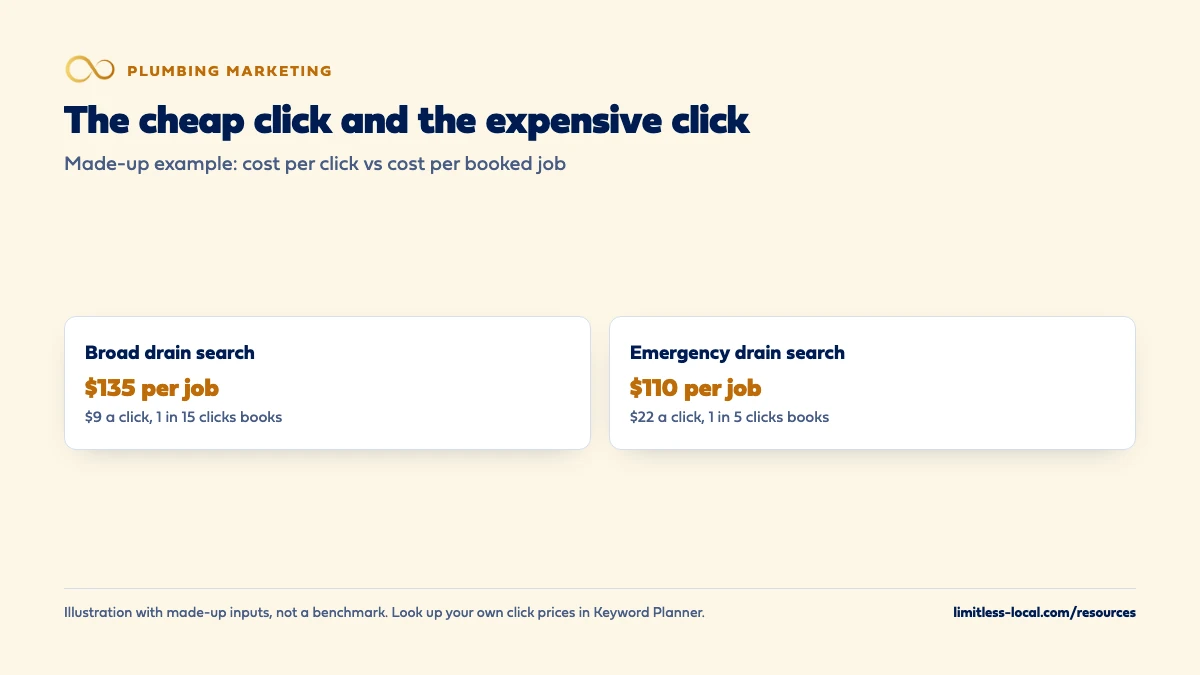
Keyword A, a broad drain search, costs a made-up $9 a click. One in fifteen clicks becomes a booked job, so a booked job costs $135 in ad spend.
Keyword B, an emergency drain search, costs a made-up $22 a click. One in five clicks becomes a booked job, so a booked job costs $110.
The click that costs more than twice as much is the cheaper way to buy a booked job. Run your own click prices from Keyword Planner and your own booking rates from your job software through the same math before you cut or raise a bid. A free visibility audit is the simplest way to see the numbers side by side.
Frequently asked questions
Is there an average cost per click for plumbers?
Published averages exist, but they mix very different markets and keywords. Your own Keyword Planner range for your service area, and then your own account data, are better guides.
Why is my average CPC lower than my bid?
Google says what you actually pay for a click is often less than your maximum bid; it depends on the auction around you.
Do Local Services Ads charge per click?
No. Google says Local Services Ads are moving into Google Ads with pay-per-lead goals, so you still pay per lead, not per click. Compare them by cost per booked job, not click price.
Will a higher bid always put me at the top?
Not always. Ad Rank also uses ad quality, thresholds and the context of the search, so a better ad can sometimes win a higher spot with a lower bid.
How often should I check my click prices?
In our judgement, weekly in a new account and monthly once it’s steady, plus during any freeze or busy spell.
Key takeaways
- There’s no single plumbing click price; every search is its own auction.
- Use Keyword Planner’s low and high ranges for your own service area, keyword by keyword.
- Your actual cost per click is often below your maximum bid.
- Ad quality (expected CTR, ad relevance, landing page) is the lever that can lower click prices.
- Judge clicks by cost per booked job, not by click price alone.
Ready to compare options?
Book a short growth call and we'll walk through the math for your service area, including when we're not the right fit.
More in this section
- How much should a plumbing company spend on Google Ads?
- What keywords should my plumbing Google Ads target?
- Why are my plumbing Google Ads getting clicks but no calls?
- Are Google Local Services Ads worth it for plumbers?
- If I stop Google Ads, will my plumbing leads drop?
Sources
- About Ad Rank — Google Ads Help
- About Keyword Planner forecasts — Google Ads Help
- About Quality Score for Search campaigns — Google Ads Help
- Top of page bid estimate: Definition — Google Ads Help
- Manual CPC bidding — Google Ads Help
- Local Services Ads transition to Performance Max campaigns with pay-per-lead goals — Google Ads Help