
Which conversions should I track in my plumbing Google Ads?

- What actions should count as conversions in a plumbing Google Ads account?
- What is a conversion in Google Ads, in plumbing terms?
- Which phone calls should count as conversions?
- What's the difference between primary and secondary conversions?
- Should a tap on my phone number count as a conversion?
- Can I track which ad clicks turned into booked plumbing jobs?
- Can I import only the calls that booked a job?
- Should my conversions have values?
- Why does Google Ads show more conversions than jobs I booked?
- How long before conversion changes affect my plumbing ads?
- What should I check every month?
- What's different about conversion tracking for plumbing companies
- A worked example: what bidding learns from each setup
- Frequently asked questions
- Key takeaways
- More in this section
- Sources
The short version
- Count calls from ads and from your website, with a minimum call length.
- Count completed booking and quote forms, not form views.
- Make real-contact actions primary; keep softer actions secondary.
- Import booked jobs from your job software when you can.
For plumbing owners setting up or cleaning up conversion tracking inside Google Ads. Tracking which marketing books jobs across every channel is covered in tracking which plumbing marketing books jobs; this page is the in-account setup that feeds Google’s bidding.
Get a free visibility audit · Book a growth call
What actions should count as conversions in a plumbing Google Ads account?
Track the actions that mean a real customer reached you: phone calls from your ads that last long enough to be a real conversation, calls from your website’s tracked number, and completed booking or quote forms. Make those primary conversions so Google bids toward them, keep softer actions like page views or button taps as secondary, observation-only actions, and when you can, import booked jobs from your job software so Google learns which clicks became paying work.
Conversion tracking is set up as part of every one of our local ads packages, because bidding is only as good as what it’s told to chase. How that fits a plumbing shop is on our plumbing marketing page, and the rest of the plumbing marketing questions library goes question by question.
What is a conversion in Google Ads, in plumbing terms?
A conversion is an action you tell Google Ads counts, like a call or a submitted form. Google uses conversion measurement to show which clicks led to valuable actions, and its automated bid strategies use those conversions to decide what to bid.
For a plumber, that makes the choice of conversions the most important setting in the account. If you count every visit to the contact page, Google will happily find you more contact page visits. If you count real calls and booked jobs, it learns to find more of those.
Which phone calls should count as conversions?
Google lists several ways to track phone call conversions. The two most plumbers need:
- Calls from ads: calls made directly from your ad’s call button or call asset.
- Calls to a phone number on your website: calls from people who clicked your ad and then called the forwarding number Google shows on your site.
For both, you set a minimum call length, and every call that lasts at least that long counts. Pick a length that filters out hang-ups and wrong numbers but keeps a quick booking call. Google notes that these methods, and importing call conversions, require Google forwarding numbers. If you’re worried about tracking numbers on your listings, whether call tracking numbers hurt rankings covers it.
What's the difference between primary and secondary conversions?
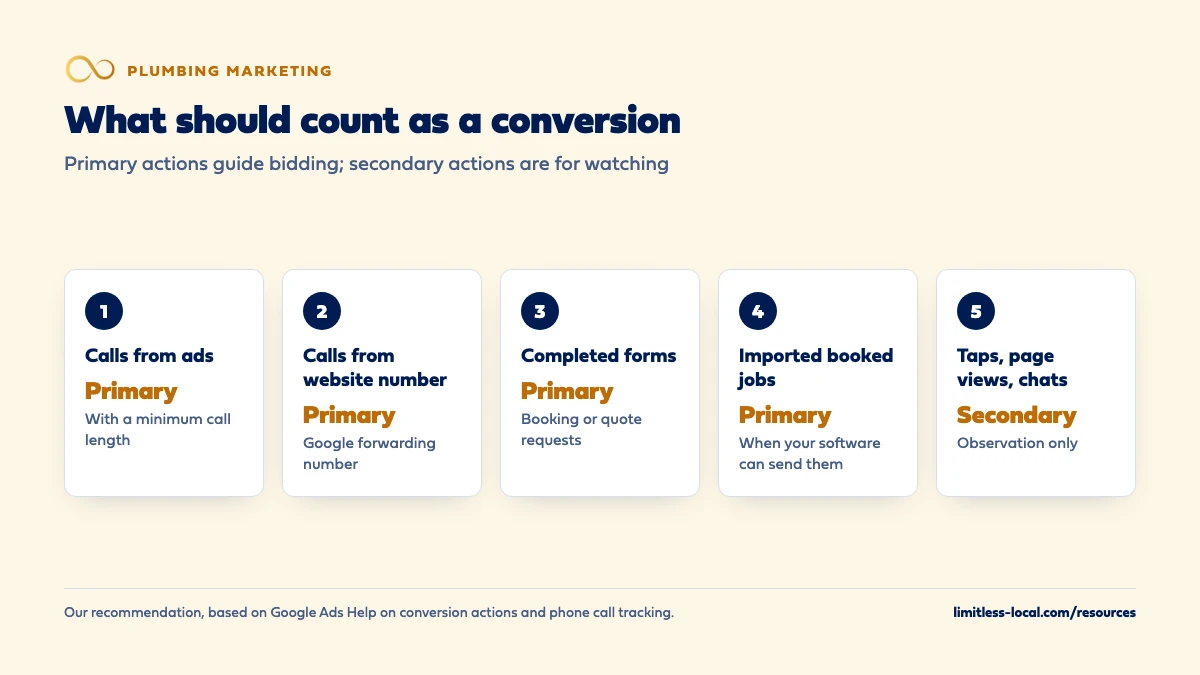
Google splits conversion actions into two kinds. Primary actions show in the Conversions column and are used for bidding; secondary actions are for observation only and show in the All conversions column.
For a plumbing account, in our judgement:
- Primary: qualified calls from ads, qualified calls from the website number, completed booking or quote forms, and imported booked jobs if you have them.
- Secondary: clicks on the phone number, directions requests, visits to key pages, chat starts.
Google itself warns that misconfiguring primary and secondary settings can stop Smart Bidding optimizing well, because the bidding relies on these signals.
Should a tap on my phone number count as a conversion?
Not as a primary one, in our judgement. A tap on a phone link shows interest, but it doesn’t tell you whether the call connected, how long it lasted or whether anyone answered. Counting taps as primary teaches bidding to chase taps. Keep them as secondary so you can still see them, and let the tracked calls with a minimum length do the bidding work.
Curious what your marketing is actually booking?
Get a free visibility audit — no obligation, no sales pitch.
Can I track which ad clicks turned into booked plumbing jobs?
Yes, by importing them. Google’s offline conversion imports let you send conversions that happen outside your website, such as a job booked in your office, back to Google Ads. Google now recommends that advertisers who haven’t started with offline imports begin with enhanced conversions for leads instead, which it describes as easier to set up and more accurate.
Enhanced conversions send hashed first-party data, like the email or phone number a customer gave on your form, to match conversions back to ad clicks. In practice for a plumber, that means your booking form and your job software have to share a customer detail, and someone has to keep the import running.
Can I import only the calls that booked a job?
Google offers a way to import call conversions you track in another system, which it says gives you more control over which calls count. That’s the route if your call tracking or job software can mark a call as booked. It requires Google forwarding numbers, so check that your call setup supports it before you plan around it.
Should my conversions have values?
Once you’re counting booked jobs, values help. Google lets you assign conversion values so it can tell a bigger result from a smaller one. A water heater replacement and a faucet repair aren’t worth the same to you, so giving them different values lets bidding favour the work that pays more, in our judgement. Until you have reliable booked-job data, keep it simple and count conversions without values.

Why does Google Ads show more conversions than jobs I booked?
Usually because it’s counting actions that aren’t jobs: page views, taps or duplicate forms set as primary, short calls, or the same customer calling twice. Check which actions are primary, raise the minimum call length if hang-ups are counting, and compare against jobs in your software. If clicks aren’t turning into calls at all, why plumbing ads get clicks but no calls covers what to check.
How long before conversion changes affect my plumbing ads?
Give it time. Google says Smart Bidding needs a standard 7-14 day learning phase to gather data, and advises against frequent changes to budgets, targets or conversion goals during it, because changes reset that window. Change conversion settings once, deliberately, then leave them while bidding adjusts.
What should I check every month?
Three numbers side by side: primary conversions in Google Ads, calls answered by your office from ads, and jobs booked from ads in your job software. If the three drift apart, something in the setup is counting the wrong thing. A call that lasts past your minimum length counts as a conversion whether or not anyone booked the job, so answering matters too; how fast a plumbing office should answer covers that side.
Want to see where your company stands?
A free visibility audit shows where you show up on Google, Maps and AI answers, and what it's costing you in calls.
What's different about conversion tracking for plumbing companies
Most leads are calls. Urgent plumbing problems usually mean a phone call, not a form, so call tracking does most of the work.
Short calls are common. Wrong numbers, parts suppliers and quick hang-ups make a minimum call length essential.
Job values vary widely. A drain call and a repipe can both be one conversion unless you add values or import booked jobs.
After-hours calls are real conversions. A night call that reaches voicemail and lasts long enough may be counted as a conversion but never booked.
A worked example: what bidding learns from each setup
These numbers are made up to show the math, not a benchmark for your market.
A plumbing account spends $3,000 in a month. Setup A counts every phone-number tap and contact page view as primary: Google reports 150 conversions, or $20 per conversion. It looks great, but the office booked 20 jobs from ads.
Setup B counts only calls over a minimum length and completed forms: Google reports 40 conversions, or $75 per conversion. The office still booked 20 jobs, so $150 per booked job either way.
The spend and the jobs are identical; only Setup B tells Google what a good click looks like. A free visibility audit is the simplest way to check what your account is counting.
Frequently asked questions
Do I need call tracking software to track plumbing calls?
Not for basic tracking. Google Ads can track calls from ads and from your website with Google forwarding numbers. Separate call tracking helps if you want recordings or to mark which calls booked.
Should Google Business Profile calls count in Google Ads?
Only if they come from your ads. Keep organic profile calls out of your ad conversions so you’re judging ads on what ads did.
Is a form with only a name and email worth counting?
Count completed forms as primary if they’re real requests for work. If many are spam, keep them secondary until you can filter them.
Can I change conversions without hurting my campaigns?
You can, but Google says frequent conversion goal changes during the learning phase reset it. Make one planned change and wait.
What about Local Services Ads leads?
Google says Local Services Ads are moving into Google Ads with pay-per-lead goals; track the leads they bring, and count booked jobs from them separately from search ads.
Key takeaways
- Count calls from ads and website calls with a minimum call length as primary conversions.
- Count completed booking and quote forms, not form views or phone taps.
- Keep taps, page views and chats as secondary, observation-only actions.
- Import booked jobs through enhanced conversions for leads or offline imports when you can.
- Compare Google’s conversions with answered calls and booked jobs every month.
Not sure what's working right now?
Start with a free visibility audit: rankings, Google profile, reviews and tracking, checked against your service area.
More in this section
- How should I structure my plumbing Google Ads campaigns?
- What keywords should my plumbing Google Ads target?
- Why are my plumbing Google Ads getting clicks but no calls?
- If I stop Google Ads, will my plumbing leads drop?
- How much should a plumbing company spend on Google Ads?
Sources
- About conversion measurement — Google Ads Help
- About phone call conversion tracking — Google Ads Help
- About primary and secondary conversion actions — Google Ads Help
- About offline conversion imports — Google Ads Help
- About enhanced conversions — Google Ads Help
- About conversion values — Google Ads Help
- Local Services Ads transition to Performance Max campaigns with pay-per-lead goals — Google Ads Help