
What is the map pack, and why do roofers need to be in it?
- What does the Google map pack mean for a roofing company's phone calls?
- What is the map pack on Google?
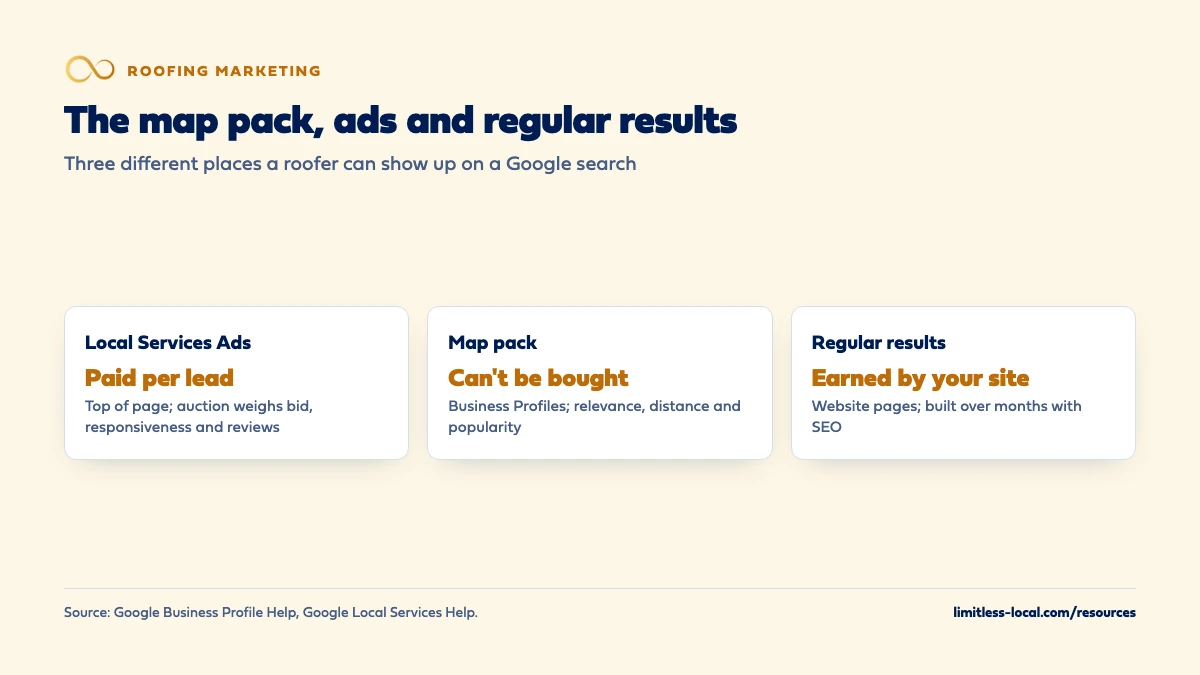
- How is the map pack different from the regular Google results?
- How is the map pack different from ads?
- Why do roofers need to be in the map pack?
- What decides which roofers make the map pack?
- Can a roofer without a storefront get into the map pack?
- Why do I show up in the map pack in one town but not the next?
- How do I check whether my roofing company is in the map pack?
- What does it take to get a roofing company into the map pack?
- What should a roofer avoid when chasing the map pack?
- What's different about the map pack for roofers
- A worked example: what a map pack spot can be worth
- Frequently asked questions
- Key takeaways
- More in this section
- Sources
The short version
- The map pack is the small group of local business listings, with a map, near the top of Google.
- Each listing is a Google Business Profile, with reviews and a call button.
- It's separate from the ads above it and the regular website results below it.
- You can't pay for a better spot; relevance, distance and popularity decide it.
For roofing owners who keep hearing about the map pack and want to know what it is, how it differs from ads and regular results, and what it does for their calls.
Get a free visibility audit · Book a growth call
What does the Google map pack mean for a roofing company's phone calls?
The map pack is the short list of local businesses, with a map, that Google shows near the top of the results when someone searches for something like “roofer near me” or “roof repair” plus a town. Each listing comes from a Google Business Profile and shows the business’s rating, reviews and a call button, so a homeowner can phone a roofer without ever visiting a website. Roofers need to be in it because it’s where many homeowners with a leak or storm damage pick who to call, and you can’t buy your way in: Google ranks those spots mainly on relevance, distance and popularity.
Getting into the map pack, and staying there, is the core of our local SEO work for roofers: Google Business Profile management, listing cleanup with your name, address and phone synced across 50+ directories, reviews, and the website pages that back your profile up. It’s part of every roofing marketing package. For how SEO fits with the rest, see the guide to roofing SEO, and the roofing marketing questions library goes question by question.
What is the map pack on Google?
Search “roofer” or “roof repair” on your phone and, below any ads, you’ll usually see a small map with a short list of local roofing companies underneath it. That’s the map pack. Marketers also call it the local pack or the 3-pack, because it typically shows three businesses before a “more” link.
Each entry shows the business name, star rating and number of reviews, and buttons to call, visit the website or get directions. Tap one and the full Google Business Profile opens, with photos, hours, services and reviews.
Google’s help page on local ranking describes these as local results: when a customer searches for a business near their location, they find local results on Google Maps and Search, and Google tries to show the kind of nearby business they’d want. The same listings also show inside the Google Maps app when someone searches there.
How is the map pack different from the regular Google results?
They’re two different systems pulling from two different places:
- The map pack is built from Google Business Profiles. What’s on your profile (your category, services, service area, reviews and photos) is what Google is matching against.
- The regular results, sometimes called organic results, are web pages. They’re built from your website: its pages, what they say, and how other sites link to it.
The two are connected. A strong website helps your profile, and your profile links to your website. But you can rank well in one and poorly in the other. Plenty of roofers with a good website are missing from the map pack because their profile is thin, and some roofers show up in the map pack with a barely-there website because their profile and reviews are strong.
For a roofer, that means two jobs, not one: the profile and reviews for the map pack, and the website for the regular results.
How is the map pack different from ads?
Ads are the paid placements, and they’re labeled. Two kinds matter for roofers:
- Local Services Ads sit at the very top of many local searches, with a Google Verified badge. You pay per lead, and their order is set by an auction. Google’s page on Local Services ad rankings lists your bid, your responsiveness, how relevant you are to the search, and profile quality, including your rating and number of reviews.
- Google Ads search ads show above the regular results, and can also appear on Maps. Google’s help page on local search ads on Maps says they can show as promoted pins or in the Maps search results, and separates them from your business’s organic listing.
The map pack itself isn’t for sale: there’s no way to request or pay for a better local ranking. You can buy a spot above the map pack, but you can’t buy a spot in it. That’s exactly what makes a map pack position so valuable, and so hard for a competitor to take from you overnight.
Why do roofers need to be in the map pack?
Because that’s where a lot of roofing calls start. A homeowner with water coming through the ceiling isn’t going to read ten websites. They search, look at the map, check the stars and tap call. If you’re not one of the businesses on that short list, you’re not in the running for that call.
A few things make it especially important for roofers:
- It’s built for phones. The call button is right there, so map pack visibility tends to turn into phone calls, not just website visits.
- Reviews do the selling. The homeowner sees your rating and review count next to two competitors before they ever talk to you.
- It’s local. The map pack favors businesses close to the searcher, so a well-run local roofer can compete with much bigger companies.
- It keeps working. Unlike ads, a strong map pack position doesn’t switch off when the budget runs out.
A roofing client of ours got 3x map pack visibility in its target towns; better presence and consistent info across the web increased inbound calls. Why marketing matters for roofing companies covers how this fits with everything else.
Curious what your marketing is actually booking?
Get a free visibility audit — no obligation, no sales pitch.
What decides which roofers make the map pack?
Local results are mainly based on three things:
- Relevance: how well your Business Profile matches what someone searched. Complete, detailed business information helps Google match you to the right searches.
- Distance: how far your business is from the person searching. If they don’t share where they are, Google uses what it knows about their location.
- Popularity: how well-known your business is. It’s based partly on how many websites link to you and how many reviews you have, and more reviews and positive ratings can help your ranking.
You control a lot of the first and third, and very little of the second. That’s why two roofers can see very different results in different parts of the same metro. What makes a roofing company rank higher in Google Maps goes through each factor and what to do about it.
Can a roofer without a storefront get into the map pack?
Yes. Most roofers don’t have customers visiting an office, and Google has a setup for that: the service-area business. Google’s service-area help page explains that service-area businesses serve customers at their locations, and that you set your service area by city, postal code or other areas, up to 20 of them. You can’t set it as a radius around your office anymore, and if customers don’t come to your business address, you remove the address from your profile.
Google’s guidelines for representing your business add the rules that matter: a service-area business should have one profile for its central office with a service area, and can’t list a “virtual” office unless it’s staffed during business hours.
Setting it up wrong, like using a fake address in a town you want to rank in, can get your profile suspended. What a service-area business is on Google walks through the setup.
Why do I show up in the map pack in one town but not the next?
Distance, mostly. The map pack is built for the person searching, so a homeowner two miles from your shop and one twenty miles away can see completely different results for the same search.
Adding a town to your service area doesn’t by itself put you in that town’s map pack. It tells homeowners you’ll come there. To show up in towns farther out, the other two factors have to work harder: a profile that clearly matches the jobs, a website with pages about the towns and services you want, and a strong, steady flow of reviews, ideally from customers in those towns.
Be realistic about the edges. A roofer can usually compete strongly near their office and in the towns around it, and has to fight harder the farther out they go. If you used to show up somewhere and suddenly don’t, that’s a different problem. How to get your roofing company back into the map pack covers that.
How do I check whether my roofing company is in the map pack?
Searching from your own office will mislead you, because you’re close to your own business. Better ways to check:
- Search from different towns. When you’re on a job across the service area, search “roof repair” and “roofer near me” and note where you show.
- Search the way homeowners do. “Roof replacement,” “roof leak repair,” “metal roofing” plus the town. Not just your company name.
- Check your profile’s numbers. If your profile is verified, Google’s Business Profile performance report shows how many people viewed your profile on Search and Maps, the search terms people used to find you, and how many tapped to call or clicked to your website. It also notes the numbers include interactions from both organic results and Google Ads.
A rising number of calls from your profile is the best sign you’re showing up where it counts.
What does it take to get a roofing company into the map pack?
No single trick. It’s a handful of basics done well and kept up:
- Verify your Business Profile. Verified businesses are more likely to show up in search results.
- Pick the right primary category (Roofing contractor) and add the related services you actually do.
- Fill out everything: hours, services, service area, description and real photos of your crews and finished roofs.
- Keep your name, address and phone the same everywhere they appear online, from your website to directories.
- Ask every customer for a review, and reply to every review you get.
- Back it up with a website that has pages for your main services and the towns you serve.
Then keep going. Reviews and photos keep adding up, and a profile that goes quiet slowly loses ground to roofers who don’t stop. How to set up a roofing Google Business Profile to bring calls has the full checklist.
What should a roofer avoid when chasing the map pack?
A few shortcuts break Google’s rules and can get your profile suspended, which leaves you worse off than being in fourth place:
- Stuffing keywords into your business name. Google’s guidelines say your name should reflect your real-world business name, as used on your website, signs and paperwork. “Smith Roofing” is fine; “Smith Roofing Best Roof Repair Dallas” isn’t, unless that’s genuinely your name.
- Fake or virtual addresses in towns you don’t really operate from.
- Duplicate profiles for the same business.
- Buying or faking reviews, or offering discounts in exchange for them.
If your profile has already disappeared, why a roofing company may not be showing up on Google Maps walks through the usual causes.
Want to see where your company stands?
A free visibility audit shows where you show up on Google, Maps and AI answers, and what it's costing you in calls.
What's different about the map pack for roofers
Searches spike with the weather. After a hailstorm, searches for roofers can jump overnight, and homeowners call whoever looks credible in the map pack. A profile that’s already strong before storm season catches that surge; one you start fixing afterward doesn’t.
Storm chasers come and go. Out-of-town crews often show up after big storms. A local roofer with a long review history and real local photos has an edge in the map pack that a new arrival can’t build in a week.
Your service area is wide. Many roofers drive farther than a plumber or electrician would. That makes the distance factor matter more, and makes town-by-town checks and town pages on your website worth the effort.
A worked example: what a map pack spot can be worth
These numbers are made up to show the math, not a benchmark for your market. Say your Google Business Profile brings 25 calls a month once you’re showing in the map pack for your main towns. About half are real roofing leads, and the rest are wrong numbers, sales calls and existing customers. That’s roughly 12 leads.
If you book an inspection with two-thirds of those, that’s 8 inspections. If one in four inspections signs, that’s 2 signed roofs a month. At $4,000 profit per roof after materials and labor, the map pack is worth about $8,000 a month in profit, before you’ve paid for a single click.
That’s why roofers who are missing from the map pack in their best towns often have the most to gain from fixing their profile and reviews. Your own numbers will differ, and the only way to know them is to track which profile calls become signed roofs.
Frequently asked questions
Is the map pack the same as Google Maps?
Not quite. The map pack is the short list of local businesses shown in Google Search results. The same Business Profiles also show inside the Google Maps app, where a searcher can scroll through more of them.
How many roofers show in the map pack?
Usually three, with a link to see more. That’s why it’s often called the 3-pack.
Do I need a website to be in the map pack?
Not strictly, since the map pack is built from your Google Business Profile. But a website with pages for your services and towns helps Google understand what you do, and homeowners often check it before they call.
Does running Google Ads help me get into the map pack?
No. There’s no way to pay for a better local ranking. Ads can put you above the map pack, but they don’t change your spot in it.
How long does it take a roofer to get into the map pack?
It varies with your market and where you’re starting. SEO typically takes 3 to 6 months to show meaningful growth, and nobody can honestly guarantee a map pack position.
Can I be in the map pack for towns where I don't have an office?
You can show up in nearby towns, especially with a strong profile and reviews, but distance from the searcher matters. Never set up a fake address to get a spot in another town.
Key takeaways
- The map pack is the short list of local Business Profiles, with a map, near the top of Google’s results.
- It’s separate from ads above it and the website results below it, and it can’t be bought.
- Google ranks it mainly on relevance, distance and popularity.
- For roofers, the map pack turns into phone calls, and reviews do much of the selling.
- Get in with a verified, complete profile, consistent details, steady reviews and a supporting website.
Not sure what's working right now?
Start with a free visibility audit: rankings, Google profile, reviews and tracking, checked against your service area.
More in this section
- How do I get my roofing company back into the Map Pack?
- Why is marketing important for roofing companies?
- What is roofing business management software, and do I need it?
- What does a roofing marketer actually do each month?
- What is call tracking, and does a roofing company need it?
Sources
- Tips to improve your local ranking on Google — Google Business Profile Help
- Show local search ads on Google Maps — Google Ads Help
- About ad rankings — Google Local Services Help
- Manage your service areas for service-area & hybrid businesses — Google Business Profile Help
- Guidelines for representing your business on Google — Google Business Profile Help
- Understand your Business Profile performance & insights — Google Business Profile Help