
How does a roofer get better results from Facebook ads?
- How can a roofing company turn cheap Facebook leads into booked inspections and signed roofs?
- Where are my Facebook roofing ads actually losing money?
- Step 1: How fast am I getting back to Facebook leads?
- Step 2: How do I make my lead form screen out junk?
- Step 3: What offer works better for roofing on Facebook?
- Step 4: Who should my roofing ads be shown to?
- Step 5: What should the ad itself show?
- Step 6: Should I use call ads instead of lead forms?
- Step 7: How do I teach Facebook which leads are good?
- Step 8: How long should I wait before changing my roofing ads?
- What should I change first, based on what I'm seeing?
- How do I know Facebook ads are actually working for my roofing company?
- What's different about Facebook ads for roofers
- A worked example: a higher cost per lead, a lower cost per roof
- Frequently asked questions
- Key takeaways
- More in this section
- Sources
The short version
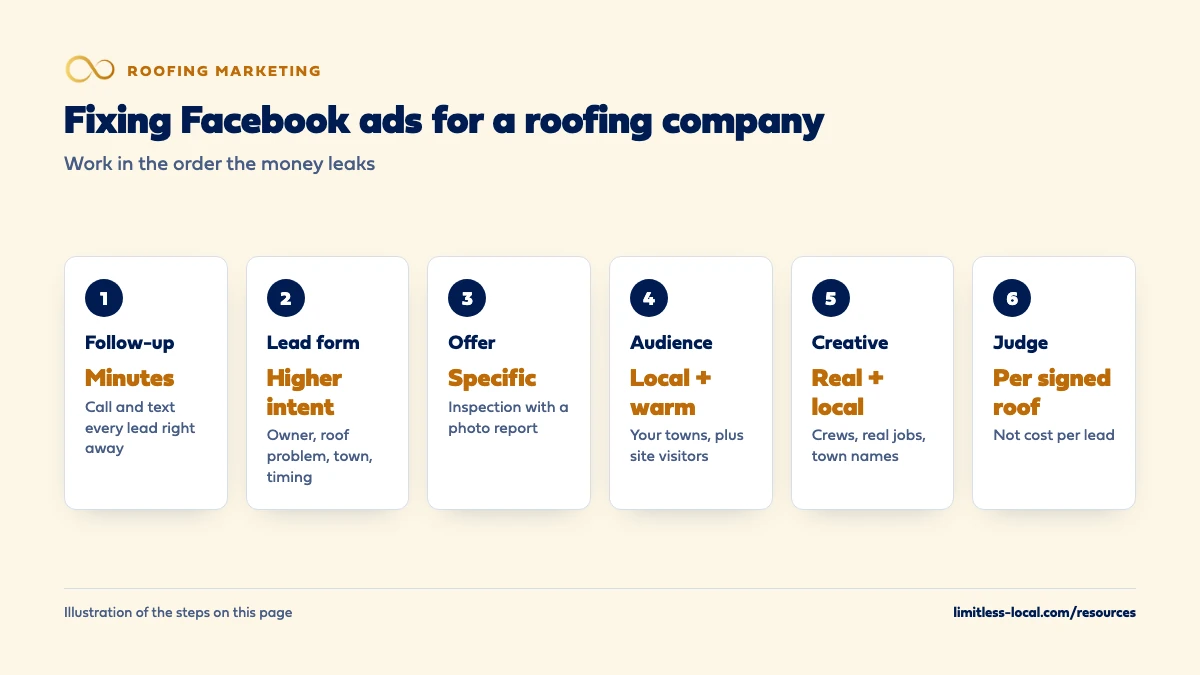
- Fix follow-up first: call every lead within minutes.
- Use a higher-intent form with a few roofing questions.
- Make the offer specific: an inspection with a photo report, in named towns.
- Then work on audience and creative, one change at a time.
- Judge by cost per inspection and per signed roof.
For roofing owners already running Facebook or Instagram ads who are getting leads that don’t answer, don’t book or don’t sign.
Get a free visibility audit · Book a growth call
How can a roofing company turn cheap Facebook leads into booked inspections and signed roofs?
Fix Facebook ads in the order the money leaks: call every lead back within minutes, make the lead form do some screening, sharpen the offer, and only then change the audience and the ad itself. A higher-intent form with a few roofing questions (do you own the home, what’s going on with the roof, which town, how soon) trades some volume for homeowners who actually pick up, and a specific offer like a free inspection with a photo report beats a vague discount. Give each change time to settle before judging it, and measure by inspections booked and roofs signed, not cost per lead.
On the Meta side, our Growth package ($4,500 a month) covers remarketing on Facebook and Instagram to people who already visited your site, plus ad design and creative (limits apply), alongside Google Ads and Local Services Ads; Scale is custom. Ad spend is paid directly to Meta and Google. See how it fits together on our local ads page and our roofing marketing page, read the guide to getting roofing leads, or browse more roofing marketing questions.
Where are my Facebook roofing ads actually losing money?
Before you change anything, find the step where things fall apart. Pull the last month and count:
- Leads: form fills, calls and messages from the ads.
- Reached: how many of those you actually spoke to.
- Inspections booked from the ones you reached.
- Roofs signed from those inspections.
Where the number drops hardest is what to fix first. Lots of leads but few reached points to follow-up speed or a form that’s too easy to fill out. Plenty reached but few inspections points to the offer or the wrong audience. Inspections that don’t sign is a sales problem, not an ad problem.
If you’re still deciding whether Facebook belongs in your mix at all, whether Facebook ads work for roofing leads covers the basics, including the Special Ad Category check if you promote financing. This page assumes the ads are running and you want more out of them.
Step 1: How fast am I getting back to Facebook leads?
This is the fix that costs nothing and usually helps most. A homeowner who fills out a form while scrolling at night has moved on by the next afternoon. Call within minutes during business hours, and text right away if you can’t call.
Make sure leads actually reach you fast. Once your CRM is connected to your lead ads, new leads land in one place without downloading a file each time. A lead sitting in Ads Manager until Friday is a lead you paid for and lost.
Then set a follow-up pattern for the ones who don’t answer: a call and text on day one, again the next day, and a last try a few days later. How fast a roofing company should call back a new lead sets the standard, and turning roofing leads into booked inspections covers what to say once they pick up.
Step 2: How do I make my lead form screen out junk?
The default instant form is built for volume, and you get exactly that: lots of names, many of them barely interested. Meta’s page on instant form types describes the alternative. A higher intent form adds a review screen so people confirm their details, and a note that your business may follow up, which Meta says helps prevent submissions from people who are only marginally interested. Higher intent forms only run in Facebook and Instagram feeds on mobile.
Then add a few custom questions. For a roofer, these do most of the screening:
- Do you own the home?
- What’s going on with the roof? (Leak, storm damage, old roof, just want an inspection.)
- Which town or ZIP code is the home in?
- How soon do you want someone to look at it?
Instant forms also offer phone number verification by one-time code, which cuts fake and mistyped numbers. Expect fewer leads after these changes. That’s the point: fewer names you can’t reach, more you can.
Step 3: What offer works better for roofing on Facebook?
Most people scrolling Facebook weren’t thinking about their roof. The offer has to give them a clear, low-risk reason to raise their hand now. What tends to work for roofers:
- A free roof inspection with a photo report, so the homeowner sees what you saw.
- A storm check in named towns after hail or wind, with real dates and places.
- A seasonal check before the rainy months or hurricane season, where that applies.
- A replacement estimate with clear options, for homeowners with an older roof who’ve been putting it off.
What tends to backfire: vague percent-off discounts that pull in price shoppers, “free roof” style headlines, and anything that sounds like a promise about what someone else will pay for. Keep every ad about the inspection and the written estimate.
Step 4: Who should my roofing ads be shown to?
Start with where, not who. Set the location to the towns your crews actually serve, and leave out the ones you don’t want to drive to. A lead an hour past your last job site isn’t cheap if you won’t go.
Then split your budget between two groups:
- People who already know you. With the Meta Pixel on your site, you can build a website custom audience of people who visited, including specific pages like your roof replacement or storm damage pages. These are your warmest leads, and the audience starts filling from the day you create it, so set it up early.
- Homeowners in your area who don’t know you yet. Keep this broad and let the offer and the form do the screening. Stacking narrow interests on a small local audience often just makes leads more expensive.
Remarketing usually brings the better leads per dollar, but the pool is only as big as your website traffic. If your site gets little traffic, fix that with search first.
Curious what your marketing is actually booking?
Get a free visibility audit — no obligation, no sales pitch.
Step 5: What should the ad itself show?
Homeowners scroll past stock photos of perfect roofs. What stops them is something that looks local and real:
- Your crews at work in safety gear on houses that look like theirs.
- Before-and-after photos of real jobs, or close-ups of the damage you find on inspections.
- Short video of an inspection walkthrough or a finished roof from the street.
- The town name in the first line, so locals know it’s for them.
- A line from a real review, with permission, or your star rating.
Keep the text short: the offer, the towns, what happens next. Run two or three versions at a time, not ten, and swap out the weakest every few weeks so the same people don’t see the same ad until they tune it out.
Step 6: Should I use call ads instead of lead forms?
For urgent jobs like leaks and storm damage, a call is often worth more than a form. Meta’s lead ads with calling include call ads with a Call now button that opens the phone’s keypad, call add-ons that send people to your site with a Call now button at the bottom, and campaigns that optimize for both website and calls.
A few settings matter for a roofer. Schedule call ads to run during your business hours so someone’s there to answer, and turn on callback requests for people who couldn’t reach you. The call reporting shows calls placed plus 20-second and 60-second calls, which tells you how many were real conversations.
Many roofers run both: call ads for urgent repair and storm messages, forms for inspections and replacement estimates.
Step 7: How do I teach Facebook which leads are good?
By default, the ads chase whoever is most likely to fill out a form, which isn’t the same as whoever’s most likely to sign a roof. Meta offers performance goals that aim higher: maximize number of qualified leads, which shows ads to people more likely to convert after sharing their information, and maximize value of conversions.
These need data from you. Since April 2026, the qualified leads goal isn’t available for new campaigns without a Conversions API integration, and existing campaigns are affected starting August 2026. That integration is how your CRM sends lead stages back, and once it’s set up for qualified leads, you choose which stages in your sales process count, such as inspection booked or estimate signed.
This only pays off if your stages are kept up to date. If nobody marks leads as booked or signed, there’s nothing useful to send. Tracking which roofing leads turn into signed jobs covers setting up the stages.
Step 8: How long should I wait before changing my roofing ads?
Longer than most owners do. When you launch a new ad set or make a significant edit, it goes through a learning phase. Ad sets usually exit learning after about 50 results in the week after the last significant edit; until then, results are less stable and usually more expensive, and editing during learning resets it.
Many local roofers will never hit 50 leads a week from one ad set, so the practical rules are:
- Keep fewer ad sets, so each one gets more results. The fewer ads and ad sets you run, the more the system learns about each, so combine similar ad sets.
- Change one thing at a time, then wait a couple of weeks before judging it.
- Avoid frequent budget swings, which can send an ad set back into learning.
Constant tinkering keeps a small Facebook account from ever settling down.
What should I change first, based on what I'm seeing?
- Cheap leads that won’t answer: faster follow-up, then a higher intent form with verification.
- Leads from outside your area: location settings, then a ZIP code question on the form.
- Few leads at all: the offer and the photos first, then budget.
- Leads who answer but won’t book: the offer, and what’s said on the first call.
- Inspections that don’t sign: your sales process and estimate follow-up, not the ads.
- Results swing week to week: stop editing, combine ad sets and let them settle.
Junk from every channel at once is a different problem. Stopping junk roofing leads from wasting your time covers fixes across Google, Local Services Ads, forms and Facebook.
How do I know Facebook ads are actually working for my roofing company?
Cost per lead will fool you on Facebook. Forms make leads cheap, and cheap leads that never answer are expensive. Track three numbers every month:
- Cost per inspection booked: ad spend divided by inspections from Facebook leads.
- Cost per signed roof: ad spend divided by roofs signed from those leads.
- Revenue from Facebook-sourced jobs, against what you spent.
Compare those with your other channels. If Facebook signs roofs at a cost you’re happy with, scale it slowly. If it books inspections that rarely sign, it may be bringing earlier-stage homeowners, which makes it better as remarketing and follow-up than as your main source.
Not sure which of these is costing you jobs?
A free visibility audit checks the Google profile, reviews, site and tracking, and shows what to fix first.
What's different about Facebook ads for roofers
Most homeowners aren’t in the market. A roof is replaced once every couple of decades, so most of the people seeing your ad don’t need you yet. That’s why the offer, the form questions and remarketing matter more for roofers than for trades with frequent, small jobs.
Storms change everything for a few weeks. After hail or wind, homeowners in the hit area are suddenly interested. Have a storm ad and form ready, aimed at the affected towns, and pause it when the inspections stop being useful.
A signed roof takes several steps. Lead, call, inspection, estimate, signature. Facebook leads tend to enter earlier in that chain than search leads, so the follow-up after the inspection decides whether the ads pay.
A worked example: a higher cost per lead, a lower cost per roof
These numbers are made up to show the math, not a benchmark for your market. Say you spend $1,500 a month on Facebook with the default form and a discount offer. You get 100 leads, so $15 each. You reach 40 of them, book 12 inspections and sign 3 roofs. Each signed roof cost $500 in ads.
Now you switch to a higher intent form with four questions and phone verification, offer a free inspection with a photo report, and call every lead within minutes. Same $1,500. Leads drop to 35, so each costs about $43. But you reach 28, book 14 inspections and sign 4 roofs. Each signed roof now cost $375.
On a cost-per-lead report, the change looks like it made things worse. On the number that matters, it made them better.
Frequently asked questions
Should I boost posts or run ads from Ads Manager?
Use Ads Manager for lead generation. It’s where you build lead forms with custom questions, call ads and the lead performance goals.
Do Facebook ads work for roof repairs?
They can, especially call ads for leaks and storm damage. Repairs are urgent, so a call button often works better than a form.
Should I run ads on Instagram too?
Usually yes, as part of the same campaign. Higher intent forms and call ads already run in Instagram feeds on mobile, and your crew and job photos suit it.
How many questions should my roofing lead form have?
Three or four. Enough to confirm they own the home, what the problem is, where it is and how soon. More than that and good leads start dropping off.
Should I send Facebook leads to my website instead of a form?
A website visit with a clear call button and a short form can bring stronger leads, but fewer of them. Test both against cost per inspection, not cost per lead.
Why did my results drop after I changed the ad?
A significant edit sends the ad set back into the learning phase, where results are less stable. Give it time before changing anything else.
Key takeaways
- Find where leads drop off before changing the ads.
- Call every lead within minutes, and get leads into your CRM automatically.
- Use a higher intent form with a few roofing questions and phone verification.
- Give the ads a specific offer, real local photos and time to settle after each change.
- Judge Facebook by cost per inspection and per signed roof, not cost per lead.
Want a second set of eyes on your setup?
We'll look at how you show up locally and where calls are leaking, then send you a plain-English breakdown.
More in this section
- Do Facebook ads work for getting roofing leads?
- How does a roofer manage a new marketing agency better?
- Which roofing companies get the best results from SEO versus ads?
- Can a roofer target specific neighborhoods with ads?
- How does a roofer run a profitable business with marketing?
Sources
- About Instant Form Types — Meta Business Help Center
- About Lead Ads with Instant Form — Meta Business Help Center
- About CRM System Integrations for Lead Ads — Meta Business Help Center
- About lead ads with calling — Meta Business Help Center
- About Performance Goals for Lead Ads — Meta Business Help Center
- Set Up Your CRM for Qualified Leads — Meta Business Help Center
- About the Learning Phase — Meta Business Help Center
- Create a website custom audience — Meta Business Help Center