
Is $5,000 a month too much plumbing marketing for my crew to handle?
- Is $5,000 a month a sensible marketing budget for a growing plumbing company?
- Is $5,000 a month a lot for a plumbing company?
- How many extra jobs does $5,000 a month have to book?
- Does $5,000 a month include the ad spend?
- What should $5,000 a month fund for a plumber?
- How much of $5,000 should go to Google Ads and Local Services Ads?
- Can my crew handle the work $5,000 a month brings in?
- Can my office answer the calls $5,000 a month brings in?
- When is $5,000 a month too much for a plumbing company?
- When is $5,000 a month not enough?
- Should $5,000 go to an agency or straight to ad spend?
- How long before I know if $5,000 a month is paying off?
- What's different about a $5,000 budget for plumbers
- A worked example: does $5,000 a month pay?
- Frequently asked questions
- Key takeaways
- More in this section
- Sources
The short version
- Break-even = $5,000 ÷ gross profit per job.
- At $450 of gross profit per job, 12 extra booked jobs a month cover it.
- It can fund ads, Local Services Ads, your Google profile and tracking at once.
- It's too much if the crew can't take the work or the office can't answer.
For plumbing owners with a few trucks who are weighing a serious monthly marketing budget, and want to know what $5,000 should buy and when it’s money they can’t use.
Get a free visibility audit · Book a growth call
Is $5,000 a month a sensible marketing budget for a growing plumbing company?
No, $5,000 a month isn’t too much for plumbing marketing if your crew can run the extra work and your office can answer the calls it brings. Divide $5,000 by the gross profit on a typical job to find your break-even: at $450 a job, that’s 12 extra booked jobs a month. At this level the money can fund Google search ads, Local Services Ads, your Google profile and reviews, and tracking together. It’s too much when the trucks are already full, calls go to voicemail, or nothing tells you which jobs the money booked.
This is the budget range where owners start weighing a managed program against running it themselves. Our packages start with Essentials at $3,500 a month for one location, which includes Google Ads management up to $2,500 a month in ad spend, Google Business Profile management, review generation and call tracking; Growth, at $4,500 a month, adds Local Services Ads management and a higher Google Ads spend limit. Ad spend is paid directly to Google on top of either. Our plumbing marketing page shows how we work with plumbing companies, and the plumbing marketing questions library goes question by question.
Is $5,000 a month a lot for a plumbing company?
It depends far more on your shop than on the number. For a one-truck plumber in year one, $5,000 a month is a big bet. For a shop with four or five trucks and a full-time office, it’s a normal working budget. The SBA’s article on getting the most from your marketing budget says there’s no hard and fast answer to how much a business should spend, and that many businesses use a percentage of revenue as a guide.
For a quick gut check, set $5,000 against what you invoice in a month. For a shop invoicing $100,000 a month, it’s 5% of revenue. For a shop invoicing $40,000, it’s an eighth of everything coming in, and every dollar has to earn its place.
The better test is whether it books enough extra work to pay for itself, and whether you can run that work. How much a plumbing company should spend on marketing each month covers how to set the budget from scratch.
How many extra jobs does $5,000 a month have to book?
Break-even jobs per month = $5,000 ÷ gross profit per job
Gross profit is what’s left from an invoice after parts and the tech’s time. Pull it from your last few months of invoices by job type, because a drain clearing and a water heater replacement leave very different amounts.
- If a typical job leaves $450 of gross profit, you need 12 extra booked jobs a month to cover $5,000 (11.1, rounded up).
- If the marketing pulls in larger jobs like water heaters, repipes and sewer lines, fewer jobs cover it.
- If most of what comes in is small service calls, you need a lot more of them, and the truck time to run them.
Count only the jobs the marketing brought in, not repeat customers or referrals who would have called anyway. A new customer who comes back next year, or sends a neighbor, is worth more than one invoice, so break-even is the floor, not the goal.
Does $5,000 a month include the ad spend?
Settle this first, because it changes everything. “$5,000 a month for marketing” means one of two things:
- $5,000 all-in. Ad spend, any management fees, call tracking and tools all come out of the same $5,000.
- $5,000 in ad spend, plus management on top. The whole amount goes to Google, and whoever runs it is paid separately.
If someone quotes you $5,000 a month, ask which one it is, in writing. Ad spend is usually paid to Google directly, so a $5,000 management quote can mean $5,000 before a single ad runs.
On the rest of this page, $5,000 is the total you’re putting into marketing each month.
What should $5,000 a month fund for a plumber?
At this level you can stop choosing one channel and run the pieces that work together. For a plumbing company, that usually means:
- Google search ads for the jobs you want most, in the towns your trucks reach fastest.
- Local Services Ads, if you’re verified and have a healthy set of reviews. You pay per lead, not per click.
- Your Google Business Profile and reviews, so you show up in Maps for the calls that never touch an ad.
- Website pages for your main services and towns, so ads and Maps have somewhere good to send people.
- Call tracking, so every call carries its source and you can see which jobs each dollar booked.
What it shouldn’t fund is everything at once. Start with two or three pieces done properly and add the next once they’re booking.
How much of $5,000 should go to Google Ads and Local Services Ads?
If all of it went to Google search ads, $5,000 a month is about $164 a day. Google’s page on average daily budgets explains that a campaign’s monthly limit is 30.4 times its average daily budget, and that spend can run higher on busy days and lower on quiet ones within that limit.
Local Services Ads are moving into Google Ads, and Google’s transition page lists plumbing among the select service businesses in the first phase, which began in August 2026. Once your account moves, the weekly budget becomes a daily average budget, with monthly spend capped at that daily budget times 30.4, and you still pay per valid lead.
A common way to split $5,000 is most of it to search ads aimed at the jobs you want, a slice to Local Services Ads, and a small amount for tracking and tools. The right split comes from your own cost per booked job once both are running. If you haven’t tested ads yet, whether $2,500 a month is enough to test plumbing Google Ads covers the smaller first step.
Curious what your marketing is actually booking?
Get a free visibility audit — no obligation, no sales pitch.
Can my crew handle the work $5,000 a month brings in?
This is the question owners skip, and it’s the one that decides whether $5,000 is too much. Work it out before you spend:
- Count the open slots. How many more jobs a week could your current techs run without overtime eating the margin?
- Compare with break-even. If break-even is 12 extra jobs a month and you only have room for six, the budget can’t pay for itself, however good the ads are.
- Check the job mix. A sewer line replacement ties up a crew for a day or more. Ten drain calls fit into the same time.
- Plan for the busy weeks. If the marketing works, some weeks will overflow. Decide now whether that means a later slot, a sub, or turning the ads down.
If the trucks are already full, the money is better spent on a new tech than on more calls. Whether to market before or after hiring another plumber walks through that order.
Can my office answer the calls $5,000 a month brings in?
A bigger budget means more calls at the worst times: during the morning dispatch rush, while the owner is under a sink, and after hours. Every call nobody answers is money spent on a job someone else books.
- Run ads only when someone answers. Google’s ad schedule lets you choose the days and times your ads can show, so a shop without night coverage can keep search ads to the hours it covers.
- Local Services Ads charge for missed calls too. Google’s page on how leads work says a call you miss during business hours is a charged lead if the caller stays on the line more than 20 seconds.
- Forms and texts need a fast reply. Set a rule for how quickly someone gets back to them, and check that it happens.
When is $5,000 a month too much for a plumbing company?
When it can’t pay off, whatever the ads look like. Watch for these:
- The schedule is already full. More calls become longer waits, then bad reviews.
- Calls go unanswered. Paid calls that ring out are the most expensive kind.
- There’s no tracking. At $5,000 a month, not knowing which jobs the money booked is a $60,000-a-year guess.
- You’re brand new. With few reviews and no website, $5,000 a month buys clicks that don’t trust you yet. Build the basics with a smaller budget first.
- Cash can’t carry a slow start. Paid ads can bring calls within days, but tuning them takes a few months. If a weak first month would mean missing payroll, start smaller.
- It’s spread over everything. Eight channels sharing one budget is eight small tests, not one real program.
If several of these are true, a much smaller budget, like $500 a month, aimed at one channel is the better place to start.

When is $5,000 a month not enough?
When the goal is bigger than one well-run program can carry. $5,000 may fall short if:
- Clicks are expensive where you work. In a crowded metro, $164 a day may only cover one or two job types well.
- You serve a wide area. Spreading ads and pages across many towns thins out every one of them. How many service areas is too many for a small plumbing crew covers where to draw the line.
- You run two locations. Each location needs its own Google profile, reviews and ad targeting.
- You want SEO and paid ads at full strength, plus a new website. One of those has to wait, or the budget has to grow.
If that’s you, keep the budget on what books best, and raise it in steps as cost per booked job holds.
Should $5,000 go to an agency or straight to ad spend?
At $5,000 a month, both are on the table, and the answer comes down to your time and the total.
- Running it yourself puts nearly all of it in front of homeowners, but it takes hours every week: search terms, negative keywords, call recordings, the Google profile, review requests and tracking.
- Paying for management buys those hours back. The catch is that a management fee comes out of the same pot if $5,000 is your total. With our Essentials package at $3,500 a month, for example, $5,000 all-in would leave $1,500 for ad spend, so most owners going that route budget the fee and the ad spend separately.
Run the numbers both ways: total monthly cost, divided by the booked jobs you expect, against your break-even. What a plumbing marketing agency costs per month covers what’s normally included in a fee.
How long before I know if $5,000 a month is paying off?
Ads can generate leads within days of launch, so you’ll know quickly whether the phone is ringing. SEO typically takes 3-6 months to show meaningful organic growth, so the Maps and website side of the budget needs longer before you judge it.
For the paid side, give it two to three months of tracked results. Use the first month to fix the obvious: search terms you don’t want, calls nobody answered, towns that send nothing. Judge the next two months on cost per booked job against your break-even. If it’s comfortably under, you’ve found room to grow. If it’s over, look at the ads, the landing pages and the phones before deciding the budget is the problem.
Not sure which of these is costing you jobs?
A free visibility audit checks the Google profile, reviews, site and tracking, and shows what to fix first.
What's different about a $5,000 budget for plumbers
Emergency calls set the pace. A homeowner with water coming through the ceiling calls whoever answers first. At this budget, the speed and coverage of your phones matter as much as the ads.
Big tickets carry the math. Water heaters, repipes and sewer line replacements can cover a big share of $5,000 with a handful of jobs. Point part of the budget at them, and track them separately, because they often start as an estimate visit and close later.
Freezes and storms flood the phones. A hard freeze can bring a week’s calls in a day. Daily budgets can run higher on busy days, and that’s fine, as long as the trucks can follow.
Nights and weekends are a decision. After-hours plumbing calls can be some of the best-paying work, or wasted spend if nobody picks up. Decide whether you’re covering them before the ads run around the clock.
A worked example: does $5,000 a month pay?
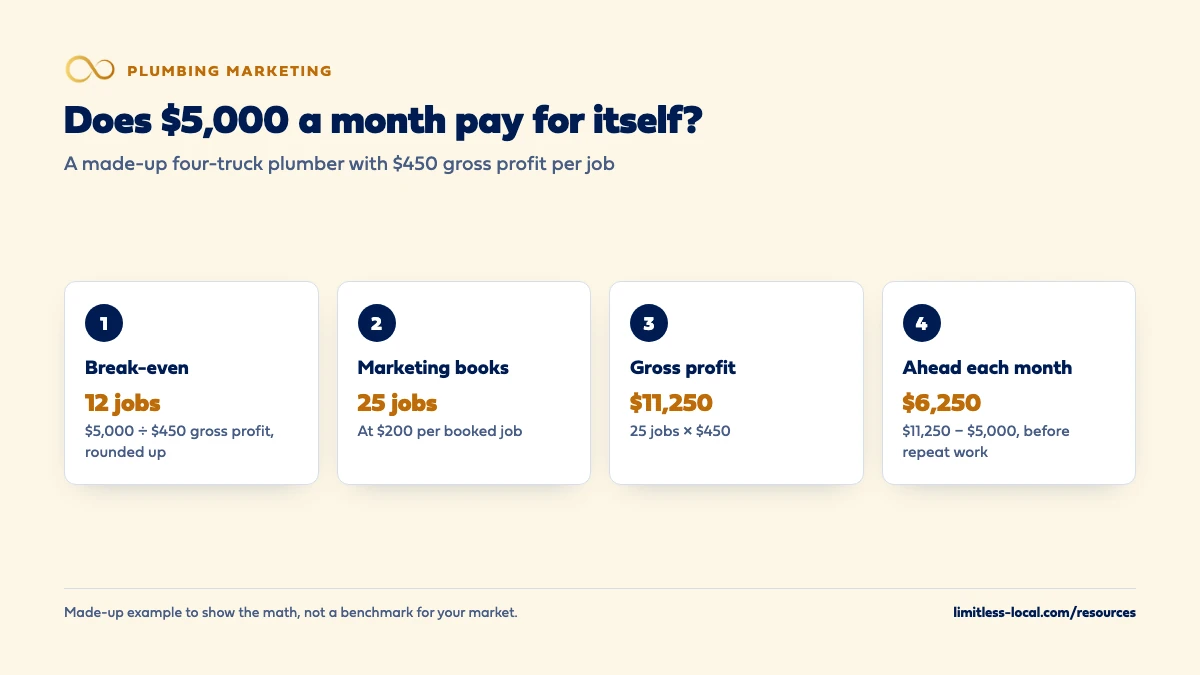
These numbers are made up to show the math, not a benchmark for your market. Say a four-truck plumbing company’s typical job leaves $450 of gross profit after parts and labor. The owner puts $5,000 a month into search ads, Local Services Ads and tracking, aimed at drains, water heaters and leak repairs in the towns closest to the shop.
- Break-even: $5,000 ÷ $450 is about 11.1, so 12 booked jobs a month.
- What the marketing books: say each booked job ends up costing $200. $5,000 ÷ $200 is 25 booked jobs.
- Gross profit from those jobs: 25 × $450 is $11,250.
- After paying for the marketing: $11,250 − $5,000 leaves $6,250 a month ahead, before repeat work and referrals.
25 extra jobs spread over four trucks is roughly six more each a month, which a busy shop has to have room for. Now flip it: if each booked job cost $625 instead, $5,000 books 8 jobs, worth $3,600 in gross profit, and the shop is $1,400 behind. Same budget, opposite answer. The number to watch is cost per booked job, and the fix is usually the targeting, the pages or the phones, not the budget.
Frequently asked questions
Is $5,000 a month enough for plumbing SEO on its own?
It can fund solid local SEO, but SEO typically takes 3-6 months to show meaningful growth, so spending all of it there leaves nothing to make the phone ring in the meantime. Most owners at this level keep part of it in ads while SEO builds.
Should a one-truck plumber spend $5,000 a month?
Usually not yet. One truck can only run so many extra jobs, and break-even at $5,000 can eat most of that room. Start smaller, prove what each booked job costs, and grow the budget with the crew.
Can I spend $5,000 only in busy months?
You can lower it in slow months, but stopping and restarting means rebuilding each time, and the Google profile and website work stalls while it’s off. A steady base with extra in peak season usually works better.
What should I track at $5,000 a month?
Calls and forms by source, which of them booked, what each booked job cost, and the revenue behind those jobs, by month. If your field software has a lead source field, fill it in on every job.
Should all $5,000 go to Local Services Ads?
Rarely. You pay per lead and can’t pick keywords, so one channel carries all the risk. Most plumbers do better pairing them with search ads aimed at the jobs they want most.
Key takeaways
- $5,000 a month breaks even at $5,000 divided by your gross profit per job; at $450 a job, that’s 12 extra booked jobs.
- Ask whether any $5,000 quote includes ad spend; it changes what the money buys.
- At this level, ads, Local Services Ads, your Google profile, pages and tracking can work together, not one at a time.
- It’s too much if the trucks are full, calls go unanswered or nothing is tracked.
- Judge it on cost per booked job after two to three months of tracked results.
Want a second set of eyes on your setup?
We'll look at how you show up locally and where calls are leaking, then send you a plain-English breakdown.
More in this section
- Is $500 a month too much for plumbing marketing?
- How much should a plumbing company spend on marketing each month?
- Is $2,500 a month enough to test plumbing Google Ads?
- How much does a plumbing marketing agency cost per month?
- How many hours a week should a plumber spend on marketing?
Sources
- How to Get the Most From Your Marketing Budget — U.S. Small Business Administration
- About average daily budgets — Google Ads Help
- Local Services Ads transition to Performance Max campaigns with pay-per-lead goals — Google Ads Help
- Set up an ad schedule — Google Ads Help
- How leads work — Google Local Services Help