
How many hours a week should a plumber spend on marketing?

- How much of an owner's week should plumbing marketing take?
- How many hours does plumbing marketing really need from the owner?
- Where should those hours go each week?
- What should I check monthly or quarterly instead of every week?
- Which marketing tasks can my techs and office take off my plate?
- Which marketing decisions should stay with me?
- How do I work out how much time I'm actually spending now?
- What is my marketing time worth?
- How do the hours change as my plumbing company grows?
- When should I hand the marketing hours to someone else?
- How much of my time does an agency still need?
- What happens to my marketing in a busy week when I have no time?
- What's different about marketing time for plumbing owners
- A worked example: what your marketing hours cost
- Frequently asked questions
- Key takeaways
- More in this section
- Sources
The short version
- About two to three hours a week covers the basics for most plumbing owners.
- Use a fixed weekly block, not whatever time is left after the last call.
- Techs and the office can own review requests, photos and lead-source tags.
- Past about five hours a week, hand off the management and keep the decisions.
For plumbing owners who do their own marketing between jobs and estimates, and want to know how much time is enough and where it should go.
Get a free visibility audit · Book a growth call
How much of an owner's week should plumbing marketing take?
Most plumbing owners can run the basics in about two to three hours a week: reviews and the Google profile, a check on ads and calls, and a look at which jobs came from where. Put those hours in a fixed weekly block, and hand the repeat tasks like review requests, job photos and lead-source tags to your techs and office. Once marketing is taking much more than about five hours of your week, your time is usually worth more on estimates and crews, and that’s the point to hand off the management and keep only the decisions.
If your marketing hours keep slipping, or keep growing, that’s the trade-off our packages are built around: your team spends a few hours getting us set up, and after that you read a monthly report and make the calls instead of running the accounts. See how that works for plumbing companies, or keep reading the plumbing marketing questions library.
How many hours does plumbing marketing really need from the owner?
It depends less on the size of your budget than on who else can help. A rough guide:
- You run the basics yourself, with some help from the office: about two to three hours a week.
- You also manage your own Google Ads or Local Services Ads: add an hour or two, more in the first months while you learn the account.
- Someone else runs it: about an hour a week reading the numbers, plus a longer monthly sit-down to decide where money and effort go next.
Below about an hour a week, things quietly stop: reviews stall, the Google profile goes stale, and nobody notices an ad wasting money. Above about five, the marketing is eating time that could go on estimates, hiring or the jobs themselves. For the time and money each channel needs on its own, see budget and time by plumbing marketing channel.
Where should those hours go each week?
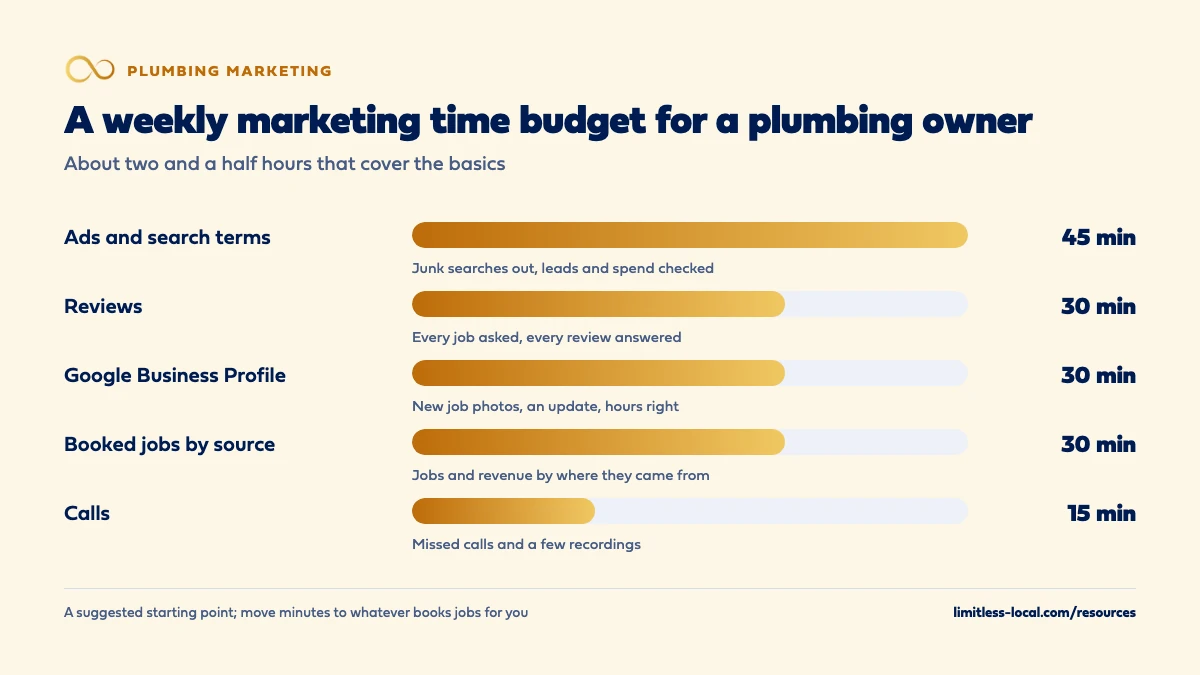
Here’s a weekly time budget that covers the basics in about two and a half hours. Treat it as a starting point and move minutes to whatever is booking jobs for you.
- Reviews (30 minutes). Check that every finished job got a review request, and reply to every new review. You can only reply once your Business Profile is verified (Manage customer reviews).
- Google Business Profile (30 minutes). Add a few new photos from real jobs, post an update, and check your hours and services are right.
- Ads (45 minutes). Look at what people actually searched before clicking your ads, which the search terms report shows, and add any junk searches as negatives (About the search terms report). Then glance at leads and spend.
- Booked jobs by source (30 minutes). Count booked jobs and revenue by where each customer came from. Field software can do the counting; Jobber’s lead source report, for example, tracks the number of leads and the revenue tied to them by marketing channel (Lead Source Report).
- Calls (15 minutes). Spot-check missed calls and a couple of recordings, if you record them.
Notice what isn’t on the list: scrolling social media, taking calls from ad sales reps and redesigning the logo. Those are where marketing hours usually leak.
What should I check monthly or quarterly instead of every week?
Some numbers move too slowly to read weekly. Once a month:
- Your Google profile’s performance. It shows views and interactions such as calls, website clicks, direction requests, messages and bookings, and the numbers include both organic results and Google Ads (Business Profile performance).
- Cost per booked job by channel. Spend divided by booked jobs, not leads.
- Budget moves. Shift money toward what booked jobs and away from what didn’t.
Once a quarter, step back: which job types and towns you want more of, whether your service pages match them, whether your offers still make sense, and whether you’re ready to add a channel or a truck. That quarterly hour is worth more than any single weekly task, because it decides where the next three months of effort go.
Which marketing tasks can my techs and office take off my plate?
Most of the repeat work. The owner’s hours should go on decisions, not on chores someone else can do in the moment.
- Review requests: the tech, at the end of every job. Google lets you create a review link or QR code to send or show customers (Create a Google link or QR code to request reviews). A text with the link before the truck leaves the driveway takes seconds.
- Job photos: the tech. Before-and-after shots of real work, sent to the office.
- Lead source on every job: the office. Ask every new caller how they found you and record it in your field software.
- Review replies and profile updates: the office manager, with a few rules from you on tone and what never to say.
For the tech side, getting your plumbing techs to ask for reviews covers scripts and habits that stick.
Which marketing decisions should stay with me?
Whoever does the work, these stay with the owner:
- Which jobs and towns you want more of. Nobody else knows which work pays and where your trucks should be.
- How much to spend, and where. Raising or cutting the budget is an owner call.
- Prices and offers. Discounts, financing and maintenance plans touch your margin.
- Whether a channel stays or goes. Based on cost per booked job, not on how busy the account looks.
- Who you hire to help, and whether they’re earning it.
If you only have one hour a week, spend it here. A well-run account pointed at the wrong jobs is still the wrong account.
Curious what your marketing is actually booking?
Get a free visibility audit — no obligation, no sales pitch.
How do I work out how much time I'm actually spending now?
Track it for two weeks instead of guessing. It’s easy to underestimate, because marketing time comes in scraps: a call from a directory sales rep, twenty minutes fixing the website at night, a half-hour arguing with an ad account on a Sunday.
- Keep a note on your phone and log every marketing task with its minutes, including calls with vendors and salespeople.
- Sort the entries into three piles: tasks that tie to booked jobs (reviews, ads, answering), upkeep (profile, photos, website fixes) and noise (sales calls, social scrolling, redoing things).
- Add up each pile.
The noise pile is usually the surprise, and the easiest to cut. If the useful piles still add up to more hours than you have, that’s your answer on whether to get help.
What is my marketing time worth?
Put a dollar value on an hour of your time and multiply. The real value isn’t your old wage as a tech. It’s what that hour would earn if you spent it on the work only you can do: running a big estimate, closing a repipe, training a new plumber or covering a call so a truck doesn’t sit.
Then compare. Two or three hours a week on the basics is usually worth it, because reviews and a current Google profile cost almost nothing else. Eight hours a week wrestling an ad account is a different story, because that’s a full working day lost every week, and a beginner can waste ad money on top of it. What you still pay for when you do plumbing marketing yourself lays out the money side of the same decision.
How do the hours change as my plumbing company grows?
One truck, owner on the tools. Keep it to the minimum that keeps the phone ringing: review requests on every job, a current Google profile and fast answering. That’s often an hour or two at night. Skip anything that needs daily attention.
Two to five trucks with an office manager. Hand the repeat tasks to the office and keep two to three hours a week for the checks and decisions. This is where a simple weekly routine pays off most.
Ten or more trucks. Marketing is someone’s job by now, in-house or an agency. Your part shrinks to about an hour a week on the numbers and a monthly meeting, but it never goes to zero, because the decisions are still yours.

When should I hand the marketing hours to someone else?
When the hours start costing you jobs. Signs it’s time:
- Your weekly marketing block keeps getting cancelled by work, and nothing has been checked in weeks.
- You’re spending more than five hours a week and still can’t tell which channel books jobs.
- The tasks that need training, like Google Ads structure, tracking and technical website work, are the ones eating your time.
You don’t have to hand over everything. For a small local business, Google’s own guidance on hiring an SEO says you can probably do much of the work yourself, and that a good time to hire is when you’re planning a site redesign (Do you need an SEO?). Many owners keep reviews and the profile in-house and hand off ads and the website. Which parts of plumbing marketing need an expert sorts the tasks.
How much of my time does an agency still need?
Less than doing it yourself, but not zero. Expect a few hours from you and your team at the start to hand over access, answer questions about your services, towns and prices, and agree on what counts as a booked job. After that, campaigns usually go live in the first week or two.
From then on, your part is the decisions: reading the monthly report, a strategy call (quarterly on our Essentials package, monthly on Growth), and telling the team when your capacity changes, such as a new truck, a tech out sick or a freeze on the way. The jobs that never leave your shop are answering the phone fast, asking for reviews and marking where each job came from, because no agency can do those from the outside.
What happens to my marketing in a busy week when I have no time?
Something will slip, so decide in advance what doesn’t. In a freeze week or a run of emergencies, keep three things going: answering every call, review requests on every job, and a quick look at ad spend so a budget doesn’t run away while you’re under a house. Everything else can wait a week.
Busy weeks are also when your best reviews come in, because you’re fixing real emergencies for grateful people. Don’t let the review requests be the thing you drop. If your capacity swings with the season, changing marketing spend with seasons and tech capacity covers how to turn the dial up and down.
Talk it through with someone who runs this every day
A 15-minute growth call: your market, your numbers, and what a realistic budget looks like. No pressure.
What's different about marketing time for plumbing owners
Emergencies wreck any fixed schedule. A burst pipe at 2 p.m. will eat your marketing hour. Book the block early in the day or early in the week, and have a backup slot, so one emergency doesn’t push it back a month.
Your best marketing happens on the job. A tech who explains the problem, cleans up and asks for a review does more for your reputation than an hour of posting. Training your plumbers to do that is marketing time well spent.
Big tickets need owner time. Water heater replacements, repipes and sewer lines are where an owner’s eye on pages, photos and follow-up pays off most. If you have one spare hour, spend it on the work that makes the biggest invoices, not on the drain-cleaning coupon.
A worked example: what your marketing hours cost
These numbers are made up to show the math, not a benchmark for your shop. A two-truck plumbing owner values an hour of their time at $120, which is roughly what that hour brings in when it’s spent on estimates and big jobs instead.
The basic routine: about two and a half hours a week on reviews, the Google profile, an ad check and booked jobs by source. That’s $300 a week, or $1,200 over a four-week month. Cheap for what it protects.
Running everything alone: 8 hours a week, mostly fighting a Google Ads account. That’s $960 a week, or $3,840 over a four-week month, before any ad money wasted while learning. For comparison, our Essentials package is $3,500 a month and includes Google Ads management up to $2,500 a month in ad spend, along with the Google profile, reviews, tracking and a monthly report; ad spend is paid to Google separately.
If you’re in the first situation, keep doing it yourself. If you’re in the second, the hours are already costing more than help would. A free visibility audit shows which tasks are worth your time in your market.
Frequently asked questions
Is it better to do marketing a little every day or in one weekly block?
One weekly block for the checks, plus the small daily habits that happen on the job, like review requests. Daily marketing sessions tend to get eaten by calls.
Should my office manager do the marketing?
They can own the repeat tasks: review replies, profile updates and lead-source tags. Ads and tracking need training, so only hand those over if they’re willing to learn properly.
How much time does social media need for a plumbing company?
Less than most owners give it. A few real job photos a week, shared to your Google profile and Facebook, is plenty unless you have proof that social is booking jobs.
Do I need to spend more time on marketing when I first start?
Yes, for the first couple of months. Setting up the Google profile, review habits, tracking and any ads takes more hours than keeping them running.
What's the one marketing task I should never skip?
Answering new calls fast. Every other task is wasted if the phone rings out when the customer finally calls.
Can I do all my plumbing marketing on my phone?
Most of the weekly tasks, yes: review replies, photos, profile updates and a quick ads check. Changes to ad campaigns and the website are easier and safer at a computer.
Key takeaways
- About two to three hours a week covers the basics for most plumbing owners.
- Spend them on reviews, the Google profile, an ads check and booked jobs by source.
- Hand repeat tasks to techs and the office; keep budget, prices and channel decisions yourself.
- Track your real hours for two weeks; the leaks are usually sales calls and redoing things.
- Past about five hours a week, your time is usually worth more on estimates and crews.
Ready to compare options?
Book a short growth call and we'll walk through the math for your service area, including when we're not the right fit.
More in this section
- What percentage of revenue should a plumber spend on marketing?
- How much should a plumbing company spend on marketing each month?
- How much budget and time does each plumbing marketing channel need?
- How much should I budget for marketing to start a plumbing company?
- What return should a plumber expect from a marketing agency?
Sources
- Manage customer reviews — Google Business Profile Help
- About the search terms report — Google Ads Help
- Understand your Business Profile performance & insights — Google Business Profile Help
- Create a Google link or QR code to request reviews — Google Business Profile Help
- Do you need an SEO? — Google Search Central
- Lead Source Report — Jobber Help Center