
How much budget and time does each plumbing marketing channel need?

- What monthly budget and owner time does each plumbing marketing channel really take?
- Why count time as well as money for each plumbing channel?
- Google Business Profile and reviews: what do they take?
- Local Services Ads: what budget and time do they need?
- Google search ads: what budget and time do they need?
- SEO and the website: what budget and time do they need?
- Referrals and repeat customers: what do they take?
- Direct mail and door hangers: what budget and time do they need?
- Facebook ads and paid lead sites: what do they take?
- What's the smallest budget that tells me anything?
- How long before I can judge each plumbing channel?
- How much of my own time can I give to marketing?
- What's different about channel budgets for plumbing companies
- A worked example: splitting $3,000 and four hours a week
- Frequently asked questions
- Key takeaways
- More in this section
- Sources
The short version
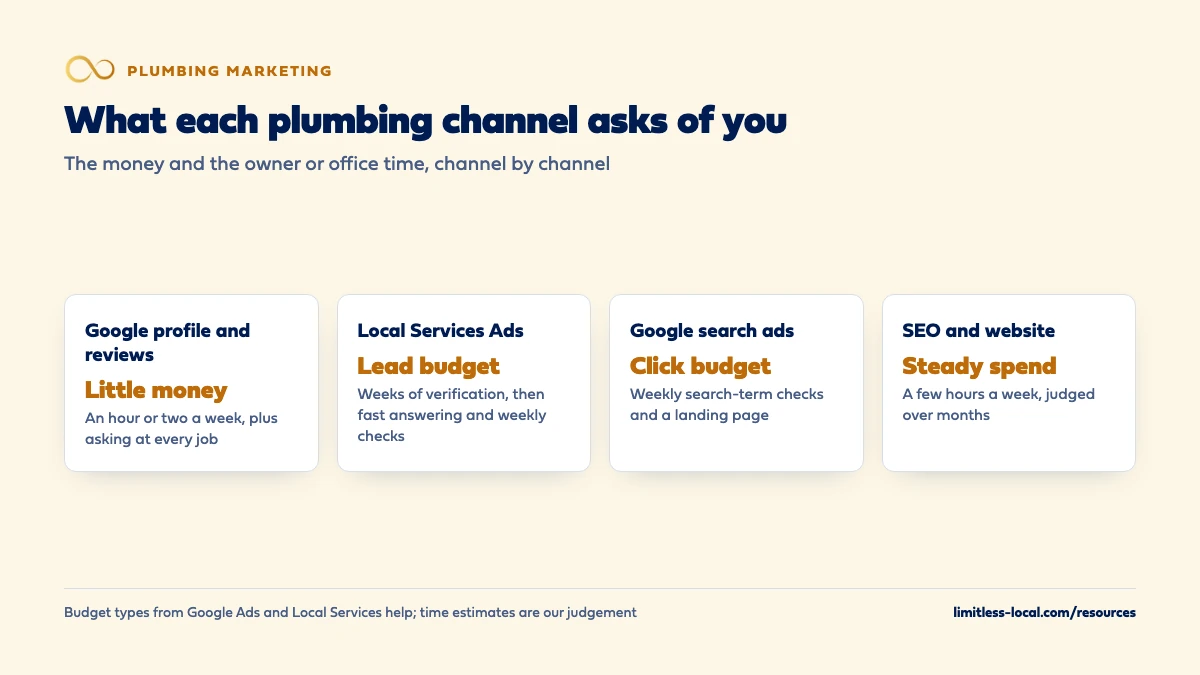
- Google profile and reviews: little money, steady weekly time.
- Local Services Ads and search ads: a budget sized to your local prices, plus fast answering and weekly checks.
- SEO and the website: steady money or hours, judged over months, not weeks.
- Fund fewer channels well rather than many thinly, and only the ones you can staff.
For plumbing owners deciding which channels they can afford, and staff, before they commit money to any of them.
Get a free visibility audit · Book a growth call
What monthly budget and owner time does each plumbing marketing channel really take?
Each channel asks for a different mix of money and time. Your Google Business Profile and reviews cost almost nothing but need an hour or two a week and a habit of asking at every job; Local Services Ads and Google search ads need a lead or click budget sized to your local prices plus someone answering fast and checking the account weekly; SEO needs steady monthly money or hours, and typically takes 3 to 6 months to show meaningful growth. Start with the channels you can both fund well and staff, because a channel with money but nobody to answer or manage it books few jobs.
Our packages take the management time off the owner: Essentials is $3,500 a month and includes Google Business Profile management, review response and Google Ads management for up to $2,500 a month in ad spend; Growth is $4,500 a month and adds Local Services Ads management and up to $5,000 in Google Ads spend. Ad spend is paid to Google separately. How that fits a plumbing shop is on our plumbing marketing page, and the plumbing marketing questions library covers each channel in more depth.
Why count time as well as money for each plumbing channel?
Because most channels fail for lack of time before they fail for lack of money. A Local Services Ads budget with nobody answering the phone pays for missed calls. A Google Ads account nobody checks keeps paying for the wrong searches. Reviews nobody asks for don’t come in.
So for each channel below there are two numbers to plan: what it costs each month, and whose hours it takes. The total monthly number, and how to work it backward from booked jobs, is covered in how much a plumbing company should spend on marketing. This page is about splitting that number, and your week, between channels.
Google Business Profile and reviews: what do they take?
Money: close to none. The profile is free, and so is asking for reviews.
Time: in our judgement, an hour or two a week from someone in the office, plus a few seconds at the end of every job. Google’s tips to get more reviews are to remind customers to leave one, using a Google link or a QR code, and to reply to reviews. It also warns that offering incentives, such as discounts, in exchange for reviews is treated as fake and misleading content. The weekly hour goes on replies, new photos of real jobs and keeping hours and services current.
Floor: there isn’t a money floor, but there is a habit floor. If nobody owns the job, it stops within a month.
Local Services Ads: what budget and time do they need?
Money: you pay for valid leads, and Google says lead prices may vary depending on your location, the job type, the type of lead and your bidding (How leads work). Until your account moves, you set an average weekly budget with a monthly maximum. Google is moving Local Services Ads into Google Ads, starting in August 2026 with plumbing among the first categories; after the move, the weekly budget is divided by 7 into a daily average, and monthly spend is capped at that daily budget times 30.4 (Google Ads Help).
Time: two kinds. Setup takes a while: Google says screening and verification takes 3–4 weeks on average after you submit your documents (Business screening and verification requirements). After that, the time is on the phone. A missed call during your business hours is a charged lead once the caller stays on the line more than 20 seconds, so someone has to answer every call and reply to messages quickly, and in our judgement someone should check the leads and their charge status every week.
Google search ads: what budget and time do they need?
Money: a click budget sized to your market. Keyword Planner shows a top-of-page bid range for each keyword, which Google describes as roughly the 20th to 80th percentile of what advertisers have historically paid, based on your location settings (About Keyword Planner forecasts). Look up the jobs you want, in the area your trucks cover. Google Ads then works on an average daily budget: your monthly number divided by 30.4. A busy day can spend up to twice that for most campaigns, but over a month you won’t be charged more than 30.4 times the daily budget.
Time: in our judgement, the most hands-on of the paid channels. Someone needs to check search terms and add negative keywords weekly, keep a landing page worth sending clicks to, and make sure calls from ads are tracked. How much a plumbing company should spend on Google Ads goes deeper on sizing the budget.
SEO and the website: what budget and time do they need?
Money: a website build is a one-time project; SEO is a steady monthly cost if you pay someone, or steady hours if you don’t. Google says that if you run a small local business, you can probably do much of the SEO work yourself, starting with its SEO starter guide (Do you need an SEO?).
Time: more patience than hours. Ads can generate leads within days of launch, but SEO typically takes 3 to 6 months to show meaningful organic growth. In our judgement, the weekly work is a few hours: a new or improved service or town page, fixing what’s broken, and adding real job photos. How long plumbing SEO takes to bring calls covers the ramp.
Floor: SEO started and stopped every few months rarely gets past the ramp. Fund it for at least six months or don’t start it yet.
Curious what your marketing is actually booking?
Get a free visibility audit — no obligation, no sales pitch.
Referrals and repeat customers: what do they take?
Money: very little. A reminder email, a postcard to past customers, or a thank-you to people who send you work.
Time: mostly habits, in our judgement: plumbers asking at the end of good jobs, the office sending reminders for water heater flushes or drain maintenance, and someone recording where each new customer came from. Your field software can usually send the reminders automatically once they’re set up.
The catch is that you can’t turn this channel up when the phone goes quiet. It grows slowly and steadily, which is why it sits next to the paid channels, not in place of them. Getting more repeat customers and referrals covers how to build it.
Direct mail and door hangers: what budget and time do they need?
Money: postage, printing and design, per drop. As one example, the USPS Every Door Direct Mail page listed EDDM Retail postage for marketing flats at $0.26 per piece when we checked; printing and design come on top.
Time: a few hours per drop to pick routes, approve the design and track results. Give each mailing its own phone number or offer code so you can tell what it booked.
Floor: in our judgement, one small drop tells you little. Plan several mailings to the same routes before judging, and pick routes in the towns you most want work from. Whether direct mail works for plumbing companies looks at when it pays.
Facebook ads and paid lead sites: what do they take?
Facebook and Instagram ads: a daily or lifetime budget you set, plus someone to make the ads and reply to messages. In our judgement, for most plumbing shops they work better reminding people who already know you than catching someone with a leak right now, so they come after search channels.
Lead-sharing sites: you pay per lead, and the time cost is speed. Those leads often go to more than one company, so in our judgement the shop that calls back first usually has the best chance. If nobody can call back within minutes during the day, the money tends to go to whoever can.

What's the smallest budget that tells me anything?
The one that produces enough leads in a month for you to judge cost per booked job. A rough way to set that floor for a paid channel, in our judgement:
- Decide how many leads you need to see before you’ll judge it. A handful won’t tell you much.
- Find what a lead or click costs in your area, from Keyword Planner’s bid range for search ads or your first weeks of Local Services Ads charges.
- Multiply. That’s the least a month of testing has to cost.
If the result is more than you can spend, run one channel in your best town for your best job type rather than everything everywhere. A budget split too thinly across channels can leave each one producing too few leads to judge.
How long before I can judge each plumbing channel?
- Google search ads: leads can start within days; in our judgement, give them a few weeks of steady spend before you decide.
- Local Services Ads: add the 3–4 weeks of verification on average, then a few weeks of leads.
- SEO and the website: typically 3 to 6 months to show meaningful growth.
- Google profile and reviews: months, building steadily.
- Direct mail: several drops, in our judgement.
- Referrals: a year or more to see the habit pay off fully.
Judge every one of them on booked jobs and cost per booked job, not clicks or calls.
How much of my own time can I give to marketing?
Be honest about it, because it decides the plan. In our judgement, an owner who can give two or three hours a week can run reviews and the Google profile plus one paid channel, if someone else answers the phone. An owner with less time than that should pick the channel with the least ongoing management, or hand the management to someone else and spend the hours on checking results.
Hiring a plumbing marketing agency or doing it yourself lays out that trade-off. Whoever runs it, the owner’s job doesn’t go away: reading the monthly numbers and deciding where the money goes next.
Not sure which of these is costing you jobs?
A free visibility audit checks the Google profile, reviews, site and tracking, and shows what to fix first.
What's different about channel budgets for plumbing companies
The phone is part of every paid channel’s budget. Plumbing calls are often urgent, and on Local Services Ads a missed call during business hours can still be charged. Money spent on answering, or on an after-hours plan, can lower cost per booked job as much as a cheaper lead would.
Emergency and planned work need separate budgets. A drain emergency and a water heater replacement have very different values. In our judgement, giving them separate campaigns or job types lets a slow week for one not starve the other.
Freezes and storms move the time demands. A cold snap can bring a week of burst-pipe calls. Plan for the office time those weeks take, and expect paid budgets to run out faster when demand spikes.
A worked example: splitting $3,000 and four hours a week
These numbers are made up to show the math, not a benchmark for your market. Say an owner has $3,000 a month and about four hours a week for marketing, and the office answers the phone.
- Google profile and reviews: no ad spend; an hour a week of the owner’s or office’s time.
- Local Services Ads: $1,500 a month in lead budget; half an hour a week checking leads.
- Google search ads for water heater replacements only: $1,200 a month, or about $39 a day ($1,200 divided by 30.4); an hour and a half a week on search terms and the landing page.
- Call tracking and a review request tool: $300 a month; the last hour goes on reading the numbers.
SEO waits until there’s room in the budget or the week. On these numbers a full agency package doesn’t fit: our Essentials package alone is $3,500 a month before ad spend. The honest move at this size is to run it in-house, keep it tight and measure cost per booked job. A free visibility audit is a simple way to check your own split.
Frequently asked questions
Which plumbing channel needs the least of my time?
In our judgement, Local Services Ads, once they’re verified, because you choose job types and service areas rather than managing keywords. But they need the most from whoever answers the phone, since missed calls during business hours can still be charged.
Can I run Google Ads with a small daily budget?
Yes. Google says you choose an average daily budget based on your goals and what you’re comfortable spending each day. The question is whether it buys enough clicks, at your local prices, to produce leads you can judge. Keyword Planner’s bid range for your area shows roughly what a click costs.
Is it better to spread my budget across channels or focus it?
Focus it until one channel is booking jobs at a cost you’re happy with, then add the next. A budget split too thinly can leave every channel without enough leads to judge.
Do I need to budget for a website before ads?
You need a page worth sending search ad clicks to. Local Services Ads leads come in as calls, messages and bookings through Google (How leads work), so in our judgement they can run first, but a weak site still costs you customers who check you out before calling.
How much office time does more marketing create?
More calls, more messages and more follow-up. In our judgement, every step up in paid budget should come with a check that the office can answer and book the extra calls.
Should I pay for SEO if I can only afford it for two months?
Usually not yet. SEO typically takes 3 to 6 months to show meaningful growth, so a short burst rarely gets past the ramp. Put that money into one paid channel and the free Google profile and review work instead.
Key takeaways
- Every channel takes money and time; plan both before starting one.
- Google profile and reviews cost little money but need weekly time and a review habit at every job.
- Local Services Ads and search ads need budgets sized to your local prices plus fast answering and weekly checks.
- SEO needs steady money or hours and typically takes 3 to 6 months before you can judge it.
- A budget too small or too thinly spread to produce leads you can judge is the most expensive kind.
Want a second set of eyes on your setup?
We'll look at how you show up locally and where calls are leaking, then send you a plain-English breakdown.
More in this section
- How much should a plumbing company spend on marketing each month?
- How much does a plumbing marketing agency cost per month?
- What should a complete plumbing marketing plan include?
- When should a plumbing company raise or cut its marketing budget?
- Should I hire a plumbing marketing agency or do it myself?
Sources
- About average daily budgets — Google Ads Help
- About Keyword Planner forecasts — Google Ads Help
- How leads work — Google Local Services Help
- Local Services Ads transition to Performance Max campaigns with pay-per-lead goals — Google Ads Help
- Business screening and verification requirements – United States — Google Local Services Help
- Do you need an SEO? — Google Search Central
- Tips to get more reviews — Google Business Profile Help
- Every Door Direct Mail (EDDM) — USPS