
What should a complete plumbing marketing plan include?

- How do I put together a marketing plan for my plumbing business?
- What goes into a plumbing marketing plan?
- How do I set goals for a plumbing marketing plan?
- Which foundations should come before spending on ads?
- Which channels should a plumbing marketing plan use?
- In what order should a plumber turn the channels on?
- How should a plumbing marketing budget be split?
- How does answering the phone fit into a marketing plan?
- How should the plan handle busy and slow seasons?
- How often should I review my plumbing marketing plan?
- What numbers should a plumbing marketing plan track?
- What are the most common gaps in a plumbing marketing plan?
- What's different about marketing plans for plumbing companies
- A worked example: turning a goal into a monthly plan
- Frequently asked questions
- Key takeaways
- More in this section
- Sources
The short version
- Start from the jobs you want and what one booked job is worth to you.
- Foundations first: Google profile, website, reviews and call tracking.
- Run paid search for calls now while SEO builds over months.
- Answer every call, and review the numbers monthly and the plan quarterly.
For plumbing owners who want one plan instead of a pile of channels: what goes in it, in what order, how the budget splits, and how often to review it.
Get a free visibility audit · Book a growth call
How do I put together a marketing plan for my plumbing business?
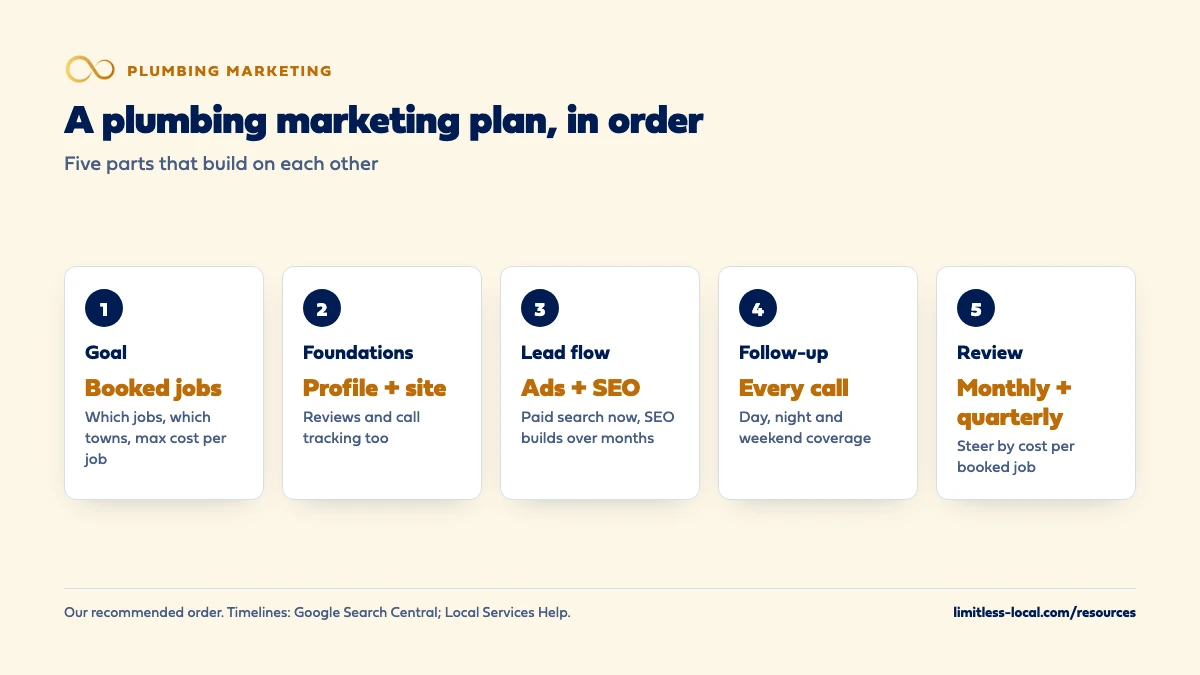
A complete plumbing marketing plan starts with the jobs you want more of and what you can afford to pay to book one, then covers the foundations (a complete Google Business Profile, a website with a page for each main service, steady reviews and call tracking), the channels that bring calls (paid search for calls now and SEO that builds over months), and how every call gets answered and followed up. It sets a monthly budget split between ad spend and the work to run it, and a review rhythm, monthly for spend and quarterly for the plan, judged on cost per booked job.
Our marketing packages follow the same order: build the foundation, turn on lead flow, then improve every month based on calls, leads and revenue. It’s how we approach plumbing marketing. The plumbing marketing questions library has a page for each channel in the plan.
What goes into a plumbing marketing plan?
The SBA describes a marketing plan as something that can persuade customers to buy your products and services (U.S. Small Business Administration). For a plumbing company, in our judgement, a complete plan answers six questions on a page or two:
- Which jobs do we want more of, and in which towns?
- What can we afford to pay to book one of those jobs?
- Are the foundations in place: Google profile, website, reviews, tracking?
- Which channels bring the calls, now and over the next year?
- Who answers every call and follows up every request?
- How much do we spend each month, and when do we review it?
Anything that doesn’t serve one of those answers is a distraction.
How do I set goals for a plumbing marketing plan?
Set goals in booked jobs, not clicks or leads. In our judgement, a useful goal names the job, the place and the number: more water heater replacements in two specific towns, more drain and sewer work, or more maintenance memberships. Then work out the most you can pay to win one of those jobs from its average ticket and your margin.
Different jobs get different ceilings. A sewer line replacement can carry a far higher marketing cost than a faucet repair, and the plan should say so.
Which foundations should come before spending on ads?
In our judgement, four things come first because every channel leans on them:
- Google Business Profile: verified, with honest categories, services, hours and service area. Google says local results are mainly based on relevance, distance and popularity (Google Business Profile Help).
- Website: a page for each main job and an emergency page if you take urgent calls.
- Reviews: a request after every completed job.
- Tracking: call tracking and tagged form leads, so you know which channel booked which job.
Skipping these makes every ad dollar work harder than it should. Tracking which marketing books jobs covers the last one, which owners most often skip.
Which channels should a plumbing marketing plan use?
Most plumbing plans rest on the same core: your Google profile and reviews, Local Services Ads, Google search ads, and SEO for your website. After that come repeat and referral work, and in some markets direct mail, Facebook or lead platforms. Where plumbing leads come from compares the channels one by one.
In our judgement, add channels one at a time and only once you can measure them. Five channels at once, none tracked, is how owners end up unsure what’s working.
In what order should a plumber turn the channels on?
In our judgement, the usual order is: foundations first, then paid search for calls now, with SEO started at the same time because it ramps slowly. Ads can bring calls within days of launch, while SEO typically takes 3 to 6 months to show meaningful organic growth.
For Local Services Ads, start Google’s screening early: Google says it takes 3 to 4 weeks on average after you submit your documents, and recommends starting as soon as possible after creating your account (Local Services Help). Local Services Ads are also moving into Google Ads as Performance Max campaigns with pay-per-lead goals, still showing on Google Search and Maps (Google Ads Help). LSAs, Google Ads or SEO first goes through which paid channel to lead with.
Curious what your marketing is actually booking?
Get a free visibility audit — no obligation, no sales pitch.
How should a plumbing marketing budget be split?
Split the monthly budget into two parts: ad spend, paid to Google or Meta, and the cost of running it, whether that’s your time, software or someone you pay. In our judgement, early in a plan most money goes to paid search and the foundations, and the share for SEO and content grows once tracking shows which jobs come from where.
Set the total from your goal, not a percentage of revenue: the jobs you want times what you can pay for each. How much to spend on marketing walks through that math in detail.
How does answering the phone fit into a marketing plan?
It’s part of the plan, not an afterthought. Many plumbing calls are urgent, and in our judgement a caller who reaches voicemail often calls the next plumber. The plan should say who answers during the day, what happens after hours and on weekends, and how fast web requests get a call back.
A plan that doubles leads but misses a third of calls has a hole in it. Stopping lost after-hours calls covers the options.
How should the plan handle busy and slow seasons?
In our judgement, a plumbing plan should expect swings: freeze emergencies in cold snaps, water heater failures when the weather turns, and quieter stretches between. Plan to raise ad budgets when demand spikes and calls are profitable, and use slow months for maintenance memberships, past-customer outreach and work on the website.
Keeping calls coming in slow months covers the quieter stretches.

How often should I review my plumbing marketing plan?
In our judgement, look at spend, calls and booked jobs monthly, and revisit the plan itself quarterly: which jobs to push, which towns to add, which channels to cut. Google’s Search Console Performance report shows clicks, impressions and the search queries that show your site (Search Console Help), which helps judge the SEO side between reviews.
Give each change time to show results before you judge it. Google says some website changes take effect in a few hours and others could take several months (Google Search Central).
What numbers should a plumbing marketing plan track?
In our judgement, five numbers tell you whether the plan is working:
- Calls and form requests, by source.
- The share of those that became booked jobs.
- Cost per booked job, by channel.
- Revenue from those jobs.
- Missed calls and slow follow-ups.
Cost per booked job is the one to steer by. A channel with cheap leads that rarely book can cost more per job than one with expensive leads that usually do.
What are the most common gaps in a plumbing marketing plan?
In our judgement, the most common gaps are: no tracking, so nobody knows which channel booked which job; ads sent to a home page instead of the page for the job; reviews requested only now and then; no plan for after-hours calls; and SEO started and stopped before it had time to ramp.
None of these needs more money to fix. They need the plan to say who owns each one.
Not sure which of these is costing you jobs?
A free visibility audit checks the Google profile, reviews, site and tracking, and shows what to fix first.
What's different about marketing plans for plumbing companies
Emergencies and planned work need different channels. In our judgement, emergency calls lean on paid search, the map pack and fast answering, while water heaters, repipes and sewer replacements reward pages that answer questions, reviews and follow-up over days or weeks. A good plumbing plan budgets for both.
After-hours coverage is a marketing decision. If your ads run at night but nobody answers, you’re paying for calls you can’t take. The plan should match ad schedules to the hours someone picks up.
Repeat customers are cheap jobs. Plumbing customers need you again: drain maintenance, water heater service, the next leak. In our judgement, memberships and past-customer reminders belong in the plan from the start.
A worked example: turning a goal into a monthly plan
These numbers are made up to show the math, not a benchmark. Say a plumbing company wants a made-up 20 more booked jobs a month and decides it can pay a made-up $150 in marketing to book an average job.
- Monthly ceiling: 20 × $150 = $3,000.
- Split: a made-up $1,800 in ad spend paid to Google, and the remaining $1,200 for running it, tools and reviews.
- Monthly check: if tracking shows jobs booking under $150 each, raise the budget; if they’re booking above it, fix the pages and follow-up before spending more.
For context, our Essentials package is $3,500 a month and manages up to $2,500 a month in Google Ads spend; Growth is $4,500 a month and adds Local Services Ads management with up to $5,000 a month in Google Ads spend. Ad spend is paid directly to Google and isn’t included in either.
Frequently asked questions
Do I need a written marketing plan for a small plumbing company?
A page or two is enough. In our judgement, writing down the jobs you want, the budget and the review dates keeps you from chasing every new channel a salesperson pitches.
Should a new plumbing company's plan look different?
Yes. In our judgement, a new company leans harder on people who already know it, the Google profile and reviews, and adds paid search once someone can answer every call.
Is social media part of a plumbing marketing plan?
It can be, mostly for referrals, photos and reminders. In our judgement, it rarely belongs at the center of a plumbing plan, which runs on Google search and Maps.
How do I market a plumbing business with almost no budget?
Start with the free foundations: a complete Google Business Profile, a review request after every job, and outreach to past customers and local businesses that need a plumber.
Should I hire an agency or run the plan myself?
It depends on your time and how many channels you run. In our judgement, whoever runs it should report cost per booked job, not just clicks and leads.
Key takeaways
- Start the plan from the jobs you want and what one booked job is worth.
- Build the foundations before spending on ads: profile, website, reviews, tracking.
- Run paid search for calls now and start SEO at the same time.
- Make answering every call, day and night, part of the plan.
- Review spend monthly and the plan quarterly, steering by cost per booked job.
Want a second set of eyes on your setup?
We'll look at how you show up locally and where calls are leaking, then send you a plain-English breakdown.
More in this section
- What makes a good plumbing marketing company?
- What should I look for in a plumbing marketing agency contract?
- What should a plumbing company website include?
- How much should a plumbing company spend on marketing each month?
- How should a plumbing company market to commercial customers?
Sources
- Marketing and sales — U.S. Small Business Administration
- Tips to improve your local ranking on Google — Google Business Profile Help
- Business screening and verification requirements – United States — Local Services Help
- Local Services Ads transition to Performance Max campaigns with pay-per-lead goals — Google Ads Help
- Performance report (Search results): Overview and basic setup — Search Console Help
- SEO Starter Guide: The Basics — Google Search Central