
Should plumbing marketing spend change with seasons and tech capacity?

- How should a plumbing marketing budget change with the seasons, open tech hours and new service areas?
- What should decide my plumbing marketing spend each month?
- How do I measure open tech capacity?
- Which plumbing marketing should stay steady all year?
- Which plumbing marketing can flex with the seasons?
- When are a plumbing company's busy and slow seasons?
- What happens when I change my Google Ads budget?
- How should Local Services Ads change with my crew's capacity?
- Should I cut ads or schedule them around my crew?
- How should spend change when I hire another plumber?
- How should spend change when I add a new town or service area?
- What should I do when the schedule is already full?
- What's different about flexing spend for plumbing companies
- A worked example: matching ad spend to open hours
- Frequently asked questions
- Key takeaways
- More in this section
- Sources
The short version
- Let open tech hours set the budget, not the calendar alone.
- Keep SEO, your Google profile, reviews and emergency ads steady all year.
- Flex Google Ads and Local Services Ads week to week.
- Raise spend in steps when you add a plumber or a town.
For plumbing owners whose schedule swings from slammed to slow, and who want a simple rule for when to turn marketing up and when to ease off.
Get a free visibility audit · Book a growth call
How should a plumbing marketing budget change with the seasons, open tech hours and new service areas?
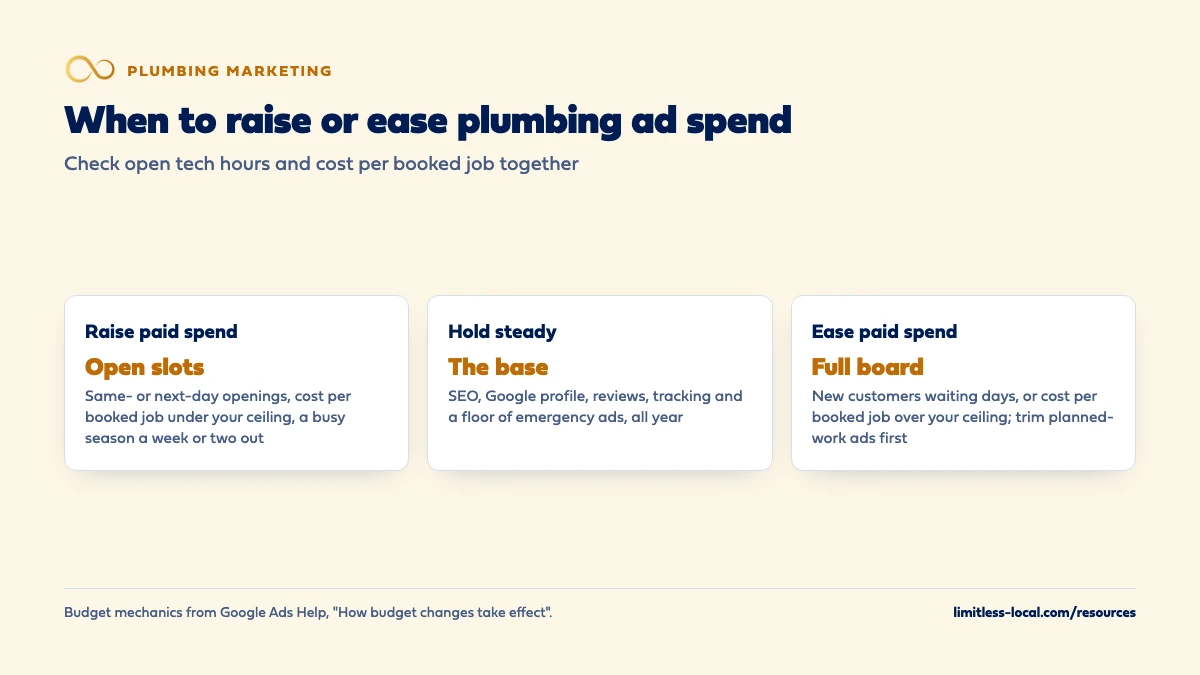
Yes, but let open tech hours lead and the calendar follow. Raise paid spend ahead of your busy seasons and whenever your plumbers have empty slots, and ease it back when new customers are already waiting days for an appointment. Keep a steady base under SEO, your Google profile, reviews and emergency ads all year, and flex the paid part, mostly Google Ads and Local Services Ads, week to week. When you add a plumber or a town, raise spend in steps and check cost per booked job before each next step.
Flexing spend like this only works when someone is watching calls, booked jobs and the schedule together, which is how every one of our Limitless Engine packages runs: build the foundation, turn on lead flow with local SEO and ads, then improve month by month based on calls, leads and revenue. Ad spend is never included in a package; you pay it to Google directly, and we recommend a budget after a quick audit. See how it fits plumbing companies, or browse more plumbing marketing questions.
What should decide my plumbing marketing spend each month?
Three things, checked together:
- Open capacity. How many hours your plumbers have that aren’t already booked over the next week or two.
- Demand. How many people are searching for plumbing help in your area right now, which swings with weather, holidays and the season.
- Cost per booked job. What each channel is costing you per job, compared with the most you can afford to pay.
Most owners only look at the second one, so they spend hardest when the phone is already ringing and the crew is already full. That’s backwards. Paying for calls you can’t run in a reasonable time wastes the money and annoys the customer, who calls the next plumber anyway.
The rule that follows: spend more when you have open slots and the cost per booked job is under your ceiling. Spend less when the schedule is full or the cost per job climbs past it.
How do I measure open tech capacity?
You don’t need a fancy report. Once a week, look at your dispatch board or field software for the next five working days and answer two questions:
- How many tech hours are open? Total hours your plumbers are scheduled to work, minus hours already booked.
- How soon can a new customer get a non-emergency appointment? If the answer is same day or next day, you have room. If it’s three or four days out, you’re close to full.
Track those two numbers every week next to your calls and booked jobs. After a couple of months you’ll see your own pattern: which weeks fill on their own, and which need a push.
If you’re full most weeks and turning work away, the question isn’t marketing spend at all; it’s whether to hire. Whether to market harder before or after hiring another plumber covers that decision.
Which plumbing marketing should stay steady all year?
Anything that builds slowly should never ride the seasons:
- SEO and your website. SEO typically takes 3 to 6 months to show meaningful organic growth. Stop and start it with the seasons and you keep paying for the ramp without reaching the payoff.
- Your Google Business Profile. Posts, photos and review replies keep going, busy or slow.
- Review requests after every job. Busy months are when you finish the most jobs, so they’re your best review months.
- Call tracking and reporting. You need them most when you’re changing budgets.
- A base level of emergency ads. Burst pipes and backups don’t follow a calendar, and those calls are among your best-paying work.
This base is your floor. The flexing happens on top of it. For why SEO can’t be switched on for a slow month, see why plumbing SEO takes months when you need jobs this month.
Which plumbing marketing can flex with the seasons?
The paid channels that can be turned up or down within days:
- Google Ads search campaigns, especially for planned work like water heaters, repipes and fixture installs.
- Local Services Ads, through the daily budget or by pausing.
- Paid lead services, if you use them.
- Mailers and past-customer offers, which you can time to land in slow weeks.
A useful split: keep emergency campaigns on all year and change their budget with demand, and treat planned-work campaigns as the lever for filling slow weeks. A homeowner can wait two weeks for a tankless upgrade; they can’t wait two weeks for a sewer backup. So when the crew is full, planned-work ads are the first to come down, and when it’s quiet, they’re the first to go up.
When are a plumbing company's busy and slow seasons?
It depends on where you work, so your own job history is a better guide than any national chart. Pull booked jobs by month for the last two years from your field software and mark the peaks and dips.
Patterns plumbers commonly see:
- Freezes bring burst and frozen pipes, often in a rush after the first hard cold snap.
- Holidays bring drain and disposal calls when houses fill with guests.
- Heavy rain brings sump pump and backup calls.
- Quiet stretches are when planned work, maintenance memberships and commercial customers keep the trucks moving.
Once you know your pattern, set budget changes a week or two ahead of each peak, not after the phones start ringing. How plumbers should prepare their marketing for a winter freeze has the freeze checklist, and keeping plumbing calls coming in during slow months covers the quiet side.
Curious what your marketing is actually booking?
Get a free visibility audit — no obligation, no sales pitch.
What happens when I change my Google Ads budget?
Budget changes take effect right away, and Google’s page on how budget changes take effect spells out the limits:
- On most campaigns, you’ll never be charged more than 2 times your highest average daily budget on a given day, so busy days can run over your daily number.
- A month’s spending is capped at your average daily budget times 30.4, the average number of days in a month.
- After a mid-month change, the rest of the month won’t go past your new daily budget times the days left.
That means you can move budgets week to week without surprises at the end of the month. What it doesn’t do is read the weather. Google also offers seasonality adjustments for Smart Bidding, but they’re meant only for expected major changes in conversion rates, they suit short events of one to seven days, and Smart Bidding already manages seasonal events. For most plumbers, raising the budget a few days before a forecast freeze does the job.
How should Local Services Ads change with my crew's capacity?
Plumbing is one of the first categories in Google’s move of Local Services Ads into Google Ads, which began for select advertisers in August 2026. Once your account moves, your weekly budget becomes a daily average budget, and monthly spend is capped at that daily average times 30.4. You can pause the campaign when you can’t take leads and turn it back on when you can, and your service areas and ad schedules can be set separately from your Google Business Profile.
Google’s own ad scheduling guidance suggests running your ads when you can respond to customer calls in a timely manner. That’s the right lens for capacity, too. If every lead that comes in this week will wait four days for a visit, pausing or trimming the budget for a week costs you less than the bad reviews and missed bookings from leads you can’t serve.
One caution if your account has just moved: allow up to two weeks for the campaign to settle after the migration, so avoid big budget swings in that window.
Should I cut ads or schedule them around my crew?
Often scheduling is the better tool. With a Google Ads ad schedule, your ads only show during the days and times you set, and you can create up to six schedules per day for each campaign.
Ways plumbers use it:
- Emergency campaigns run whenever someone actually answers, including nights if you have an on-call plumber.
- Planned-work campaigns run during office hours, when someone can quote and book.
- Busy weeks: trim planned-work hours instead of turning everything off.
The schedule report also shows clicks and cost by day and hour, which tells you when your best calls come in. Match the schedule to who’s answering, then adjust the budget to how many jobs you can take.

How should spend change when I hire another plumber?
A new plumber adds a week of open hours you need to fill. Work out roughly how many extra jobs a week that is, multiply by your current cost per booked job from each channel, and that’s the extra spend it could take to fill the schedule from ads alone.
Then raise it in steps rather than all at once:
- Start a step up a week or two before the new plumber’s start date, so calls are there on day one.
- Hold each step for at least two weeks and check cost per booked job before the next one.
- Lean on planned work first, because it can be booked into the new plumber’s open days.
- Watch for the point where more spend stops bringing more booked jobs at a cost you can afford. That’s your ceiling for now.
Repeat customers, referrals and your Google profile will usually fill part of the new hours over time, so ad spend for a new hire often comes back down once those catch up.
How should spend change when I add a new town or service area?
Treat a new area like a new channel: separate budget, separate tracking, separate verdict. In Google Ads, you can target geographic locations so ads reach people in, regularly in, or who’ve shown interest in an area, and Google may also show ads in nearby related areas. Putting a new town in its own campaign or location group lets you see its cost per booked job on its own.
Alongside the ads:
- Add the town to your Google profile’s service area only if your trucks will really go there.
- Build a useful page for the town on your website.
- Ask for reviews from your first jobs there.
Expect the first weeks in a new area to cost more per job than your home turf, because nobody knows you yet. Give it a fair run before judging. Which towns a plumber should target first helps you pick the order.
What should I do when the schedule is already full?
Don’t switch everything off. Ease the paid side down and keep the base running:
- Trim planned-work ad budgets or hours first.
- Keep emergency ads on, at a level your on-call setup can handle.
- Keep collecting reviews and posting on your profile.
- Keep a list of planned-work leads to call back when the rush ends.
Then raise spend again as soon as next week’s board shows open hours. Full schedules don’t last, and the owners who keep a steady base come out of the rush with more reviews and better rankings than the ones who went dark. For signs that a budget needs a bigger reset, see when a plumbing company should raise or cut its marketing budget.
Not sure which of these is costing you jobs?
A free visibility audit checks the Google profile, reviews, site and tracking, and shows what to fix first.
What's different about flexing spend for plumbing companies
Emergencies peak when you’re busiest. A freeze fills the board and floods the phone at the same moment. Plan who answers and how emergency calls get triaged before the cold snap, not during it.
Planned work is your shock absorber. Water heaters, repipes, fixture swaps and softeners can be booked into next week. That makes planned-work campaigns the right lever to raise in quiet weeks and lower in rushes.
On-call capacity counts. If you run nights or weekends, night ad spend should match how many night calls your on-call plumber can actually take.
Memberships fill slow weeks. Tune-ups and inspections for maintenance members can be scheduled into dips, which means less paid marketing is needed to keep the trucks moving then.
A worked example: matching ad spend to open hours
These numbers are made up to show the math, not a benchmark for your market. Say you have three plumbers working 40 hours each, so 120 tech hours a week. With drive time, an average job takes about two and a half hours, so you can run about 48 jobs a week.
Repeat customers, members and referrals usually fill around 30 of those. That leaves 18 open slots. Your Google profile and website bring in about 8 new jobs a week, so ads need to fill about 10. If Google Ads books plumbing jobs for you at $150 each, that’s about $1,500 a week in ad spend.
Now you hire a fourth plumber: another 40 hours, or about 16 more job slots. Filling all of them from ads at $150 would be $2,400 more a week. Instead, you raise spend by $1,200 a week for two weeks, check that cost per booked job is still near $150, then add the rest. In a freeze week, when emergency calls fill the board on their own, you’d pull the planned-work part back down.
Frequently asked questions
Should I pause all my ads in a slow month?
Usually not. Slow months are when you have the most open hours, so they’re often the time to push planned work. Lower spend only if cost per booked job is over what you can afford.
How far ahead of a freeze should I raise my budget?
A few days ahead of a forecast hard freeze is usually enough for search ads, since budget changes apply right away. Make sure the phones are covered first.
Does pausing Google Ads hurt my campaigns?
Pausing stops your ads from showing and you can turn them back on later. Pausing often makes results harder to read, so lowering the budget or trimming the schedule is usually the gentler move.
Should SEO spend go up in the busy season?
No. SEO works on a months-long ramp, so keep it steady. Busy-season changes belong on the paid side.
What if I'm full every week of the year?
Then marketing spend isn’t your bottleneck; capacity is. Look at hiring, raising prices on low-margin work, or shifting your mix toward bigger jobs before adding spend.
Can an agency change my budgets week to week?
It can, if it can see your schedule and booked jobs. Agree up front on who decides and how fast changes are made, especially before a forecast freeze.
Key takeaways
- Let open tech hours and cost per booked job decide paid spend, with the calendar as a guide.
- Keep SEO, your Google profile, reviews, tracking and a base of emergency ads steady all year.
- Use planned-work campaigns as the lever: up in quiet weeks, down in rushes.
- Raise budgets a few days before a busy spell, not after the phones are already ringing.
- When you add a plumber or a town, raise spend in steps and check cost per booked job before each step.
Want a second set of eyes on your setup?
We'll look at how you show up locally and where calls are leaking, then send you a plain-English breakdown.
More in this section
- When should a plumbing company raise or cut its marketing budget?
- How do I turn plumbing marketing spend into more revenue?
- How much budget and time does each plumbing marketing channel need?
- How much should a plumbing company spend on marketing each month?
- How long until plumbing marketing hits a profitable cost per job?
Sources
- How budget changes take effect — Google Ads Help
- About seasonality adjustments — Google Ads Help
- Local Services Ads transition to Performance Max campaigns with pay-per-lead goals — Google Ads Help
- About ad scheduling — Local Services Help
- Set up an ad schedule — Google Ads Help
- About targeting geographic locations — Google Ads Help