
How do I turn plumbing marketing spend into more revenue?

- How do I get more revenue out of the plumbing marketing budget I already spend?
- Where does plumbing marketing money leak before it becomes revenue?
- Why is answering every call the first lever?
- How do I book more of the calls I already get?
- How much revenue is sitting in open plumbing estimates?
- How does job mix change what my marketing earns?
- Should I raise ticket size instead of buying more leads?
- How do repeat customers and referrals stretch my marketing spend?
- How do I know which marketing channel actually makes money?
- Can Google Ads learn which plumbing calls are worth more?
- When should I spend more, and when should I fix the leaks first?
- What's different about turning plumbing marketing into revenue
- A worked example: more revenue from the same $3,000
- Frequently asked questions
- Key takeaways
- More in this section
- Sources
The short version
- Revenue from marketing is calls, times the share you answer, times the share you book, times the ticket, plus repeat work.
- Answering, booking and estimate follow-up usually add revenue faster than a bigger budget.
- Aim your marketing at higher-value jobs like water heaters, repipes and sewer lines.
- Track revenue by source and judge each channel on what it books, not what it costs per lead.
For plumbing owners who are paying for calls already and want more booked jobs and bigger tickets out of the same budget before they spend more.
Get a free visibility audit · Book a growth call
How do I get more revenue out of the plumbing marketing budget I already spend?
Fix what happens after the phone rings before you buy more calls: answer every call fast, book more of the calls you answer, follow up on every open estimate, point your marketing at the jobs worth the most to you, and bring past customers back. Each of those multiplies the revenue from the same spend, while a bigger budget only multiplies whatever leaks you already have. Then track revenue by marketing source, so you put the next dollar where it books the most work.
That order, fixing the follow-through first and then turning up the spend, is how every one of our Limitless Engine packages runs: build the foundation (tracking, follow-up and a clean online presence), turn on lead flow with local SEO and ads, then improve month by month based on calls, leads and revenue. See how it works for plumbing companies, or browse the rest of the plumbing marketing questions.
Where does plumbing marketing money leak before it becomes revenue?
Think of every marketing dollar going through a chain:
- The phone rings (or a form or message comes in).
- Someone answers while the customer still wants to talk.
- The job gets booked on that call or the callback.
- The job happens and the ticket is whatever the homeowner chose.
- The customer comes back or sends someone.
Each step multiplies the one before it. If you answer seven in ten calls and book half of those, only about a third of your paid calls become jobs, and the rest are gone before a tech leaves the shop. Doubling the budget doubles the calls, and doubles the ones you lose.
Most owners push only on step one because it’s the one an ad account can change. The other four are where the cheapest revenue sits. If you aren’t sure whether you have a volume, quality or booking problem, working out whether it’s lead volume, quality or closing helps you find the weak step.
Why is answering every call the first lever?
Because an unanswered plumbing call is usually a job for the next company on the list. A homeowner with a backed-up drain calls until someone picks up.
Some channels also charge you for the miss. Google’s How leads work page for Local Services Ads counts a missed call during your business hours as a valid, charged lead once the customer stays on the line for more than 20 seconds. You pay for that call whether anyone picks up or not.
Speed matters on forms and messages too. A 2007 study by InsideSales.com and an MIT professor of web form leads at six companies found the odds of reaching a lead dropped a hundred times when the first call came at 30 minutes instead of 5. Your numbers will differ, but the direction is hard to argue with.
Practical fixes: a second line that rolls to a person, a clear plan for lunch and after hours, and a callback rule for every missed call. How fast a plumbing office should answer a new call sets the targets.
How do I book more of the calls I already get?
Listen to ten calls that didn’t book. The reasons repeat, and most are fixable without a cent more in marketing:
- No time offered. The caller asked a question and nobody offered a slot. Every call should end with a specific time or a clear reason why not.
- Price brush-offs. “It depends” with nothing after it loses the call. Have a plain answer ready for your service call fee and how pricing works.
- Wrong person on the phone. A tech answering from under a sink isn’t a booking agent. Route calls to someone who can book.
- No callback. “Let me check with my wife” needs a follow-up the same day.
Write a short call script, record calls, and review a handful each week with whoever answers. What percentage of plumbing leads should turn into booked jobs helps you see where your own rate sits.
How much revenue is sitting in open plumbing estimates?
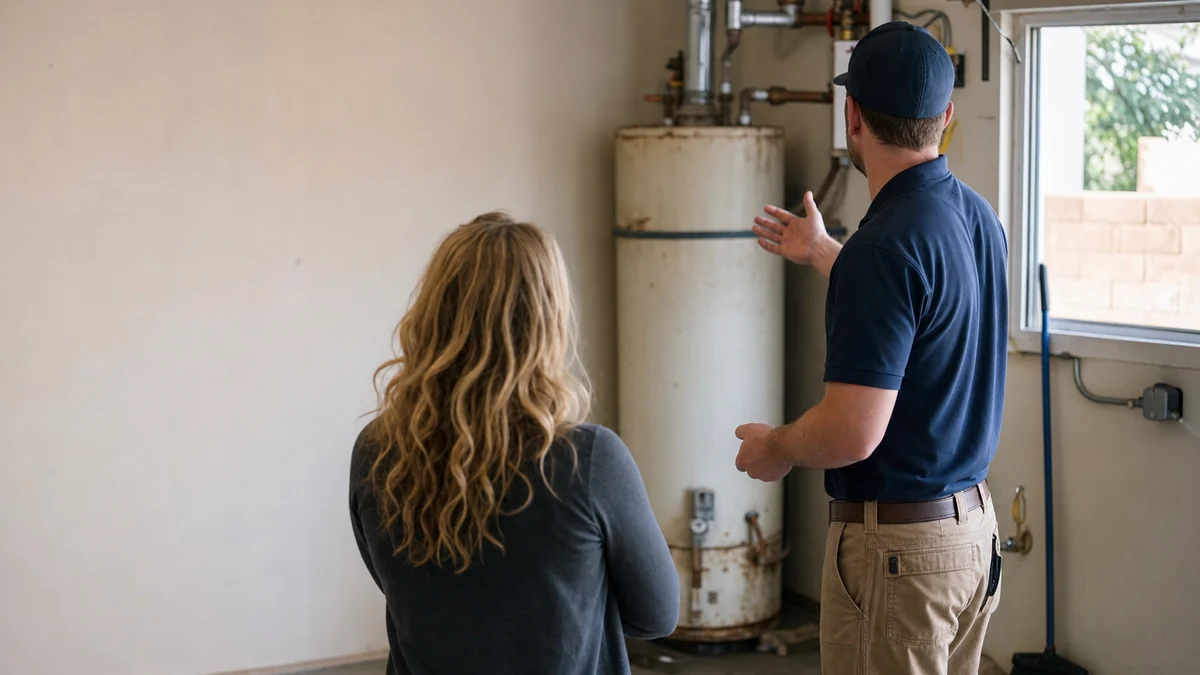
Often more than owners think, because the biggest tickets are the ones that don’t book on the spot. A water heater replacement, a repipe or a sewer line job usually comes with a quote, a homeowner who wants to think about it, and a second company quoting the same job.
Following up is the cheapest revenue in the business: you’ve already paid for the lead and the truck roll. Field service software can handle the reminders. Jobber’s automations, for example, can send up to two quote follow-ups by email or text, on a schedule you set by the number of days since the quote went out, through the same channel the quote was sent.
A good follow-up names the job, answers the question most homeowners have at that point, and offers a time. A person should also call on the biggest quotes rather than leave them to an automatic text. Using AI to draft those messages is covered in using AI to improve plumbing ads and messages.
Curious what your marketing is actually booking?
Get a free visibility audit — no obligation, no sales pitch.
How does job mix change what my marketing earns?
Two calls can cost the same and be worth very different amounts. A clogged toilet and a failing water heater might come from the same ad at the same price, but one pays for a small service call and the other can pay for the whole month’s marketing.
Ways to tilt your mix toward bigger work:
- Separate campaigns for high-value jobs like water heaters, repipes and sewer lines, with their own budgets.
- Service pages that sell those jobs properly, with real photos and a clear process.
- Fewer dollars on jobs you don’t want. If you’d rather not do small fixture work, stop paying to advertise it.
- Seasonal timing, pushing water heater and freeze work when demand rises.
The goal isn’t to stop taking small calls. It’s to stop paying the same for a $150 call as for a $4,000 job without knowing it.
Should I raise ticket size instead of buying more leads?
For many shops it’s the faster lever, because a bigger average ticket raises the revenue from every call you already pay for. That doesn’t mean upselling people things they don’t need. It means making sure homeowners hear their real options.
- Present options on every repair: fix it today, fix it properly, or replace. Many homeowners pick the middle when they see all three.
- Mention related work the tech actually found, like a corroded shutoff or an aging water heater.
- Offer a maintenance plan at the end of the visit, so the next job comes from a customer you already have.
- Check your prices against your costs at least once a year. Marketing can’t fix a job that loses money.
A maintenance plan also turns a one-off customer into a scheduled visit, which feeds the next lever: repeat work.
How do repeat customers and referrals stretch my marketing spend?
The first job carries the full cost of winning a customer. Every job after that comes at a fraction of it, because you already have their name, number and trust. A plumbing company that wins a customer once and never hears from them again is paying full price for every job.
Simple habits that bring customers back:
- Save every customer, with the job and equipment details, in your field service software.
- Send a reminder for work that comes due, like a water heater flush or drain maintenance.
- Ask for a Google review after every good job, while the customer is still happy.
- Stay in touch a few times a year with something useful, such as a freeze-prep reminder.
When you work out what marketing earns, count the repeat work it led to, not just the first ticket. A channel that brings customers who come back is worth more than its first-job numbers show.
How do I know which marketing channel actually makes money?
Tag every job with where the customer came from, then add up revenue by source. Most field service software can do this. Jobber’s lead source report shows leads by source alongside the first revenue earned from each one, so you can see which channels bring in new work, not just calls.
For each channel, every month, look at three numbers:
- Cost per booked job: what you spent divided by jobs booked.
- Revenue per marketing dollar: revenue from those jobs divided by what you spent.
- Average ticket: whether this channel brings the jobs you want.
A channel with cheap leads and small tickets can lose to a pricier one that brings water heaters. Setting up the tagging is covered in tracking which plumbing marketing books jobs.
Can Google Ads learn which plumbing calls are worth more?
Yes, if you tell it. By default an ad account counts a drain call and a repipe the same: one conversion each. Google’s page on conversion values explains that assigning values lets you see the total business value your ads generated, not just the number of conversions, and that automated bidding can use those values to aim for higher-value results.
The catch for plumbers is that the value isn’t known when the phone rings. It’s known when the invoice is paid. Google’s offline conversion imports exist for that: an ad starts a path that ends in a sale over the phone or in person, and importing what happened lets Google Ads measure it. If you’re setting this up fresh, Google recommends starting with enhanced conversions for leads, its upgraded version of the same import.
In practice, that means connecting your call tracking and field service software so booked job revenue flows back to the ad account. It takes careful setup, but once it’s working, the account starts chasing jobs instead of calls.
When should I spend more, and when should I fix the leaks first?
Spend more when the chain behind the phone is holding: calls get answered, a healthy share book, estimates get followed up, and each channel’s cost per booked job sits comfortably under what a job earns you. Then more calls really do mean more revenue.
Fix first when any of these are true:
- You can’t say what each channel’s booked jobs cost.
- Calls go to voicemail during the day, or nobody covers nights.
- Open estimates sit with no follow-up.
- Most of your paid calls are for work you’d rather not do.
And give each channel a fair run before you judge it: ads can bring leads within days of launch, while SEO typically takes 3 to 6 months to show meaningful organic growth. How much a plumbing company should spend on marketing each month covers setting the budget once the leaks are fixed.
Not sure which of these is costing you jobs?
A free visibility audit checks the Google profile, reviews, site and tracking, and shows what to fix first.
What's different about turning plumbing marketing into revenue
Emergency calls book now or never. A homeowner with water on the floor won’t wait for a callback. For emergency work, answering live is the whole game, and an ad running when nobody can answer is money spent for a competitor.
Small calls lead to big tickets. A leak check can turn into a repipe, and a slow drain into a sewer line replacement. Make sure those later jobs keep the original lead source, or your reports will undercount the channel that started them.
Freeze and peak weeks expose every leak. When a cold snap hits, calls spike and the office gets swamped. That’s when missed calls and dropped estimates cost the most, so plan the extra phone coverage before the weather turns.
Water heaters are the swing job. For many residential plumbers, a few extra water heater replacements a month change the whole marketing math. Treat them as their own campaign, page and follow-up sequence.
A worked example: more revenue from the same $3,000
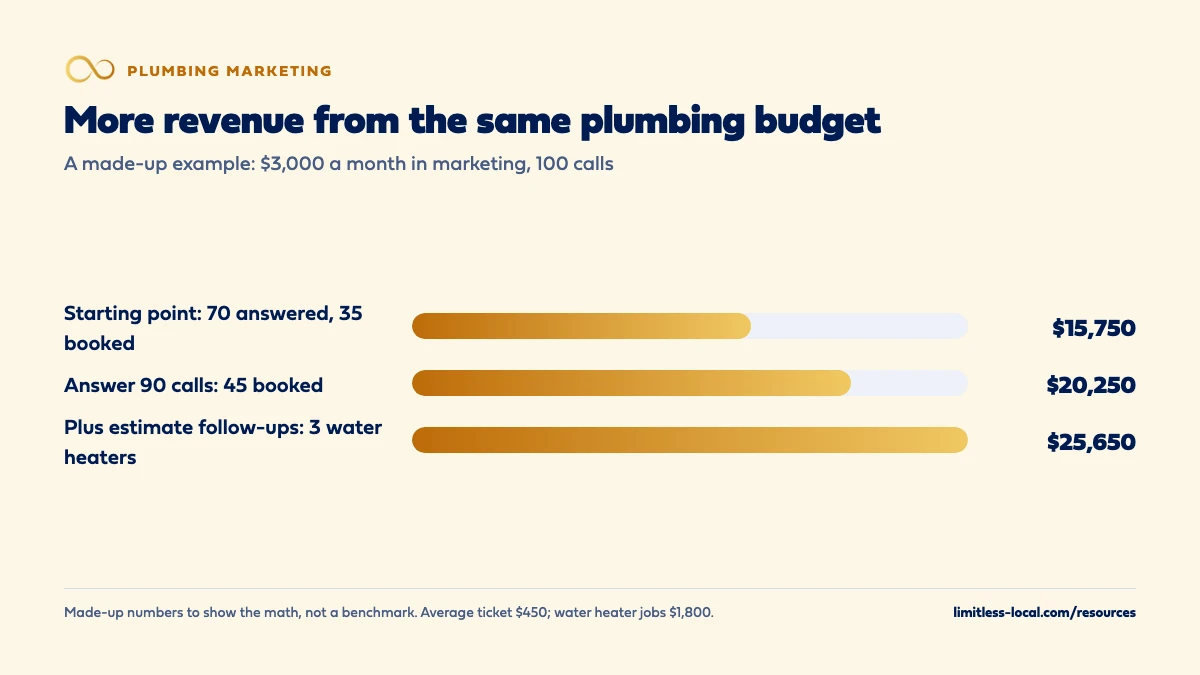
These numbers are made up to show the math, not a benchmark for your market. Say a plumbing company spends $3,000 a month on marketing and gets 100 calls. The office answers 70 of them, half of those book, and the average ticket is $450. That’s 35 jobs and $15,750 in revenue, or $5.25 for every marketing dollar.
Now the owner adds a rollover line and a missed-call callback rule, and the office answers 90 of the same 100 calls. Half still book, so that’s 45 jobs and $20,250.
Then he starts following up on every open water heater estimate, and 3 more of them book each month at $1,800 each, adding $5,400. Total: $25,650 from the same $3,000, or $8.55 per marketing dollar. Not one extra call was bought.
Frequently asked questions
What's a good return on plumbing marketing?
There’s no single number that fits every shop, because margins differ. Work out the gross profit each channel’s jobs bring in, and keep spending where that comfortably beats what you paid.
Should I measure marketing by revenue or profit?
Profit tells the truth. Revenue is easier to track, so start there, then apply your typical gross margin per job type to see what each channel really earns.
Do maintenance plan renewals count as marketing revenue?
Count the first sale toward the channel that brought the customer, and track renewals separately. Mixing them makes a channel look better or worse than it is.
Can my office staff really change my marketing results?
Yes. Whoever answers the phone decides whether a paid call becomes a job. Training, a script and weekly call reviews often do more than a budget increase.
How soon will fixing these leaks show up in revenue?
Answering and follow-up changes can show up within weeks, because they work on calls you’re already getting. Job mix and repeat work build more slowly.
Should I cut marketing while I fix the leaks?
Not usually. Keep the channels that book jobs at a cost you can carry, pause the ones you can’t measure, and fix the follow-through alongside.
Key takeaways
- Every marketing dollar passes through answering, booking, the ticket and repeat work; each step multiplies the revenue.
- Answer every call and follow up every open estimate before buying more calls.
- Point spend at the jobs worth the most to you, like water heaters, repipes and sewer lines.
- Track revenue by source, and judge channels by cost per booked job and revenue per dollar.
- Feed booked job values back to Google Ads so it chases jobs, not just calls.
Want a second set of eyes on your setup?
We'll look at how you show up locally and where calls are leaking, then send you a plain-English breakdown.
More in this section
- How do I scale a plumbing business with marketing?
- Is a plumbing business profitable, and where does marketing fit?
- How do I get more plumbing leads?
- What plumbing marketing should I keep in-house vs. outsource?
- How can I tell if my plumbing marketing agency is making progress?
Sources
- How leads work — Google Local Services Help
- The InsideSales.com/MIT Lead Response Management Study — InsideSales.com and MIT
- Automations — Jobber Help Center
- Lead Source Report — Jobber Help Center
- About conversion values — Google Ads Help
- About offline conversion imports — Google Ads Help