
How do I scale a plumbing business with marketing?
- How do I grow a plumbing business from a few trucks to more, step by step?
- What does scaling a plumbing business with marketing actually mean?
- Step 1: Am I short on calls or short on plumbers?
- Step 2: What has to be in place before I scale the marketing?
- Step 3: Which channel should carry the growth first?
- Step 4: How do I time marketing around a new hire?
- Step 5: When should I widen my service area?
- Step 6: Should I add services or commercial work to grow?
- Step 7: When does a second location make sense?
- Step 8: How does the office keep up as the calls grow?
- What numbers tell me it's time for the next step?
- What usually goes wrong when plumbers scale their marketing?
- When should I hand the marketing to someone else?
- What's different about scaling a plumbing company
- A worked example: what marketing has to book at each step
- Frequently asked questions
- Key takeaways
- More in this section
- Sources
The short version
- Marketing can only grow a plumbing company as fast as you can add plumbers to run the calls.
- Fill the trucks you have first, with the job types and towns you want most.
- Raise paid budgets in steps while cost per booked job holds; start slow channels like SEO months ahead.
- Widen the area, add services or open a location only after the core is full and tracked.
For plumbing owners who want to grow past a few trucks and need to know what the marketing has to do at each step, and in what order.
Get a free visibility audit · Book a growth call
How do I grow a plumbing business from a few trucks to more, step by step?
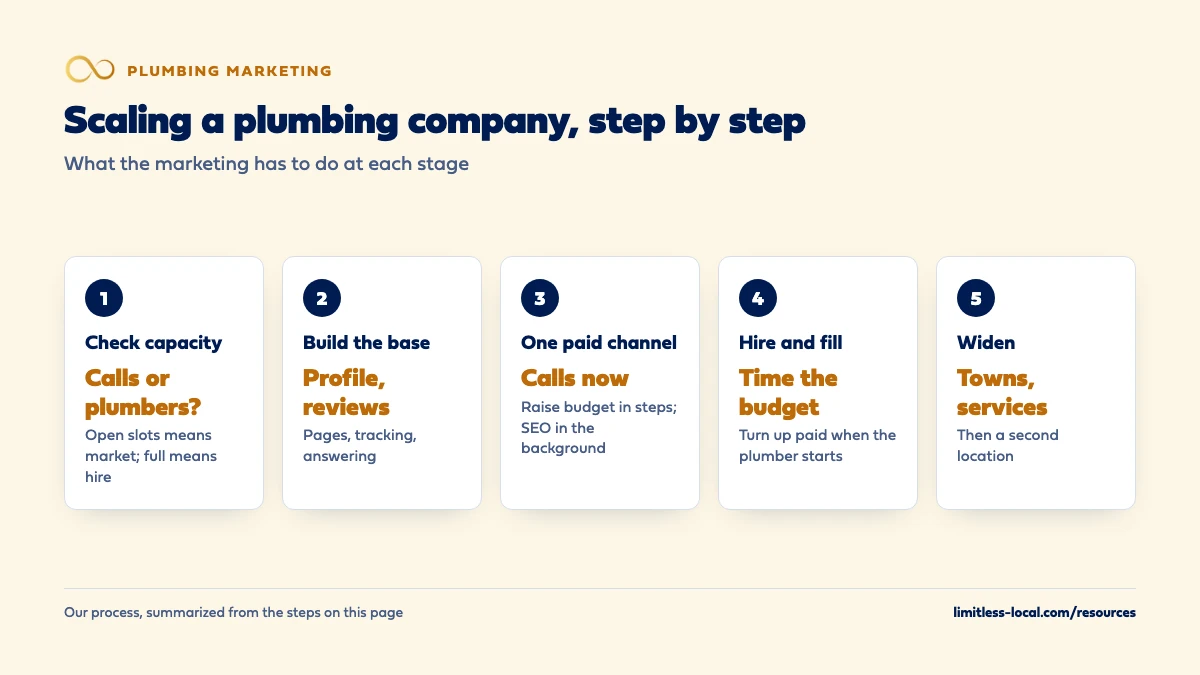
Scale in steps and let marketing follow capacity: fill the trucks you have with the jobs you want most, add a plumber when the schedule stays full, and only then widen the area, add services or open a second location. At each step the marketing has a different job, starting with a complete Google profile, steady reviews and one paid channel run well, then tracking and a bigger budget aimed at your best job types, then more towns, pages and channels. Judge every step by cost per booked job and how full the schedule is, not by how many calls came in.
Our packages follow the same path: Essentials covers one location, Growth adds Local Services Ads and SEO for up to two locations, and Scale is custom for multi-location shops, with ad spend paid to Google separately on every tier. How that fits a plumbing company is on our plumbing marketing page, and the rest of the plumbing marketing questions library covers each channel in detail.
What does scaling a plumbing business with marketing actually mean?
Booking more jobs each month at a cost per booked job that still leaves you a profit, with the plumbers to run them. The second half is the hard part. Ads can start bringing in calls within days of launch; adding the people to work that schedule takes much longer.
The Bureau of Labor Statistics notes that most plumbers learn through an apprenticeship, typically four or five years, and that most states and some localities require plumbers to be licensed, often after 2 to 5 years of experience and an exam, before they can work on their own. In our judgement, that’s why scaling a plumbing company is mostly a hiring plan with marketing timed around it, not a marketing plan with hiring as an afterthought.
Step 1: Am I short on calls or short on plumbers?
Find out before you spend a dollar more. Look at the last few months:
- Short on calls: plumbers have open slots most days, the office isn’t turning work away, and new customers can be seen the same or next day.
- Short on plumbers: new customers are booked days out, emergency calls go to voicemail or get turned away, and your plumbers are working long overtime.
If you’re short on calls, the next steps are marketing steps. If you’re short on plumbers, more marketing mostly buys calls you can’t run, and those customers remember. Whether to market before or after hiring another plumber goes through that decision in detail.
Step 2: What has to be in place before I scale the marketing?
The pieces that make every later dollar work harder. In our judgement, a plumbing company is ready to scale when it has:
- A verified, complete Google Business Profile and a steady habit of asking every customer for a review.
- A website with a page for each main service and the towns you serve.
- Call tracking and a lead source on every job, so you know what each booked job came from.
- Someone answering the phone during business hours, every time, and a plan for after-hours calls.
- A clear idea of which jobs and towns you want more of.
Scaling without these usually means paying more for the same leaks: more calls missed, more jobs you can’t trace. What a plumbing marketing plan should include covers each piece.
Step 3: Which channel should carry the growth first?
Usually one paid channel run well, with the slow channels started at the same time. Ads can generate leads within days of launch; SEO typically takes 3 to 6 months to show meaningful organic growth. So paid search or Local Services Ads carry the first stage of growth while your Google profile, reviews and website build up behind them.
Paid channels also scale in a controlled way. Google Ads uses an average daily budget, and Google says changes to budgets take effect in the next auction and don’t trigger a “Learning” status for Smart Bidding (About Smart Bidding learning). In our judgement, raise the budget in steps, watch cost per booked job for a few weeks at each level, and stop raising when it climbs past what a job is worth to you. Whether to start with LSAs, Google Ads or SEO compares the options.
Step 4: How do I time marketing around a new hire?
Start the slow work early and turn up the paid work when the plumber can take calls. A rough order, in our judgement:
- Months ahead: keep reviews, your Google profile and website pages going, because they take months to pay off.
- A few weeks ahead: check that the office can book more calls without dropping any, and that tracking is working.
- The week the plumber can run calls: raise paid budgets in a step sized to fill one more schedule.
Who you hire changes the math. An apprentice adds hands to an existing truck, so the marketing has to fill bigger jobs, not more of them. A licensed plumber who can work alone adds a second schedule to fill. Plan the budget increase around which one you’ve hired.
Curious what your marketing is actually booking?
Get a free visibility audit — no obligation, no sales pitch.
Step 5: When should I widen my service area?
After the towns you already serve are giving you most of what they can. In our judgement, signs you’re there: your best job types are booking steadily, your cost per booked job in the core towns is rising as you spend more, and your trucks can reach a new town without losing too much of the day to driving.
Add towns one or two at a time, and add them everywhere at once: in your Local Services Ads service areas, where you can include or exclude counties, cities and ZIP codes (Edit your industries, service areas, and job types), in your Google Ads locations, on your Google Business Profile service area and on your website. Then watch whether the new towns book at a cost per job close to the old ones.
Step 6: Should I add services or commercial work to grow?
Sometimes that grows a plumbing company faster than more towns do. Selling more to the customers and area you already have, such as water treatment, maintenance plans or small commercial accounts, can mean more revenue per truck without more drive time.
Each new service needs its own marketing: its own website page, its own ad group or Local Services Ads job type, and plumbers who can sell and do the work. Commercial work in particular is won differently, often through property managers and repeat accounts rather than urgent searches. How a plumbing company markets to commercial customers covers that side.
Step 7: When does a second location make sense?
When there’s a real branch, with its own staff, serving an area your first shop can’t reach well. A second address used only to show up in more towns is a different thing, and the page linked below covers what Google allows.
One Google rule shapes how far apart the two should be: if your business has multiple locations that serve the same geographic area, Local Services Ads will show only the highest-ranking ad for a search (About ad rankings). In our judgement, that’s one more reason to split the towns between locations rather than overlap them. How to market a second plumbing location walks through the setup.

Step 8: How does the office keep up as the calls grow?
Usually it doesn’t, unless you plan for it. More marketing means more calls at the busiest times, and a missed call costs more as you grow: on Local Services Ads, missed calls may negatively affect your responsiveness, one of the factors in how your ad ranks (About ad rankings).
Before each step up in budget, check the answer rate and how quickly web forms and texts get a reply. Options as the volume grows include a second person on the phones, an answering service or on-call rotation for nights, and AI answering for overflow. Whether AI can help a plumbing company answer leads faster covers where that helps and where a person still has to pick up.
What numbers tell me it's time for the next step?
In our judgement, four numbers, checked monthly:
- How full the schedule is for the next week, by plumber.
- Cost per booked job, all-in, by channel, against the most you can afford per job.
- Booking rate: the share of new-customer calls that become booked jobs.
- Review flow: new Google reviews per month and your rating.
A full schedule with a steady cost per job means it’s time to hire. Open slots with a steady cost per job means it’s time to spend more. A climbing cost per job means fix the leak before scaling anything: the answer rate, the settings or the towns.
What usually goes wrong when plumbers scale their marketing?
In our judgement, the same handful of mistakes:
- Spending ahead of the plumbers, then turning away the calls you paid for.
- Spreading the budget across too many towns so no area gets enough to work.
- Stopping SEO and reviews when the schedule is full, then starting from scratch in the next slow season.
- Growing without tracking, so nobody knows which channel booked the jobs.
- Cutting marketing the moment sales dip. The SBA warns that cutting marketing when sales drop can lead sales to decline even further, and says a slowdown might be the right time to increase marketing (How to Get the Most From Your Marketing Budget).
When should I hand the marketing to someone else?
When it’s taking time the business needs from you elsewhere. Google says that if you run a small local business, you can probably do much of the SEO work yourself (Do you need an SEO?), and many owners run their first paid channel themselves. As the company grows, the work multiplies: more towns, more services, more campaigns and more reporting. In our judgement, the moment to hand it off is when the owner’s hours are worth more running crews and selling big jobs than adjusting ad budgets, and whoever takes it over should report in booked jobs and cost per job.
Not sure which of these is costing you jobs?
A free visibility audit checks the Google profile, reviews, site and tracking, and shows what to fix first.
What's different about scaling a plumbing company
Licensing sets the pace. With most states licensing plumbers, according to the Bureau of Labor Statistics, you can’t add independent plumbers as fast as you can add ad budget. Plan marketing growth around realistic hiring, not the other way around.
Emergencies don’t scale on a schedule. Burst pipes and backups come in at night and in cold snaps. A bigger company needs a real after-hours plan, or the extra marketing just produces more calls that go unanswered when they’re worth the most.
The job mix changes as you grow. A one-truck shop lives on service calls. A larger one can take on repipes, sewer replacements and commercial work that need more people per job. Shift the marketing toward those jobs as you add the crews to run them.
A worked example: what marketing has to book at each step
These numbers are made up to show the math, not a benchmark for your market. Say each plumber can run about 60 jobs a month, and you have three, so the schedule holds about 180 jobs. Repeat customers and referrals bring in 110, so marketing has to book the other 70. At an all-in cost of $100 per booked job, that’s $7,000 a month.
Now you hire a fourth plumber who can work alone. Marketing has to book 60 more jobs. Say those extra jobs cost more, $125 each, because you’re reaching further into new towns or tougher keywords. That’s another $7,500, for $14,500 a month in total. If the average job leaves $220 in gross profit, the extra 60 jobs earn 60 times ($220 minus $125), or $5,700 a month more, before the new plumber’s wages. If that doesn’t cover the hire, the step isn’t ready yet.
Frequently asked questions
How fast can marketing grow a plumbing company?
As fast as you can run the calls well. Ads can generate leads within days of launch, but SEO typically takes 3 to 6 months to show meaningful growth, and hiring licensed plumbers takes longer than either. Nobody can honestly promise a growth rate.
Should I lower my prices to grow faster?
Usually not. Lower prices fill the schedule with work that leaves less profit per job, which makes every later step harder to pay for. Aim the marketing at the jobs and customers you want instead.
Is buying shared leads a good way to scale?
It can add volume quickly, but if the same lead is sold to several companies, speed and price decide who wins. Track the cost per booked job against your own channels before relying on them.
Do I need a bigger website to scale?
You need pages for each main service and the towns you serve. Size matters less than whether each page answers what a customer in that town needs to call you.
Should I add Facebook ads as I grow?
Possibly, once search channels are working and tracked. In our judgement, Facebook is better at reminding people who already know you than at catching someone with a leak right now.
What if growth stalls after the first few trucks?
Go back to the four numbers: schedule, cost per booked job, booking rate and reviews. A stall usually shows up in one of them first, and fixing that one comes before spending more.
Key takeaways
- Marketing can only scale a plumbing company as fast as you can add plumbers to run the calls.
- Check whether you’re short on calls or short on plumbers before spending more.
- Get the base right first: Google profile, reviews, service pages, tracking and answering.
- Grow with one paid channel raised in steps while SEO builds over months, then widen towns, services and locations.
- Judge each step by cost per booked job and how full the schedule is.
Want a second set of eyes on your setup?
We'll look at how you show up locally and where calls are leaking, then send you a plain-English breakdown.
More in this section
- How do I market a second plumbing location?
- What makes a good plumbing marketing company?
- How should a plumbing company market to commercial customers?
- What needs fixing before I launch my plumbing marketing?
- Should I hire a plumbing marketing agency or do it myself?
Sources
- Plumbers, Pipefitters, and Steamfitters: Occupational Outlook Handbook — U.S. Bureau of Labor Statistics
- How to Get the Most From Your Marketing Budget — U.S. Small Business Administration
- Do you need an SEO? — Google Search Central
- About average daily budgets — Google Ads Help
- About Smart Bidding learning — Google Ads Help
- About ad rankings — Google Local Services Help
- Edit your industries, service areas, and job types — Google Local Services Help