
Why does plumbing SEO take months when I need jobs this month?

- How do I keep a plumbing crew busy this month while SEO is still building?
- Why does SEO take months to bring in plumbing calls?
- What can bring in plumbing jobs this month?
- Am I losing jobs from the calls I already get?
- Should I reach out to past plumbing customers first?
- How fast can Google Ads bring plumbing calls?
- Are Local Services Ads a faster bridge for plumbers?
- What can my Google profile do for me this month?
- Can reviews and referrals fill the gap?
- Should I stop paying for SEO to free up money for ads?
- How do I split a tight budget between this month and later?
- How do I know the short-term push is working?
- What's different about the cash-flow gap for plumbing companies
- A worked example: booking a month's work while SEO builds
- Frequently asked questions
- Key takeaways
- More in this section
- Sources
The short version
- SEO builds on a ramp; paid ads can bring calls within days of launch.
- Start with the work you're already paying for: missed calls, open estimates and past customers.
- Use Google Ads or Local Services Ads as the bridge, on a budget you set and can cap.
- Keep SEO running underneath so you're not renting every call forever.
For plumbing owners who were told SEO takes months, and still have payroll due this month.
Get a free visibility audit · Book a growth call
How do I keep a plumbing crew busy this month while SEO is still building?
SEO takes months because Google has to find your pages, connect them to the towns and jobs you want, and see enough reviews and links to trust you over plumbers who’ve been at it for years. You can’t speed that clock up much, but you don’t have to wait on it. Book this month’s work from things that pay off in days: answer every call, reach past customers, ask for reviews and referrals, and run paid search or Local Services Ads while SEO builds underneath.
Both clocks are part of how we run plumbing marketing: ads and the Google profile for this month’s calls, local SEO for the months after. Google Ads management is in every plumbing marketing package, and Local Services Ads are added on Growth; how we set up the paid side is on our local ads page. The rest of the plumbing marketing questions library goes question by question.
Why does SEO take months to bring in plumbing calls?
Because Google is checking you against everyone else who already ranks. Before your site or Google profile shows up for “water heater repair” in your main town, Google has to find the pages, understand which jobs and towns they’re about, and decide you deserve a spot over shops that have years of reviews, links and history behind them.
Google’s own tips to improve your local ranking say local results are mainly based on relevance, distance and popularity. You can fix relevance fast by filling in your profile and service pages. Distance you can’t change. Popularity, which leans on things like how many reviews you have and how many sites link to you, is the slow part. It grows one job, one review and one mention at a time.
SEO typically takes 3–6 months to show meaningful organic growth. How long it takes in your market, and what slows it down, is covered in how long plumbing SEO takes to bring in calls.
What can bring in plumbing jobs this month?
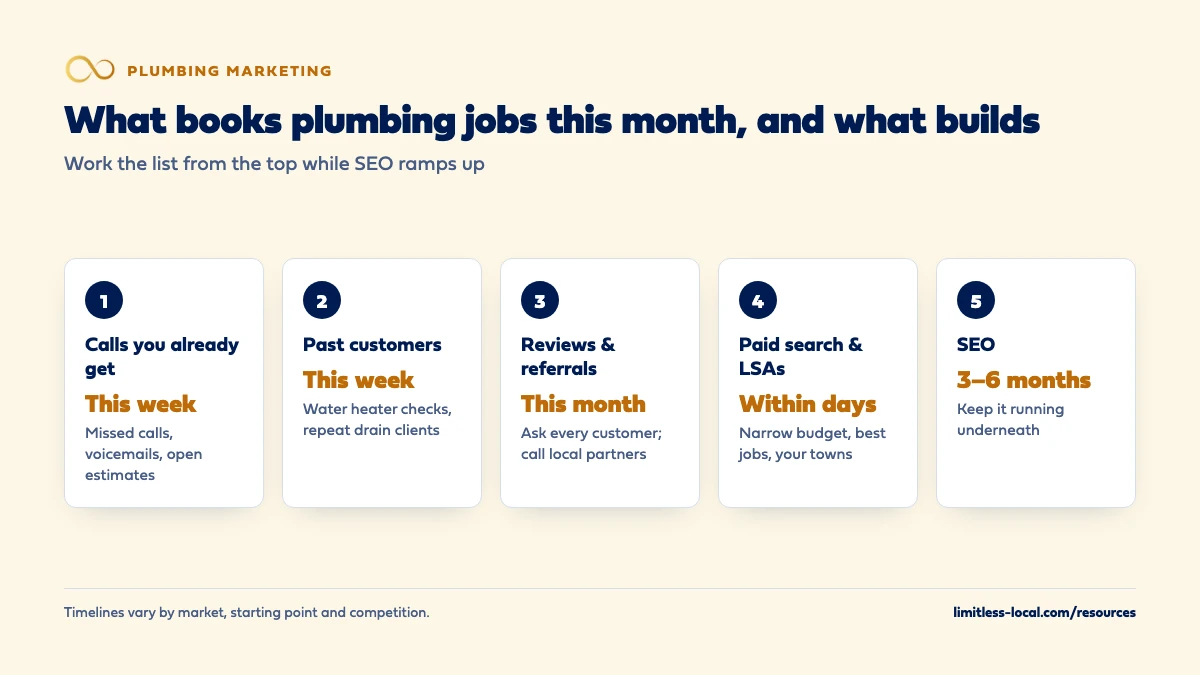
Sort your options by how cheaply and how quickly they turn into booked work, not by what’s popular. In the order to work them:
- Calls and estimates you already have. Missed calls, voicemails nobody returned and quotes nobody followed up on. These cost nothing new.
- Past customers. People who already trust you, sitting in your job software.
- Reviews and referrals. Asking happy customers this week pays off this month and keeps paying.
- Paid search and Local Services Ads. These can bring calls within days of going live.
- Your Google profile. Quick fixes help this month; the bigger gains build with SEO.
- SEO. The slowest to start and the one that keeps working when the ads stop.
Most owners jump straight to number four. Work the list from the top and you’ll often find a week of jobs you were already owed.
Am I losing jobs from the calls I already get?
Check this before you spend a dollar on anything new. Pull last month’s call log and count how many calls went to voicemail, how many voicemails got a callback the same day, and how many estimates never got a second touch.
Plumbing calls are urgent. Someone with water on the floor calls the next number on the list if you don’t pick up, and that call is gone. Every missed call you fix is a lead you already paid for, whether it came from a truck wrap, a referral or an ad.
- Daytime: route calls so someone answers, even if it’s a second line in the office or a tech who can take two minutes between jobs.
- After hours: decide who covers the phone, and say so in your Google hours. Stopping lost after-hours plumbing calls walks through the options.
- Open estimates: call back every water heater, repipe and sewer quote from the last two months. Big jobs often stall because nobody asked again.
Should I reach out to past plumbing customers first?
Yes. It’s the cheapest booked job you’ll get this month. Your field software already knows who had a water heater installed eight years ago, who calls you every spring for the same slow drain, and which landlords use you on more than one property.
Pick a reason to get in touch that helps them:
- Water heater flushes or checks for customers whose tanks are getting older.
- A drain cleaning reminder for customers with repeat clogs.
- A free look at anything you flagged on the last visit but didn’t fix.
If you email them, the FTC’s CAN-SPAM compliance guide says commercial email needs your valid physical postal address and a way to opt out, and that opt-out requests have to be honored within ten business days. Texts have their own rules, which keeping plumbing calls coming in during slow months covers along with more ideas for quiet weeks.
How fast can Google Ads bring plumbing calls?
Ads can generate leads within days of launch, once the account is set up, the ads are approved and the phone number is tracked. That’s why they’re the usual bridge while SEO builds. You’re paying to be at the top of the page today instead of earning it over months.
For a tight month, start narrow. Put the money on the searches that book the most for you, like emergency repair, water heaters and drain cleaning, in the towns your trucks already cover. A small, focused campaign gives you calls you can judge faster than a big, scattered one.
Spend is easy to cap. Google’s page on average daily budgets says a campaign can spend up to two times its daily budget on a busy day, but never more than 30.4 times the daily budget across a month for most campaigns. Set the daily number from the monthly amount you can actually afford. How fast the plumbing phone starts ringing after a new campaign covers what the first few weeks usually look like.
Curious what your marketing is actually booking?
Get a free visibility audit — no obligation, no sales pitch.
Are Local Services Ads a faster bridge for plumbers?
They can be. With Local Services Ads you pay for valid leads, such as calls and messages, instead of clicks, and there are no keywords to build. That makes them a quick way to get on the page if your Google profile and reviews are in decent shape.
Two things to know first. Google is moving Local Services Ads into Google Ads, and its transition page lists plumbing in the first phase, starting August 2026. Budgets become daily, and monthly spend is capped at the daily budget times 30.4. Second, Google’s help page on how leads work says a missed call during your business hours is charged if the caller stays on the line for more than 20 seconds. If nobody answers, you’re paying for leads you can’t book.
So answer the phone first, then turn them on.
What can my Google profile do for me this month?
Some profile work pays off quickly because it fixes things that turn people away today, even before your ranking moves:
- Hours that match who answers. If you take emergency calls, make sure the hours say so, and that the phone is actually covered.
- Services listed. Water heaters, drain cleaning, sewer lines, repiping, leak detection. Homeowners skim the list.
- Fresh photos. Real trucks, real crews, real jobs.
- Replies to reviews. A short reply to every review shows the next caller someone’s paying attention.
The ranking gains from your profile build over months alongside SEO. The calls you stop losing from a confusing or out-of-date profile start right away.
Can reviews and referrals fill the gap?
They’re slower than an ad but faster than SEO, and they cost almost nothing. Ask every customer for a Google review when the job’s done, and ask your best customers directly: “Know anyone who needs a plumber? We’d love to help them.”
Look at who sends work your way already. Property managers, landlords, real estate agents, home inspectors and remodelers all run into plumbing problems every week. A phone call to five of them this week can turn into jobs before the month is out, and into steady work after that.
Keep reviews clean: ask everyone, offer nothing in return and never write them yourself.
Should I stop paying for SEO to free up money for ads?
Usually not, if you can avoid it. SEO and ads run on different clocks. Ads stop the day you stop paying. SEO keeps working after you stop, but it can’t be restarted at full speed, because the months you skipped are months of reviews, pages and links you don’t have.
If cash is truly tight, scale both down instead of cutting one to zero. Keep the SEO foundation going, especially the Google profile and the core service pages, and put a smaller, focused budget on ads for the jobs that pay best. Then shift the mix as the organic calls start showing up in your call log.
What you shouldn’t do is pay for a promise. No one can guarantee a #1 ranking on Google, as Google’s own advice on hiring an SEO puts it. A company that says it can get you there this month is selling you something else.
How do I split a tight budget between this month and later?
Think of it as two buckets: money that books jobs in the next 30 days, and money that makes the next six months cheaper.
- This month: phone coverage, past-customer outreach, paid search on your best jobs and, once you’re answering every call, Local Services Ads.
- Later: the Google profile, service pages for each job and town, steady reviews, and links from local sites.
When money’s short, lean harder into the first bucket. As the organic calls grow, move money back. How much a plumbing company should spend on marketing helps you set the total.
How do I know the short-term push is working?
Count booked jobs, not clicks or calls. For each thing you tried this month, write down how many jobs it booked and what it cost. Past customers might book six jobs for the price of an email. Paid search might book ten at a higher cost per job, but on bigger tickets.
That only works if every job gets a source: the ad’s tracking number, the past-customer list, the referral partner. Tag it in your job software the day the call comes in. Tracking which plumbing marketing books jobs covers the setup in ServiceTitan, Housecall Pro or Jobber.
Talk it through with someone who runs this every day
A 15-minute growth call: your market, your numbers, and what a realistic budget looks like. No pressure.
What's different about the cash-flow gap for plumbing companies
Emergencies don’t wait for SEO. Most plumbing calls come from someone with water on the floor or no hot water. They search, they call whoever’s on top, and they book within the hour. That’s why paid search, Local Services Ads and the map listings matter so much in the short term, and why answering the phone counts more than almost anything else.
A few big tickets change the month. One repipe or sewer line replacement can cover a week of payroll. Go after open estimates for those jobs first, and make sure your ads cover them as well as the small service calls.
Weather can do the work for you. A hard freeze or a wet stretch brings burst pipes, backups and sump pump calls. If one is coming, be ready to raise the ad budget and cover the phones before it hits, not after.
A worked example: booking a month's work while SEO builds
These numbers are made up to show the math, not a benchmark for your market. Say a two-truck plumbing shop needs about 19 more booked jobs this month than SEO is bringing in.
- Paid search: $1,500 for the month. At a made-up $60 per lead, that’s 25 leads. If 2 in 5 book, that’s 10 booked jobs, or $150 per booked job.
- Past customers: an email and a call list to 300 past customers. If about 1 in 50 books, that’s 6 jobs for the cost of an afternoon.
- Referrals: calls to five property managers and agents book 3 jobs.
That’s 19 jobs. None of it waits on SEO, and the reviews from those jobs help the slow part along. The cost per booked job tells you where to put next month’s money.
Frequently asked questions
Is it normal to be told SEO takes months?
Yes. SEO typically takes 3–6 months to show meaningful organic growth, and longer in crowded markets or for a brand-new site. Ask what you’ll see along the way, like more Maps views and calls, before the big organic gains.
Will running Google Ads help my map ranking?
No. Google says there’s no way to request or pay for a better local ranking. Ads put you on the page while you pay; the map ranking comes from your profile, reviews and site.
Should I buy leads from lead sites to cover the gap?
It can fill a short gap, but those leads are often sent to several plumbers at once. Judge them the same way as anything else: what each booked job cost.
Can I run ads for just one month?
Yes. You can pause a Google Ads campaign at any time and turn it back on later with its settings and history kept. Removing a campaign is permanent, so pause instead.
Do discounts help fill the schedule fast?
They can fill a slow week, but they also attract price shoppers and train past customers to wait for a deal. A reason to call, like a water heater check, usually works better than a lower price.
What if I can't afford ads at all right now?
Start with the free list: answer every call, call back open estimates, reach past customers and ask every customer for a review and a referral. Add a small, focused ad budget once those are running.
Key takeaways
- SEO builds on a ramp, typically 3–6 months to meaningful organic growth; ads can bring calls within days.
- Fix missed calls and follow up on open estimates before spending anything new.
- Past customers and referrals are the cheapest jobs you’ll book this month.
- Use paid search or Local Services Ads as a capped, focused bridge, and answer every call they bring.
- Scale SEO down if you must, but don’t cut it to zero.
- Judge every short-term channel by cost per booked job.
Ready to compare options?
Book a short growth call and we'll walk through the math for your service area, including when we're not the right fit.
More in this section
- How long does plumbing SEO take to bring in calls?
- How does competition affect how fast plumbing SEO works?
- How long until plumbing marketing hits a profitable cost per job?
- How do I keep plumbing calls coming in during slow months?
- How much does a plumbing marketing agency cost per month?
Sources
- Tips to improve your local ranking on Google — Google Business Profile Help
- CAN-SPAM Act: A Compliance Guide for Business — Federal Trade Commission
- About average daily budgets — Google Ads Help
- Local Services Ads transition to Performance Max campaigns with pay-per-lead goals — Google Ads Help
- How leads work — Google Local Services Help
- Do You Need an SEO? — Google Search Central
- Enable, pause, or remove a campaign — Google Ads Help