
Should an electrician change marketing budget by season?

- How should an electrician's marketing budget change between slow and busy months?
- Does an electrical business really have seasons?
- Which parts of the budget should stay the same all year?
- Which parts should move with the season?
- How do I set each month's ad budget from crew capacity?
- When should I raise the budget before a busy stretch?
- Should I cut ad spend when the crews are booked out?
- If sales drop, should I cut marketing or spend more?
- How do Google's budget settings handle seasonal changes?
- What about Local Services Ads across the year?
- How do I plan a full year of marketing budget?
- What's different about seasonal budgets for electricians
- A worked example: budgeting a busy month and a slow one
- Frequently asked questions
- Key takeaways
- More in this section
- Sources
The short version
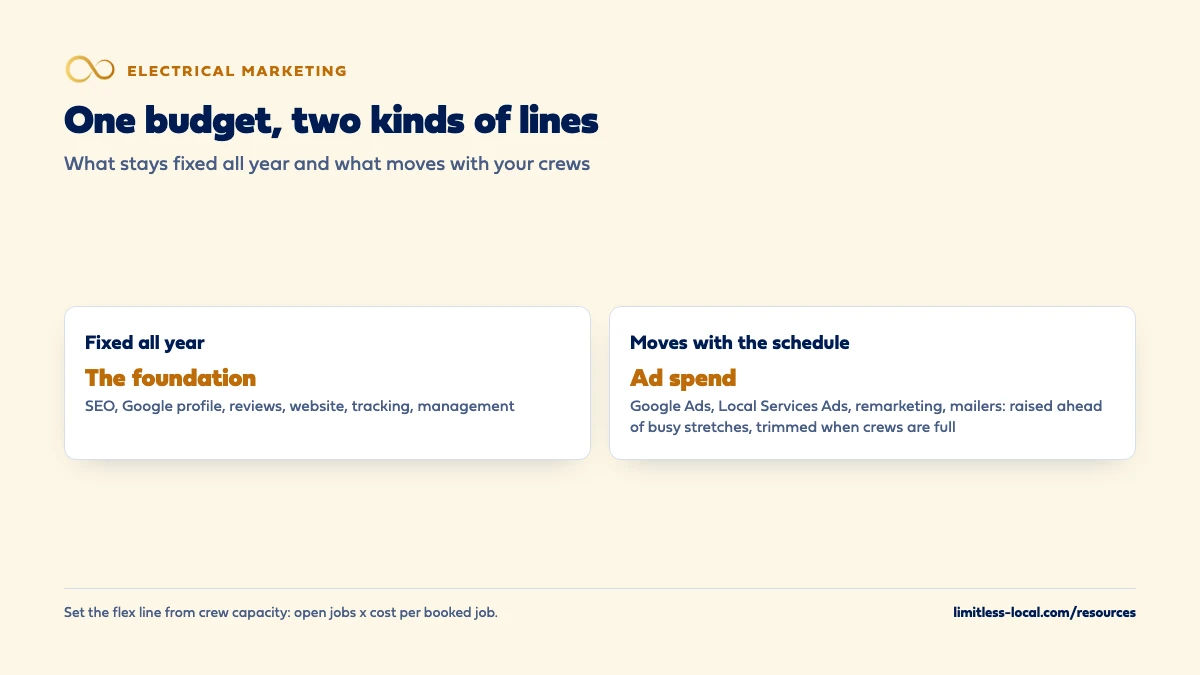
- Fixed all year: Google profile, reviews, SEO, website and tracking.
- Flexible: Google Ads, Local Services Ads and other paid placements.
- Raise ad spend ahead of busy stretches, earlier for quoted work.
- Trim rather than pause when crews are full; shift to planned work when it's slow.
For electrical contractors whose schedule swings during the year and who want to know which parts of the marketing budget to move, when, and by how much.
Get a free visibility audit · Book a growth call
How should an electrician's marketing budget change between slow and busy months?
Yes, but let open crew time set the changes, not the calendar. Keep the foundation steady all year: your Google profile, reviews, SEO, website and tracking. Move ad spend with your schedule, raising it a few weeks before busy stretches (earlier for quoted work like panel upgrades and generators) and trimming it, not switching it off, when crews are booked out. In slow stretches, shift money toward planned work instead of cutting everything, and judge every month on cost per booked job.
That split is how we plan budgets with owners too: the foundation work in every package runs all year, and ad spend, which is paid to Google separately, is the part that moves with your schedule. Essentials covers Google Ads management up to $2,500 a month in spend and Growth up to $5,000 with Local Services Ads included, so if your peak months run well above the first number, that’s worth knowing up front. Our packages page shows what each tier covers, our electrical contractor marketing page shows how we work with electrical shops, and the rest of the electrical marketing questions library goes question by question.
Does an electrical business really have seasons?
Most do, but they’re softer and more personal than an air conditioning company’s. Electrical work isn’t driven by one big weather swing, so your busy and slow stretches depend on your mix: how much is service work, how much is panel upgrades and EV chargers, how much is generators, and how much comes from builders and commercial customers.
So start with your own numbers. Pull booked jobs and revenue by month for the last two or three years from ServiceTitan, Housecall Pro or Jobber, split by job type. Then check demand in your area: Google’s Keyword Planner shows search trends for a specific location and lets you compare two date ranges, which helps you see which keywords pick up at different times of year. Put the two side by side and your real seasons show up fast. If you’re mostly here because of a slow patch right now, how to get more leads in a slow season covers the tactics; this page is about the budget itself.
Which parts of the budget should stay the same all year?
Anything that builds slowly or breaks when you stop it:
- SEO and content. SEO typically takes 3-6 months to show meaningful organic growth. Cut it in your slow months and you’ll feel it in next year’s busy months, right when it should be paying off.
- Your Google Business Profile and reviews. Posts, photos and a steady flow of new reviews keep you showing in Maps. A review gap in a quiet stretch still looks like a gap to the next homeowner.
- Your website and call tracking. If tracking lapses, you lose the very numbers you need to decide where next season’s money goes.
- Management. Whoever runs the work, whether that’s you, an employee or an agency, needs steady hours to do it. A budget that swings to zero every winter usually means starting over every spring.
Think of this as rent. It’s the cost of being findable when the work comes back.
Which parts should move with the season?
The paid placements that turn on and off quickly. Ads can generate leads within days of launch, which is exactly why they’re the right lever to flex:
- Google search ads. The main dial. Daily budgets can be changed any day.
- Local Services Ads. You pay per lead, so the budget sets roughly how many leads you can get.
- Remarketing and social ads. Useful for planned work when homeowners take their time deciding.
- Mailers and door hangers. Timed drops ahead of the work you want, such as generator service before storm season.
If you’re not sure which lines your budget even has, what to include in a monthly marketing budget lists them one by one.
How do I set each month's ad budget from crew capacity?
Work backward from the schedule, not forward from last month’s spend:
- How many jobs can your crews take this month? Count real capacity, including vacations and the commercial job that’s eating a crew for three weeks.
- How many will come without ads? Referrals, repeat customers, builders and your Google profile. Use the same month last year as your guide.
- The gap is what ads need to fill. Capacity minus free work equals booked jobs you need from paid channels.
- Multiply by your cost per booked job. Use your own tracked number for each channel, not a guess.
- Turn it into a daily budget. Divide the monthly amount by 30.4, the average number of days in a month that Google uses.
That’s the whole method. The worked example below runs it for a busy month and a slow one. It only works if you know what a booked job costs you by channel, so if you don’t yet, tracking which marketing brings in real jobs comes first.
Curious what your marketing is actually booking?
Get a free visibility audit — no obligation, no sales pitch.
When should I raise the budget before a busy stretch?
Earlier than feels natural, and earliest for quoted work. A service call booked from an ad today is often done this week. A panel upgrade, EV charger or generator goes through a call, a site visit and a quote, and the homeowner may sign weeks later. If you want those crews busy in a given month, the ad money has to start working well before it.
A simple rule: raise budgets for service work a week or two ahead of when you expect calls to pick up, and for quoted project work, about one full quote cycle ahead. If your panel quotes usually take a month to sign, start the push a month early.
Raise in steps rather than one big jump, and watch cost per booked job as you go. The next dollar of ad spend usually buys a little less than the last one, so the jump that looked smart on paper can cost more per job than you planned.
Should I cut ad spend when the crews are booked out?
Trim it, but rarely switch it all off. A full schedule this week doesn’t mean a full schedule in six weeks, and campaigns that go dark lose momentum you’ll pay to rebuild. Here’s what to do instead:
- Drop the low-value work first. Pause keywords and job types for small service calls you can’t get to, and keep the ones for panel upgrades, EV chargers and generators that you’ll book further out.
- Lower budgets on the rest. Enough to keep the campaigns running and learning, not enough to flood a phone you can’t answer.
- Keep the foundation going. Busy months are when reviews come easiest, so keep asking.
Unanswered calls are the expensive part of a too-high budget. They waste paid clicks, and on Local Services Ads, Google’s page on ad rankings says missed calls may negatively affect your responsiveness, which feeds your ranking. If your crews are full, it’s better to have fewer leads you can answer than more you can’t.
If sales drop, should I cut marketing or spend more?
It depends on why they dropped. A 2019 SBA blog post on getting the most from your marketing budget warns about a chicken-and-egg trap: sales drop, you cut marketing, and sales drop further. It suggests that slowing sales might be the right time to increase marketing, particularly in a slow economy when other businesses are cutting back.
Before you decide, check two things. First, did demand drop, or did your share of it? If Keyword Planner shows searches for your main jobs holding steady while your bookings fell, the work is still out there and spending to win it back can make sense. If searches fell too, plan around the dip instead of fighting it. Second, is a channel broken? A sudden drop is often a tracking problem, a lost Maps spot or missed calls, not the season. Why an electrical business goes slow walks through those checks.

How do Google's budget settings handle seasonal changes?
Better than most owners expect. Google’s page on average daily budgets explains that your daily budget is an average: Google spends more on days with more searches and less on quiet ones. For most campaigns you’ll never pay more than twice your average daily budget on any day, or more than 30.4 times it in a month.
When you change a budget mid-month, Google’s page on how budget changes take effect says the change shows up in your account immediately, and your spend for the rest of the month won’t exceed the new daily budget times the days left. So you can raise or lower budgets whenever the schedule changes without worrying about a surprise bill.
For a short, planned push, such as a generator campaign before storm season, a new campaign can use a campaign total budget instead: you set one amount and start and end dates between 3 and 90 days, and Google won’t charge more than that total. Existing campaigns can’t switch to it, so it’s best for a separate seasonal campaign.
What about Local Services Ads across the year?
Local Services Ads are moving into Google Ads, and electrical is in the first phase, which began in August 2026 for select advertisers. Once your account moves, Google’s transition page says weekly budgets become daily ones, with monthly spend capped at the daily average budget times 30.4, and you can set the campaign to Paused and back to Enabled whenever you want leads again.
Because you pay per lead, the budget works like a lead cap. In a busy stretch, lower it rather than letting calls ring out. In a slow one, raise it and check that your job types include the planned work you want more of. Whether Local Services Ads are worth it for electricians covers the settings that decide what you pay for.
How do I plan a full year of marketing budget?
One simple sheet does it:
- One row per month, with your expected crew capacity and the jobs you expect without ads, from last year’s numbers.
- A fixed line for the foundation: SEO, Google profile, website, tracking and management. Same every month.
- A flex line for ad spend, worked out from the capacity gap and your cost per booked job.
- A notes column for pushes you’ll start early: quoted project work, generator season, a builder’s new subdivision.
Look at it once a quarter and adjust. Compare each month with the same month last year rather than with last month, and judge channels on a rolling three months so one odd month doesn’t swing the plan. If you’re planning for growth rather than just keeping the schedule full, how marketing changes when you want to grow covers the different math.
Not sure which of these is costing you jobs?
A free visibility audit checks the Google profile, reviews, site and tracking, and shows what to fix first.
What's different about seasonal budgets for electricians
Your seasons come from your job mix. A shop that’s mostly service calls has a fairly steady year with soft spots around the holidays. A shop heavy in generators lives by storm seasons and outages. A shop doing new construction follows builder schedules. Plan from your own mix, not from what another trade does.
Quoted work needs the longest lead. Panel upgrades, EV chargers, generators and rewires all go through a quote. Budget for them a full quote cycle before you want the crews busy, and keep some of that spend going in quiet months, because those are the jobs homeowners plan ahead.
Commercial work fills the gaps differently. Commercial and builder work rarely comes from ads, so a slow residential stretch is a good time to put hours, not ad dollars, into those relationships.
A worked example: budgeting a busy month and a slow one
These numbers are made up to show the math, not a benchmark for your market. Say your two crews can handle 40 jobs a month, and your tracked cost per booked job from Google Ads is $150.
Busy month. Referrals, repeat customers and your Google profile are expected to bring 32 jobs. That leaves 8 to fill from ads. 8 times $150 is $1,200 for the month, or about $39 a day.
Slow month. Free work drops to 18 jobs, leaving 22 to fill. 22 times $150 is $3,300, or about $109 a day. In practice, pushing harder usually costs more per job, so if your test month shows cost per booked job creeping up toward what a job is worth to you, stop there and put the rest of the slow-month effort into past customers and open quotes.
Notice what didn’t change: SEO, the Google profile, reviews and tracking cost the same both months. Only the ad line moved.
Frequently asked questions
Should I pause SEO in my slow months to save money?
It’s usually the wrong line to cut. SEO typically takes 3-6 months to show meaningful growth, so a pause in the quiet months tends to show up as fewer calls in the busy ones.
Is it better to use one yearly budget or set it month by month?
Both. Set a yearly total so you know what you’re committing to, then set the ad line month by month from crew capacity. The fixed line stays the same every month.
Do Google Ads cost more in busy months?
They can, because other shops are bidding too. That’s one more reason to raise budgets in steps and watch cost per booked job, rather than doubling spend the week the phones get busy.
Should I run a discount to fill a slow month?
Only if the math still works. A small offer on planned work, like a panel inspection or generator service, can fill gaps, but discounting service calls mostly gives margin away to customers who’d have called anyway.
What if my agency charges the same fee all year?
That’s normal, because the foundation work doesn’t stop in slow months. Ad spend is paid to the platform separately, so that’s the part to move with your schedule.
How far ahead should I plan a generator push?
At least one full quote cycle before storm season, because generator installs go through a site visit and quote first. A separate campaign with a total budget and set dates keeps that push from spilling over.
Key takeaways
- Change the budget by crew capacity, not by calendar alone.
- Keep SEO, the Google profile, reviews, website and tracking steady all year.
- Flex ad spend: raise it ahead of busy stretches, earlier for quoted work, and trim rather than pause when crews are full.
- Google caps most campaigns at twice the daily budget on a day and 30.4 times it in a month, so mid-month changes are safe.
- Plan the year on one sheet, and compare each month with the same month last year.
Want a second set of eyes on your setup?
We'll look at how you show up locally and where calls are leaking, then send you a plain-English breakdown.
More in this section
- What should electricians include in their monthly marketing budget?
- How should an electrician change marketing to grow vs stay busy?
- How much should an electrical contractor spend on marketing?
- What marketing should I pause while I'm hiring electricians?
- How much does a marketing agency cost for an electrician?
Sources
- How to Find Keywords with Keyword Planner — Google Ads
- About average daily budgets — Google Ads Help
- How budget changes take effect — Google Ads Help
- About campaign total budgets — Google Ads Help
- About ad rankings — Google Local Services Help
- Local Services Ads transition to Performance Max campaigns with pay-per-lead goals — Google Ads Help
- How to Get the Most From Your Marketing Budget — U.S. Small Business Administration