
What should I check when my plumbing phone stops ringing?
- What's the quickest way for a busy plumbing owner to find out why calls dropped?
- Did calls drop, or did booked jobs drop?
- What can I check in ten minutes if I have no time?
- Are calls reaching a person when they do come in?
- What does my Google profile's performance report show?
- Are my Google Ads still showing as often as they were?
- Are my Local Services Ads running and within budget?
- Is my website still turning visits into calls?
- Is it the season, the weather or the whole market?
- Did a competitor get louder?
- Did my reviews or map rankings slip?
- What should I ask whoever runs my marketing?
- What's different when a plumbing company's calls drop
- A worked example: finding which channel fell
- Frequently asked questions
- Key takeaways
- More in this section
- Sources
The short version
- First decide whether calls dropped or bookings dropped; they're different problems.
- Test the phones before you touch the marketing.
- Use your Google profile's performance report and your ads' impression share to see which channel fell.
- Compare with the same weeks last year before blaming the season or a competitor.
For plumbing owners whose calls have dropped, suddenly or over a few months, who need a short list to work through before deciding the marketing has failed.
Get a free visibility audit · Book a growth call
What's the quickest way for a busy plumbing owner to find out why calls dropped?
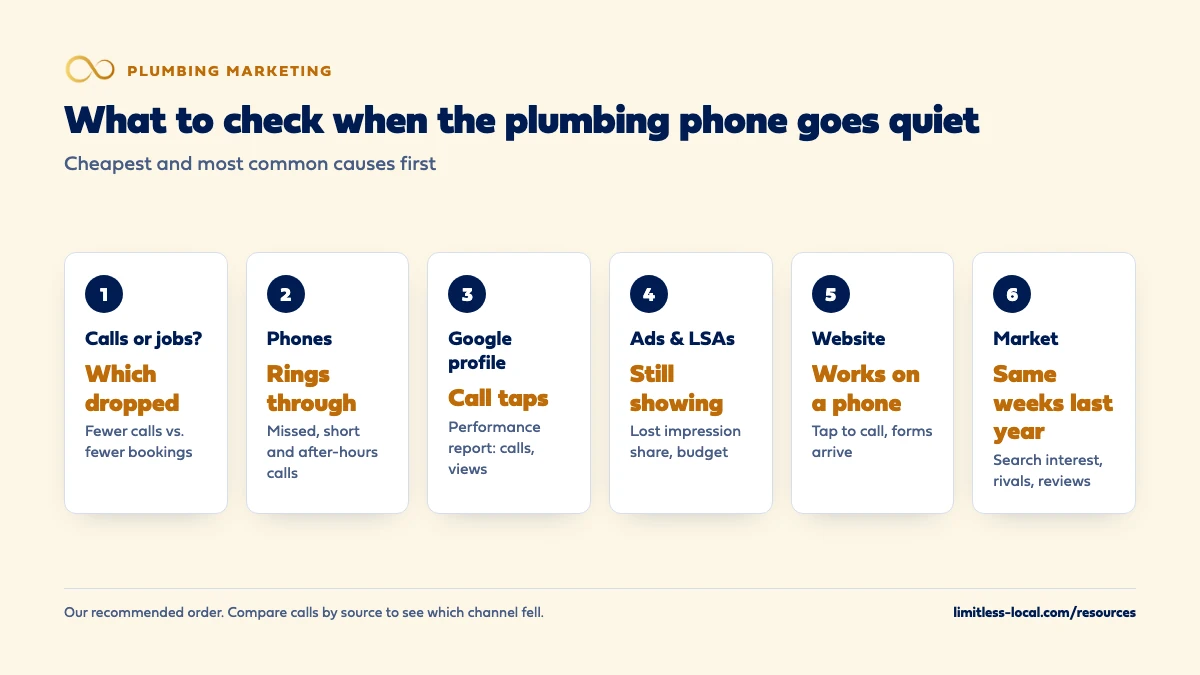
Check the cheapest, most common causes first, in this order: whether calls actually dropped or just stopped turning into jobs, whether every number you advertise still rings through to a person, whether your Google profile is still getting call taps, and whether your ads and Local Services Ads are running and showing as often as before. Then check your website on a phone, and only after that look at the market: the same weeks last year, search interest, competitors and your reviews. Compare calls by source so you know which channel fell, because that tells you where to look.
Every one of these checks gets easier when calls are tracked by source. Our plumbing marketing packages include call tracking with recording, source tagging, a real-time dashboard and a monthly report with a cost-per-lead breakdown, so a channel that falls off shows up in days. The local SEO work covers the Google profile, reviews and Maps side. The rest of the plumbing marketing questions library goes question by question.
Did calls drop, or did booked jobs drop?
Start here, because the two feel the same from the truck and need completely different fixes.
- Fewer calls. Fewer people are reaching you. That points at the phones, your Google profile, your ads, your website or the market.
- Same calls, fewer jobs. People are still calling but not booking. That points at how calls are answered, how fast you call back, your prices or the kind of calls you’re getting.
Pull a simple count for the last four weeks and the four weeks before: calls in, calls answered, jobs booked. If calls held steady and bookings fell, skip most of this page and read whether it’s a lead volume, quality or closing problem instead.
Then ask one more question: sudden or slow? A phone that went quiet in a few days usually means something broke or got switched off. A slide over two or three months usually means something weakened.
What can I check in ten minutes if I have no time?
If you’re running calls yourself and can’t spare an afternoon, do these five things from your phone tonight:
- Call your own number from a phone your office doesn’t know, during the day and after hours.
- Open your call log and count missed calls in the last week.
- Search your company on Google Maps while signed out. Is it open, with the right phone number?
- Open Google Ads and tap the notifications bell for billing or policy alerts.
- Load your website on cellular data and tap the phone number.
Those five catch most breaks. If one of them fails, fix it and watch the next few days. If the drop happened overnight, why a plumbing phone suddenly stops ringing goes through each break in detail, from blocked calls to an expired domain.
If all five pass, you’re probably looking at a slower problem, and the rest of this list is where to spend your next hour.
Are calls reaching a person when they do come in?
A quiet phone sometimes isn’t quiet at all. Calls arrive, ring out, go to a full voicemail or land on a forwarding rule nobody updated, and the owner only sees that fewer jobs got booked.
Look at the missed and short calls in your phone system or call tracking, and sort them by time of day:
- Missed during the workday usually means the office or the tech in the truck can’t get to the phone.
- Missed after hours usually means the on-call forwarding, the answering service or the on-call plumber’s phone settings.
- Lots of very short calls can mean callers are hanging up on a phone menu, a long ring or a voicemail greeting.
For a plumbing shop, a missed call is often a lost job. Someone with water on the floor tries the next number. If calls are reaching you but sitting too long, how fast your office should answer a new call covers the fix.
What does my Google profile's performance report show?
For many plumbers the Google profile is the biggest free source of calls, and Google gives you a report on it. Open the Business Profile performance view while signed in to the account that manages your profile, and set a date range to compare.
The numbers to look at:
- Calls. The number of times someone tapped the call button on your profile. It counts taps, not answered calls, so a drop here means fewer people tried to call from Google.
- Views. How many people saw your profile on Search and Maps.
- Searches. The search terms people used to find you. Google updates this at the start of each month, and it can take up to 5 days to appear.
- Website clicks. How many people went from the profile to your site.
Read them together. Views down and calls down means fewer people are seeing you, which points at rankings, distance or a closed or edited profile. Views steady and calls down points at the profile itself: the phone number, hours, photos or a fresh bad review. Performance data covers verified profiles only and includes interactions from both organic results and Google Ads.
Are my Google Ads still showing as often as they were?
Ads that are running can still be showing far less than before. The number that shows it is impression share: the impressions your ads got compared with the total they could have got.
Add these columns to your campaigns view, from Google’s guide to getting impression share data:
- Search lost IS (budget). The percentage of time your ads didn’t show on the Search Network because the budget ran out.
- Search lost IS (rank). The percentage of time they didn’t show because of poor Ad Rank in the auction.
If lost to budget jumped, your money is running out earlier in the day, often because clicks got more expensive. If lost to rank jumped, competitors are bidding more or your ads and landing pages are weaker than theirs. Small swings are normal; look for a clear change that lines up with the drop in calls.
Then open change history. It lists changes to the account, campaigns and ad groups for the past 2 years, including who paused what and what the old budgets were, laid against clicks and conversions so you can see which change lined up with the drop.
Curious what your marketing is actually booking?
Get a free visibility audit — no obligation, no sales pitch.
Are my Local Services Ads running and within budget?
Local Services Ads can go quiet without anything looking broken. Google’s checklist for Local Services Ads that aren’t running covers the usual causes:
- The ad is toggled off, or the ad schedule doesn’t cover the days and hours you want.
- Your business hours show you as closed or not taking customers.
- The targeting is so tight the ads rarely qualify.
- There’s an account or billing alert under the notifications bell.
- The budget for the month has already been spent.
Plumbing is also in the first group of Local Services Ads moving into Google Ads in 2026, so a dip around the switch may be the move settling in or a lead-routing number that needs updating. Check both before you raise the budget.
Is my website still turning visits into calls?
If your Google profile’s website clicks held steady but website calls and forms fell, the site is the suspect. Check it the way a homeowner would, on a phone:
- Does the page load quickly on cellular data?
- Is the phone number at the top, and does tapping it dial the right line?
- Does your contact form send, and how long until someone sees it?
- Did anything change recently: a new site, a new page builder, a plugin update, a removed call button?
- If you use call tracking on the site, does the number on the page ring through?
A website rarely causes a sudden drop on its own unless it went down. More often, a redesign quietly removed what made people call, like the emergency phone number, the service area or the reviews.
Is it the season, the weather or the whole market?
Before you blame anything, compare the same weeks last year, not last week. Plumbing has its own rhythm: a hard freeze or a heavy storm can bring a rush of calls, and the weeks after can feel dead by comparison.
Two quick checks:
- Your own history. Calls and booked jobs for the same weeks last year, from your phone system or field software.
- Search interest. Google Trends shows interest in a search topic down to city level. It’s scaled from 0 to 100 relative to all searches in that place and time, not a count of searches, and low-volume terms can show zero, so use broad terms like “plumber” and compare the shape over time.
If last year looked the same, it’s probably the season, and keeping plumbing calls coming in slow months covers what to do with the quiet stretch. If last year was busier and search interest held, something on your side changed.
Did a competitor get louder?
A new shop in town, or an established one spending more, can take calls without anything on your side breaking. Check two places.
In your ads. The auction insights report compares your performance with other advertisers in the same auctions, including their impression share and how often they show above you. Google doesn’t show it when your impression share is under 10%. A new name near the top, or a rival whose share jumped, explains a lot.
On Maps. Search for “plumber” and your main services from a few spots in your service area, signed out. Note who shows above you and how many reviews they have compared with last time you looked.
Don’t answer a louder competitor by copying them. Find where they’re weak, like slow review replies or no after-hours coverage, and win there. Seeing what plumbing competitors are doing online walks through the full check.
Did my reviews or map rankings slip?
Google says local results are mainly based on relevance, distance and popularity, in its tips to improve your local ranking. The same page says more reviews and positive ratings can help your local ranking, and that there’s no way to pay for a better one.
Slow drops often trace back here:
- New reviews stopped. Look at the dates on your last ten reviews. If they used to come weekly and the latest is months old, the asking habit slipped.
- A run of bad reviews. A few recent low ratings at the top of your profile can cut calls even if your rank holds.
- A category or service change. A primary category or service list that changed can affect which searches you show up for.
If your profile views fell and your review flow stalled, getting into the map pack covers what to rebuild first.
What should I ask whoever runs my marketing?
If an agency, a freelancer or someone on your team runs your marketing, don’t start with blame. Start with numbers. Ask for:
- Calls by source, week by week, for the last three months and the same stretch last year.
- Impression share and lost impression share for each Google Ads campaign.
- Google profile calls and views for the same periods.
- Anything that changed: budgets, campaigns, landing pages, the website, the call tracking numbers.
- Booked jobs and cost per booked job by source, if they have it.
Anyone running your marketing well can pull that in a day. If they can’t tell you which source fell, that’s worth knowing too, because it means nobody was watching.
Not sure which of these is costing you jobs?
A free visibility audit checks the Google profile, reviews, site and tracking, and shows what to fix first.
What's different when a plumbing company's calls drop
Emergencies don’t leave a trail. A homeowner with a burst pipe who reaches voicemail calls the next plumber. You never hear about it, so missed calls are worth checking first in this trade.
Weather swings the baseline. A freeze, a storm or a heat wave that stresses water heaters can make one stretch look huge and the next look empty. Compare against the same weeks last year, not the busy week before.
The on-call phone is part of the marketing. Many shops forward nights and weekends to whoever’s on call. When the rotation changes, test the forwarding the same day.
A worked example: finding which channel fell
These numbers are made up to show the method, not a benchmark. Say a plumbing shop had 230 calls in October last year and 180 this October, down 50.
Split by source, last year was 102 from the Google profile, 75 from Google Ads, 33 from Local Services Ads and 20 from the website. This year it’s 95, 40, 30 and 15. Google Ads fell by 35 calls, which is most of the 50.
So the owner opens the Google Ads campaigns and adds the lost impression share columns. Search lost IS (budget) went from almost nothing to 45%: the ads now run out of money most afternoons, so they’re simply not showing when people search. The fix is a budget, bid or targeting decision, not a new channel.
Frequently asked questions
How long should I wait before I start checking?
If calls are clearly down for two or three days in ordinary weather, start with the ten-minute check. It costs nothing, and a broken line costs plumbing jobs the same day.
Do I need call tracking to work through this list?
No, but it makes it faster. Without it, use your Google profile’s performance report, your Google Ads reports and a quick “how did you hear about us?” on every new call.
Should I raise my ad budget when calls drop?
Not until you know why. If lost impression share to budget jumped, more budget may help. If the phones or the profile are the problem, more spend just buys more missed calls.
Should I pause my marketing until I figure it out?
Usually not. Pausing everything removes the data you need to find the problem. Fix what’s broken, and pause only a channel you’ve confirmed is wasting money.
Why do my Google profile calls not match my phone bill?
The performance report counts taps on the call button, not answered or completed calls, and it only counts calls made from the profile. Your phone bill counts every call from every source.
Can one bad review really slow my calls?
A recent low rating sitting at the top of your profile can put off some callers, especially if your newest reviews are old. Getting fresh reviews from recent jobs is the steadiest fix.
Key takeaways
- Decide first whether calls dropped or bookings dropped.
- Test every number and read the missed-call log before touching the marketing.
- Your Google profile’s performance report shows call taps and views; read them together.
- In Google Ads, lost impression share to budget or rank shows whether ads stopped showing.
- Compare with the same weeks last year before blaming the season or a competitor.
- Ask whoever runs your marketing for calls by source, week by week.
Want a second set of eyes on your setup?
We'll look at how you show up locally and where calls are leaking, then send you a plain-English breakdown.
More in this section
- Why did my plumbing phone suddenly stop ringing?
- How do I keep plumbing calls coming in during slow months?
- How do I stop losing after-hours plumbing calls?
- How fast can my plumbing phone start ringing after a new campaign?
- How fast should my plumbing office answer a new call?
Sources
- Understand your Business Profile performance & insights — Google Business Profile Help
- Get impression share data — Google Ads Help
- About change history — Google Ads Help
- Why aren’t my Local Services Ads running? — Google Local Services Help
- FAQ about Google Trends data — Google Trends Help
- Use auction insights to compare performance — Google Ads Help
- Tips to improve your local ranking on Google — Google Business Profile Help
- Local Services Ads transition to Performance Max campaigns with pay-per-lead goals — Google Ads Help