
How many Google reviews does a restoration company need?
- How many Google reviews does a water damage company need to compete in the map pack?
- Does Google say how many reviews I need?
- How do I find the review count I need in my market?
- Do I need more reviews than the top company?
- How many new reviews a month should a restoration company aim for?
- Does a steady pace matter more than the total?
- What star rating does a restoration company need?
- Do the first few reviews matter most?
- Do reviews affect Local Services Ads too?
- What shouldn't I do to hit a review number?
- What's different about reviews for restoration companies
- A worked example: setting a 12-month review target
- Frequently asked questions
- Key takeaways
- More in this section
- Sources
The short version
- Google publishes no review threshold; your map pack competitors set it.
- Count the reviews and rating of the top three for your main searches.
- Close the gap first, then match the pace they add each month.
- Steady recent reviews from real jobs beat a burst, and never buy or bribe them.
For restoration owners trying to set a real review target and a monthly pace, instead of guessing at a magic number.
Get a free visibility audit · Book a growth call
How many Google reviews does a water damage company need to compete in the map pack?
There’s no fixed number: Google says more reviews and positive ratings can help your local ranking, but it doesn’t publish a threshold, so your target is set by the restoration companies already showing in your map pack. Look at the three companies Google shows for your main searches, aim to get within reach of their review count with a rating in the same range, and then match or beat how many new reviews they add each month. Pace matters as much as the total, because a steady flow of recent reviews from real jobs is what keeps you in the running once you get there.
Reviews are one of the few ranking signals Google names that you control, which is why review generation is part of every package in our local SEO work for restoration companies. The restoration marketing guide covers where reviews fit among your channels, and the restoration marketing questions library takes the rest one question at a time.
Does Google say how many reviews I need?
No. Google’s page on improving your local ranking says local results are mainly based on relevance, distance, and popularity. In the part on how well-known a business is, it says the factor is partly based on how many reviews you have, and that more reviews and positive ratings can help your business’s local ranking. That’s all it says about numbers. There’s no count at which you’re “done”.
Google also says there’s no way to request or pay for a better local ranking. So the useful question isn’t “how many reviews does Google want?” but “how many do I need to stand next to the companies Google already shows?” That answer is different in every town.
How do I find the review count I need in my market?
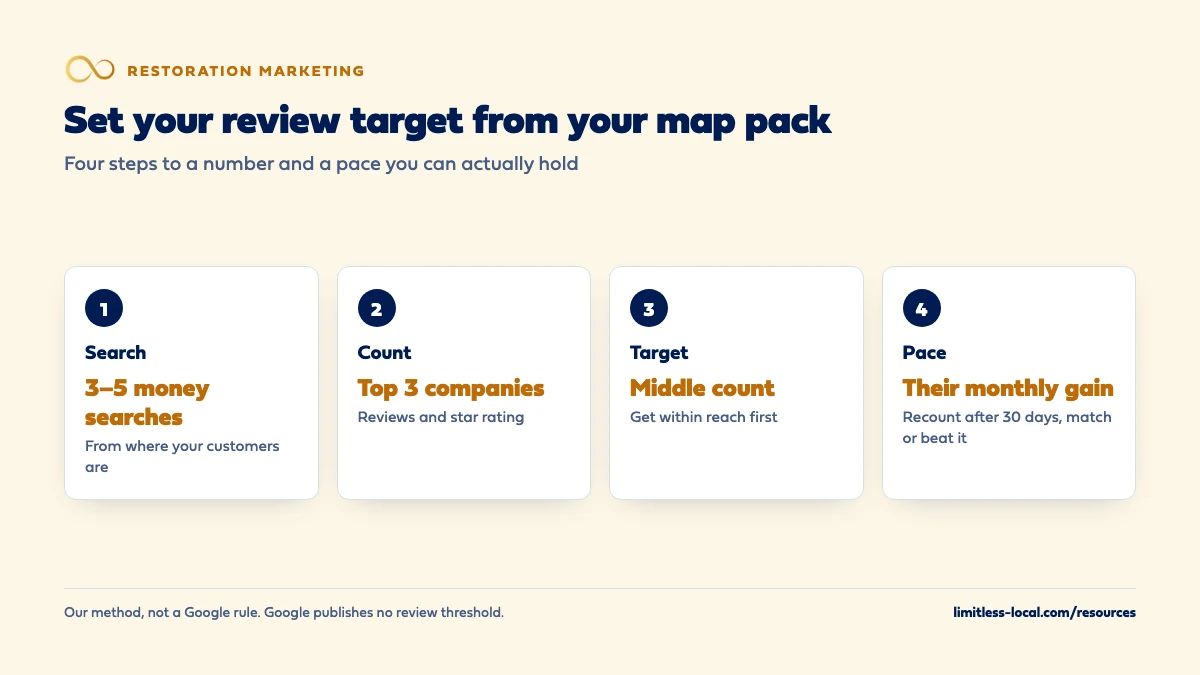
Do this once. It takes about twenty minutes and, in our judgement, it’s the most useful part of review planning:
- Pick your three to five money searches, like “water damage restoration”, “water damage repair” and “mold removal”, plus your main town names.
- Search from where your customers are. Your office location skews the result; drive to a neighborhood you want, or ask someone there.
- Write down the three companies in the map pack for each search, with their review count and star rating.
- Take the middle number of those counts. That’s your first target.
Most owners find the same few names in every search. Those are the companies you’re really competing with for reviews. If you’ve dropped out of the map pack entirely, getting back into the map pack covers the other causes to check first.
Do I need more reviews than the top company?
Not necessarily. Reviews are one part of how well-known Google judges you to be, alongside relevance and distance. A company with fewer reviews can outrank a bigger one for searches near its address or for services its profile lists more clearly.
In our judgement, getting within reach is the first goal: if the top three have 150, 220 and 400 reviews, you probably don’t need 400 to show up, but at 20 you’re unlikely to be in the conversation. Once you’re within reach, the rest of your profile, your categories and your website decide more of the outcome.
Remember the homeowner is reading too. A restoration company with a handful of reviews next to three with hundreds looks risky to someone letting a crew into their house at night.
How many new reviews a month should a restoration company aim for?
Match or beat the pace of the companies you’re chasing. To measure it, note each competitor’s count today and again in 30 days. The difference is their monthly pace.
Then check whether your target is realistic against your job count. If you finish 25 water jobs a month and half of those homeowners leave a review when asked well, you can add roughly a dozen a month. If you finish eight jobs, a target of twenty a month isn’t real, and trying to hit it is how owners end up breaking the rules.
The reliable way to raise the number is to ask every customer at the same point in the job. Getting detailed reviews after a water damage job covers the moment, the wording and the link.
Curious what your marketing is actually booking?
Get a free visibility audit — no obligation, no sales pitch.
Does a steady pace matter more than the total?
In our judgement, yes, for two reasons. First, homeowners notice dates. A profile whose newest review is eight months old looks like a company that slowed down or changed hands. Second, a steady pace survives Google’s filters better than bursts. Google uses automated spam detection to remove reviews that are probably spam, and a sudden spike after months of silence is the pattern those filters are built to question.
Restoration makes steady pace harder than most trades because work comes in waves after storms and freezes. The fix is to ask on every job, every week, not to run a review drive after a busy month. If your rating has already dropped or reviews have disappeared, start with recovering when reviews drop.
What star rating does a restoration company need?
Google doesn’t publish a minimum either. It says positive ratings can help, and its review tips page says a mix of positive and negative feedback often feels more trustworthy.
Research published in 2021 by the Spiegel Research Center at Northwestern, based on online product reviews rather than home services, found that purchase likelihood typically peaks at ratings in the 4.0 – 4.7 range and then begins to decrease as ratings approach 5.0. In our judgement, the same instinct applies to homeowners: a few honest, well-answered complaints don’t sink a restoration company, and a perfect score with thin reviews can look less believable than a 4.7 with detailed ones.
What a bad review does to you depends more on your reply than the star. How to reply to Google reviews covers what to say, especially when the complaint is really about an insurance claim.
Do the first few reviews matter most?
For buyers, the first handful seems to carry a lot of weight. The same Spiegel research found that the purchase likelihood for a product with five reviews was 270% greater than for a product with no reviews, and that the marginal benefit of additional reviews begins diminishing rapidly after the first five. That was about online products, not contractors, so treat it as a direction, not a rule for your trade.
For a new restoration company or a new location, in our judgement, the first goal is simply to stop being the company with almost no reviews: ask every early customer, including commercial and property management jobs, and reply to each one.

Do reviews affect Local Services Ads too?
Yes. Google’s page on how Local Services Ads ranking works lists profile quality as a factor, and says your rating and number of reviews are part of it, alongside response time, images and verification checks. It also says higher quality profiles may rank higher and may also pay lower prices.
So the same review count and pace does double duty if you run LSAs. Getting verified for LSAs covers the rest of the setup.
What shouldn't I do to hit a review number?
Don’t buy reviews, write them, or have staff and family post them. Google says offering incentives, like free or discounted goods or services, in exchange for customers to post reviews, change reviews or remove negative reviews counts as fake and misleading content.
The FTC’s rule on consumer reviews goes further on the legal side. Its questions and answers on the rule say businesses can be liable for buying, selling or creating fake reviews, and that incentivized reviews are treated as testimonials. The FTC says the rule doesn’t ban incentives that don’t require a particular sentiment, but Google’s own policy forbids incentives for Google reviews, so the safe line for your Google profile is no incentives at all. This page is general guidance, not legal advice.
Don’t ask only happy customers, either. Ask everyone the same way, and let the occasional bad review be answered well.
What's different about reviews for restoration companies
Fewer, bigger jobs. A plumber may finish a hundred calls a month; a restoration crew may finish a few dozen water jobs. Your review pace will be lower, so ask on every single one.
Stressful jobs. Customers are often dealing with an insurance claim and a damaged home. The best time to ask is usually when the drying is done and the house feels normal again, not on day one.
Other decision makers. Adjusters, property managers and landlords are often involved. Reviews from tenants and property managers count too, if they’re genuine customers of the job.
Seasonal waves. Storms create bursts of jobs. Asking on every job turns those bursts into a steady review flow rather than a suspicious spike.
Not sure which of these is costing you jobs?
A free visibility audit checks the Google profile, reviews, site and tracking, and shows what to fix first.
A worked example: setting a 12-month review target
These numbers are made up to show the math, not a benchmark for your market. Say you search your five money searches and the map pack keeps showing three companies with 90, 140 and 310 reviews. The middle number is 140. You have 40.
Thirty days later, they’ve added 3, 6 and 9 reviews. Their average pace is 6 a month.
- Gap to the middle competitor: 140 − 40 = 100 reviews.
- In 12 months the middle competitor, at 6 a month, will be at about 140 + 72 = 212.
- To reach 212 from 40 in 12 months, you need 172 reviews, or about 14 a month.
If you finish 28 jobs a month, that means half of your customers leaving a review. That’s ambitious, in our judgement, and only works if every customer is asked, every time. If it’s not realistic, pick a target you can hold and accept that it takes longer.
Review generation is part of every package; our Essentials package at $3,500 a month includes review response and basic review generation, and Growth at $4,500 a month adds advanced review generation.
Frequently asked questions
Do reviews on other sites count toward my Google ranking?
Google’s ranking page talks about reviews in general as part of how well-known a business is, but your Google review count is the one homeowners see next to your listing. Keep other platforms healthy, but put your effort into Google first.
Should I reply to every review?
Google’s tips page recommends replying and focusing on reviews where you can share a helpful update or answer a question. Replying to every review is a good habit for a restoration company with a modest monthly count.
Can I ask customers to mention water damage or mold in their review?
You can invite them to describe the job in their own words. Don’t script the review or tie anything to what it says.
Does each location need its own reviews?
Yes. Each Business Profile collects its own reviews, so a second location starts its count from zero.
What if a competitor's count looks fake?
Report reviews that break Google’s policies through Google’s own process, and keep building yours the honest way. You can’t control their count, only your pace.
Why did my review count go down?
Google’s spam filters remove reviews that are probably spam, and some legitimate reviews may be removed too. A drop usually means removed reviews rather than lost rankings.
Key takeaways
- Google publishes no review threshold; it says more reviews and positive ratings can help your local ranking.
- Set your target from the middle review count of the three companies in your map pack.
- Measure their monthly pace and match it, within what your job count can really produce.
- A steady flow of recent reviews from real jobs beats bursts, and reviews also count toward LSA profile quality.
- Never pay for, write or incentivize Google reviews, and ask every customer, not just happy ones.
Want a second set of eyes on your setup?
We'll look at how you show up locally and where calls are leaking, then send you a plain-English breakdown.
More in this section
- How should a restoration company reply to Google reviews?
- How do I get detailed Google reviews after a water damage job?
- How does a restoration company recover when its reviews drop?
- Do job photos on Google help a restoration company rank?
- How do I optimize my restoration company's Google Business Profile?
Sources
- Tips to improve your local ranking on Google — Google Business Profile Help
- Tips to get more reviews — Google Business Profile Help
- How Local Services Ads ranking works — Local Services Ads Help
- How Online Reviews Influence Sales — Spiegel Research Center, Northwestern University
- Consumer Reviews and Testimonials Rule: Questions and Answers — Federal Trade Commission